In brief · summary: Atlanta
Atlanta is one of the premier growth markets of the American South, the economic capital of the Southeast, and a market that in 2026 presents investors with a widely discussed setup: durable demand fundamentals working through the tail end of a historic apartment supply wave. The metropolitan area, formally the Atlanta Sandy Springs Roswell metro spanning 29 counties, held roughly 6.41 million residents on the American Community Survey 2024 basis, ranking among the six to eight largest metros in the country, and it has continued to add population, jobs, and corporate investment at a pace few large metros have matched.
The City of Atlanta itself grew to an estimated 529,110 residents as of July 1, 2025, up about 6.1 percent since the 2020 census, a notable urban core rebound. The multifamily story is a version of the one playing out across the Sun Belt but with Atlanta specific nuance.
A construction wave that peaked above 40,000 units under construction in 2023 has fallen roughly 60 percent, with the active pipeline down to a decade low near 16,800 units by late 2025 and projected 2026 deliveries of roughly 8,400 units, down about 50 percent year over year. Metro apartment rents have stabilized after the correction, with the average asking rent near …
Section 01Executive Summary
Atlanta is one of the premier growth markets of the American South, the economic capital of the Southeast, and a market that in 2026 presents investors with a widely discussed setup: durable demand fundamentals working through the tail end of a historic apartment supply wave. The metropolitan area, formally the Atlanta Sandy Springs Roswell metro spanning 29 counties, held roughly 6.41 million residents on the American Community Survey 2024 basis, ranking among the six to eight largest metros in the country, and it has continued to add population, jobs, and corporate investment at a pace few large metros have matched. The City of Atlanta itself grew to an estimated 529,110 residents as of July 1, 2025, up about 6.1 percent since the 2020 census, a notable urban core rebound.
The multifamily story is a version of the one playing out across the Sun Belt but with Atlanta specific nuance. A construction wave that peaked above 40,000 units under construction in 2023 has fallen roughly 60 percent, with the active pipeline down to a decade low near 16,800 units by late 2025 and projected 2026 deliveries of roughly 8,400 units, down about 50 percent year over year. Metro apartment rents have stabilized after the correction, with the average asking rent near 1,646 dollars in the fourth quarter of 2025, up about 1.6 percent year over year, and vacancy around 6.3 percent. The combination of firming rents and a declining pipeline is a central theme market participants are watching, though how it develops is uncertain and no particular outcome is assured.
Atlanta is also the epicenter of the institutional single family rental industry, a defining feature that sets it apart from most markets, and one of the top five industrial and logistics markets in the country, anchored by the world's busiest airport and rail connections to the Port of Savannah. Working in investors' favor are a moderate property tax burden by national standards, a falling flat state income tax now at 4.99 percent, and a strongly landlord friendly legal regime, though recent tenant protection legislation has modestly rebalanced that. Offsetting factors include an office sector with vacancy near 25 percent, rising insurance costs tied to severe storms, and genuine physical risk from tornadoes and inland hurricane remnants. This review develops each point with explicit figures and scope.
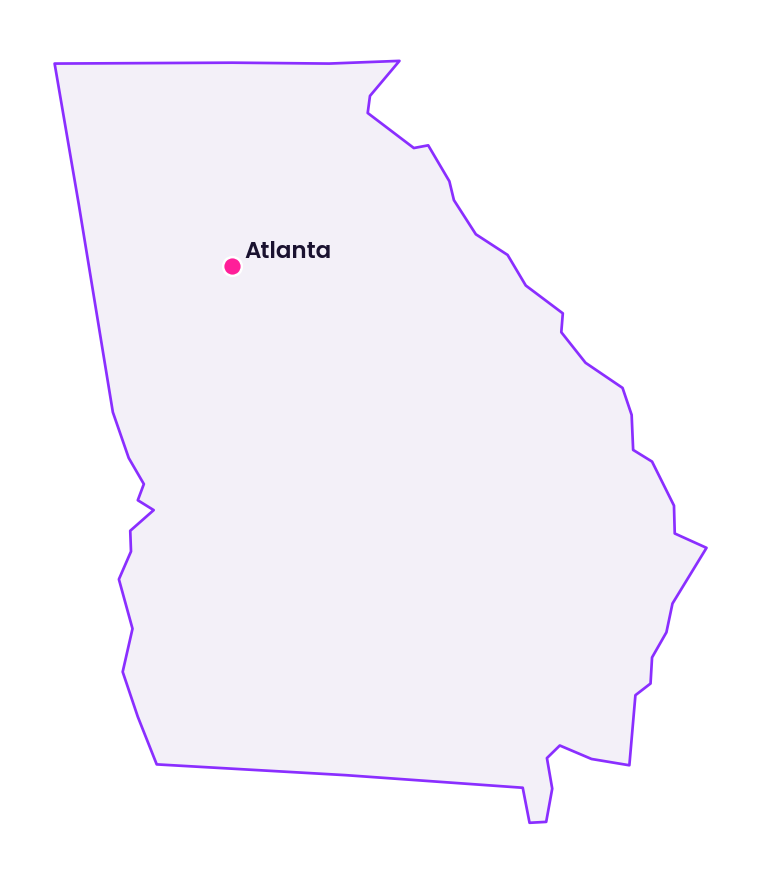
Section 02Population and Migration
The City of Atlanta had an estimated 529,110 residents as of July 1, 2025, up from the 2020 census count of 498,715, a gain of about 6.1 percent that reflects a genuine revival of the urban core after decades of slower city growth. Fulton County, the largest county in the metro and the one that contains most of the city, reached about 1,098,791 residents, up about 3.0 percent since 2020. The full 29 county metro held roughly 6.41 million residents on the American Community Survey 2024 basis, placing Atlanta among the largest metropolitan economies in the nation, generally ranked between sixth and eighth depending on the vintage.
The metro continued to grow at a healthy clip, adding roughly 75,000 people, about 1.2 percent, in the year to 2024, according to regional analysis of Census data. The composition of that growth has shifted in an important way: foreign immigration has become the primary driver, while net domestic migration in the core counties has been roughly flat to slightly negative, with growth spreading to the outer suburban and exurban counties. The Atlanta Regional Commission, which tracks an 11 county core region, estimated that region at about 5,221,074 residents after adding roughly 62,700 people in a single year.
| Geography | Population | Scope and period | Source |
|---|---|---|---|
| City of Atlanta | 529,110 | July 1, 2025 estimate | U.S. Census Bureau |
| Fulton County | 1,098,791 | July 1, 2025 estimate | U.S. Census Bureau |
| Atlanta metro | ~6,409,047 | ACS 2024 estimate | U.S. Census Bureau |
| Regional 11 county core | 5,221,074 | April 2024 estimate | Atlanta Regional Commission |
For a real estate investor, the reading is that Atlanta has enjoyed deep, broad based, and diversified population growth, no longer dependent on a single migration channel, with a reviving urban core and expanding suburbs together supporting demand across housing types and price points. Whether that pattern persists is not assured.
Section 03Jobs and Economic Anchors
Atlanta's labor market is large, diversified, and has been steadily expanding. Metro total nonfarm employment reached about 3,127,800 jobs in June 2026, up about 12,700 jobs or 0.4 percent over the prior year, with the metro unemployment rate around 3.5 percent and the labor force at a record high. Job growth was concentrated in education and health services, which added about 21,300 jobs, a strong 4.7 percent gain, followed by leisure and hospitality and professional and business services, while government shed about 7,200 jobs and construction about 4,100. Metro gross domestic product was about 570.7 billion dollars in nominal terms in 2023, roughly the ninth largest metropolitan economy in the country.
The economic anchor base is exceptional. Metro Atlanta hosts 15 Fortune 500 headquarters, ranking seventh nationally, including Home Depot, UPS, Delta Air Lines, Coca Cola, and Southern Company, along with major operations of Truist and Aflac. The metro is a national center for logistics, film and television production, which is a major statewide industry, financial technology, and healthcare. The crown jewel of its infrastructure and economy is Hartsfield Jackson Atlanta International Airport, which handled about 108.1 million passengers in 2024, retaining its position as the busiest airport in the world.
| Sector | Employment | Year over year change | Scope and period | Source |
|---|---|---|---|---|
| Trade, transportation, utilities | 646,400 | down 3,100 | Atlanta metro, June 2026 | BLS |
| Professional and business services | 569,300 | up 3,100 | Atlanta metro, June 2026 | BLS |
| Education and health services | 476,800 | up 21,300 | Atlanta metro, June 2026 | BLS |
| Government | 351,600 | down 7,200 | Atlanta metro, June 2026 | BLS |
| Leisure and hospitality | 329,400 | up 4,200 | Atlanta metro, June 2026 | BLS |
The diversity across logistics, corporate headquarters, media, technology, finance, and healthcare is a meaningful risk mitigant, giving Atlanta multiple, partly uncorrelated engines of housing and commercial demand.
Section 04Income
Atlanta incomes run above the national line at the metro and county level, though the city itself displays the wide inequality for which it is well known. The City of Atlanta reported a median household income of about 85,652 dollars on the American Community Survey 2020 through 2024 five year basis, in 2024 dollars, above the national figure near 80,734 dollars. Fulton County was higher at about 95,292 dollars, and the broader metro was about 92,344 dollars on the American Community Survey 2024 basis, roughly 10 percent above the national level. Per capita income in the City of Atlanta was about 65,718 dollars, elevated by the affluent northern neighborhoods.
The inequality shows up starkly in the poverty data. Despite its high median income, the City of Atlanta carried a poverty rate of about 16.9 percent, well above Fulton County at about 11.3 percent and the national rate near 10.6 percent. This coexistence of high median income and high poverty reflects a city split between wealthy and lower income populations, a pattern with direct real estate implications: it supports both a robust luxury and market rate rental segment in the affluent districts and a deep workforce and affordable housing need in others. An investor should treat the city as several distinct submarkets rather than a single income profile, a theme developed in the neighborhoods section below.
Section 05Housing and Multifamily
The City of Atlanta contained about 284,949 housing units on the American Community Survey 2024 basis, and the metro about 2,573,295 units. The city is majority renter, with an owner occupancy rate of about 46.4 percent, far below the national norm and consistent with a dense urban core, while the metro overall is more balanced. Home values diverge by geography: the median value of owner occupied homes was about 462,200 dollars in the City of Atlanta against about 402,100 dollars across the metro on the American Community Survey 2024 basis, reflecting the premium on close in city living.
On the apartment side, Atlanta is one of the largest institutional multifamily markets in the country, with a stock that public pipeline data implies to be in the range of roughly 550,000 to 600,000 units, though no single clean published inventory figure is available and that range is derived from the pipeline shares cited by market analysts. As with most large metros, apartment operating metrics are reported at the metro level, and this review labels them as such and uses Census data for the city where property level data does not exist. The defining multifamily dynamic in 2026 is the digestion of a large supply wave against still solid demand, which the rent, vacancy, and supply sections quantify.
Section 06Rents
Metro apartment rents have stabilized after the supply driven correction of the prior two years. Northmarq reported an average asking rent of about 1,646 dollars in the fourth quarter of 2025, up about 1.6 percent year over year, and Yardi Matrix reported an average rent near 1,634 dollars in March 2026, essentially flat and running about 20 basis points below the national average. Within the city, Apartment List reported a median rent near 1,537 dollars in August 2026, roughly flat year over year. The federal benchmark, the fiscal year 2026 Fair Market Rent for a two bedroom unit in the Atlanta metro area set by the Department of Housing and Urban Development, was about 1,820 dollars, slightly below the prior year's figure, consistent with a market that has flattened rather than resumed rapid growth.
| Rent measure | Value | Year over year | Scope and period | Source |
|---|---|---|---|---|
| Average asking rent | $1,646 | up 1.6% | Atlanta metro, Q4 2025 | Northmarq |
| Average rent | $1,634 | about flat | Atlanta metro, March 2026 | Yardi Matrix |
| Median rent | $1,537 | down 0.1% | City of Atlanta, August 2026 | Apartment List |
| Fair Market Rent, two bedroom | $1,820 | slightly lower | Atlanta metro, FY2026 | HUD |
The consistent signal across the cited sources is that Atlanta rents have, to date, found a floor and firmed modestly. Whether that firming continues or reverses is uncertain and depends on future absorption, supply, and macroeconomic conditions; nothing here should be read as a projection or assurance of future rent levels.
Section 07Vacancy
Vacancy rose during the delivery wave but remains at a manageable level and has started to improve on a year over year basis. Northmarq reported metro apartment vacancy of about 6.3 percent in the fourth quarter of 2025, up about 60 basis points in the quarter as new units delivered but roughly 90 basis points below the year earlier level, a sign that absorption has been catching up with supply. Yardi Matrix reported metro stabilized occupancy of about 93.3 percent in February 2026, up about 20 basis points year over year, consistent with a market that has been tightening on a stabilized basis even as lease up product weighs on the all class figure.
The reading for an investor is that Atlanta did not experience the extreme vacancy spikes of the most oversupplied Sun Belt markets, and its vacancy has recently improved year over year. Whether vacancy continues to compress as deliveries fall in 2026 and 2027 is not assured and will depend on demand holding up against supply; these observations are historical and educational and are not a forecast.
Section 08Supply Pipeline
Supply is the pivotal variable, and the pipeline has fallen sharply. The active construction pipeline peaked above 40,000 units in 2023 and had fallen roughly 60 percent to a decade low near 16,800 units by the fourth quarter of 2025, according to Northmarq, though methodologies differ and Yardi Matrix counted about 22,302 units under construction as of March 2026 using a broader geography. Full year 2025 deliveries came in just under 16,700 units, and projected 2026 deliveries are around 8,400 units, down roughly 50 percent year over year and the slowest pace in over a decade. Multifamily permitting has fallen sharply as well, reported down about 28 percent from the prior year. Over the trailing year, net absorption exceeded 20,000 units, outpacing the shrinking supply.
| Supply metric | Value | Scope and period | Source |
|---|---|---|---|
| Peak under construction | 40,000 plus units | Atlanta metro, 2023 | Northmarq, industry reports |
| Under construction | ~16,800 units | Atlanta metro, Q4 2025 | Northmarq |
| 2025 deliveries | ~16,700 units | Atlanta metro, full year 2025 | Northmarq |
| 2026 projected deliveries | ~8,400 units | Atlanta metro, 2026 | Matthews, industry reports |
| Trailing net absorption | 20,000 plus units | Atlanta metro, trailing year | Northmarq |
Some market analysts have characterized these dynamics as pointing toward a potential supply reduction, sometimes called an "air pocket," in 2027 and 2028, on the reasoning that halving deliveries alongside continued absorption could tighten conditions. That is a hypothesis about the future, not an established outcome: absorption, demand, and financing conditions could evolve differently, and there is no assurance that vacancy will compress or that rents will accelerate. Any investor evaluating an acquisition during the current soft window should test that thesis against its own diligence rather than treat it as a given.
Section 09Single Family Homes
The for sale market has cooled modestly from its peak but remains fundamentally sound and affordable relative to coastal metros. Redfin reported a City of Atlanta median sale price of about 429,238 dollars as of May 2026, down about 1.6 percent year over year across all home types. The Atlanta REALTORS Association, using the broader multiple listing service across an 11 county area, reported a metro median sales price of about 418,000 dollars in March 2026, also down about 1.6 percent year over year, with an average price near 525,500 dollars, about 4.0 months of supply, roughly 17,723 active listings, an average of 58 days on market, and about 4,670 single family homes sold, up about 4.0 percent year over year. Zillow's Home Value Index for the metro was about 373,494 dollars, essentially flat at down about 0.4 percent over the year.
| Measure | Value | Year over year | Scope and period | Source |
|---|---|---|---|---|
| Median sale price | $429,238 | down 1.6% | City of Atlanta, May 2026 | Redfin |
| Median sales price | $418,000 | down 1.6% | Atlanta metro, March 2026 | Atlanta REALTORS |
| Home Value Index | $373,494 | down 0.4% | Atlanta metro, mid 2026 | Zillow |
| Months of supply | 4.0 | up 6.4% | Atlanta metro, March 2026 | Atlanta REALTORS |
The single family rental angle is where Atlanta stands apart from nearly every other market, because it is the national epicenter of the institutional single family rental industry. Invitation Homes, the largest such operator, derives about 13 percent of its revenue from Atlanta, its single largest market, out of a portfolio of about 85,970 wholly owned homes, and in January 2026 it acquired Atlanta based ResiBuilt Homes, a build to rent homebuilder that has delivered more than 4,200 homes since 2018. American Homes 4 Rent also maintains a large Atlanta presence and delivers build to rent homes at scale. Analysis of Atlanta Regional Commission data found that seven corporations own more than 51,000 homes across the metro, with three controlling more than 19,000. This institutional concentration has become a political issue, but for an investor it signals a deep, liquid, professionally operated single family rental market with mature build to rent supply chains. Single family rent growth in Atlanta was modest, running around 0.9 percent in 2026, reflecting the same broad supply absorption affecting apartments.
Section 10Commercial Real Estate and Retail Centers
The commercial sectors are sharply divergent, and understanding that split is essential. Office is the clear weak point. Cushman and Wakefield reported metro office vacancy of about 24.9 percent in the second quarter of 2026, though improving slightly, with a direct asking rent near 33.72 dollars per square foot and positive net absorption of about 299,456 square feet, the second consecutive quarter of gains, led by strong leasing in Midtown. An alternate survey placed vacancy closer to 26.1 percent with asking rents at an all time high near 33.93 dollars, the difference reflecting different building universes. The office picture is a flight to quality in which premier Midtown and well located assets lease while older and commodity space, and space exposed to federal downsizing, struggles. Downtown and suburban submarkets remain uneven.
Industrial and logistics is a genuine strength and one of the largest such markets in the country. CBRE reported metro industrial direct vacancy of about 8.2 percent in the second quarter of 2026, with an average asking rent near 7.76 dollars per square foot on a triple net basis, up about 80 basis points year over year, robust net absorption of about 2.6 million square feet, deliveries of about 3.9 million square feet, and about 9.4 million square feet under construction. Atlanta's position as a rail and air logistics hub with connections to the Port of Savannah underpins durable demand from distributors and manufacturers.
Retail is healthy, particularly necessity and grocery anchored space. Colliers reported a metro retail asking rent near 19.19 dollars per square foot in the second quarter of 2026, down about 1.0 percent year over year but up about 3.3 percent for the quarter, with demand concentrated in premier and grocery anchored centers even as some other center types saw negative absorption. Grocery anchored retail benefits from the metro's steady population growth and remains among the most sought after retail product.
| Sector | Vacancy | Asking rent | Scope and period | Source |
|---|---|---|---|---|
| Office | 24.9% | $33.72 psf | Atlanta metro, Q2 2026 | Cushman and Wakefield |
| Industrial | 8.2% | $7.76 psf | Atlanta metro, Q2 2026 | CBRE |
| Retail | not cleanly published | $19.19 psf | Atlanta metro, Q2 2026 | Colliers |
Section 11Transactions and Capital Markets
Comprehensive Atlanta specific transaction volume is largely proprietary, held within subscription databases such as MSCI Real Assets, so no verified metro wide dollar figure is available in public form and it would be misleading to invent one. For national context, MSCI reported about 113.7 billion dollars of total U.S. commercial real estate investment volume in the second quarter of 2026, up about 9 percent year over year, the third consecutive quarter of near double digit gains, with industrial and hospitality leading. Deal flow color specific to Atlanta in mid 2026 included federal downsizing pressure on office, as the Environmental Protection Agency moved to reduce its Atlanta office footprint, alongside continued suburban office leasing momentum and selective office acquisitions.
On pricing, the most recent Atlanta specific public capitalization rate commentary came from Northmarq, which noted multifamily deals settling in the low to mid 5 percent range, with high quality stabilized assets in the mid 5 percent area and value add product trading below 5 percent, at a median price around 189,500 dollars per unit year to date, up about 4 percent versus the prior year. Capitalization rate figures commonly cited for multifamily near 5.6 percent and industrial near 7.5 percent are national averages and should not be attributed specifically to Atlanta without consulting the metro tables of the underlying survey. The broad message is that capitalization rates have repriced meaningfully higher from cycle lows, transaction activity has been recovering, and multifamily pricing has firmed; whether that continues depends on future conditions and is not assured.
Section 12Taxes
Georgia offers a comparatively moderate and improving tax environment, a real part of Atlanta's competitive appeal. The state converted to a flat individual income tax and has been cutting the rate, which stands at 4.99 percent for the 2026 tax year, down from 5.39 percent in 2024 and 5.19 percent in 2025. Property taxes are moderate by national standards; the Tax Foundation places the Georgia effective property tax rate on owner occupied housing at about 0.79 percent, though methodology varies and some aggregators place the Fulton County median effective rate closer to 1.05 percent. Georgia assesses property, including commercial and multifamily, at 40 percent of fair market value, and local millage rates apply on top of that assessed value. The Fulton County general fund millage was held flat at 8.87 mills, and the City of Atlanta millage was about 31.870 mills in 2025, with total bills combining county, school, and city levies.
A significant recent change is House Bill 581, which created a statewide floating homestead exemption effective in 2025 that caps annual growth in the taxable assessed value of a primary residence to the rate of inflation, using a 2024 base year, though local jurisdictions were permitted to opt out. This benefits owner occupants but does not shield commercial or multifamily investment property, which continues to be assessed at fair market value and is therefore exposed to rising assessments in an appreciating market. On transfers, Georgia imposes a modest real estate transfer tax of about 1 dollar per 1,000 dollars of consideration, low relative to many states. The state sales tax is 4 percent, with the combined City of Atlanta rate around 8.9 percent. Overall, the tax structure is favorable for investors relative to high tax states, with property taxes on income producing property being the main recurring consideration.
Section 13Insurance
Property insurance costs in Georgia have been rising, driven by severe convective storms, hail, tornadoes, and inland exposure to hurricane remnants, though the state remains less expensive than the most catastrophe exposed markets. No single official figure from the state insurance regulator for an average premium was located, and third party aggregators place the Georgia average homeowners premium in a range of roughly 2,000 to 2,435 dollars per year, with Atlanta specifically averaging closer to 2,620 dollars, and premiums reported to have risen about 8.6 percent in 2025. These aggregator figures should be treated as an indicative range rather than an official number. For a multifamily or commercial owner, the practical implication is that insurance has become a larger and more volatile expense line tied to the region's storm exposure, and it should be quoted specifically for each asset rather than assumed from a statewide average, particularly for assets in higher hail and wind risk parts of the metro.
Section 14Landlord Tenant and Regulatory Environment
Georgia has long been one of the most landlord friendly states, though recent legislation has modestly strengthened tenant protections. Residential tenancies are governed by Title 44, Chapter 7 of the Georgia Code. Critically for rent underwriting, Georgia prohibits local rent control: state law bars any county or municipality from enacting or enforcing an ordinance regulating the amount of rent for privately owned residential property, so there is no statewide rent control and no local pricing restriction anywhere in the metro. The eviction process, known as a dispossessory, remains relatively fast.
The most consequential recent change is the Safe at Home Act, effective July 1, 2024, which established Georgia's first express statutory implied warranty of habitability, requiring landlords to keep premises fit for human habitation. The same law created a 3 day written demand and right to cure before an eviction filing and, for the first time, capped security deposits at 2 months of rent, where previously there was no statutory cap. Security deposits must be returned with an itemized statement within 30 days of the tenancy ending. Even with these additions, Georgia remains distinctly favorable to owners relative to tenant protective states, with no rent control, a fast eviction path, and a predictable statutory framework. Investors should simply be aware that the operating rules tightened modestly in 2024 and ensure lease documents and habitability practices comply.
Section 15Infrastructure
Atlanta's infrastructure is a genuine competitive moat, anchored by the busiest airport in the world. Hartsfield Jackson Atlanta International Airport handled about 108.1 million passengers in 2024, its second busiest year on record, along with about 796,224 aircraft operations, cementing the metro's role as a national and global connectivity hub that underpins its logistics, corporate, and tourism economies. On the ground, the Metropolitan Atlanta Rapid Transit Authority operates a rail network of about 48 miles and 38 stations, carrying roughly 65.6 million total trips in 2024, a system that, while limited in geographic reach relative to the sprawling metro, provides meaningful transit access along its corridors.
The highway network is extensive, built around interstates 75, 85, and 20, the Interstate 285 perimeter loop, and the Interstate 575 and Interstate 985 spurs. Rail and logistics connectivity is a particular strength: Norfolk Southern relocated its corporate headquarters to a roughly 575 million dollar campus in Midtown Atlanta, and the metro is a major rail hub with connections to the Port of Savannah, whose Mason Mega Rail facility is the largest on terminal intermodal rail facility in North America and offers rapid double stack service to Atlanta. Norfolk Southern is also building the Blue Ridge Connector inland terminal near Gainesville, opening in 2026, further strengthening the inland logistics network. For real estate, this infrastructure supports the industrial and logistics demand that has made Atlanta a top tier distribution market and reinforces the long run case for the metro.
Section 16Climate and Physical Risks
Atlanta faces a real physical risk profile centered on severe convective storms, tornadoes, inland flooding, and the remnants of hurricanes that track up from the Gulf. NOAA recorded 134 billion dollar weather and climate disasters affecting Georgia between 1980 and 2024, of which severe storms accounted for about 68, or roughly half, and tropical cyclones about 27, with the frequency of billion dollar events rising sharply in recent years to about 13 in 2024 alone. The tornado risk is concrete: in March 2008, an EF2 tornado struck downtown Atlanta directly, causing about 500 million dollars in damage and hitting the CNN Center, the Georgia Dome, and other landmarks. Flooding is also a documented hazard; the September 2009 Atlanta flood dropped more than 20 inches of rain in under 48 hours, killed 9 people, caused more than 193 million dollars in damage, and exceeded the 500 year flood level at multiple gauges.
Inland hurricane exposure became vivid in 2024, when Hurricane Helene made landfall in Florida and carved inland through Georgia, causing about 37 deaths and roughly 5.5 billion dollars in damage in the state, much of it to crops and timber but also demonstrating that even an inland metro like Atlanta is not immune to tropical systems. For an investor, these risks translate into the insurance cost pressures discussed above and into concrete diligence obligations: verify Federal Emergency Management Agency flood zones and elevation for any specific asset, particularly near creeks and the areas affected in 2009, and factor wind and storm resilience into acquisition and capital planning. The physical risk is meaningful but may be managed through specific underwriting rather than broad avoidance.
Section 17Neighborhoods and Submarkets
Atlanta is a market of highly distinct submarkets, and treating it as one uniform city would obscure very different dynamics. The affluent northern arc, including Buckhead and the northern suburbs of Sandy Springs, Roswell, Alpharetta, and the Central Perimeter, commands the metro's highest incomes, home values, and office rents, and it is where much of the corporate and luxury residential demand concentrates. Midtown has emerged as the metro's premier office and dense residential submarket, leading office leasing and attracting corporate relocations such as Norfolk Southern. Downtown is more mixed, carrying higher office vacancy but benefiting from major public investment and its role as the civic and convention core. The intown neighborhoods along the Atlanta BeltLine have seen strong multifamily and mixed use development and rising values.
On the single family and rental side, the demand pulls toward the suburban and exurban counties where household formation, build to rent activity, and institutional single family rental ownership are concentrated, and where the metro's population growth is spreading. Industrial demand concentrates along the interstate corridors and near the airport and rail intermodal facilities on the south and west sides of the metro. The investment implication is that strategy must be matched to submarket precisely: luxury and market rate multifamily in the northern arc and Midtown, value add and workforce housing in the intown and inner suburban submarkets, single family rental and build to rent in the growth suburbs, and industrial along the logistics corridors. The wide income inequality within the city reinforces the need for a submarket level rather than a citywide view.
Section 18Opportunities
Market participants have highlighted several themes in Atlanta, which are described here for educational purposes and not as recommendations or assurances of return. The most discussed is cyclical timing in multifamily. The construction wave that peaked above 40,000 units under construction has fallen roughly 60 percent, 2026 deliveries are projected to halve to about 8,400 units, and net absorption has recently outpaced supply, with rents firming and vacancy improving year over year. Some investors view the current soft window, at capitalization rates that have repriced into the low to mid 5 percent range, as a point of possible entry ahead of a potential 2027 and 2028 supply reduction, though whether that tightening materializes is uncertain and not assured. The single family rental and build to rent sector is often cited as a distinct area of interest in the market that pioneered institutional single family rental, with mature operators, deep liquidity, and established build to rent supply chains. Industrial and logistics are frequently noted as demand led, anchored by the world's busiest airport and Port of Savannah rail connectivity, and grocery anchored retail is cited for its relative stability backed by steady population growth. Underpinning these themes are the metro's structural features: broad based population and job growth, a deep and diversified corporate base, a falling flat state income tax, moderate property taxes, and a landlord friendly legal regime. The observations in this section are general and educational, are not projections, forecasts, or assurances of any particular return, yield, occupancy, rent level, or appreciation, and any specific investment must be evaluated on its own facts.
Section 19Risks
The dominant near term risk is that the multifamily supply overhang, while receding, could still weigh on rents and occupancy through 2026 before any recovery takes hold, and lease up assets may face continued concession pressure in the interim. Office is a genuine and possibly prolonged weakness, with metro vacancy near 25 percent, exposure to federal downsizing, and a bifurcation that leaves commodity space vulnerable to obsolescence. Insurance costs are rising on severe storm exposure, and the physical risk is real given the 2008 downtown tornado, the 2009 flood, and the 2024 inland impact of Hurricane Helene. The concentration of institutional single family rental ownership has attracted political and regulatory scrutiny that could affect that segment. Rising property assessments on commercial and multifamily property, which are not shielded by the new homestead cap, are a recurring cost risk. And while capitalization rates have repriced higher, elevated debt costs continue to constrain valuations and refinancing relative to the last cycle. Real estate investments are speculative, are subject to market, financing, liquidity, tax, regulatory, insurance, and physical hazard risks, and can result in the loss of some or all of an investor's invested capital, including the possible loss of principal.
Section 20Investor Implications
For an accredited investor, Atlanta in 2026 is often discussed as offering one of the more attractive risk and reward profiles among large Sun Belt markets, provided the analysis is done at the submarket and asset level; that characterization is not a guarantee of outcomes. The considerations that follow from the data are these. First, some treat the multifamily softness as a possible timing opportunity, acquiring during the current window at repriced capitalization rates while underwriting conservative near term rents, recognizing that the projected 2026 decline in deliveries and any resulting tightening are not assured. Second, Atlanta's unusual depth in single family rental and build to rent is a distinguishing feature, subject to modest rent growth and the political scrutiny of institutional ownership. Third, the metro's strengths in industrial and logistics along the airport and rail corridors and in grocery anchored retail are frequently cited. Fourth, office warrants selectivity, with premier Midtown and well located quality assets distinguished from commodity space exposed to structural decline. Fifth, the favorable tax and legal environment, a falling flat income tax, moderate property taxes, no rent control, and a landlord friendly framework, coexists with rising assessments on investment property and insurance tied to storm risk that should be budgeted. None of this constitutes a recommendation to pursue any specific strategy or investment; it is a framework for independent diligence against the sourced figures above, and there is no assurance that any objective or outcome described will be achieved.
Section 21Conclusion
Atlanta combines the scale, diversification, and growth of a top tier American metro with the specific 2026 circumstance of a multifamily market emerging from a supply correction. Its population and economy have continued to expand across multiple engines, its apartment pipeline has fallen to a decade low even as absorption has stayed strong, its single family rental and industrial markets are among the deepest in the nation, and its tax and legal environment is favorable to owners. Against those strengths sit a weak office sector, rising insurance costs, genuine physical risk from storms and inland hurricanes, and the recurring drag of property assessments on investment real estate. The open question is one of timing and selection: whether today's repriced valuations and firming rents adequately reward capital deployed ahead of a possible, but not assured, 2027 and 2028 supply reduction, and whether a specific asset's submarket, sector, and physical resilience fit the strategy. The data support a constructive but disciplined posture, grounded in submarket level underwriting against the sourced figures presented here, though no particular outcome or return is assured.
Sources
- U.S. Census Bureau, QuickFacts Atlanta city and Fulton County, Georgia,, https://www.census.gov/quickfacts/fact/table/atlantacitygeorgia,fultoncountygeorgia/PST045225
- U.S. Census Bureau via Census Reporter, Atlanta Sandy Springs Roswell metro profile,, https://censusreporter.org/profiles/31000US12060-atlanta-sandy-springs-roswell-ga-metro-area/
- U.S. Census Bureau via Census Reporter, Atlanta city profile,, https://censusreporter.org/profiles/16000US1304000-atlanta-ga/
- Atlanta Regional Commission, 2024 population estimates,, https://atlantaregional.org/news/uncategorized/arc-2024-population-estimates-show-atlanta-region-adds-62700-residents-in-past-year/
- U.S. Bureau of Labor Statistics, Atlanta area economic summary,, https://www.bls.gov/regions/southeast/summary/blssummary_atlanta.pdf
- U.S. Bureau of Economic Analysis via FRED, Atlanta metro nominal GDP (series NGMP12060),, https://fred.stlouisfed.org/series/NGMP12060
- U.S. Bureau of Economic Analysis via FRED, Atlanta metro per capita personal income (series ATLA013PCPI),, https://fred.stlouisfed.org/series/ATLA013PCPI
- RealPage, 2025 Fortune 500 company analysis,, https://www.realpage.com/analytics/fortune-500-companies-2025/
- Metro Atlanta Chamber, 2025 Fortune 500 companies list,, https://metroatlantachamber.com/wp-content/uploads/2025/06/MAC_Fortune-500-Companies_2025.pdf
- Hartsfield Jackson Atlanta International Airport, 2024 passenger release,, https://www.atl.com/media-center/press-releases/read/?id=67c038d615a7f50014d0b5f7
- Northmarq, Atlanta multifamily construction pipeline report,, https://www.northmarq.com/insights/insights/construction-pipeline-atlanta-multifamily-falls-decade-low
- Yardi Matrix, Atlanta multifamily market report,, https://www.yardimatrix.com/blog/atlanta-multifamily-market-report/
- Apartment List, average rent in Atlanta,, https://www.apartmentlist.com/renter-life/average-rent-in-atlanta
- HUD, FY2026 Fair Market Rents schedule,, https://www.huduser.gov/portal/datasets/fmr/fmr2026/FY2026_FMR_Schedule.pdf
- Matthews, Atlanta multifamily market report Q2 2025,, https://www.matthews.com/market_insights/q225-multifamily-market-report-atlanta-ga
- Axios Atlanta, multifamily permitting analysis,, https://www.axios.com/local/atlanta/2025/06/03/atlanta-multifamily-permits-pandemic-levels-housing
- Redfin, Atlanta Georgia housing market,, https://www.redfin.com/city/30756/GA/Atlanta/housing-market
- Atlanta REALTORS Association, Market Brief March 2026,, https://atlantarealtors.com/resources/news/atlanta-realtors-market-brief-march-2026
- Zillow, Atlanta Sandy Springs Roswell home values,, https://www.zillow.com/home-values/394347/atlanta-sandy-springs-roswell-ga/
- Invitation Homes, Q1 2026 earnings summary,, https://quartr.com/events/invitation-homes-inc-invh-q1-2026_3PoArAG4
- ResiClub Analytics, Invitation Homes and ResiBuilt acquisition,, https://www.resiclubanalytics.com/p/institutional-landlord-invitation-homes-homebuilding-housing-market-build-to-rent-bet-resibuilt
- American Economic Liberties Project, institutional ownership in Atlanta,, https://www.economicliberties.us/wp-content/uploads/2026/04/Rent-Seekers-ATL-PDF.pdf
- Cushman and Wakefield, Atlanta office MarketBeat,, https://www.cushmanwakefield.com/en/united-states/insights/us-marketbeats/atlanta-marketbeats/office
- CBRE, Atlanta Industrial Figures Q2 2026,, https://www.cbre.com/insights/figures/atlanta-industrial-figures-report-q2-2026
- Colliers, Atlanta retail market report Q2 2026,, https://www.colliers.com/en/research/atlanta/2026-q2-atlanta-retail-market-report
- Northmarq, Atlanta high value multifamily transactions,, https://www.northmarq.com/insights/insights/high-value-multifamily-transactions-gain-momentum-atlanta
- MSCI via Colliers Knowledge Leader, Q2 2026 capital trends,, https://knowledge-leader.colliers.com/steig_seaward/msci-q2-2026-entity-deals-lift-volume-as-sector-recoveries-diverge/
- Georgia Department of Revenue, important tax updates,, https://dor.georgia.gov/taxes/important-tax-updates
- Fulton County, 2025 millage rate release,, https://www.fultoncountyga.gov/News/2025/08/06/Fulton-Holds-Millage-Rate-at-8-87-mills-for-2025
- Fulton County Tax Commissioner, millage rates through 2025,, https://www.fultoncountytaxes.org/media/Millage_Rates_Through_2025.pdf
- Tax Foundation, Georgia,, https://taxfoundation.org/location/georgia/
- Georgia Department of Revenue, floating homestead exemption overview,, https://dor.georgia.gov/document/document/overview-floating-homestead-exemption-and-annual-inflationary-index-rate/download
- Georgia Department of Revenue, real estate transfer tax,, https://dor.georgia.gov/real-estate-transfer-tax
- Insure.com, average cost of homeowners insurance in Georgia,, https://www.insure.com/home-insurance/average-cost-of-homeowners-insurance-in-georgia/
- Georgia Code O.C.G.A. Section 44 7 19, local rent control prohibition,, https://law.justia.com/codes/georgia/title-44/chapter-7/article-1/section-44-7-19/
- Office of the Governor of Georgia, HB 404 Safe at Home Act,, https://gov.georgia.gov/document/2024-signed-legislation/hb-404/download
- Georgia Appleseed, Safe at Home Act summary,, https://gaappleseed.org/resource/safeathome/
- Metropolitan Atlanta Rapid Transit Authority, system statistics,, https://en.wikipedia.org/wiki/Metropolitan_Atlanta_Rapid_Transit_Authority
- Invest Atlanta, Norfolk Southern headquarters relocation,, https://www.investatlanta.com/impact-insights/norfolk-southern-announces-headquarters-relocation-to-atlanta
- Georgia Ports Authority, Garden City Terminal,, https://gaports.com/facilities/port-of-savannah/garden-city-terminal/
- NOAA National Centers for Environmental Information, Georgia billion dollar disasters,, https://www.ncei.noaa.gov/access/billions/state-summary/GA
- National Weather Service, 2008 Atlanta tornado report,, https://www.weather.gov/ffc/pns32308.txt
- National Weather Service, 2009 Atlanta epic flood,, https://www.weather.gov/ffc/0909epicflood
- Axios Atlanta, Hurricane Helene Georgia impact,, https://www.axios.com/local/atlanta/2025/04/10/hurricane-helene-in-georgia-stats-37-dead-5-5-billion-in-damages