In brief · summary: Augusta
Augusta, GA (Richmond County) , Educational Market Review
Section 01Overview
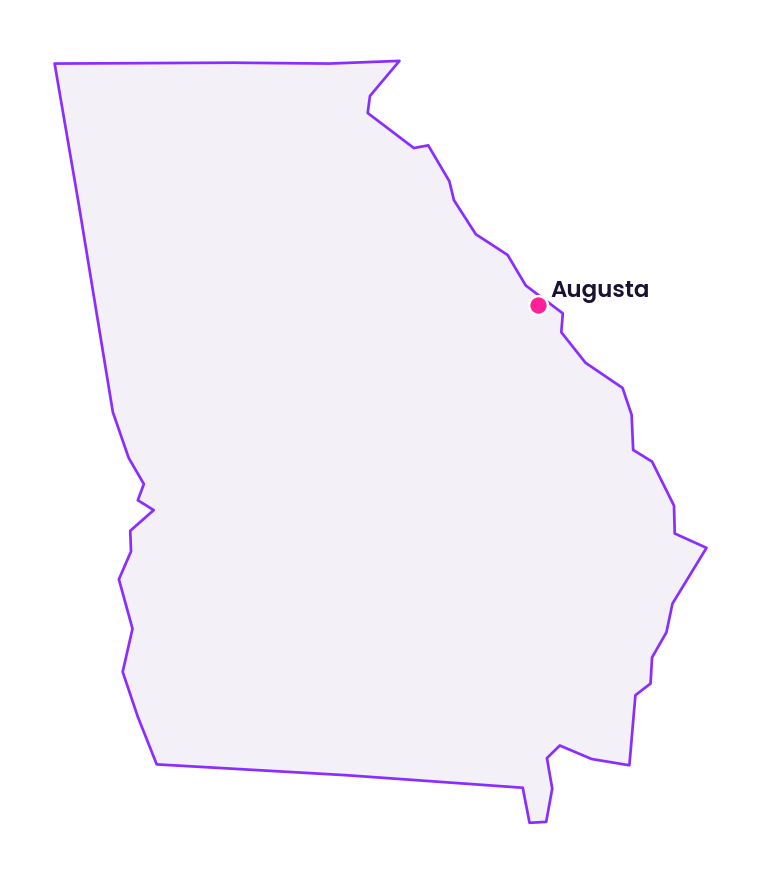
Augusta is Georgia's second oldest city and the anchor of the Augusta Richmond County, GA SC metropolitan statistical area, a two state region straddling the Savannah River. The consolidated Augusta Richmond County government reported a population of 206,069, while the surrounding metro area reached 636,658, both per the US Census Bureau American Community Survey 2024. The regional economy rests on three durable pillars: a large military and cybersecurity presence anchored by Fort Eisenhower, a substantial medical and higher education complex, and a diversified base of manufacturing, logistics, and government employment. Augusta is best understood as a mid sized, affordable, employment anchored market rather than a high growth boom market, with fundamentals shaped by institutional employers that are unusually resistant to economic cycles.
Section 02Population & Demographics
The population profile combines a mid sized central county with a considerably larger metropolitan footprint. Median age differs meaningfully between the two geographies, with the central county younger than the metro overall.
| Measure | Augusta-Richmond County | Augusta GA-SC Metro | Source and period |
|---|---|---|---|
| Total population | 206,069 | 636,658 | US Census Bureau, ACS 2024 |
| Median age | 35.2 years | 39.0 years | US Census Bureau, ACS 2024 |
| Total housing units | 93,145 | 279,681 | US Census Bureau, ACS 2024 |
A precise Census measured population change figure for the 2020 to 2024 period was not available in the retrieved public tables, so growth is described in words rather than a specific percentage: the metro area has grown steadily and modestly, driven in part by military and cybersecurity expansion at Fort Eisenhower, while the central county has been comparatively flat. The metro's older median age of 39.0 years against the county's 35.2 years reflects a younger urban core and older suburban and exurban counties around it.
Section 03Household Income
Income levels illustrate the gap between the urban core and the broader metro. Median household income in the central county was $55,637, well below the metro figure of $72,176, per the US Census Bureau ACS 2024. Per capita income followed the same pattern, at $31,825 in the county and $38,539 across the metro. The poverty rate was 20% in Augusta Richmond County and 14% across the metro, both per ACS 2024, a spread that reflects concentrated urban poverty within an otherwise middle income region.
| Income measure | Augusta-Richmond County | Augusta GA-SC Metro | Source and period |
|---|---|---|---|
| Median household income | $55,637 | $72,176 | US Census Bureau, ACS 2024 |
| Per capita income | $31,825 | $38,539 | US Census Bureau, ACS 2024 |
| Poverty rate | 20% | 14% | US Census Bureau, ACS 2024 |
For a rental investor, the county's lower income and higher poverty rate point toward a workforce and affordable rental thesis in the urban core, while the wealthier surrounding counties support a different, higher price point strategy.
Section 04Employment & Major Employers
The Augusta metro labor market was solid as of July 2026, with a civilian labor force of 281,400 and an unemployment rate of 4.0%, per the US Bureau of Labor Statistics. Total nonfarm employment stood at 253,000. The defining feature of the market is the concentration of stable, institutional employers. Fort Eisenhower, formerly Fort Gordon, is the home of US Army Cyber Command, the Cyber Center of Excellence, and associated National Security Agency and Defense Information Systems Agency operations, and reported a workforce of 31,155 military and civilian personnel per the Augusta Economic Development Authority. The medical sector, anchored by Wellstar MCG Health and the Augusta University enterprise, and the Savannah River Site nuclear facility across the river in South Carolina, round out a base dominated by government, defense, and healthcare.
| Labor market measure | Value | Source and period |
|---|---|---|
| Civilian labor force | 281,400 | US BLS, July 2026 |
| Unemployment rate | 4.0% | US BLS, July 2026 |
| Total nonfarm employment | 253,000 | US BLS, July 2026 |
| Fort Eisenhower personnel | 31,155 | Augusta Economic Development Authority |
Section 05Industry Base & Economic Drivers
The metro's nonfarm payrolls are broadly diversified across sectors, with government, trade and logistics, and education and health services forming the three largest blocks as of July 2026, per the US Bureau of Labor Statistics.
| Sector | Employment | Source and period |
|---|---|---|
| Trade, transportation, and utilities | 44,800 | US BLS, July 2026 |
| Government | 43,100 | US BLS, July 2026 |
| Education and health services | 41,100 | US BLS, July 2026 |
| Professional and business services | 37,700 | US BLS, July 2026 |
| Leisure and hospitality | 28,100 | US BLS, July 2026 |
| Manufacturing | 23,300 | US BLS, July 2026 |
| Mining, logging, and construction | 14,800 | US BLS, July 2026 |
| Other services | 10,700 | US BLS, July 2026 |
| Financial activities | 7,800 | US BLS, July 2026 |
| Information | 1,600 | US BLS, July 2026 |
The combined weight of government at 43,100 and education and health services at 41,100 underscores the counter cyclical nature of the base: these two blocks together exceed 84,000 jobs and are anchored by the military, cyber, and medical institutions that do not shed workers in a downturn the way discretionary sectors do. That stability is the core of the Augusta investment thesis.
Section 06Wage Trends
In descriptive terms, the presence of high skill cyber, defense, and medical employment supports above average earnings within the professional segment of the workforce, while the region's overall median household income of $72,176 across the metro, per the US Census Bureau ACS 2024, sits near the middle of the national distribution. Investors underwriting wage driven rent growth should obtain current BLS Quarterly Census of Employment and Wages data for the specific occupations relevant to their tenant base.
Section 07Housing Stock & Inventory
The metro contained 279,681 total housing units and the central county 93,145 units, per the US Census Bureau ACS 2024. Redfin reported that 584 homes sold in Augusta Richmond County in June 2026, up from 566 in the same month a year earlier, and that homes sold after a median of 50 days on market, down from 70 days a year earlier, indicating a market that has tightened modestly on the demand side. The improvement in days on market points to steady absorption rather than a glut, consistent with a market where employment inflows support housing demand.
Section 08Home Prices
Home values in Augusta remain affordable by national standards, a defining feature of the market. The Zillow Home Value Index for Augusta Richmond County stood at $224,573, up 5.6% over the trailing year, per Zillow as of 2026. Redfin reported a median sale price of $220,000 over the trailing three months, up 2.0% year over year, with a median price per square foot of $139, unchanged year over year. The US Census Bureau ACS 2024 recorded a median owner occupied home value of $178,500 in the central county and $262,100 across the broader metro, the latter reflecting more expensive suburban counties.
| Home price measure | Value | Change | Source and period |
|---|---|---|---|
| Zillow Home Value Index, county | $224,573 | +5.6% YoY | Zillow, 2026 |
| Redfin median sale price | $220,000 | +2.0% YoY | Redfin, trailing 3 months to mid 2026 |
| Redfin price per square foot | $139 | +0.0% YoY | Redfin, mid 2026 |
| ACS median value, county | $178,500 | not applicable | US Census Bureau, ACS 2024 |
| ACS median value, metro | $262,100 | not applicable | US Census Bureau, ACS 2024 |
The gap between the ACS owner occupied median and the Zillow and Redfin transaction based figures is expected: ACS reflects the full standing owner occupied stock including long held homes, while Zillow and Redfin track current market values and recent sales.
Section 09Rental Market & Rents
HUD Fair Market Rents provide a clean public read on rent levels for the Augusta Richmond County GA SC HUD Metro FMR Area. Between fiscal year 2025 and fiscal year 2026, the two bedroom FMR held steady at $1,175, while several other bedroom sizes moved.
| Unit size | FY2025 FMR | FY2026 FMR | Source |
|---|---|---|---|
| Efficiency | $868 | not available in retrieved FY2026 base table | HUD, FY2025 |
| One bedroom | $1,039 | not available in retrieved FY2026 base table | HUD, FY2025 |
| Two bedroom | $1,175 | $1,175 | HUD, FY2025 and FY2026 |
| Three bedroom | $1,545 | not available in retrieved FY2026 base table | HUD, FY2025 |
| Four bedroom | $1,890 | not available in retrieved FY2026 base table | HUD, FY2025 |
The full FY2025 bedroom schedule is confirmed from the HUD FY2025 FMR release. For FY2026, only the two bedroom base FMR of $1,175 was cleanly confirmed in the retrieved public data, so the remaining FY2026 bedroom sizes are shown as not available rather than estimated.
Section 10Vacancy Rates
The observable demand signals point in a constructive direction: Redfin reported homes selling in a median of 50 days as of mid 2026, down from 70 days a year earlier, and 584 homes sold in June 2026 versus 566 a year earlier, both consistent with steady absorption rather than oversupply. Investors requiring a precise vacancy figure should obtain the ACS 2024 housing occupancy table for Richmond County or current professionally surveyed apartment vacancy data for the metro.
Section 11New Construction & Building Permits
New residential construction in the central county has been modest, a supply picture that supports existing rental owners. Richmond County authorized 558 new private housing units by building permit in 2024, per the US Census Bureau Building Permits Survey as redistributed through the Federal Reserve Bank of St. Louis FRED series BPPRIV013245. That is a restrained level of new supply for a county of more than 200,000 residents, and it stands in contrast to high growth Sun Belt markets that have permitted new units at multiples of that rate. Constrained new construction in the core county is generally favorable for existing owners, as it limits competitive lease up pressure on standing rental stock.
Section 12Multifamily / Commercial Fundamentals
In descriptive terms, secondary Sun Belt markets anchored by government and healthcare employment, such as Augusta, have historically traded at higher capitalization rates than primary coastal markets, reflecting the yield premium buyers require for smaller, less liquid markets.
Section 13Property Taxes & Millage
Richmond County levies property taxes through a combination of county government and Board of Education millage. In 2025, the Richmond County Board of Education advertised an intent to raise its property tax levy by 5.33% over the rollback millage rate, per local reporting on the required public notice. In structural terms, Georgia assesses property at 40% of fair market value statewide, and Richmond County is generally regarded as a relatively high millage jurisdiction within Georgia, a cost factor that investors should model explicitly in net operating income.
Section 14Insurance Environment
Property insurance in the Augusta area is moderate relative to catastrophe exposed coastal Georgia and the Gulf Coast, because the region sits well inland and faces no direct hurricane storm surge or coastal wind exposure. The primary insured perils are severe thunderstorms, wind, hail, and localized riverine and creek flooding. Flood insurance, discussed in the next section, is a distinct and material cost for properties within the mapped floodplain and should be quoted specifically rather than assumed.
Section 15Natural Hazard & Flood Risk
The dominant mapped natural hazard in Augusta is riverine and creek flooding rather than coastal or seismic risk. FEMA Flood Insurance Rate Maps for Richmond County designate Special Flood Hazard Areas, principally Zone AE, along the Savannah River floodplain and along creeks including Butler Creek, Rocky Creek, and Spirit Creek, per FEMA. Zone AE denotes areas with a 1% annual chance of flooding, where flood insurance is mandatory for federally backed mortgages. Properties outside the mapped high risk zones carry lower but nonzero risk. Investors should verify the specific flood zone of any target property through the FEMA Flood Map Service Center and price flood coverage into underwriting for any parcel in or near a mapped Special Flood Hazard Area, particularly along the Savannah River corridor and the named creek basins.
Section 16Infrastructure & Transportation
Augusta is served by Interstate 20, connecting the metro west to Atlanta and east to Columbia and the Interstate 95 corridor, and by a network of US highways feeding the two state region. Augusta Regional Airport at Bush Field provides commercial passenger service, and the Savannah River supports the region's water infrastructure. The city's consolidated Augusta Richmond County government structure, one of the earliest city county consolidations in Georgia, centralizes many municipal services. Freight and logistics benefit from the Interstate 20 corridor and proximity to the Port of Savannah's inland reach. The infrastructure picture is that of an established mid sized metro with adequate highway and air connectivity rather than a rapidly expanding transportation hub.
Section 17Development & Public Investment
The most consequential public and institutional investment in the region is defense and cyber driven. Fort Eisenhower has been the focus of major federal construction associated with the buildup of US Army Cyber Command and the cyber mission, and the broader Georgia Cyber Center in downtown Augusta represents a significant state backed investment in cybersecurity education and industry, a state owned facility developed to concentrate cyber talent, research, and private employers. This defense and cyber investment is the single most important forward driver of the local economy and, by extension, of housing demand tied to relocating military, civilian, and contractor personnel. Downtown Augusta and the medical district around Augusta University have also been focal points for revitalization and institutional expansion.
Section 18Regulatory & Zoning Environment
Augusta Richmond County operates under a consolidated government with a single planning and development function handling zoning, permitting, and land use for the county. Georgia is broadly regarded as a landlord favorable and business friendly state, with no statewide rent control and a legal framework that permits relatively efficient enforcement of lease terms by national standards. A specific current permitting timeline or impact fee schedule for Augusta Richmond County was not available from a named public source with a clean scope and date, and investors pursuing development or value add strategies should confirm current zoning, permitting, and any short term rental rules directly with the Augusta Planning and Development Department before underwriting.
Section 19Education & Anchor Institutions
Augusta's anchor institutions are a central strength of the market. Augusta University is a public research university and academic health center whose medical enterprise, operated with Wellstar as Wellstar MCG Health, is a major regional employer and the core of the area's healthcare economy. The Cyber Center of Excellence and associated Army cyber and signal schools at Fort Eisenhower make the region a national node for military cyber education and training. The Georgia Cyber Center adds a state backed higher education and workforce development dimension in downtown Augusta. Together, these institutions provide the stable, high skill employment base and the steady inflow of students, medical personnel, and military affiliated residents that underpin durable rental demand.
Section 20Market Risks & Considerations
Augusta carries genuine risks that must be underwritten candidly. First is employer and sector concentration: the economy leans heavily on federal defense and cyber spending at Fort Eisenhower and on a small number of large medical and government employers, so a change in federal basing, mission, or budget priorities would have outsized local effects. Second is the urban core's socioeconomic profile, with a 20% poverty rate and a $55,637 median household income in the central county, per the US Census Bureau ACS 2024, which constrains market rent growth and raises collection and turnover risk in lower income submarkets. Third is flood exposure along the Savannah River and the named creek basins, where FEMA Zone AE designation brings mandatory flood insurance and real hazard. Fourth is modest overall growth: with only 558 new permits in Richmond County in 2024 and steady rather than rapid population gains, this is an income and stability market, not an appreciation driven growth market, and should be underwritten for cash flow rather than for rapid value gains. None of these is disqualifying, but each requires explicit modeling.
Section 21Data Limitations
Data dates vary by source and are noted per figure. Population, income, poverty, median age, housing units, and owner occupied home value figures are from the US Census Bureau American Community Survey 2024. Labor force, unemployment, nonfarm employment, and sector employment are from the US Bureau of Labor Statistics for July 2026. Home value and sales figures are from Zillow and Redfin as of mid 2026. Fair Market Rents are from HUD for fiscal years 2025 and 2026. Building permits are from the US Census Bureau Building Permits Survey for 2024 as redistributed through FRED. Several figures were not available from a named public source with a clean scope and date and are described in words rather than stated as numbers: population change since 2020, a current wage growth rate, rental and homeowner vacancy rates, the full FY2026 HUD FMR bedroom schedule beyond the two bedroom, current multifamily cap rates and the apartment pipeline, a precise consolidated millage rate in mills, and specific insurance premium figures. No figure in this document has been estimated, interpolated, or projected.
Sources
- US Census Bureau, American Community Survey 2024, Augusta Richmond County consolidated government and Augusta GA SC metro area, population, age, income, poverty, housing units, and home value, via Census Reporter, http://censusreporter.org/profiles/17000US1304200-augusta-richmond-county-consolidated-government-ga/
- US Bureau of Labor Statistics, Augusta Richmond County GA SC Economy at a Glance, labor force, unemployment, nonfarm and sector employment, July 2026, https://www.bls.gov/eag/eag.ga_augusta_msa.htm
- Zillow, Augusta Richmond County Home Values, Zillow Home Value Index, 2026, https://www.zillow.com/home-values/394352/ga/
- Redfin, Augusta Richmond County Housing Market, median sale price, days on market, homes sold, mid 2026, https://www.redfin.com/city/36058/GA/Augusta-Richmond/housing-market
- HUD, Fair Market Rents, Augusta Richmond County GA SC HUD Metro FMR Area, FY2025 via RentData, https://www.rentdata.org/augusta-richmond-county-ga-sc-hud-metro-fmr-area/2025
- HUD, Fair Market Rents, Augusta Richmond County GA SC, FY2026 two bedroom, effective October 1, 2025, https://www.bnbcalc.com/section8/ga/augusta-richmond-county
- US Census Bureau, Building Permits Survey, Richmond County GA, new private housing units authorized 2024, via FRED series BPPRIV013245, https://fred.stlouisfed.org/series/BPPRIV013245
- Augusta Economic Development Authority, Fort Eisenhower workforce and cyber mission, https://augustaeda.org/business-industry/ft-gordon/
- Georgia Department of Revenue, Property Tax Millage Rates, County Ad Valorem Tax Digest, https://dor.georgia.gov/local-government-services/digest-compliance/property-tax-millage-rates
- FEMA, Flood Insurance Rate Maps and National Flood Hazard Layer, Richmond County GA, Flood Map Service Center, https://msc.fema.gov/portal/home