In brief · summary: Cary
Cary is an affluent, technology anchored suburb inside the Raleigh Cary metropolitan area in Wake County, North Carolina, and it presents a study in stability rather than volatility. The town counted 174,721 residents at the 2020 Census and roughly 181,838 in the American Community Survey 2024 one year estimate reported through Census Reporter, while the Census Bureau's July 1, 2025 population estimate stands at 183,582, which places it among the largest municipalities in the state.
Its economy leans on high wage employers, led by the global headquarters of SAS Institute and the headquarters of Epic Games, with the research and pharmaceutical density of nearby Research Triangle Park reinforcing demand. The Raleigh Cary metro unemployment rate stood at 3.1% in June 2026 according to the Bureau of Labor Statistics Local Area Unemployment Statistics series carried on the Federal Reserve Economic Data platform, well below the national figure.
Household incomes are high, with a median household income of $134,905 in 2024 dollars per the Census Bureau QuickFacts drawing on the ACS 2020 to 2024 five year file, and more than 70% of adults holding a bachelor's degree or higher. For real estate, the story in 2026 is a soft landing. For sale home values have edged down modestly over the past year, …
Section 01Executive Summary
Cary is an affluent, technology anchored suburb inside the Raleigh Cary metropolitan area in Wake County, North Carolina, and it presents a study in stability rather than volatility. The town counted 174,721 residents at the 2020 Census and roughly 181,838 in the American Community Survey 2024 one year estimate reported through Census Reporter, while the Census Bureau's July 1, 2025 population estimate stands at 183,582, which places it among the largest municipalities in the state. Its economy leans on high wage employers, led by the global headquarters of SAS Institute and the headquarters of Epic Games, with the research and pharmaceutical density of nearby Research Triangle Park reinforcing demand. The Raleigh Cary metro unemployment rate stood at 3.1% in June 2026 according to the Bureau of Labor Statistics Local Area Unemployment Statistics series carried on the Federal Reserve Economic Data platform, well below the national figure. Household incomes are high, with a median household income of $134,905 in 2024 dollars per the Census Bureau QuickFacts drawing on the ACS 2020 to 2024 five year file, and more than 70% of adults holding a bachelor's degree or higher.
For real estate, the story in 2026 is a soft landing. For sale home values have edged down modestly over the past year, with Zillow reporting an average Cary home value of $620,401 as of mid 2026, down 1.8% year over year, and Redfin reporting a median sale price of $645,149 in June 2026, down 0.75% year over year. On the rental side, the broader Raleigh Durham apartment market has absorbed a large construction wave, keeping the average advertised asking rent near $1,539 with essentially flat growth per Yardi Matrix. Property taxes remain among the lowest in Wake County, the physical climate risk is comparatively low for an inland location, and demand drivers are durable. The counterweight is a supply pipeline that has pressured rents and a for sale market that has plateaued after years of rapid appreciation. What follows is a section by section examination for educational purposes, with every figure tied to a named public source and its scope stated in the text.
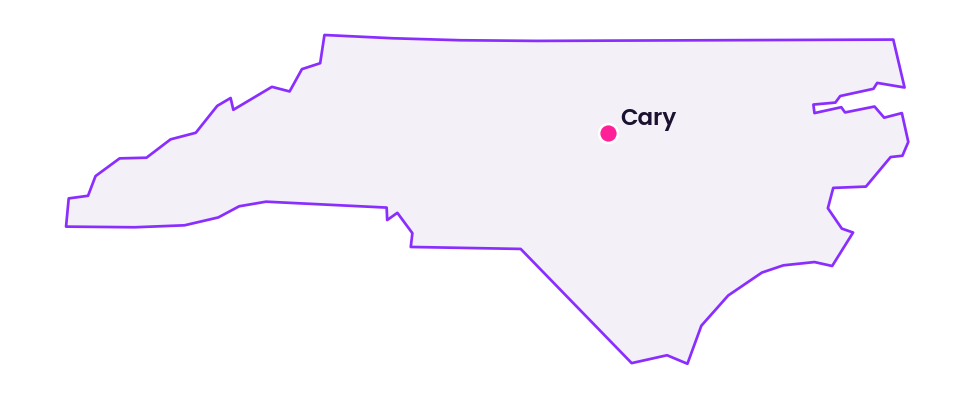
Section 02Population and Migration
Cary is one of North Carolina's largest municipalities and a core node of a fast growing metro. The United States Census Bureau counted 174,721 residents in Cary at the 2020 Decennial Census, living in 62,789 households. The American Community Survey 2024 one year estimate, as presented by Census Reporter, places the population near 181,838, and the Census Bureau's July 1, 2025 population estimate is 183,582, implying continued but moderating growth off the 2020 base. The surrounding county and metro carry the growth narrative most clearly. Wake County Government's Comprehensive Planning division reports that more than 1.2 million people now live in the county, that it has added more than 103,000 residents since 2020, and that it grows by roughly 66 people per day. The Raleigh Cary metropolitan statistical area reached approximately 1.56 million residents in 2024 per USAFacts, with Census Reporter placing the metro at 1,562,009.
The composition of Cary's population matters as much as its size for real estate demand. The Census Bureau QuickFacts for Cary town, drawing on the ACS 2020 to 2024 file, reports the following, indicating a family heavy but aging profile that is notably diverse, internationally connected, and residentially stable.
| Demographic measure (Cary town, ACS 2020 to 2024) | Value |
|---|---|
| Persons under 18 years | 23.4% |
| Persons 65 years and over | 14.1% |
| Asian alone | 20.4% |
| Language other than English spoken at home, age 5 and over | 26.6% |
| Living in the same house one year earlier | 84.8% |
| Persons per household | 2.57 |
Source is United States Census Bureau QuickFacts for Cary town, ACS 2020 to 2024 file,.
Migration flows favor Cary. Redfin's relocation tracking for the period covering early 2026 shows that among buyers moving into the Cary market from outside the metro, the largest inbound sources were Washington, New York, Charlotte, Los Angeles, Boston, Seattle, and San Francisco, a list dominated by higher cost coastal metros whose residents find Cary relatively affordable and job rich. The same data show that 72% of Cary buyers searched to stay within the local metro, underscoring internal retention, while the largest outbound flows ran to lower cost North Carolina and coastal destinations such as Greensboro, Myrtle Beach, and Fayetteville. The net effect is a population that is well educated, high earning, geographically sticky, and continually refreshed by inbound arrivals from more expensive markets.
Section 03Jobs and Economic Anchors
Cary's investment case rests heavily on the quality and stability of its employment base. The Raleigh Cary metropolitan area recorded an unemployment rate of 3.1% in June 2026 per the Bureau of Labor Statistics Local Area Unemployment Statistics series, a level consistent with full employment and materially below the national rate. The Bureau of Labor Statistics Raleigh area economic summary, updated July 1, 2026, corroborates a low unemployment, high wage regional profile.
The town's signature employer is SAS Institute, the privately held analytics and artificial intelligence software company founded in 1976 and headquartered on a large campus in Cary. LinkedIn's company profile lists SAS at approximately 11,366 employees globally, while Revelio Labs estimated approximately 12,327 total employees worldwide as of March 2026, on annual revenue near $3 billion. A meaningful share of that workforce sits in Cary, making SAS the anchor tenant of the local white collar economy. Cary is also the headquarters of Epic Games, the maker of Fortnite and the Unreal Engine, and hosts a major MetLife technology campus. The wider Research Triangle, immediately adjacent, adds pharmaceutical, life science, and technology employers concentrated in Research Triangle Park, one of the largest research parks in the country; the Raleigh News and Observer reported that Fidelity Investments alone employed roughly 8,290 workers statewide entering 2025, much of that in the Triangle. John Deere Financial and a broad roster of financial and technology firms round out the base.
The following table summarizes the principal economic anchors most relevant to Cary demand, with sources and scope noted.
| Anchor | Metric | Value | Source and scope |
|---|---|---|---|
| SAS Institute | Global employees (headcount) | ~11,366 to ~12,327 | LinkedIn profile; Revelio Labs, March 2026, global |
| Epic Games | Headquarters | Located in Cary | Company headquarters, 2026 |
| Fidelity Investments | NC statewide employees | ~8,290 | Raleigh News and Observer, entering 2025, statewide |
| Raleigh Cary metro | Unemployment rate | 3.1% | BLS LAUS via FRED, June 2026, metro |
| Cary town | Total retail sales, 2022 | $5,759,439 thousand | Census Bureau QuickFacts, 2022, town |
The analytical conclusion is that Cary's labor demand is anchored by a small number of very large, well capitalized, high wage employers plus proximity to a diversified research economy. That concentration is a strength for occupancy and rent durability, and a risk to monitor, since a sharp contraction at a single anchor such as SAS would be felt locally.
Section 04Income
Cary is a high income community by any national benchmark. The Census Bureau QuickFacts for Cary town reports the income and educational attainment profile below for the ACS 2020 to 2024 period, cross checked against Census Reporter tabulations.
| Measure (Cary town unless noted) | Value | Source and scope |
|---|---|---|
| Median household income | $134,905 | QuickFacts, ACS 2020 to 2024 |
| Per capita income | $67,409 | QuickFacts, ACS 2020 to 2024 |
| High school graduate or higher, age 25 and over | 96.3% | QuickFacts, ACS 2020 to 2024 |
| Bachelor's degree or higher, age 25 and over | 70.5% | QuickFacts, ACS 2020 to 2024 |
| Median household income, town cross check | $135,132 | Census Reporter, ACS |
| Median household income, Raleigh Cary metro | $100,103 | Census Reporter, ACS |
Census Reporter's town median of $135,132 effectively confirms the QuickFacts figure, and the metro median of $100,103 shows that Cary households out earn the surrounding metro by a wide margin. The income distribution is skewed toward the top, which supports both premium rents and elevated for sale price points. Census Reporter's tabulation of Cary household income is shown below.
| Household income band | Share of Cary households | Source and scope |
|---|---|---|
| Under $50,000 | 16% | Census Reporter, ACS, Cary town |
| $50,000 to $100,000 | 19% | Census Reporter, ACS, Cary town |
| $100,000 to $200,000 | 35% | Census Reporter, ACS, Cary town |
| Over $200,000 | 30% | Census Reporter, ACS, Cary town |
The conclusion for investors is that roughly two thirds of Cary households earn above $100,000, and nearly a third earn above $200,000. That concentration of purchasing power underpins the town's ability to sustain median home values above $580,000 and to support Class A rents at the upper end of the metro range, while also meaning that the deepest renter demand pool sits in the workforce and moderate income segments that are priced well below the for sale market.
Section 05Housing and Multifamily
Cary's housing stock is predominantly owner occupied and high value. The Census Bureau QuickFacts reports the following housing profile for the ACS 2020 to 2024 period.
| Housing measure (Cary town, ACS 2020 to 2024) | Value |
|---|---|
| Owner occupied housing unit rate | 66.6% |
| Households | 69,710 |
| Median value of owner occupied home | $580,200 |
| Median monthly owner cost with a mortgage | $2,389 |
| Median gross rent, all renter households | $1,738 |
Source is United States Census Bureau QuickFacts for Cary town, ACS 2020 to 2024 file,. The Cary town median owner occupied value of $580,200 sits well above the Wake County median of $461,300 reported by Census Reporter, confirming Cary's position as a premium submarket within the county.
On the multifamily side, city specific operating data are thin because Cary apartments are typically reported inside the broader Raleigh Durham market by the major data vendors, so the metro serves as the most defensible proxy and is labeled as such throughout. Yardi Matrix, in its June 2026 Raleigh report, put the average advertised asking rent for the Raleigh Durham metro at $1,539. Cary, as one of the higher income and higher rent submarkets, generally sits above that metro average, though no separately published Cary only average advertised rent from a primary vendor is available here to state a precise town level figure. The multifamily thesis for Cary rests on the same fundamentals that drive the for sale market: a high wage employment base, in migration from more expensive metros, and a scarcity of entitled land inside the town that constrains new supply relative to demand over the long run.
Section 06Rents
Rent growth across the market Cary belongs to has flattened after the pandemic era surge, a direct consequence of heavy apartment deliveries. The clearest primary read comes from Yardi Matrix. Its June 2026 Raleigh report states that the average advertised asking rent in Raleigh Durham was up just 0.1% on a trailing three month basis as of April 2026, at $1,539, which was 10 basis points below the national average pace. The prior Yardi Matrix Raleigh report, dated February 2026, showed advertised asking rents had actually fallen 0.7% year over year through December 2025, holding at $1,539 while the national average was unchanged. The table below sets out the metro rent readings from these two primary vendor reports.
| Reading | Average asking rent | Change | Source and scope |
|---|---|---|---|
| Through December 2025 (year over year) | $1,539 | -0.7% | Yardi Matrix Raleigh report, February 2026, Raleigh Durham metro |
| Through April 2026 (trailing three month) | $1,539 | +0.1% | Yardi Matrix Raleigh report, June 2026, Raleigh Durham metro |
For a Cary specific benchmark, the Census Bureau reports a Cary town median gross rent of $1,738 for the ACS 2020 to 2024 period, a measure of rent actually paid across all renter households rather than current advertised asking rent, which sits above the metro advertised average and is consistent with Cary's rent premium. The analytical takeaway is that metro rents have stopped falling and are hovering near flat as the market digests supply, with the trailing three month pace turning marginally positive by spring 2026. For Cary specifically, which commands a rent premium to the metro average on the strength of incomes and school quality, the base case is stabilization now with a return to modest growth as deliveries slow, rather than a sharp rebound. Investors should treat any pro forma that assumes rapid near term rent acceleration as a scenario value, not a forecast of fact.
Section 07Vacancy
Apartment vacancy across the Raleigh Durham market rose over 2024 and 2025 as new communities leased up, and it has been stabilizing in 2026. Lee Associates, in its Q1 2026 Raleigh Durham multifamily overview, reported that trailing twelve month net absorption reached 6,557 units and that vacancy improved during the quarter, describing the market as relatively stable. Northmarq, in its Q4 2025 Raleigh market insights, characterized operating conditions as having softened during the fourth quarter, consistent with a supply led rise in vacancy before the 2026 stabilization.
For commercial property, vacancy readings are clearer and are addressed in the commercial section, but the headline contrast is worth previewing: apartment vacancy has been pressured by supply yet is backed by strong absorption, whereas office vacancy across the metro sits far higher in the low twenties percent range. The conclusion for multifamily investors is that vacancy risk in and around Cary is cyclical and supply driven rather than demand driven, since absorption of 6,557 units over twelve months is robust; the risk fades as the delivery pipeline thins.
Section 08Supply Pipeline
Supply is the single most important near term variable for this market. Yardi Matrix reported that developers brought 2,157 units online across Raleigh Durham in the first four months of 2026, equal to 1.0% of existing stock, a delivery pace running about 50 basis points above the national figure for the same period. That above average pace is the proximate cause of flat rents and elevated vacancy described in the prior two sections. The encouraging signal for owners is that the pipeline appears to be moderating: Lee Associates' description of stabilizing vacancy and firmer absorption in early 2026 is consistent with a market that is working through its peak deliveries.
Cary itself has limited large scale raw land, which structurally caps how much new apartment supply can be added inside the town relative to outlying submarkets such as those along the metro's growth corridors. A prominent example of Cary's development pattern is the large mixed use Fenton project in the town, which pairs retail, office, and residential uses and illustrates that new Cary supply tends to arrive as dense, amenitized, mixed use product rather than sprawling garden apartment tracts. No precise, current count of units under construction inside the Cary municipal boundary from a primary source is available here to state a town level pipeline figure, so the metro delivery data stand as the labeled proxy. The conclusion is that the supply overhang is a metro wide and largely temporary phenomenon, and that Cary's land constraints should make it a relative outperformer as the wave passes.
Section 09Single Family Homes
The for sale market in Cary has cooled from its rapid appreciation into a plateau, with values slipping modestly over the past year even as transaction volume has held up. The three most cited public trackers disagree on the exact level, which reflects differences in methodology and geography rather than a genuine data conflict, so they are presented side by side below with their scopes.
| Source | Metric | Value | Change year over year | Scope and date |
|---|---|---|---|---|
| Zillow | Average home value | $620,401 | -1.8% | Cary, mid 2026 |
| Redfin | Median sale price | $645,149 | -0.75% | Cary, June 2026 |
| HousingData.report | Typical home value | $619,301 | -1.1% | Cary, 2026 |
Beneath the headline price softening, the demand signals remain firm. Redfin reports that Cary homes sold in a median of 16 days in June 2026, faster than the 18 days a year earlier, that 716 homes sold in June 2026 versus 578 a year earlier, and that homes sold at 99.7% of list price with a Redfin Compete Score of 77, a very competitive reading. The median sale price per square foot was $264, down 1.1% year over year. The picture is therefore a market where prices have flattened to modestly negative while activity and competition remain healthy, a classic late cycle plateau rather than a distressed decline.
For the single family rental angle, Cary's combination of top rated schools, high incomes, and family oriented housing stock makes it a natural target for single family rentals and for the build to rent product that has expanded across the Triangle. High for sale price points near and above $620,000 keep monthly ownership costs elevated, with QuickFacts reporting median monthly owner costs with a mortgage of $2,389, which supports rental demand from households that can afford Cary but are not ready or able to buy at current prices and rates. No precise, current Cary only single family rent index from a primary vendor is available here to state an exact figure, so investors should underwrite single family rents from comparable listings and treat any single number as a point estimate.
Section 10Commercial Real Estate and Retail Centers
Commercial conditions vary sharply by property type, and the metro data are the correct lens since Cary's commercial inventory reports inside Raleigh Durham. The clearest weakness is office. Cushman and Wakefield's Raleigh MarketBeat put overall office vacancy at 22.3% in the first quarter of 2026 and 21.9% in the second quarter of 2026, effectively flat across three consecutive quarters within a narrow band. That elevated vacancy reflects the national reset in office demand and means office is a value and repositioning story rather than a stabilized income story in this market.
Industrial and logistics is healthier but is digesting its own supply. TenantBase's Q2 2026 Raleigh Durham report placed the broad industrial vacancy rate at 9.0%, driven by newly completed speculative product entering the market without preleasing, with space under construction climbing from 2.2 million square feet to 5.6 million square feet. CBRE's Raleigh Durham industrial figures for Q2 2026 noted that warehouse vacancy decreased on strong absorption concentrated in new deliveries, including a confidential tenant taking new construction. The industrial read is therefore a market with a temporary vacancy bump from speculative completions but genuine tenant demand behind it.
Retail is the tightest and most defensive sector, though granular current public figures are the thinnest. Cary is a strong retail trade area, with the Census Bureau QuickFacts reporting total retail sales of $5,759,439 thousand in 2022 and retail sales per capita of $32,021, both well above what a town of Cary's size would typically generate, reflecting affluent households and strong daytime population. Grocery anchored neighborhood centers in high income, high traffic suburbs like Cary have historically posted low vacancy and resilient demand, but no precise, current Cary only retail vacancy rate from a primary vendor is available here to state an exact figure, so this point is described in words rather than with a false number. The table below consolidates the commercial vacancy readings that are available at the metro level.
| Sector | Vacancy rate | Source and scope |
|---|---|---|
| Office | 21.9% (Q2 2026), 22.3% (Q1 2026) | Cushman and Wakefield Raleigh MarketBeat, Raleigh Durham metro |
| Industrial and logistics | 9.0% | TenantBase Q2 2026, Raleigh Durham metro |
| Retail | Historically low; no current town level figure available | Described in prose; Census QuickFacts retail sales, 2022, Cary town |
The conclusion is a clear ranking of sector risk and opportunity: office is oversupplied and repricing, industrial is fundamentally sound but working through speculative deliveries, and retail, especially grocery anchored and daily needs centers serving Cary's affluent base, is the most defensive of the three.
Section 11Transactions and Capital Markets
Investment sales across the market compressed during the high interest rate environment of 2023 through 2025 and have shown signs of stabilizing into 2026. Northmarq's Q4 2025 Raleigh market insights reported on transaction activity and a median price per unit for the metro, while noting softened operating conditions, and Lee Associates' early 2026 commentary describes a market returning to relative stability.
The capital markets context that investors can rely on is directional and well supported: the metro absorbed strong volumes of new units, with Lee Associates reporting 6,557 units of trailing twelve month net absorption as of Q1 2026, which supports underwriting on the demand side, while the elevated deliveries reported by Yardi Matrix explain why sellers and buyers spent 2024 and 2025 apart on price. The base case for 2026 is a gradual thaw in transaction volume as rent trends stabilize and the delivery pipeline thins, though the pace depends on the trajectory of interest rates, which is outside the scope of this town level review.
Section 12Taxes
Property taxes in Cary are among the most favorable in the region, which is a genuine and quantifiable advantage for owners. A Cary property owner pays a combined bill that includes both the Town of Cary municipal rate and the Wake County rate, since Wake County bills and collects property tax for municipalities per local agreement. For the fiscal year 2026 budget covering July 1, 2025 through June 30, 2026, the Town of Cary set its property tax rate at $0.34 per $100 of assessed value, which the town described as the lowest of all municipalities in Wake County, equal to roughly $97 more per year for the median Cary home valued at $648,000 after a 1.5 cent increase. For the fiscal year 2027 budget adopted on June 25, 2026 and covering July 1, 2026 through June 30, 2027, the Town of Cary raised the municipal rate to 36.75 cents per $100, an increase of 2.75 cents. On the county side, the Wake County Board of Commissioners adopted a fiscal year 2027 budget on June 1, 2026 that raised the county rate by 2 cents to 53.71 cents per $100.
| Jurisdiction and fiscal year | Rate per $100 assessed value | Change | Source and scope |
|---|---|---|---|
| Town of Cary, FY2026 | $0.3400 | +1.5 cents | Town of Cary budget, FY2026, municipal |
| Town of Cary, FY2027 | $0.3675 | +2.75 cents | Town of Cary FY2027 adopted budget, municipal |
| Wake County, FY2027 | $0.5371 | +2 cents | Wake County FY2027 adopted budget, county |
| Combined Cary resident, FY2027 | $0.9046 | Sum of the above | Author summation of the two cited FY2027 rates |
The combined FY2027 rate for a Cary resident is therefore approximately 90.46 cents per $100 of assessed value, the sum of the two cited municipal and county rates. On transfer costs, North Carolina imposes a statewide excise stamp tax on deeds of $1 per $500 of consideration, equal to 0.2% of price, which is low relative to transfer taxes in many other states. The conclusion is that Cary offers a comparatively light property tax and transfer tax burden, a durable structural positive for net operating income and for after tax returns, even after the FY2027 increases at both the town and county levels.
Section 13Insurance
Homeowners insurance costs in North Carolina are rising, but Cary's inland location places it in the lower tier of increases rather than the punishing coastal tier. In January 2025 the North Carolina Department of Insurance announced a negotiated settlement with the North Carolina Rate Bureau on homeowners insurance rates. The Rate Bureau had originally requested an average statewide increase of 42.2%, with proposed increases of up to 99.4% in some coastal areas. Under the settlement signed by the Insurance Commissioner, the statewide average base rate rises by 7.5% on June 1, 2025 and by a further 7.5% on June 1, 2026, which independent reporting summarized as an average increase of about 15% over two years. The steepest increases fall on beach and coastal counties, while inland territories that include the Cary area face the lower end of the schedule.
| Item | Value | Source and scope |
|---|---|---|
| Rate Bureau original request, statewide average | +42.2% | NC Department of Insurance, January 2025, statewide |
| Rate Bureau request, highest coastal areas | up to +99.4% | NC Department of Insurance, January 2025, coastal beach counties |
| Settled statewide average, effective June 1, 2025 | +7.5% | NC Department of Insurance settlement, statewide |
| Settled statewide average, effective June 1, 2026 | +7.5% | NC Department of Insurance settlement, statewide |
The analytical conclusion is that insurance is a rising cost line that must be underwritten with escalation, but that Cary's inland position is a meaningful advantage. Owners here avoid the extreme coastal premiums and wind pool exposure that erode returns in beachfront North Carolina markets, and the settled inland increases, while real, are modest compared with the increases seen in high hazard coastal and convective storm regions nationally.
Section 14Landlord Tenant and Regulatory Environment
North Carolina is broadly regarded as a landlord friendly, light regulation state, and Cary operates within that framework. Residential landlord tenant relationships are governed primarily by Chapter 42 of the North Carolina General Statutes. Critically for investors, North Carolina does not permit rent control: state law preempts local governments from adopting rent control ordinances, so neither Cary nor Wake County can cap rents, which removes a major regulatory risk that weighs on returns in several coastal and West Coast markets. Security deposits on residential tenancies are limited by statute based on the length of the tenancy, and the eviction process for nonpayment and lease violations is relatively efficient by national standards, though owners must follow the statutory summary ejectment procedure through the courts rather than pursuing self help.
Because the exact statutory citations and any recent legislative amendments can change, investors should confirm current provisions of Chapter 42 and any Cary specific rental or inspection ordinances with counsel before acquisition; the general characterization here is that the regulatory environment is stable and owner favorable, but the precise current text of each provision is a legal question rather than a market data point. The conclusion is that the regulatory backdrop is one of Cary's underappreciated strengths: predictable, preemptive of rent control, and efficient in enforcement, which supports both underwriting confidence and exit liquidity.
Section 15Infrastructure
Cary's infrastructure position is a core demand driver. The town sits at the heart of the Research Triangle, adjacent to Research Triangle Park and within a short drive of Raleigh Durham International Airport, one of the fastest growing airports in the Southeast, which supports both the corporate employer base and residential desirability. Major road infrastructure includes Interstate 40, US Highway 1, and US Highway 64, giving Cary strong connectivity to Raleigh, Durham, and the wider region. The town has invested in placemaking, most visibly through the large mixed use Fenton development and the redevelopment of its downtown, which pair walkable retail, office, and residential density and reinforce Cary's appeal to the high wage workforce that anchors housing demand.
Utility infrastructure is actively funded through the town budget; the fiscal year 2027 budget includes a 4% overall utility rate increase applied to the base charge, which the town estimated at roughly $3.08 per month for a typical household, alongside continued capital investment in streets, sidewalks, and public safety technology. The conclusion is that Cary's infrastructure supports rather than constrains growth: airport access, highway connectivity, research park adjacency, and deliberate mixed use placemaking combine to sustain the location premium that underpins both rents and values.
Section 16Climate and Physical Risks
Cary's physical risk profile is comparatively favorable because it is an inland location well removed from the coast, sitting on the rolling Piedmont at an elevation far above sea level. It carries no direct storm surge exposure, which is the single largest driver of catastrophic coastal losses in North Carolina. The primary physical hazards are inland freshwater flooding along local creeks and the wind and rainfall bands of hurricanes and tropical systems that track inland after landfall, as the region experienced historically with Hurricane Fran in 1996 and with the inland rainfall of later storms such as Matthew and Florence.
On flooding specifically, the Town of Cary maintains its own floodplain management program and reads FEMA Flood Insurance Rate Maps to determine whether individual properties sit in mapped special flood hazard areas, and the North Carolina Flood Risk Information System provides parcel level flood risk statewide. The third party analytics firm ClimateCheck estimates that about 8% of buildings in Cary are at some risk of flooding, a modest share concentrated along creek corridors such as Swift Creek and Crabtree Creek rather than town wide. The analytical conclusion is that Cary's climate risk is low relative to coastal North Carolina and to hurricane exposed markets in Florida and the Gulf, that the material risk is localized creek flooding that can be diligenced parcel by parcel using FEMA and state maps, and that this favorable risk profile is one reason the town's insurance increases sit in the lower inland tier described earlier.
Section 17Neighborhoods and Submarkets
Cary is not a monolith; its submarkets carry distinct price points and buyer profiles, generally organized by ZIP code and by age of development. West Cary, covering the 27,519 area and adjacent newer growth, contains much of the town's recent higher value single family construction and commands the strongest for sale prices. Central and older Cary, in the 27,511 and 27,513 areas, offers more established neighborhoods, a range of price points, and proximity to the revitalized downtown. South Cary, around 27,518, and the corridors toward Apex and Morrisville round out the residential geography, with Morrisville and the 27,560 area on Cary's northwest edge tied closely to Research Triangle Park employment.
The value gradient is visible in the assessment and valuation data. Census Reporter places the Cary township median value of owner occupied housing at $475,000, above the Wake County median of $461,300, while the Cary town median owner occupied value stands higher at $580,200 for the ACS 2020 to 2024 period per the Census Bureau QuickFacts, reflecting the town's newer and larger housing stock relative to the broader township and county. Downtown Cary has been a focus of public and private investment, including the opening of the Downtown Cary Park and continued mixed use development, which is gradually adding walkable density and rental product to a town historically defined by single family subdivisions. The conclusion is that submarket selection materially affects both entry price and buyer depth: west Cary offers premium newer product at the highest price points, while central Cary and the downtown corridor offer relative value and the strongest thesis for rental and mixed use investment as walkability improves.
Section 18Opportunities
Several durable opportunities stand out for an educational reading of this market. First, the employment base is high wage, technology anchored, and reinforced by Research Triangle Park, which supports both rent and value stability through cycles; the metro unemployment rate of 3.1% in June 2026 quantifies that strength. Second, the current plateau in for sale prices, with Zillow down 1.8% and Redfin down 0.75% year over year, combined with a flattening rather than collapsing rent trend, creates a potential entry window for patient capital before the supply wave fully clears and rent growth resumes. Third, Cary's structurally low property tax rate, the lowest municipal rate in Wake County in recent budgets, and North Carolina's low 0.2% transfer tax and absence of rent control, together produce a favorable operating and regulatory environment for net operating income. Fourth, the single family rental and build to rent thesis is well supported by high ownership costs, top rated schools, and family oriented demand, which sustain a deep renter pool of households that can afford Cary but are priced out of ownership at current rates. Fifth, grocery anchored and daily needs retail serving an affluent, high spending population, evidenced by $5.76 billion in 2022 town retail sales, is a defensive income play.
Section 19Risks
The risks are equally concrete. The most immediate is the supply overhang: Yardi Matrix reported deliveries running at 1.0% of stock in just the first four months of 2026, about 50 basis points above the national pace, which has flattened rents and lifted vacancy across the metro and will continue to pressure new lease ups until the pipeline thins. Second, the for sale market has plateaued and could soften further if mortgage rates stay elevated, since values are already modestly negative year over year across all three trackers. Third, employer concentration is a genuine tail risk; a sharp contraction at a dominant anchor such as SAS or Epic Games would hit local demand harder than in a more diversified economy. Fourth, costs are rising on multiple fronts: property tax rates increased at both the town and county levels for fiscal year 2027, homeowners insurance is climbing under the state settlement, and utility rates rose 4% in the FY2027 budget, all of which compress margins if not underwritten with escalation. Fifth, office is structurally weak, with metro vacancy near 22%, so any strategy touching office in or near Cary must be a value or conversion thesis, not a stabilized income assumption. Finally, localized creek flooding along corridors such as Swift Creek and Crabtree Creek is a parcel specific risk that must be diligenced with FEMA and state flood maps before acquisition.
Section 20Investor Implications
Read together, the data describe a high quality, low volatility suburban market that is currently mid cycle rather than early cycle. For a residential income strategy, the implication is to underwrite conservatively through the supply wave: assume flat to modest rent growth in the near term, consistent with the Yardi Matrix readings, and treat any rapid rent acceleration as a scenario value rather than a base case, while relying on the strong absorption of 6,557 units over twelve months as evidence that demand is intact once deliveries slow. For a single family rental or build to rent strategy, Cary's incomes, schools, and elevated ownership costs make it one of the more defensible Triangle submarkets, with west Cary offering premium product and central Cary offering relative value. For commercial capital, the sector ranking is clear: favor grocery anchored and daily needs retail and well located industrial, approach office only as a repricing or conversion play, and lean on Cary's affluent trade area to support retail income. Across all strategies, the low property tax burden, the absence of rent control, the low transfer tax, and the favorable inland climate risk profile are structural positives that should be explicitly credited in underwriting, while rising taxes, insurance, and utility costs are structural headwinds that must be escalated. None of the foregoing is a recommendation; it is a framing of what the public data imply, with decisions reserved to the reader and their advisors.
Section 21Conclusion
Cary is a wealthy, well educated, technology anchored suburb whose real estate fundamentals are unusually stable by national standards. Its population continues to grow within one of the fastest expanding metros in the country, its households out earn the surrounding region by a wide margin, and its employment base is anchored by marquee employers and the adjacent Research Triangle. In 2026 the town sits in a soft landing: for sale values have edged modestly lower, metro rents have flattened under a supply wave that is beginning to thin, office is weak while industrial and retail are healthier, and costs are rising even as taxes and climate risk remain comparatively favorable. The investment character of Cary is therefore defensive and durable rather than explosive, a market where the case rests on quality of demand, low regulatory and tax friction, and a favorable physical risk profile, tempered by a near term supply overhang and a plateau in for sale pricing. Every figure above is tied to a named public source with its scope stated, and where reliable town level data do not exist, that gap is stated plainly rather than filled with an estimate.
Sources
- United States Census Bureau, 2020 Decennial Census, Cary town population and households, via Wikipedia summary, https://en.wikipedia.org/wiki/Cary,_North_Carolina
- United States Census Bureau QuickFacts, Cary town, North Carolina (ACS 2020 to 2024, V2025 population estimate, and 2022 economic data), https://www.census.gov/quickfacts/fact/table/carytownnorthcarolina
- Census Reporter, Cary, NC profile (ACS 2024 one year and ACS estimates), http://censusreporter.org/profiles/16000US3710740-cary-nc/
- Census Reporter, Raleigh Cary, NC Metro Area profile, http://censusreporter.org/profiles/31000US39580-raleigh-cary-nc-metro-area/
- Census Reporter, Cary township, Wake County, NC profile (median owner occupied value), http://censusreporter.org/profiles/06000US3718390536-cary-township-wake-county-nc/
- USAFacts, Raleigh, NC metro area population, https://usafacts.org/answers/how-many-people-live-in-the-us/metro-area/raleigh-nc/
- Wake County Government, Growth and Population Trends, https://www.wake.gov/departments-government/comprehensive-planning/census-demographics/growth-and-population-trends
- Bureau of Labor Statistics via Federal Reserve Economic Data, Unemployment Rate in Raleigh, NC (MSA), June 2026, https://fred.stlouisfed.org/series/RALE537URN
- Bureau of Labor Statistics, Raleigh, NC Area Economic Summary, July 2026, https://www.bls.gov/regions/southeast/summary/blssummary_raleigh.pdf
- SAS Institute, company profile, LinkedIn, https://www.linkedin.com/company/sas
- Revelio Labs, SAS Institute employee count, March 2026, https://www.reveliolabs.com/companies/sas-institute/employees
- Raleigh News and Observer, biggest companies in the Triangle, https://www.newsobserver.com/news/business/article302221644.html
- Yardi Matrix, Matrix Multifamily Raleigh Report, June 2026, https://www.yardimatrix.com/multifamily-metro/matrix-multifamily-raleigh-report-june-2026/
- Yardi Matrix, Matrix Multifamily Raleigh Report, February 2026, https://www.yardimatrix.com/Publications/Download/File/8385-MatrixMultifamilyRaleighReport-February2026
- Lee Associates, Raleigh Durham Multifamily Market Overview, Q1 2026, https://www.lee-associates.com/raleigh/wp-content/uploads/sites/64/2026/04/2026-Q1-Raleigh-Durham-NC-Multifamily.pdf
- Northmarq, Raleigh Market Insights, Q4 2025, https://www.northmarq.com/sites/default/files/docs/NMMarketInsights-2025Q4-Raleigh.pdf
- Zillow, Cary, NC Home Values, https://www.zillow.com/home-values/51297/cary-nc/
- Redfin, Cary, NC Housing Market, https://www.redfin.com/city/35713/NC/Cary/housing-market
- HousingData.report, Cary home prices, https://housingdata.report/blog/average-home-price-cary-nc/
- Cushman and Wakefield, Raleigh MarketBeat (office), https://www.cushmanwakefield.com/en/united-states/insights/us-marketbeats/raleigh-marketbeats
- CBRE, Raleigh Durham Industrial Q2 2026, https://www.cbre.com/insights/figures/raleigh-durham-industrial-q2-2026
- TenantBase, Raleigh Durham Commercial Real Estate Market Report, Q2 2026, https://www.tenantbase.com/raleigh-durham/q2-2026/
- Town of Cary, Budget (FY2026 and FY2027), https://www.carync.gov/services-publications/budget
- Wake County Government, 2026 Property Tax Bills (FY2027 county rate), https://www.wake.gov/departments-government/tax-administration/tax-bill-help/2026-property-tax-bills
- North Carolina Department of Insurance, Commissioner Causey negotiates settlement on Rate Bureau homeowners request, January 2025, https://www.ncdoi.gov/news/press-releases/2025/01/17/commissioner-causey-negotiates-settlement-rate-bureaus-homeowners-insurance-request
- NC Newsline, North Carolinians to see average 15% rate increase for homeowners insurance over two years, January 2025, https://ncnewsline.com/briefs/north-carolinians-to-see-an-average-15-rate-increase-for-homeowners-insurance-over-two-years/
- Town of Cary, Floodplains and stormwater management, https://www.carync.gov/services-publications/water-sewer/stormwater-management/floodplains
- North Carolina Flood Risk Information System, https://fris.nc.gov/
- ClimateCheck, Cary, North Carolina climate risk, https://climatecheck.com/northcarolina/cary
- North Carolina General Statutes, Chapter 42 (residential landlord tenant law), https://www.ncleg.gov/Laws/GeneralStatuteSections/Chapter42