In brief · summary: Chesapeake
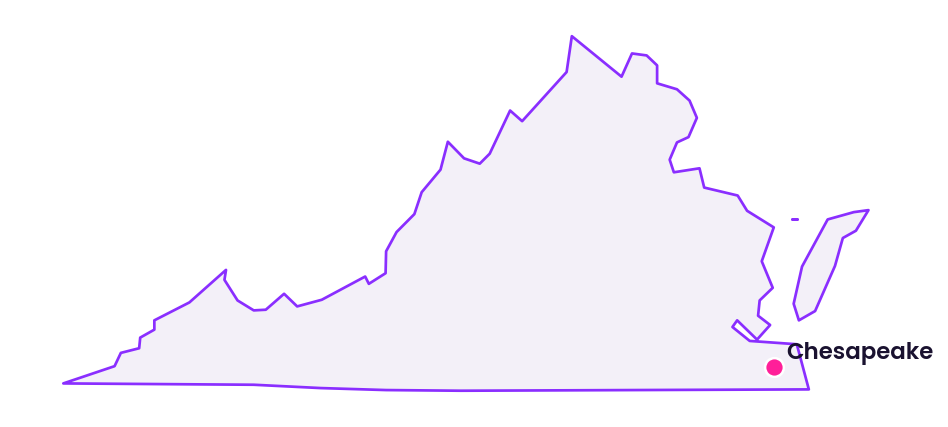
Chesapeake is a large, low density independent city in the Hampton Roads region of southeastern Virginia, part of the Virginia Beach, Chesapeake, and Norfolk metropolitan area, and it stands out as one of the most stable and owner occupied housing markets on the mid Atlantic coast. The United States Census Bureau estimated the city population at 255,332 as of July 1, 2025, up 2.4% from the April 2020 base of 249,251, making Chesapeake one of the most populous cities in Virginia.
The economy is anchored by the military and defense complex of Hampton Roads, the Port of Virginia, the headquarters of the discount retailer Dollar Tree, and a substantial health care sector, and it runs near full employment, with the metropolitan unemployment rate at 4.0% in June 2026 per the Bureau of Labor Statistics data compiled by USAFacts. Household incomes are solidly above the national norm, with a median household income of $95,373 in 2024 dollars per the Census Bureau QuickFacts drawing on the American Community Survey 2020 to 2024 file.
For real estate in 2026, Chesapeake presents a picture of steady appreciation and tight fundamentals rather than the boom and correction cycle seen in higher growth Sun Belt markets. Zillow reports an average Chesapeake home value of $429,092, up …
Section 01Executive Summary
Chesapeake is a large, low density independent city in the Hampton Roads region of southeastern Virginia, part of the Virginia Beach, Chesapeake, and Norfolk metropolitan area, and it stands out as one of the most stable and owner occupied housing markets on the mid Atlantic coast. The United States Census Bureau estimated the city population at 255,332 as of July 1, 2025, up 2.4% from the April 2020 base of 249,251, making Chesapeake one of the most populous cities in Virginia. The economy is anchored by the military and defense complex of Hampton Roads, the Port of Virginia, the headquarters of the discount retailer Dollar Tree, and a substantial health care sector, and it runs near full employment, with the metropolitan unemployment rate at 4.0% in June 2026 per the Bureau of Labor Statistics data compiled by USAFacts. Household incomes are solidly above the national norm, with a median household income of $95,373 in 2024 dollars per the Census Bureau QuickFacts drawing on the American Community Survey 2020 to 2024 file.
For real estate in 2026, Chesapeake presents a picture of steady appreciation and tight fundamentals rather than the boom and correction cycle seen in higher growth Sun Belt markets. Zillow reports an average Chesapeake home value of $429,092, up 3.5% year over year as of the end of July 2026, while Redfin reports a median sale price of $433,000, up 3.8% year over year over the three months ending June 2026. On the rental side, the Norfolk metropolitan area posted one of the strongest rent growth readings in the nation, at 4.4% year over year in May 2026 per the Apartments.com report from CoStar, reflecting a supply constrained market. The defining risk for the region is physical: Hampton Roads is one of the most exposed areas in the country to sea level rise and recurrent tidal flooding, which shapes both insurance cost and long run value. What follows is a section by section analysis for educational purposes, with each figure tied to a named public source and its scope stated in the text.
Section 02Population and Migration
Chesapeake is a geographically large city that has grown steadily rather than explosively. The Census Bureau QuickFacts reports a July 1, 2025 population estimate of 255,332, up 2.4% from the April 2020 estimates base of 249,251, a moderate pace that reflects a mature suburban market with room to grow into its undeveloped southern land rather than a market experiencing rapid in migration. The city is notably stable in its residency: 87.5% of residents lived in the same house one year earlier per the American Community Survey 2020 to 2024 data, one of the higher stability readings among large cities and a marker of an established owner occupied community.
The demographic composition supports durable family housing demand, as the following table from the Census Bureau QuickFacts illustrates.
| Component | Chesapeake value | Source and scope |
|---|---|---|
| Persons under 18 | 24.2% | Census Bureau QuickFacts, ACS 2020 to 2024, city |
| Persons 65 and over | 14.6% | Census Bureau QuickFacts, ACS 2020 to 2024, city |
| White alone, not Hispanic | 53.8% | Census Bureau QuickFacts, ACS 2020 to 2024, city |
| Black alone | 29.1% | Census Bureau QuickFacts, ACS 2020 to 2024, city |
| Veterans | 28,583 | Census Bureau QuickFacts, ACS 2020 to 2024, city |
| Persons per household | 2.65 | Census Bureau QuickFacts, ACS 2020 to 2024, city |
The conclusion is that Chesapeake is a family oriented, racially diverse, and military connected community. The veteran population of 28,583 is a direct reflection of the Hampton Roads defense economy, and the relatively high persons per household figure of 2.65, above many large city averages, indicates a housing stock oriented toward families rather than single renters. For investors this points to durable demand for single family homes and larger rental units rather than small urban studios.
Section 03Jobs and Economic Anchors
The Chesapeake economy is embedded in the broader Hampton Roads labor market, which is one of the largest concentrations of military and maritime activity in the country. The metropolitan labor market indicators are set out below.
| Labor market measure | Value | Source and scope |
|---|---|---|
| Metro unemployment rate | 4.0% | BLS via USAFacts, June 2026, Virginia Beach, Chesapeake, Norfolk metro |
| Metro labor force | 868,316 | BLS via USAFacts, June 2026, metro |
| Metro employed | 833,711 | BLS via USAFacts, June 2026, metro |
| Metro unemployed | 34,605 | BLS via USAFacts, June 2026, metro |
| Metro total nonfarm employment | approximately 830,300 | Federal Reserve Economic Data, July 2026, metro |
| Virginia statewide unemployment rate | 3.8% | Virginia Works, May 2026, seasonally adjusted |
These readings underscore a tight labor market at both the metro and statewide levels.
Chesapeake carries several specific economic anchors of its own. It is the headquarters city of Dollar Tree, a Fortune 500 discount retailer whose corporate campus and workforce are based in the city, giving Chesapeake a rare large corporate headquarters presence for a market of its size. The city also benefits from its position within the Port of Virginia complex, one of the largest container ports on the East Coast, which drives logistics, distribution, and transportation and warehousing activity; the Census Bureau QuickFacts reported total transportation and warehousing receipts of $798,929 thousand for the city in 2022. The regional military presence, centered on Naval Station Norfolk, the largest naval base in the world, and the associated shipbuilding and ship repair industry, provides an unusually stable, federally funded employment base that dampens local cyclicality. Health care is the fourth anchor, with the QuickFacts reporting health care and social assistance receipts of $1,563,227 thousand for the city in 2022. A precise, current employee headcount for Dollar Tree's Chesapeake operations from a primary source is not stated here, so its scale is described in words rather than with a specific number. The analytical conclusion is that Chesapeake's demand base is anchored by federal defense spending, port logistics, a major corporate headquarters, and health care, a combination that produces steady, recession resistant housing demand even if it lacks the explosive technology driven growth of some peer markets.
Section 04Income
Chesapeake is a comparatively affluent market by both regional and national standards. The income, affordability, and attainment measures for the city are summarized below.
| Income and affordability measure (Chesapeake city) | Value | Source and scope |
|---|---|---|
| Median household income | $95,373 | Census Bureau QuickFacts, ACS 2020 to 2024 |
| Per capita income | $44,985 | Census Bureau QuickFacts, ACS 2020 to 2024 |
| Metro median household income | $82,402 | Census Reporter |
| Persons in poverty | 9.4% | Census Bureau QuickFacts, ACS 2020 to 2024 |
| Labor force participation rate, age 16 and over | 62.8% | Census Bureau QuickFacts, ACS 2020 to 2024 |
| Bachelor's degree or higher, age 25 and over | 36.9% | Census Bureau QuickFacts, ACS 2020 to 2024 |
| Median monthly owner cost with a mortgage | $2,142 | Census Bureau QuickFacts, ACS 2020 to 2024 |
| Median gross rent | $1,586 | Census Bureau QuickFacts, ACS 2020 to 2024 |
The city median household income of $95,373 runs about 16% higher than the surrounding metropolitan figure of $82,402, confirming that Chesapeake sits toward the upper end of the Hampton Roads income distribution, while the poverty rate of 9.4% is below the national figure. Educational attainment is moderate, with 36.9% of adults age 25 and over holding a bachelor's degree or higher, a level consistent with a workforce oriented toward the military, skilled trades, logistics, retail, and health care rather than toward a concentration of white collar professional services. The homeownership economics reinforce the affluent picture, with a median monthly owner cost with a mortgage of $2,142 against a median gross rent of $1,586. The conclusion for investors is that Chesapeake households have solid, stable incomes anchored by federal and health care employment, that the income premium over the broader metro supports both for sale demand and the ability to pay market rents, and that the moderate educational profile reflects an economy built on durable middle income employment rather than on volatile high wage sectors.
Section 05Housing and Multifamily
Chesapeake is overwhelmingly a homeownership market, which is the single most important fact for framing its multifamily thesis. The Census Bureau QuickFacts reports an owner occupied housing unit rate of 74.4% over the American Community Survey 2020 to 2024 period, well above the national average and far above the roughly even splits seen in university and gateway markets. The city contained 93,626 households with an average of 2.65 persons each. This high ownership share means the renter pool, while smaller as a percentage than in denser cities, is backed by a large and growing population and by the steady turnover of military and health care households that prefer or require renting.
On apartment fundamentals, city specific vendor detail is thin, so the Norfolk and Hampton Roads metropolitan readings serve as the most defensible proxy and are labeled as such. The Apartments.com report from CoStar, covering May 2026, singled out Norfolk as one of the strongest apartment markets in the country, with year over year rent growth of 4.4%, the third highest among the top 50 United States metros and far above the national annual figure of 0.7% and the negative 0.8% posted by the South region as a whole. That outperformance signals a relatively supply constrained, well occupied market. The median gross rent for Chesapeake specifically was $1,586 per the American Community Survey 2020 to 2024 data. The multifamily case rests on the region's federally anchored demand, its comparatively restrained apartment construction relative to Sun Belt metros, and the high cost of ownership that keeps a segment of households in the rental market.
Section 06Rents
Rent dynamics in the Chesapeake area are strong relative to the national backdrop, driven by constrained supply and steady military and health care demand. The clearest current signal is metropolitan: the Apartments.com report from CoStar for May 2026 placed Norfolk among the national rent growth leaders at 4.4% year over year, a striking result at a time when the national average rose only 0.7% and the South region overall declined 0.8%. This positions Hampton Roads as a rare southern market with accelerating rather than decelerating rents. The table below sets the metro reading against the national context.
| Measure | Value | Source and scope |
|---|---|---|
| Norfolk metro rent growth, year over year | +4.4% | Apartments.com from CoStar, May 2026, Norfolk metro |
| United States average apartment rent | $1,737 | Apartments.com from CoStar, May 2026, national |
| United States rent growth, year over year | +0.7% | Apartments.com from CoStar, May 2026, national |
| South region rent growth, year over year | -0.8% | Apartments.com from CoStar, May 2026, South region |
| Chesapeake median gross rent | $1,586 | Census Bureau QuickFacts, ACS 2020 to 2024, city |
The conclusion is that Chesapeake and its surrounding metro are among the better positioned rental markets in the country for 2026, precisely because the region did not overbuild apartments the way many Sun Belt metros did, and because federal defense employment provides a demand floor that does not soften with the private business cycle. For underwriting, the region's 4.4% metro rent growth is a genuine outperformer, but investors should treat continued growth at that pace as a scenario value rather than a certainty, since national conditions remain soft and a single strong month does not guarantee a sustained trend.
Section 07Vacancy
The strong Norfolk metropolitan rent growth of 4.4% year over year in May 2026, well above the national average, is itself strong indirect evidence of a relatively tight, well occupied apartment market, since rents do not accelerate in oversupplied conditions. For national context, the Apartments.com data from CoStar reported a United States apartment vacancy rate of 8.1% in the first quarter of 2026, and Hampton Roads has historically operated tighter than that national figure given its restrained construction pipeline.
For the for sale market, inventory and days on market indicate a balanced, competitive environment. Zillow reported homes going under contract in a median of 24 days as of the end of July 2026, a brisk pace that points to healthy buyer demand and limited standing inventory. The conclusion is that both the rental and for sale sides of the Chesapeake market are relatively tight as of 2026: apartments are supported by metro rent acceleration that implies low vacancy, and homes are selling quickly. Investors should note that the absence of a precise, current city level apartment vacancy figure from a primary vendor means this judgment rests on the rent signal and days on market rather than on a directly reported vacancy rate.
Section 08Supply Pipeline
The supply pipeline is the area where public city level data are thinnest, and it must be described with appropriate caution rather than with an invented figure. The most telling indirect evidence is the region's rent behavior: Norfolk's 4.4% year over year rent growth in May 2026, at a time when much of the South posted rent declines, strongly implies that Hampton Roads has not experienced the apartment oversupply that has pressured Sun Belt metros such as Austin, Tampa, and Phoenix, where Yardi Matrix reported negative rent growth.
Two structural factors shape Chesapeake supply. First, the city retains substantial undeveloped land in its southern reaches, including areas near the Great Dismal Swamp, but much of that land faces wetland, drainage, and flooding constraints that limit how quickly it can be developed. Second, the region's coastal flooding exposure raises the cost and complexity of new construction, since elevation, stormwater, and flood mitigation requirements add expense and time. The conclusion is that Chesapeake's effective supply is more constrained than its raw land area would suggest, that this constraint is a meaningful part of why regional rents are outperforming, and that the region is far less exposed to the acute oversupply risk facing higher growth markets, though this judgment rests on the regional rent signal rather than on a direct count of units under construction.
Section 09Single Family Homes
The Chesapeake for sale market has continued to appreciate steadily through 2026, in contrast to the flat or declining markets seen in many parts of the country, reflecting tight supply and durable demand. The table below presents the headline price measures with their scopes.
| Source | Metric | Value | Change year over year | Scope and date |
|---|---|---|---|---|
| Zillow | Average home value | $429,092 | +3.5% | Chesapeake, end of July 2026 |
| Redfin | Median sale price | $433,000 | +3.8% | Chesapeake city, three months ending June 2026 |
| Redfin | Median price per square foot | $226 | +3.4% | Chesapeake, three months ending June 2026 |
Price levels vary meaningfully by submarket, as the Redfin ZIP code readings for the three months ending June 2026 show.
| ZIP submarket | Median sale price | Change year over year | Source and scope |
|---|---|---|---|
| 23,324 (older, more urban) | $320,000 | +5.8% | Redfin, three months ending June 2026 |
| 23,325 | $330,000 | +4.7% | Redfin, three months ending June 2026 |
Both submarkets sit well below the citywide median and both are appreciating faster in percentage terms, a common pattern in which lower priced submarkets post stronger percentage gains. The conclusion is a healthy, appreciating resale market with no sign of correction: prices are rising in the mid single digits across the city and faster in the more affordable inner neighborhoods, supported by tight inventory and quick sales.
For the single family rental angle, Chesapeake is a natural target given its family oriented housing stock, its stable military and health care tenant base, and a high ownership cost that keeps some households renting, with the median monthly owner cost with a mortgage at $2,142 against a median gross rent of $1,586. The steady turnover of military households, who frequently rotate through Hampton Roads on assignment and often prefer to rent, provides a durable single family rental demand pool that is relatively insulated from local economic swings. No precise, current Chesapeake only single family rent index from a primary vendor is available here to state an exact figure, so single family rents should be underwritten from comparable listings and from the Census median gross rent of $1,586 as a floor reference.
Section 10Commercial Real Estate and Retail Centers
Commercial conditions in Chesapeake are best read through the Hampton Roads regional data, and they vary sharply by property type. The retail sector is the standout strength. Cushman and Wakefield reported that Hampton Roads retail overall vacancy closed the second quarter of 2026 at just 4.2%, down 20 basis points from the prior quarter though up 50 basis points year over year, a very tight reading that reflects limited new retail construction and steady consumer demand from a stable population. Industrial and logistics, buoyed by the Port of Virginia, remains healthy though it has loosened recently: Cushman and Wakefield reported Hampton Roads industrial vacancy at 8.0% in the second quarter of 2026, up 120 basis points quarter over quarter as new supply was delivered. Office is the weakest sector, consistent with national trends, but it is far from the worst in the country: Newmark reported the Hampton Roads office market ended the second quarter of 2026 at a 12.7% vacancy rate with 129,202 square feet of positive net absorption during the quarter, indicating that space was being reabsorbed rather than emptied. The table below consolidates the readings.
| Sector | Vacancy rate | Change | Source and scope |
|---|---|---|---|
| Retail | 4.2% | -20 bps quarter over quarter | Cushman and Wakefield, Hampton Roads, Q2 2026 |
| Industrial and logistics | 8.0% | +120 bps quarter over quarter | Cushman and Wakefield, Hampton Roads, Q2 2026 |
| Office | 12.7% | Positive net absorption of 129,202 SF | Newmark, Hampton Roads, Q2 2026 |
The conclusion is a clear sector ranking. Grocery anchored and daily needs retail is the most attractive commercial segment in the Chesapeake area, with regional vacancy near 4.2% reflecting genuine scarcity of well located space serving a stable, growing population. Industrial remains fundamentally sound on the strength of the port, though the recent rise in vacancy signals that new supply is being digested. Office is soft at 12.7% but is stabilizing with positive absorption, making it a selective value and repositioning play rather than a stabilized income sector.
Section 11Transactions and Capital Markets
Investment sales activity in the Chesapeake and Hampton Roads market has been shaped, like the rest of the country, by the higher interest rate environment of recent years, and current transaction based pricing is not fully captured in the public sources extracted here.
The directional context investors can rely on is favorable relative to national conditions. The region pairs strong metro rent growth of 4.4% year over year with tight retail vacancy near 4.2% and steady industrial demand from the port, a fundamentals profile that supports income durability and should attract capital as financing conditions normalize. The federal defense anchor also makes Hampton Roads a market that institutional investors have historically viewed as defensive, since federal payrolls do not contract with the private business cycle. The conclusion is that while precise trade level pricing is not stated here, the underlying fundamentals of rent growth, low retail vacancy, and a recession resistant employment base position Chesapeake as a defensive income market, and underwriting should lean on income and replacement cost analysis given the limited public transaction data.
Section 12Taxes
Property taxes in Chesapeake are moderate and transparent, an advantage relative to higher tax jurisdictions. The city assesses real estate at 100% of fair market value, and in its recent adopted budgets the City of Chesapeake set the real estate tax rate at $1.01 per $100 of assessed value, a level the city reached after reducing the rate by a cumulative 4 cents across two prior fiscal budgets. On a home at the citywide Zillow average value of $429,092, that nominal rate implies an annual real estate tax bill of roughly $4,334 before any exemptions, and the property analytics firm Ownwell estimates an effective property tax rate of about 0.95% for Chesapeake, modestly below the national median. Virginia is not a state that layers a separate local income tax on top of property tax, which keeps the overall local tax burden contained relative to some peer states.
The conclusion for investors is that Chesapeake offers a moderate, predictable property tax environment: a single, clearly stated municipal rate applied to full market value, an effective rate near 0.95%, and no local income tax overlay. That said, because the city assesses at 100% of fair market value and reassesses periodically, rising home values translate directly into rising tax bills unless the council lowers the rate, so investors should underwrite property tax as a line that grows with assessed value over time. On transfer costs, Virginia imposes a state recordation tax on deeds along with a modest regional congestion relief fee in Hampton Roads, adding a small friction to transactions that should be confirmed with a local closing agent for the exact current amount.
Section 13Insurance
Insurance is the single most important cost consideration in Chesapeake, because the property is exposed to coastal and tidal flooding, and flood coverage is separate from standard homeowners insurance. Standard homeowners policies in coastal Virginia cover wind and storm damage but exclude flood, which must be purchased separately through the National Flood Insurance Program or the private market. Industry commentary on coastal Virginia for 2026 emphasizes that the Hampton Roads region is often referenced as one of the most vulnerable areas in the United States for sea level rise and recurrent tidal flooding, which drives both the necessity and the cost of flood coverage for a large share of properties.
For a property in Chesapeake, the flood insurance requirement and cost depend directly on the FEMA flood zone. Properties in the mapped high risk special flood hazard areas, designated as Zone AE or the higher hazard coastal Zone VE, generally require flood insurance if the property carries a federally backed mortgage, while properties in the lower risk Zone X do not carry a mandatory requirement, though coverage is still advisable. A precise, current average flood insurance premium for Chesapeake specifically from a primary source is not stated here, since premiums vary widely by elevation, zone, and structure under the FEMA pricing methodology, so the cost is described in mechanism rather than with a single invented figure. The conclusion is that insurance, and flood insurance in particular, is a material and rising cost line that must be underwritten property by property in Chesapeake using the FEMA flood zone, the elevation certificate, and current National Flood Insurance Program pricing, and that flood exposure is the defining financial risk of owning real estate in this market.
Section 14Landlord Tenant and Regulatory Environment
Virginia operates under the Virginia Residential Landlord and Tenant Act, a statewide statutory framework that governs residential leases, security deposits, maintenance obligations, and the eviction process, and that applies uniformly across the state including in Chesapeake. Virginia does not authorize local rent control, so neither Chesapeake nor any other Virginia locality can cap rents, which removes the most severe form of rent regulation and is a positive for owners. Security deposits are limited by statute to a maximum of two months of rent, and the eviction process for nonpayment and lease violations follows a defined statutory procedure through the general district court, a process that is relatively efficient and predictable by national standards.
Because the specific provisions of the Virginia Residential Landlord and Tenant Act are periodically amended by the General Assembly, investors should confirm the current text of the statute and any Chesapeake specific rental registration or inspection requirements with Virginia counsel before acquisition, rather than relying on a general characterization. The conclusion is that Chesapeake sits within a landlord friendly, statewide statutory framework that prohibits rent control, caps security deposits at a clear two month maximum, and provides an efficient eviction remedy, all of which support underwriting confidence and operating flexibility, subject to verifying the current statutory text at the time of purchase.
Section 15Infrastructure
Chesapeake is well served by regional transportation infrastructure, which is central to its logistics and commuter role. The city is crossed by Interstate 64 and Interstate 464 and by major arterials such as US Highway 17 and US Highway 13, connecting it to Norfolk, Virginia Beach, and the wider Hampton Roads region as well as to the Interstate 95 corridor to the north and North Carolina to the south. The Port of Virginia, one of the largest and deepest container ports on the East Coast, sits within the Hampton Roads harbor and drives the region's freight, rail, and trucking activity, directly benefiting Chesapeake's industrial and logistics real estate. Norfolk International Airport provides commercial air service to the region.
Water and stormwater infrastructure is a defining concern given the region's flat, low lying coastal geography, and the city and region are investing in flood mitigation, drainage, and resilience projects to manage recurrent flooding and sea level rise. The Elizabeth River and its branches, along with the Intracoastal Waterway and the Great Dismal Swamp Canal, define the city's waterfront and drainage systems. The conclusion is that Chesapeake's infrastructure strongly supports its logistics and residential functions through excellent highway and port access, while the same coastal geography that enables the port also imposes a permanent and growing burden of flood and stormwater management that shapes both public budgets and private development costs.
Section 16Climate and Physical Risks
Chesapeake's physical risk profile is dominated by coastal and tidal flooding, and this is the most important risk factor in the entire analysis. Hampton Roads is widely cited as one of the most vulnerable regions in the United States to sea level rise and recurrent tidal flooding, a consequence of its low, flat coastal elevation, its extensive tidal shoreline along the Elizabeth River and its branches, and regional land subsidence that compounds the effect of rising seas. Flooding in Chesapeake arises both from major storm and hurricane events and from routine high tide and heavy rainfall events that inundate low lying areas independent of any named storm.
The practical expression of this risk is the FEMA flood zone map and the associated flood insurance requirements discussed in the insurance section. Properties in the high risk Zone AE and the coastal high hazard Zone VE face mandatory flood insurance on federally backed mortgages and elevated construction standards, while properties in Zone X face lower risk. The Virginia Flood Risk Information System and the Virginia Institute of Marine Science flood mapping tools allow parcel level assessment of flood zone and risk. Beyond flooding, the region faces hurricane and tropical storm wind risk typical of the mid Atlantic coast. The conclusion is that Chesapeake carries a serious, well documented, and worsening physical risk centered on tidal and storm flooding, that this risk is highly location specific and can be diligenced parcel by parcel using FEMA and Virginia state mapping, and that it must be treated as a first order factor in acquisition, insurance, and long run value analysis rather than as a secondary consideration.
Section 17Neighborhoods and Submarkets
Chesapeake is a large and geographically varied city whose submarkets differ substantially in age, price, and flood exposure. The older, more urban northern neighborhoods near the Elizabeth River and the Norfolk and Portsmouth borders, including the South Norfolk area and the 23,324 and 23,325 ZIP codes, offer the most affordable entry points, with Redfin reporting median sale prices of $320,000 and $330,000 respectively over the three months ending June 2026, both below the citywide median and both appreciating in the mid single digits or faster. These inner neighborhoods carry higher flood exposure given their riverfront position and older infrastructure. The southern and western parts of the city, including the Great Bridge, Hickory, and Western Branch areas, contain newer master planned single family subdivisions at higher price points and generally represent the family oriented growth frontier of the city, though portions face wetland and drainage constraints near the Great Dismal Swamp.
Because the city spans such a range of elevations, ages, and price points, submarket selection in Chesapeake is inseparable from flood zone analysis: two homes at similar prices can carry very different flood insurance obligations and long run risk depending on their FEMA zone. The conclusion is that the inner northern neighborhoods offer value and stronger percentage appreciation but higher flood risk and older stock, while the southern and western growth areas offer newer family product at higher prices, and that in both cases the flood zone is as important as the price point in determining the true risk adjusted value of an investment.
Section 18Opportunities
Several durable opportunities emerge from the data. First, the federally anchored economy, centered on the Naval Station Norfolk complex, the Port of Virginia, and the Dollar Tree headquarters, provides a recession resistant demand floor that keeps both rental and for sale housing demand stable through cycles, reinforced by the metro unemployment rate of 4.0% in June 2026. Second, the region is a genuine rent growth outperformer, with Norfolk posting 4.4% year over year apartment rent growth in May 2026 against a national average of 0.7% and a declining South region, reflecting a supply constrained market that favors existing owners. Third, retail is exceptionally tight, with Hampton Roads retail vacancy at just 4.2% in the second quarter of 2026, making grocery anchored and daily needs centers a defensive income opportunity. Fourth, the steady appreciation of for sale homes, up 3.5% to 3.8% year over year, combined with a high 74.4% ownership rate and strong single family rental demand from rotating military households, supports a durable single family rental thesis. Fifth, moderate property taxes near a 0.95% effective rate and the absence of rent control support net operating income and operating flexibility.
Section 19Risks
The risks are equally concrete and are dominated by one factor. First and foremost, coastal and tidal flooding is a serious, worsening, and location specific risk, since Hampton Roads is among the most exposed regions in the country to sea level rise and recurrent flooding, and this risk expresses itself through mandatory flood insurance in high risk zones, rising premiums, elevated construction costs, and potential long run value impairment for the most exposed parcels. Second, flood and property insurance costs are rising and must be underwritten property by property using the FEMA flood zone, which can materially change the economics of an otherwise attractive acquisition. Third, industrial vacancy has risen 120 basis points quarter over quarter to 8.0% as new supply is delivered, so industrial strategies must account for near term absorption. Fourth, office vacancy at 12.7% remains structurally elevated, limiting office to selective value plays. Fifth, the region's dependence on federal defense spending, while a source of stability, is also a concentration risk, since a significant contraction in federal budgets or base activity would affect the local economy more than in a more diversified market. Finally, rising assessed values under the city's 100% market value assessment will push property tax bills higher over time unless the council reduces the rate.
Section 20Investor Implications
Read together, the data describe a stable, defensively positioned coastal market whose greatest strength is the durability of its demand and whose greatest challenge is its physical flood exposure. For multifamily, the implication is to underwrite to a supply constrained market that is genuinely outperforming on rents, crediting the 4.4% metro rent growth while treating continued outperformance at that pace as a scenario rather than a certainty, and to favor properties outside the highest flood hazard zones. For single family rental strategies, Chesapeake's high ownership rate, family oriented stock, and steady military tenant turnover make it a durable market, provided each acquisition is screened for flood zone and insurance cost. For commercial capital, the sector ranking is clear: favor grocery anchored and daily needs retail given the exceptionally tight 4.2% vacancy, approach industrial selectively as new supply is absorbed, and treat office as a selective value play at 12.7% vacancy. Across every strategy, flood risk and flood insurance are the defining underwriting variables and must be assessed parcel by parcel, while the moderate property tax and the absence of rent control are structural positives. None of the foregoing is a recommendation; it is a framing of what the public data imply, with decisions reserved to the reader and their advisors.
Section 21Conclusion
Chesapeake is a large, affluent, and unusually stable coastal Virginia city whose real estate fundamentals favor durability and steady income over rapid growth. Its population is growing moderately, its economy is anchored by federal defense spending, the Port of Virginia, a Fortune 500 headquarters, and health care, and its housing market is overwhelmingly owner occupied and steadily appreciating. In 2026 the market stands out for its strength relative to national conditions: home prices are rising in the mid single digits, metropolitan apartment rents are among the fastest growing in the country, and retail vacancy is exceptionally tight, all supported by a recession resistant employment base. The defining challenge is physical, since Hampton Roads is among the most flood exposed regions in the United States, and coastal and tidal flooding shapes insurance cost, construction expense, and long run value in ways that must be diligenced parcel by parcel. The investment character of Chesapeake is therefore defensive and income oriented, strong on demand durability and rent growth, and constrained above all by a serious and worsening flood risk. Every figure above is tied to a named public source with its scope stated, and where reliable city level data do not exist, that gap is stated plainly rather than filled with an estimate.
Sources
- United States Census Bureau QuickFacts, Chesapeake city, Virginia, https://www.census.gov/quickfacts/fact/table/chesapeakecityvirginia/PST045225
- Census Reporter, Chesapeake, VA profile (ACS estimates and metro comparison), http://censusreporter.org/profiles/16000US5116000-chesapeake-va/
- Data USA, Chesapeake city, VA profile (median household income), https://datausa.io/profile/geo/chesapeake-city-va
- USAFacts, unemployment rate in the Virginia Beach, VA area, June 2026, https://usafacts.org/answers/what-is-the-unemployment-rate/metro-area/virginia-beach-va/
- Bureau of Labor Statistics, Virginia Beach, Chesapeake, Norfolk, VA, NC economy at a glance, https://www.bls.gov/regions/mid-atlantic/va_virginiabeach_msa.htm
- Federal Reserve Economic Data, All Employees Total Nonfarm in Virginia Beach, Chesapeake, Norfolk, VA, NC MSA, https://fred.stlouisfed.org/series/VIRG251NAN
- Virginia Works, Virginia unemployment rate and labor force participation, May 2026, https://virginiaworks.gov/virginias-may-unemployment-rate-held-steady-at-3-8-percent-labor-force-participation-rate-decreased-to-63-3-percent/
- Zillow, Chesapeake, VA Home Values, https://www.zillow.com/home-values/44564/chesapeake-va/
- Redfin, Chesapeake, VA Housing Market, https://www.redfin.com/city/4144/VA/Chesapeake/housing-market
- Redfin, 23,324 ZIP code Housing Market, https://www.redfin.com/zipcode/23324/housing-market
- Redfin, 23,325 ZIP code Housing Market, https://www.redfin.com/zipcode/23325/housing-market
- CoStar Group, Apartments.com Multifamily Rent Growth Report for May 2026 (Norfolk metro), https://www.costargroup.com/press-room/2026/apartmentscom-releases-multifamily-rent-growth-report-may-2026
- Yardi Matrix, 2026 multifamily reports and national outlook, https://www.yardi.com/blog/multifamily-reports-yardi-matrix-2026/
- Cushman and Wakefield, Hampton Roads MarketBeat Reports (Q2 2026 industrial and retail), https://www.cushmanwakefield.com/en/united-states/insights/us-marketbeats/hampton-roads-marketbeats
- Newmark, Hampton Roads Office Market Report, Q2 2026, https://nmrk.imgix.net/uploads/fields/pdf-market-reports/2Q26-Hampton-Roads-Office-Market-Report.pdf
- City of Chesapeake, Real Estate Taxes (assessed at 100% of fair market value), https://www.cityofchesapeake.net/
- City of Chesapeake budget coverage, real estate tax rate at $1.01 per $100, https://www.pilotonline.com/
- Ownwell, Chesapeake, Virginia property tax effective rate, https://www.ownwell.com/
- Abrams Realty, Flood Insurance in Coastal Virginia, 2026, https://www.abramshomes.com/blog/flood-insurance-in-coastal-virginia-what-buyers-need-to-know-in-2026/
- Virginia Department of Conservation and Recreation, Virginia Flood Risk Information System, https://www.dcr.virginia.gov/dam-safety-and-floodplains/fpvfris
- Virginia Institute of Marine Science, Find Your Property's Flood Zone, https://www.vims.edu/ccrm/topics/flooding/zone/