In brief · summary: DeKalb
DeKalb is a small city of roughly 40,000 people about 65 miles west of Chicago, and it is best understood as the intersection of two very different real estate stories. The first is a college town anchored by Northern Illinois University, whose roughly 16,000 students make the city an unusually renter heavy, income depressed, student housing driven market.
The second is one of the most striking industrial and logistics booms in the Midwest, as national names including Meta, Ferrara Candy, Kraft Heinz, 3M, and Amazon have planted large distribution and data center facilities along the Interstate 88 corridor, drawn by cheap land, tax incentives, and a location within a day's drive of much of the country. An investor evaluating DeKalb must hold both realities at once, because they drive completely different asset classes.
A defining feature of this review is honesty about data. DeKalb is far too small for the institutional apartment and commercial data providers to cover it with published metro reports, so many of the figures an investor would expect in a larger market simply do not exist in public form. Where that is the case, this review says so plainly and falls back on Census American Community Survey data, the Department of Housing and Urban Development, Zillow, …
Section 01Executive Summary
DeKalb is a small city of roughly 40,000 people about 65 miles west of Chicago, and it is best understood as the intersection of two very different real estate stories. The first is a college town anchored by Northern Illinois University, whose roughly 16,000 students make the city an unusually renter heavy, income depressed, student housing driven market. The second is one of the most striking industrial and logistics booms in the Midwest, as national names including Meta, Ferrara Candy, Kraft Heinz, 3M, and Amazon have planted large distribution and data center facilities along the Interstate 88 corridor, drawn by cheap land, tax incentives, and a location within a day's drive of much of the country. An investor evaluating DeKalb must hold both realities at once, because they drive completely different asset classes.
A defining feature of this review is honesty about data. DeKalb is far too small for the institutional apartment and commercial data providers to cover it with published metro reports, so many of the figures an investor would expect in a larger market simply do not exist in public form. Where that is the case, this review says so plainly and falls back on Census American Community Survey data, the Department of Housing and Urban Development, Zillow, and county and university sources as the most defensible proxies, rather than manufacturing precision that the public record cannot support.
The headline facts are these. The City of DeKalb had an estimated 40,467 residents as of July 1, 2025, essentially flat since the 2020 census, and DeKalb County had 101,835, up modestly, in a state that has been losing population. Northern Illinois University enrollment rebounded 4.3 percent to 16,078 in fall 2025 after a long decline, a critical positive for student housing demand. The industrial boom has drawn cumulative capital investment that local economic development officials place above 2.48 billion dollars. Working against the market are some of the highest property taxes in the nation, a flat state income tax, elevated and rising insurance costs tied to severe storms, and a local crime free housing ordinance that adds compliance obligations for landlords. This review develops each point with explicit figures and scope.
Section 02Population and Migration
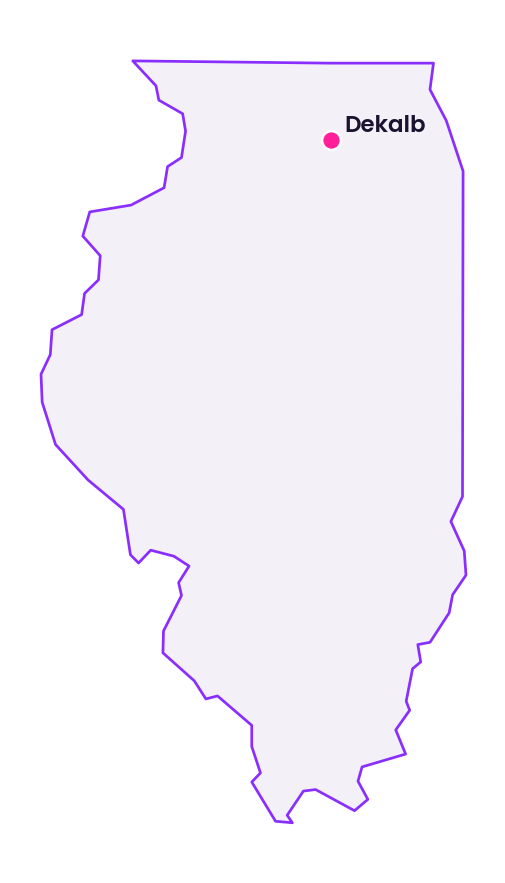
The starting point for geography is that DeKalb County is not a standalone micropolitan area; the Census Bureau classifies it as part of the Chicago metropolitan area, within the Elgin metropolitan division. That said, DeKalb functions as a distinct local market, and the relevant figures are the city and county. The City of DeKalb had an estimated 40,467 residents as of July 1, 2025, virtually unchanged from the 2020 census count of 40,290 and down roughly 8 percent from the 2010 census figure of 43,862. DeKalb County had an estimated 101,835 residents as of July 1, 2025, up about 1.4 percent from its 2020 count of 100,420 but still below its 2010 level of 105,160.
The migration detail matters because it reveals what little growth exists and where it comes from. In the year from 2023 to 2024, DeKalb County added about 674 residents, a gain of roughly 0.67 percent, driven almost entirely by international immigration of about 511 people and natural increase of about 196, while net domestic migration was slightly negative at about 41 people leaving for other U.S. counties. Over the full decade from 2014 to 2024, the county actually shrank about 3.1 percent. This sits within a broader Illinois story of population loss, as the state shed about 88,930 residents between 2020 and 2024, with recent stabilization owed largely to international arrivals. DeKalb was among the minority of Illinois counties to post a net gain over that window.
The single most important demographic variable for DeKalb real estate is university enrollment, not general population. Northern Illinois University enrolled 16,078 students in fall 2025, up 4.3 percent from 15,415 the prior fall, powered by a 22 percent jump in new freshmen to about 2,435. Roughly 4,500 students live on campus. This rebound is significant because enrollment had fallen roughly 30 percent from a peak near 25,300 in 2006 to a low around 15,400 in recent years, a decline that hollowed out student housing demand for more than a decade. The recent stabilization and uptick is the most encouraging signal for the city's multifamily market in years.
| Geography or metric | Value | Scope and period | Source |
|---|---|---|---|
| City of DeKalb population | 40,467 | July 1, 2025 estimate | U.S. Census Bureau |
| DeKalb County population | 101,835 | July 1, 2025 estimate | U.S. Census Bureau |
| County net change | 674 | 2023 to 2024 | U.S. Census Bureau |
| NIU enrollment | 16,078 | Fall 2025 | Northern Illinois University |
| NIU enrollment | 15,415 | Fall 2024 | Northern Illinois University |
Section 03Jobs and Economic Anchors
The DeKalb County labor market carries an unemployment rate that is both elevated and seasonally volatile, reflecting the university calendar and the area's manufacturing and logistics base. The county rate was about 5.2 percent in March 2026, and had run about 5.3 percent in December 2025 against 4.0 percent a year earlier, though it dipped as low as roughly 3.4 percent in spring 2025. No city only unemployment rate is published, so the county figure is the defensible proxy. Total county employment was about 29,129 across roughly 1,975 establishments in 2023, with total annual payroll near 1.505 billion dollars, according to Census County Business Patterns.
The employer base blends the university, healthcare, government, agriculture, and a rapidly expanding logistics cluster. Northern Illinois University is the largest single employer at about 3,072 workers, followed by a Target distribution center and Northwestern Medicine at roughly 1,600 each, the DeKalb school district at about 1,301, Amazon at about 1,000, and 3M at about 800, according to the DeKalb County Economic Development Corporation's 2026 employer list. The area's agricultural heritage is deep; DeKalb is the historic home of hybrid seed corn and the DeKalb Genetics brand, now part of Bayer, and the surrounding county remains prime Corn Belt farmland.
The transformative story is industrial and logistics investment along Interstate 88. Meta built a data center campus in DeKalb representing more than 1 billion dollars of investment across roughly 2.3 to 2.4 million square feet on a 505 acre site, employing more than 200 permanent workers with construction peaks around 1,200. Ferrara Candy opened a distribution and packaging complex of about 1.6 million square feet, roughly 100 million dollars of investment and about 500 jobs. Kraft Heinz committed more than 400 million dollars to a 775,000 square foot automated distribution center with more than 150 jobs. 3M operates roughly 1.6 million square feet across the Park 88 logistics development, and Amazon acquired land for a distribution facility of roughly 700,000 square feet projected at about 1,000 jobs, though its operational status has been reported as delayed and could not be confirmed as fully staffed. Cumulatively, local economic development officials place investment tracked in the county above 2.48 billion dollars.
| Employer | Approximate employment | Scope | Source |
|---|---|---|---|
| Northern Illinois University | 3,072 | DeKalb County, 2026 | DeKalb County EDC |
| Target distribution center | 1,600 | DeKalb County, 2026 | DeKalb County EDC |
| Northwestern Medicine | 1,600 | DeKalb County, 2026 | DeKalb County EDC |
| Amazon | 1,000 | DeKalb County, 2026 | DeKalb County EDC |
| 3M | 800 | DeKalb County, 2026 | DeKalb County EDC |
For an investor, the takeaway is that DeKalb's economy has diversified meaningfully beyond the university, and the logistics boom has created a durable base of blue collar employment that supports workforce rental demand independent of enrollment cycles.
Section 04Income
Income figures in DeKalb are dominated by a statistical artifact that an investor must understand: the large student population deeply depresses the city numbers, which do not reflect underlying household prosperity. The City of DeKalb had a median household income of about 46,481 dollars on the American Community Survey 2020 through 2024 five year basis, in 2024 dollars, while DeKalb County was far higher at about 70,724 dollars. Per capita income was about 27,086 dollars in the city and about 36,298 dollars in the county. The poverty rate was about 24.9 percent in the city against about 11.6 percent in the county, again a student population effect rather than a sign of countywide distress.
For context, U.S. median household income was about 81,604 dollars in 2024, Illinois about 83,211 dollars, and the broader Chicago metropolitan area about 90,770 dollars. The county median near 70,724 dollars sits below both the national and state figures, while the city figure runs at roughly 56 to 57 percent of the national level. The practical implication is that for any analysis of for sale housing or workforce rental demand, the county income figures are the more representative measure, while the city figures signal the depth of the student renter pool that drives small unit apartment demand near campus.
Section 05Housing and Multifamily
DeKalb County contained about 42,333 housing units as of July 1, 2025, and the City of DeKalb about 17,395 units on the American Community Survey five year basis, across roughly 16,388 city households. The defining structural fact is how renter heavy the city is: the owner occupancy rate in the City of DeKalb was only about 42.1 percent, far below the national rate near 65 percent, while DeKalb County was a more typical 61.4 percent. Roughly 49 percent of the city's housing stock sits in multi unit structures, again reflecting the student rental orientation. The median value of owner occupied homes was about 204,700 dollars in the city and about 243,600 dollars in the county on that five year basis.
On the apartment side, DeKalb is simply too small for the institutional data providers to publish market reports, so there is no public figure for professionally managed apartment inventory, effective rents, or property level occupancy specific to the city. This is an honest and important gap. An investor in DeKalb multifamily is operating in a market where the primary demand signal is university enrollment, the primary rent benchmark is the Census and Department of Housing and Urban Development data discussed below, and property level diligence must be done building by building rather than drawn from a metro report. The renter heavy composition and the enrollment rebound are the two structural facts that matter most.
Section 06Rents
Rent data for DeKalb comes from Census, the Department of Housing and Urban Development, and Zillow rather than institutional apartment surveys, and the figures are modest, consistent with a small Midwestern college town. The Census median gross rent was about 1,029 dollars in the City of DeKalb and about 1,049 dollars in the county on the American Community Survey 2020 through 2024 basis. The Department of Housing and Urban Development set the fiscal year 2026 Fair Market Rent for a two bedroom unit in DeKalb County at about 1,373 dollars, with a studio at about 947 dollars, a one bedroom at about 1,046 dollars, a three bedroom at about 1,825 dollars, and a four bedroom at about 2,203 dollars. Zillow reported an average DeKalb rent across all bedroom types near 1,250 dollars as of August 2026, up about 100 dollars year over year, with two bedroom units near 1,220 dollars.
| Rent measure | Value | Scope and period | Source |
|---|---|---|---|
| Median gross rent | $1,029 | City of DeKalb, ACS 2020 to 2024 | U.S. Census Bureau |
| Fair Market Rent, two bedroom | $1,373 | DeKalb County, FY2026 | HUD |
| Fair Market Rent, four bedroom | $2,203 | DeKalb County, FY2026 | HUD |
| Average rent, all types | $1,250 | City of DeKalb, August 2026 | Zillow |
The larger unit Fair Market Rents, particularly the three and four bedroom figures, are relevant because student rental economics in DeKalb often work on a per bedroom basis in shared houses and larger apartments near campus, where aggregate rent per unit can exceed the two bedroom benchmark. The modest year over year increase in the Zillow measure is consistent with the enrollment rebound beginning to firm rental demand after years of softness.
Section 07Vacancy
There is no official public rental vacancy rate specific to DeKalb apartments at the property level, and no public student housing occupancy figure for the university submarket, because that data sits behind subscription providers that do not meaningfully cover this market. The most defensible public anchors are the Census overall housing vacancy for the city, which ran near 6 percent on the American Community Survey basis, and the Illinois statewide rental vacancy rate, which was about 5.7 percent in 2025 after about 6.5 percent in 2024. An investor should treat these as broad context rather than a precise read on apartment occupancy near campus. The honest conclusion is that DeKalb apartment vacancy must be assessed through direct, property level diligence and through the enrollment trend, which is the true leading indicator of student housing occupancy, rather than through a published market vacancy series that does not exist.
Section 08Supply Pipeline
New residential construction in DeKalb is minimal, which is exactly what one would expect in a small, enrollment constrained market. DeKalb County authorized only about 264 building permits across all housing types in 2025 on the Census Building Permits Survey basis. No large publicly announced new multifamily or student housing construction project surfaced in the public record as of this writing, so on the residential side there is no meaningful supply pipeline to speak of. This matters for the investment thesis: with the enrollment trend turning up and essentially no new apartment supply being added, existing well located rental stock near the university faces limited new competition, which has generally been favorable for owners of stabilized assets.
The supply story that is genuinely dynamic is industrial, not residential. The Interstate 88 corridor has absorbed millions of square feet of new distribution and data center space over the past several years, as detailed in the commercial section below, and that pipeline continues to shape the local economy and land market even as residential construction stays quiet.
Section 09Single Family Homes
The for sale housing market in DeKalb is affordable by national standards and has been broadly stable, though the various data sources disagree on the exact price level and direction because of differing methodologies and sample windows, so each figure must be cited with its source. Redfin reported a City of DeKalb median sale price of about 248,372 dollars over the three months ending April 2026, down a marginal 0.65 percent year over year, at about 158 dollars per square foot with homes selling in roughly 46 days. Zillow's Home Value Index for DeKalb was higher at about 257,752 dollars, up about 5.5 percent year over year through the end of April 2026, with homes going to pending in roughly 11 days, a sign of tight supply at accessible price points.
| Measure | Value | Scope and period | Source |
|---|---|---|---|
| Median sale price | $248,372 | City of DeKalb, 3 months to April 2026 | Redfin |
| Home Value Index | $257,752 | City of DeKalb, through April 2026 | Zillow |
| Median listing price | $325,000 | DeKalb County, mid 2026 | Realtor.com |
| Metro median sale price | $407,000 | Chicago metro, June 2026 | Illinois REALTORS |
DeKalb County carried a higher median listing price near 325,000 dollars, but that is an asking figure rather than a closed sale price and includes higher end submarkets such as neighboring Sycamore. For broad regional context, Illinois REALTORS reported a Chicago metropolitan median sale price of about 407,000 dollars in June 2026, up about 4.6 percent year over year, with metro inventory down about 14.4 percent, illustrating the tight supply conditions across northern Illinois that keep affordable DeKalb homes moving quickly. On the single family rental angle, no institutional public data isolates DeKalb build to rent or single family rental performance, so the defensible read is that the broad Zillow rent measure near 1,250 dollars and the low homeownership rate together point to a deep rental demand pool, with single family rentals competing directly with apartments for both student groups and workforce households.
Section 10Commercial Real Estate and Retail Centers
The commercial picture in DeKalb is a study in contrasts between a booming industrial sector with strong regional data and office and retail sectors that have essentially no published local data. On industrial and logistics, DeKalb sits in the Interstate 88 west corridor of the Chicago industrial market, one of the largest in the country. CBRE reported Chicago metro industrial availability of about 8.6 percent in the second quarter of 2026, with net asking rents near 9.30 dollars per square foot, up about 7.4 percent year over year, and robust quarterly net absorption of about 6.1 million square feet. The Interstate 88 west submarket that contains DeKalb is tighter than the metro on vacancy; Cresa reported submarket inventory of about 78.9 million square feet with direct vacancy near 4.60 percent and asking rents near 8.46 dollars per square foot in early 2026, with more than 2.29 million square feet under construction. These corridor figures are the most defensible proxy for DeKalb industrial, since the large facilities built there by Meta, Ferrara, Kraft Heinz, 3M, and Amazon are precisely the kind of bulk distribution and data center product driving the submarket.
| Industrial measure | Value | Scope and period | Source |
|---|---|---|---|
| Availability | 8.6% | Chicago metro, Q2 2026 | CBRE |
| Net asking rent | $9.30 psf | Chicago metro, Q2 2026 | CBRE |
| Submarket direct vacancy | 4.60% | Interstate 88 west, Q1 2026 | Cresa |
| Submarket under construction | 2.29 million sf | Interstate 88 west, Q1 2026 | Cresa |
On office and retail, the honest answer is that no aggregate public vacancy, rent, or absorption statistic exists for DeKalb specifically, because the market is too small for institutional coverage. DeKalb has no tracked office submarket; available data is limited to individual small listings. The primary retail corridor is Sycamore Road, which a city planning document described as holding roughly 1.8 million square feet of retail, office, and hospitality space, though that figure comes from an older plan and there is no current published retail vacancy rate for the corridor. Grocery anchored and necessity retail in DeKalb serves a stable local and student population, but an investor must assess any specific center through direct diligence on its anchor, co tenancy, and trade area rather than through a market report. This data scarcity is itself an investment consideration: it raises diligence costs and reduces price transparency in a way that can create both risk and opportunity for a disciplined buyer.
Section 11Transactions and Capital Markets
DeKalb specific transaction and capitalization rate data is largely proprietary and not available in published form, so the defensible approach is to use the Chicago industrial market as context and to note individual DeKalb deals where public records exist. For the metro industrial market, Matthews reported first quarter 2026 investment volume of about 1.1 billion dollars at roughly 100 dollars per square foot and an average capitalization rate near 8.1 percent, while broker surveys place prime institutional bulk distribution capitalization rates considerably tighter in the 5.0 to 5.5 percent range, with the gap reflecting asset quality. That spread is instructive for DeKalb: the newest, credit tenant leased bulk facilities of the type built along Interstate 88 would trade at the tighter, institutional end, while older or multi tenant product would price at the higher blended market average.
At the individual asset level, public records show that a 3M distribution facility in DeKalb's Park 88 was acquired by an institutional real estate investment trust under a long term lease, and that Amazon paid about 6.3 million dollars for roughly 59 acres in 2021 for its planned facility. Beyond such disclosed transactions, DeKalb specific capitalization rates are not published, and an investor should expect to rely on broker opinions of value and metro comparables rather than a transparent local transaction record.
Section 12Taxes
Taxes are one of the most important and least favorable elements of the DeKalb investment case, because Illinois pairs a modest income tax with some of the highest property taxes in the nation. The state levies a flat individual income tax of 4.95 percent, a structure locked into the state constitution after voters rejected a graduated tax amendment in 2020. Far more consequential for real estate is the property tax. The Tax Foundation places the Illinois effective property tax rate on owner occupied housing at about 1.88 percent, among the highest of any state, and secondary aggregators place the DeKalb County effective rate higher still, in the range of roughly 2.22 to 2.44 percent of market value, with a median annual bill cited near 5,381 dollars. Those county figures come from third party aggregators rather than the county treasurer and should be treated as estimates, but the direction is unambiguous: property taxes in DeKalb are heavy, they apply to commercial and multifamily property at full assessed value, and they are the single largest recurring drag on net operating income for an owner.
Sales taxes are also elevated. The combined sales tax rate in the City of DeKalb is about 8.00 percent, built on the 6.25 percent state rate plus local and home rule additions, against an Illinois average combined rate near 8.96 percent. On transfers, Illinois imposes a state real estate transfer tax of about 0.50 dollars per 500 dollars of price, with counties adding about 0.25 dollars per 500 dollars, and home rule municipalities able to add their own. Some secondary sources reported an increase in the state rate effective in mid 2026, but that change could not be confirmed against a primary statutory source and should be independently verified before relying on it. The overall tax message for an investor is that DeKalb's affordability on a price basis is partly offset by a high carrying cost of ownership through property taxes, and underwriting must weight that expense heavily.
Section 13Insurance
Property insurance costs in Illinois have been rising sharply, driven by the severe thunderstorm, hail, and tornado exposure that characterizes the northern part of the state. Reporting on a LendingTree analysis found that Illinois home insurance rates rose about 50 percent over the three years from 2022 to 2025, the second largest increase in the country, with average annual premium estimates clustering in the range of roughly 2,400 to 3,000 dollars depending on methodology and coverage. No single clean figure from the Insurance Information Institute for an Illinois average homeowners premium was located, and the point estimates above come from insurance aggregators, so the Illinois Department of Insurance cost containment report is the most authoritative source for anyone needing official market data. For a multifamily or commercial owner in DeKalb, the practical implication is that insurance has become a materially larger and more volatile expense line, tied directly to the region's storm exposure, and it should be quoted specifically for each asset rather than assumed from a statewide average.
Section 14Landlord Tenant and Regulatory Environment
Illinois is generally more tenant protective than the Sun Belt states, and DeKalb layers a local ordinance on top of state law, so the regulatory environment requires attention. At the state level, rent control is prohibited: the Rent Control Preemption Act of 1997 bars Illinois local governments from enacting residential rent control, and that preemption remained in force as of this writing despite periodic repeal efforts. Security deposits are governed by the Security Deposit Return Act, which requires a landlord withholding any portion of a deposit to furnish an itemized statement of deductions within 30 days, and which as of January 1, 2024 applies to all residential landlords rather than only larger operators. The Security Deposit Interest Act requires landlords of buildings with 25 or more units to pay interest on deposits held more than six months. Evictions proceed under the state eviction act, which requires a 5 day written notice for nonpayment of rent and a 10 day notice for lease violations before a filing.
The distinctive local feature is the City of DeKalb's Crime Free Housing Program, updated by ordinance in 2022, which requires annual rental property registration, a crime free lease provision, and mandatory landlord training, with a minimum fine of 1,000 dollars per day for failing to include the required lease provision. The ordinance drew objections from Illinois REALTORS and fair housing advocacy groups, which is a compliance and reputational risk that a prospective landlord in DeKalb should understand and factor into operations. On balance, the regulatory environment is manageable but meaningfully more demanding than in landlord friendly states, and it adds administrative cost to owning rental property in the city.
Section 15Infrastructure
DeKalb's infrastructure profile is defined by its highway access and, notably, by what it lacks in passenger rail. Interstate 88, the tolled Ronald Reagan Memorial Tollway, runs east and west directly through DeKalb and is the artery that made the city's logistics boom possible, connecting it eastward to the Chicago metropolitan area and its interstate network and westward across northern Illinois. This highway access, combined with relatively inexpensive land, is the core reason national distributors chose DeKalb. Freight rail service is provided by Union Pacific.
The critical gap is commuter rail. DeKalb has no Metra commuter service to Chicago; the nearest Metra terminal is at Elburn, roughly 15 miles east, and a DeKalb extension exists only as a long range feasibility study by the city and university. For a market 65 miles from downtown Chicago, the absence of direct commuter rail is a genuine mobility limitation that distinguishes DeKalb from the Metra served exurbs closer to the city and constrains its appeal as a bedroom community. The DeKalb Taylor Municipal Airport serves general aviation only, with no scheduled commercial passenger service. The infrastructure picture, then, is excellent for goods movement and adequate for cars, but weak for transit dependent commuters, which reinforces DeKalb's identity as a self contained college and logistics town rather than a Chicago suburb.
Section 16Climate and Physical Risks
Northern Illinois carries a real severe weather risk profile centered on tornadoes, severe thunderstorms, hail, riverine flooding, and harsh winters. The tornado risk is not abstract. On April 9, 2015, an EF4 tornado with peak winds near 200 mph tracked across the region, destroying much of the small community of Fairdale in DeKalb County and killing two people, a vivid reminder of the area's exposure. Flooding risk in DeKalb centers on the South Branch of the Kishwaukee River, which runs through the city with a flood stage of 10 feet that has been exceeded numerous times, and federal and state agencies have been actively remapping the Kishwaukee watershed for updated flood risk. Northern Illinois is also subject to severe winter storms and periodic extreme cold from polar vortex events.
For an investor, these risks translate directly into the insurance cost pressures discussed above and into physical diligence obligations. Any specific asset should be checked against Federal Emergency Management Agency flood maps for its zone and elevation, particularly near the Kishwaukee River and its tributaries, and building resilience to wind and winter weather should factor into acquisition and capital planning. The physical risk here is meaningful but manageable, and it is the kind of exposure that is best addressed through specific underwriting rather than broad avoidance.
Section 17Neighborhoods and Submarkets
DeKalb divides into a few clear submarkets that call for different strategies. The area immediately around Northern Illinois University, including corridors such as Annie Glidden Road, is the student housing core, dominated by rental apartments and shared houses whose demand rises and falls with enrollment; the recent enrollment rebound is most directly felt here. The established residential neighborhoods away from campus, together with the higher priced adjacent community of Sycamore to the north, form the owner occupied and workforce housing submarket, where the county income figures and the tighter for sale conditions apply. The Interstate 88 corridor and the Park 88 and ChicagoWest Business Center industrial parks form the logistics submarket, which is where the region's capital investment and job growth have concentrated and where the land market is most dynamic. Finally, the Sycamore Road corridor is the primary retail spine serving the local and student population.
The investment implication is that these submarkets are only loosely correlated. A student housing asset near campus lives and dies by enrollment, a workforce rental farther out tracks the logistics job base, and an industrial asset tracks the national distribution and data center demand pulling product to the corridor. An investor should match strategy to submarket precisely, because a single citywide view would obscure very different risk and demand drivers.
Section 18Opportunities
The clearest opportunity in DeKalb is a convergence of turning enrollment and negligible new supply. Northern Illinois University enrollment rose 4.3 percent to 16,078 in fall 2025 after a decade of decline, and with only about 264 county building permits issued in 2025 and no announced apartment pipeline, existing well located rental stock near campus faces improving demand against essentially no new competition, a setup that has historically been favorable for owners of stabilized student oriented multifamily. The second opportunity is the logistics boom, which has created a durable workforce employment base through Meta, Ferrara, Kraft Heinz, 3M, and others, supporting workforce rental demand that is independent of the enrollment cycle and diversifying the local economy in a way that reduces its historic dependence on the university. For buyers comfortable with a small, low transparency market, the affordability of DeKalb real estate, with a city median sale price near 248,000 dollars and modest rents, offers accessible entry points, though the yields that can be achieved depend on asset specifics and are not assured. The observations in this section are general and educational, are not projections, forecasts, or assurances of any particular return, yield, occupancy, rent level, or appreciation, and any specific investment must be evaluated on its own facts.
Section 19Risks
The dominant risks are structural and hard to change. The very high Illinois property taxes, with a DeKalb County effective rate estimated above 2 percent of market value, are a heavy and persistent drag on net operating income and the single largest threat to returns. Population and demographic fragility is a real concern: DeKalb County shrank about 3.1 percent over the decade to 2024, Illinois has been losing residents, and the city's fortunes remain heavily tied to a university whose enrollment, while rebounding, sits far below its mid 2000s peak and could resume declining. Data scarcity itself is a risk, since the absence of published apartment, office, and retail market statistics raises diligence costs and reduces price transparency. Insurance costs are rising sharply on severe storm exposure, the 2015 EF4 tornado underscores genuine physical risk, and the local crime free housing ordinance adds compliance obligations and some legal controversy for landlords. Finally, the lack of Metra commuter rail limits DeKalb's ability to capture Chicago area spillover demand as a bedroom community. Real estate investments are speculative, are subject to market, financing, liquidity, tax, regulatory, insurance, and physical hazard risks, and can result in the loss of some or all of an investor's invested capital, including the possible loss of principal.
Section 20Investor Implications
For an accredited investor, DeKalb is a specialized, small market play that rewards local knowledge and careful asset selection over broad market exposure. The priorities that follow from the data are direct. First, underwrite property taxes aggressively, because an effective rate above 2 percent of value can overwhelm otherwise attractive going in yields, and appeal assessments where warranted. Second, treat university enrollment as the primary demand indicator for student oriented multifamily, taking note of the recent rebound while stress testing for the possibility of renewed decline. Third, recognize that the logistics boom has created a separate, more durable workforce rental demand stream tied to the distribution job base, and consider assets positioned to serve those workers. Fourth, accept that this market lacks the published apartment and commercial data of larger metros, and budget for building level diligence, direct rent surveys, and broker opinions of value rather than relying on market reports. Fifth, factor in the local crime free housing compliance burden and the rising insurance costs specific to northern Illinois. None of this constitutes a recommendation to pursue any specific strategy or investment; it is a framework for independent diligence against the sourced figures above, and there is no assurance that any objective or outcome described will be achieved.
Section 21Conclusion
DeKalb is a small market with an outsized industrial story layered on top of a traditional college town. Its multifamily demand rests on a university that has just begun to grow again after a long decline, its economy has been genuinely transformed by billions of dollars of logistics and data center investment along Interstate 88, and its for sale housing is affordable and moving quickly amid tight regional supply. Against those positives sit some of the highest property taxes in the country, a shrinking and aging state population base, rising insurance costs, real tornado and flood exposure, a local landlord compliance regime, and a striking scarcity of public market data that raises the cost of doing diligence. The investable question is whether an investor can acquire the right asset, in the right submarket, at a basis and yield that compensate for the high carrying costs and the concentration risk around a single university and a handful of large employers. The honest answer is that DeKalb rewards specialists who know the market at the property level and penalizes those who expect the data transparency of a larger metro, and the analysis here is meant to equip an investor to tell the difference against the sourced figures presented; no particular outcome or return is assured.
Sources
- U.S. Census Bureau, QuickFacts DeKalb city and DeKalb County, Illinois,, https://www.census.gov/quickfacts/fact/table/dekalbcityillinois,dekalbcountyillinois/PST045225
- U.S. Census Bureau, 2020 Illinois metropolitan and micropolitan reference map,, https://www2.census.gov/programs-surveys/metro-micro/reference-maps/2020/state-maps/17_Illinois_2020.pdf
- U.S. Census Bureau via Census Reporter, DeKalb, Illinois profile,, http://censusreporter.org/profiles/16000US1719161-dekalb-il/
- USAFacts, DeKalb County population change (citing Census),, https://usafacts.org/answers/is-the-population-growing-or-shrinking/county/dekalb-county-il/
- Illinois Policy, 2024 county population changes,, https://www.illinoispolicy.org/64-of-illinois-102-counties-see-populations-drop-in-2024/
- Northern Illinois University, Fall 2025 enrollment news,, https://newsroom.niu.edu/niu-enrollment-up-over-4-as-new-freshman-transfer-reenrollment-numbers-soar/
- Northern Illinois University, Fast Facts,, https://www.niu.edu/about/fast-facts.shtml
- Northern Illinois University, Strategic Enrollment Plan,, https://www.niu.edu/enrollment-plan/_pdf/strategic-enrollment-plan.pdf
- U.S. Bureau of Labor Statistics via FRED, DeKalb County unemployment (series ILDEKA5URN),, https://fred.stlouisfed.org/series/ILDEKA5URN
- Illinois Department of Employment Security, December 2025 county unemployment release,, https://www.illinois.gov/content/dam/soi/en/web/illinois/iisnewsattachments/32132-012926-1-chicago-december-2025-final.pdf.pdf
- DeKalb County Economic Development Corporation, Top 40 Employers list,, https://dcedc.org/wp-content/uploads/2026/04/Top40emp_20March2026.pdf
- State of Illinois, Meta DeKalb data center press release,, https://www.illinois.gov/news/press-release.28370.html
- Chicago Tribune, Meta DeKalb data center expansion,, https://www.chicagotribune.com/business/ct-biz-meta-facebook-data-center-dekalb-expansion-20220427-el3hsk6a6fbstjzyapyiuwsoam-story.html
- State of Illinois, Ferrara DeKalb distribution complex ribbon cutting,, https://www.illinois.gov/content/dam/soi/en/web/illinois/iisnewsattachments/23475-state-of-illinois-joins-ferrara-for-ribbon-cutting-on-companys-new-dekalb-distribution-complex.pdf
- Kraft Heinz, DeKalb automated distribution center press release,, https://news.kraftheinzcompany.com/press-releases-details/2023/Kraft-Heinz-Invests-400M-to-Build-One-of-the-Largest-Automated-CPG-Distribution-Centers-in-North-America/default.aspx
- REJournals, Griffin Capital acquisition of 3M DeKalb facility,, https://rejournals.com/griffin-capital-acquires-3m-distribution-facility-in-dekalb-illinois/
- Shaw Local, Amazon DeKalb land purchase records,, https://www.shawlocal.com/daily-chronicle/news/breaking/2021/12/14/amazon-paid-63m-for-nearly-59-acres-of-land-slated-for-project-barb-warehouse-in-dekalb-records/
- DeKalb County Economic Development Corporation, FY23 Annual Report,, https://www.cityofdekalb.com/DocumentCenter/View/17344/11-DCEDC-FY23-Annual-Rpt
- U.S. Census Bureau, Household Income in States and Metropolitan Areas 2024,, https://www2.census.gov/library/publications/2025/demo/acsbr-025.pdf
- HUD, FY2026 Fair Market Rents schedule,, https://www.huduser.gov/portal/datasets/fmr/fmr2026/FY2026_FMR_Schedule.pdf
- Zillow, DeKalb Illinois rental market trends,, https://www.zillow.com/rental-manager/market-trends/dekalb-il/
- U.S. Census Bureau via FRED, Illinois rental vacancy rate (series ILRVAC),, https://fred.stlouisfed.org/series/ILRVAC
- DeKalb County, building permit reports,, https://dekalbcounty.org/government/reports-of-county-officials/building-permits/
- Redfin, DeKalb Illinois housing market,, https://www.redfin.com/city/4949/IL/DeKalb/housing-market
- Zillow, DeKalb Illinois home values,, https://www.zillow.com/home-values/55433/dekalb-il/
- Realtor.com, DeKalb County market data,, https://www.realtor.com/local/market/illinois/dekalb-county
- Illinois REALTORS, Chicago metro local market update June 2026,, https://www.illinoisrealtors.org/wp-content/uploads/2026/07/Metro-June2026.pdf
- CBRE, Chicago Industrial Figures Q2 2026,, https://www.cbre.com/insights/figures/chicago-industrial-figures-q2-2026
- Cresa, Chicago Industrial Market Report Q1 2026,, https://www.cresa.com/-/media/Cresa/Files/PDF-Market-Reports/Chicago/2026/Cresa_Market-Reports_Q1-2026_Chicago-Industrial_01.pdf
- Cushman and Wakefield, Chicago Industrial MarketBeat Q4 2025,, https://assets.cushmanwakefield.com/-/media/cw/marketbeat-pdfs/2025/q4/us-reports/industrial/chicago_americas_marketbeat_industrial_q42025.pdf
- Matthews, Chicago Industrial Market Report Q1 2026,, https://www.matthews.com/insights/chicago-il-industrial-market-report-q1-2026
- City of DeKalb, Sycamore Road Retail Marketing and Development Plan,, https://www.cityofdekalb.com/DocumentCenter/Home/View/365
- Illinois Department of Revenue, income tax rates,, https://tax.illinois.gov/research/taxrates/income.html
- Tax Foundation, Illinois,, https://taxfoundation.org/location/illinois/
- City of DeKalb, Taxes and Fees,, https://www.cityofdekalb.com/271/Taxes-Fees
- WGLT, Illinois home insurance increase study,, https://www.wglt.org/illinois/2025-04-02/illinois-home-insurance-prices-jumped-50-in-three-years-second-highest-in-the-country-study-shows
- Illinois Department of Insurance, 2025 Cost Containment Annual Report,, https://idoi.illinois.gov/content/dam/soi/en/web/insurance/reports/reports/2025-cc-report.pdf
- Illinois General Assembly, Rent Control Preemption Act (50 ILCS 825),, https://www.tenantstogether.org/updates/secret-history-illinoiss-rent-control-prohibition
- Justia, Illinois Security Deposit Return Act (765 ILCS 710),, https://law.justia.com/codes/illinois/chapter-765/act-765-ilcs-710/
- City of DeKalb, Crime Free Housing Program,, https://www.cityofdekalb.com/329/Crime-Free-Housing
- City of DeKalb, Chapter 10 Landlord Tenant Regulations,, https://www.cityofdekalb.com/DocumentCenter/View/118/Chapter-10-Landlord-Tenant-Regulations-102422
- Illinois Tollway, Ronald Reagan Memorial Tollway (Interstate 88),, https://agency.illinoistollway.com/projects/reagan
- City of DeKalb, DeKalb Metra Extension Feasibility Study,, https://www.cityofdekalb.com/1458/DeKalb-Metra-Extension-Feasibility-Study
- City of DeKalb, DeKalb Taylor Municipal Airport,, https://www.cityofdekalb.com/1284/DeKalb-Taylor-Municipal-Airport
- Wikipedia, 2015 Rochelle Fairdale tornado (citing National Weather Service),, https://en.wikipedia.org/wiki/2015_Rochelle%E2%80%93Fairdale_tornado
- Illinois State Water Survey, Kishwaukee watershed flood mapping,, https://www.illinoisfloodmaps.org/ws-kishwaukee.aspx
- NOAA, South Branch Kishwaukee River at DeKalb gauge,, https://water.noaa.gov/gauges/deki2
- City of DeKalb, Flood Information,, https://www.cityofdekalb.com/1605/Flood-Information