In brief · summary: Delray Beach
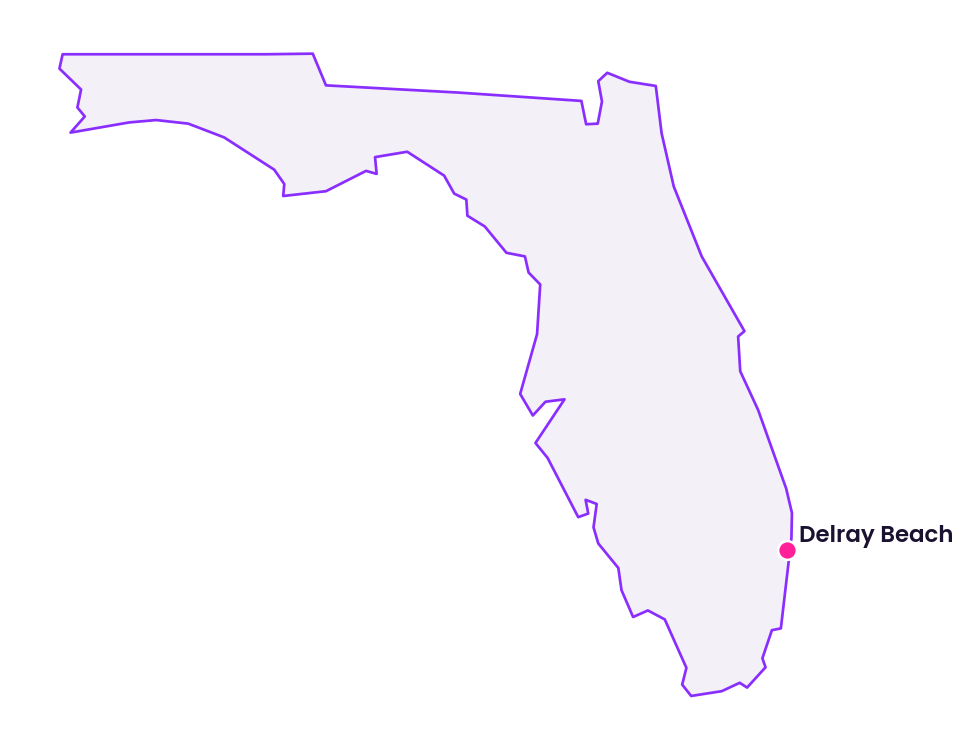
Delray Beach is a coastal city of about 70,140 residents in southern Palm Beach County, positioned between Boca Raton to the south and Boynton Beach to the north within the greater South Florida market. It is known for its walkable Atlantic Avenue downtown, its beaches, and a resident mix of professionals, retirees, and seasonal residents.
Palm Beach County holds roughly 1.58 million residents, and the county sits inside a broader South Florida rental market that is among the most supply constrained in the country over the long run, even as a near term construction wave works through. The West Palm Beach, Boca Raton, and Delray Beach metropolitan division, which covers Palm Beach County, posted an unemployment rate of about 4.4 percent in May 2026 on an unadjusted basis, a healthy labor market by national standards.
South Florida multifamily remains comparatively resilient while it digests new supply. Regional vacancy was about 6.4 percent in the second quarter of 2026 with average asking rent near 2,313 dollars per unit. Delray Beach's own for sale market firmed in mid 2026, with a Redfin median sale price near 544,674 dollars, up about 4.7 percent year over year, and average apartment asking rents near 2,430 dollars in mid 2026. The defining tensions are cost, insurance, …
Section 01Executive Summary
Delray Beach is a coastal city of about 70,140 residents in southern Palm Beach County, positioned between Boca Raton to the south and Boynton Beach to the north within the greater South Florida market. It is known for its walkable Atlantic Avenue downtown, its beaches, and a resident mix of professionals, retirees, and seasonal residents. Palm Beach County holds roughly 1.58 million residents, and the county sits inside a broader South Florida rental market that is among the most supply constrained in the country over the long run, even as a near term construction wave works through. The West Palm Beach, Boca Raton, and Delray Beach metropolitan division, which covers Palm Beach County, posted an unemployment rate of about 4.4 percent in May 2026 on an unadjusted basis, a healthy labor market by national standards.
South Florida multifamily remains comparatively resilient while it digests new supply. Regional vacancy was about 6.4 percent in the second quarter of 2026 with average asking rent near 2,313 dollars per unit. Delray Beach's own for sale market firmed in mid 2026, with a Redfin median sale price near 544,674 dollars, up about 4.7 percent year over year, and average apartment asking rents near 2,430 dollars in mid 2026. The defining tensions are cost, insurance, and supply timing. Palm Beach County average homeowners premiums including wind reached about 6,323 dollars in the July 2026 state reporting, among the higher tiers in Florida, and the county pipeline of about 4,576 units under construction in the first quarter of 2026 was the largest since 2023. The base case is a high cost, amenity rich coastal market where insurance discipline, submarket selection, and supply timing drive outcomes. This review is educational only and is not an offer of securities. See the Rule 506(c) disclosure below.
Section 02Economy
Delray Beach's economy is anchored by healthcare, education, local government, automotive retail, and a downtown hospitality and dining sector centered on Atlantic Avenue. Delray Medical Center, part of Tenet Healthcare's Palm Beach Health Network, is the city's largest single employer; it is a 536 bed acute care hospital serving southern Palm Beach County with more than 1,700 employees (Delray Medical Center; Tenet). The School District of Palm Beach County employs roughly 1,123 people within the city, and the City of Delray Beach itself employs about 838, making the public sector a major source of local jobs (City of Delray Beach Annual Comprehensive Financial Report, principal employers schedule). Other significant local employers historically include Pinecrest Rehabilitation Hospital, Meisner Electric, and several large automotive dealership groups along the Federal Highway and Linton Boulevard corridors.
Palm Beach County's economy more broadly leans on education and health services, professional and business services, leisure and hospitality, trade, and a growing wealth management and family office presence tied to sustained in migration of high income households. Delray Beach's particular strength is its downtown as a regional dining, nightlife, and cultural destination, which supports a durable leisure and hospitality base and draws both residents and visitors from across the metropolitan division of more than 1.5 million people that continues to attract domestic migration. The city's employment base is more service and healthcare oriented than the corporate and university heavy profile of neighboring Boca Raton.
Section 03Population and demographics
Delray Beach's population was about 70,140 as of July 1, 2024, up roughly 4.9 percent from the April 2020 base of 66,846 (Census Bureau QuickFacts). Palm Beach County was reported near 1,582,055 over the same period, up about 6.0 percent from 2020 (Census Bureau QuickFacts), one of the faster growing large counties in the state. The wider South Florida region, spanning Miami Dade, Broward, and Palm Beach counties, exceeds six million residents and remains a top destination for domestic and international migration.
Delray Beach's demographics reflect an established, relatively affluent coastal community with an older age profile, a median age near 51 years. The city's median household income was about 79,393 dollars in the 2019 through 2023 American Community Survey five year estimate, above the statewide figure, with per capita income near 56,068 dollars and a poverty rate near 12.6 percent (Census Bureau QuickFacts). That mix supports a broad rental pool spanning downtown professionals, service workers, retirees, and seasonal residents. Palm Beach County growth increasingly translates into redevelopment and densification along established corridors rather than pure greenfield sprawl, since desirable coastal land is limited. For Delray Beach specifically, its beaches, downtown, and reputation for walkability and quality of life make it attractive to both renters and owner occupants seeking a South Florida coastal address at a somewhat lower entry point than Boca Raton or Palm Beach.
Section 04Employment
The West Palm Beach, Boca Raton, and Delray Beach metropolitan division, which covers Palm Beach County, posted an unemployment rate of about 4.4 percent in May 2026 on an unadjusted basis, with a labor force near 774,583 and about 34,403 unemployed (Bureau of Labor Statistics, West Palm Beach metropolitan division Economy at a Glance). That is a healthy labor market supported by education, healthcare, professional services, and hospitality. A steady labor market underpins rental demand and rent stability, although the region's high cost of living, driven in large part by housing and insurance, remains a constraint on real wage growth and on lower income household formation. Delray Beach's tilt toward healthcare, government, and leisure and hospitality gives it a somewhat more service dependent employment profile than the corporate heavy submarkets elsewhere in Palm Beach County, which can make local demand more sensitive to tourism and seasonal patterns.
Section 05Apartment rents, vacancy, and supply
City level multifamily performance data specific to Delray Beach is limited in publicly available institutional reporting, so the most defensible reads combine Delray specific listing surveys with South Florida and Palm Beach County multifamily indicators, which are labeled by scope below. South Florida's apartment market remains comparatively resilient even as a construction wave is absorbed, and Palm Beach County participates fully in that dynamic. Regional (South Florida, three county) multifamily vacancy was about 6.4 percent in the second quarter of 2026, down from about 6.6 percent in the prior quarter, with average asking rent near 2,313 dollars per unit and rents rising modestly year over year (Lee and Associates, South Florida Q2 2026). Palm Beach County stabilized occupancy was reported near 93.6 percent in early 2026 (Cushman and Wakefield, Palm Beach multifamily reporting).
At the Delray Beach city level, listing survey data showed average apartment asking rent near 2,430 dollars per month in mid 2026, up about 0.5 percent year over year, with two bedroom asking rents near 2,975 dollars (Apartments.com, Delray Beach rent data). The 2019 through 2023 American Community Survey put the city's median gross rent, which blends older and rent controlled equivalent stock with newer product, near 1,914 dollars per month (Census Bureau, American Community Survey), well below asking rents for newer institutional communities, a reminder that citywide medians and current asking rents measure different things.
Supply is the key near term variable, and it is best measured at the county and regional scope. Palm Beach County had about 4,576 units under construction in the first quarter of 2026, the largest pipeline since 2023, with the county inventory near 67,372 units (Cushman and Wakefield). Across South Florida, about 49,569 units were under construction in the second quarter of 2026, down from about 52,292 in the prior quarter, indicating the pipeline is beginning to taper (Lee and Associates). The near term implication is that concentrated deliveries in specific submarkets can pressure occupancy and concessions, even as the longer run land constraint and cost to build keep the region structurally tighter than inland Sun Belt metros. Investors should verify the specific delivery schedule in each trade area, since Delray Beach has seen a cluster of newer downtown and corridor lease up projects, and a handful of large communities can weigh on a small submarket for several quarters.
Within Delray Beach, the market can be read as several broad belts. The barrier island and beachfront areas east of the Intracoastal command the highest values and rents and carry the greatest coastal risk. The downtown around Atlantic Avenue offers walkable, amenity rich rental demand and the most active redevelopment. The corridors along Federal Highway, Congress Avenue, and Linton Boulevard provide a mix of workforce rental demand, retail, and older garden stock, while the west Delray communities, including large age restricted developments, offer more single family and townhome product. The reason South Florida holds comparatively firm occupancy over time is structural rather than cyclical: desirable coastal land is limited, entitlement is slow, and construction and insurance costs make new projects expensive to deliver, so competitive supply arrives slowly outside of concentrated waves. The trade off is that the same forces that protect owners over the long run also raise the entry price and make insurance and physical risk the dominant swing factors in returns.
Section 06Transactions and capital markets
South Florida capital markets remain active but repriced for a higher cost of capital, and the most defensible transaction benchmarks are at the regional scope. The regional (South Florida) multifamily average cap rate was about 6.38 percent in the second quarter of 2026, up from about 6.31 percent in the prior quarter and about 6.05 percent a year earlier, while average pricing rose to about 327,520 dollars per unit from about 274,885 dollars a year earlier (Lee and Associates, South Florida Q2 2026). City level Delray Beach multifamily trade data is not consistently published in institutional reporting, so investors should treat the regional figures as directional and confirm asset level comparables through brokerage and county records. In general, South Florida attracts deep domestic and international buyer interest, its long run scarcity supports pricing above most Sun Belt markets, and the same insurance and interest cost pressures that affect operations also shape underwriting. Buyers of coastal Palm Beach assets should weight insurance, flood positioning, and near term supply heavily in valuation.
Section 07Insurance, taxes, and climate risk
Insurance is among the most important cost variables in coastal Palm Beach County. Average homeowners premiums including wind reached about 6,323 dollars in the July 2026 property insurance reporting summarizing state data, with premiums excluding wind near 3,175 dollars, while average condominium unit owner premiums including wind were near 2,311 dollars (Florida Office of Insurance Regulation, July 2026 report). Statewide, the July 2026 report showed premiums stabilizing and carrier health improving after litigation reforms, but coastal South Florida, including Palm Beach County, remains among the higher cost tiers, and commercial multifamily owners must separately underwrite property, wind, flood, and business interruption coverage with often large deductibles.
On taxes, Florida's environment is favorable and continues to support in migration and investor interest, with no state tax on individual income, a 6 percent state sales tax, and a documentary stamp tax on deeds (Florida Department of Revenue). Palm Beach County adopted a countywide operating millage of 4.5000 mills for the fiscal year running October 2025 through September 2026, or 4.50 dollars per 1,000 dollars of taxable value, with a small countywide voted debt levy of about 0.0330 mill and an aggregate county rate near 6.2862 mills including dependent districts (Palm Beach County Office of Financial Management and Budget). That county figure represents only part of a typical total bill once municipal Delray Beach, school, and special district levies are added. Homestead protections including Save Our Homes benefit owner occupants but not conventional investment apartments. Investors should pull the exact taxing authorities and history from the Palm Beach County Property Appraiser and underwrite taxes at the reassessed value expected after purchase.
Climate risk is central to any coastal Delray Beach investment. As a low lying Atlantic coastal city, Delray Beach faces hurricane wind, storm surge, tidal and rainfall flooding, and long term sea level rise, with the barrier island and low elevation inland areas most exposed. The Palm Beach County local mitigation strategy identifies coastal communities including Delray Beach as carrying the highest overall hurricane risk in the county owing to wind, storm surge, and storm tide exposure. FEMA flood maps that took effect in December 2024 raised base flood elevations by at least one foot for more than 16,000 county parcels (Palm Beach County Planning, Zoning and Building). The elevated insurance premiums are themselves the market's clearest signal of this risk. Parcel level FEMA flood zone, elevation, drainage, and prior claims history should drive acquisition decisions far more than any citywide average, and beachfront or ground floor units warrant conservative insurance and reserve assumptions.
Section 08For sale housing
Delray Beach's for sale market firmed in mid 2026 after moderating from its peak. Redfin reported a median sale price near 544,674 dollars for the three months ending May 2026, up about 4.7 percent year over year, with median price per square foot near 367 dollars, up about 1.9 percent (Redfin, Delray Beach housing market). Zillow reported a lower typical home value near 340,609 dollars across all property types, and the gap between the two measures reflects different methodologies and property mixes, in particular Zillow's inclusion of a large volume of lower priced condominium and age restricted stock, rather than a contradiction. The 2019 through 2023 American Community Survey put the median value of owner occupied units near 386,700 dollars (Census Bureau QuickFacts), an older, lower figure that predates the most recent price gains. Luxury single family and Intracoastal waterfront segments run substantially higher. Coastal condominium values remain elevated but face pressure from rising insurance, assessments, and new structural inspection and reserve requirements affecting older buildings across South Florida.
Section 09Investor implications
Delray Beach offers a walkable, amenity rich coastal downtown, a healthcare, government, and hospitality driven employment base, resilient regional rents, and a lower entry point than neighboring Boca Raton and Palm Beach, balanced against high insurance costs, meaningful physical risk, and a near term county supply wave that warrants careful submarket timing. Historically, well located stabilized rental housing near the downtown and along the workforce corridors, better elevated west Delray assets with strong flood positioning, and newer institutional communities have presented different defensive characteristics. This is educational commentary, not a recommendation to buy any specific asset or market. Barrier island and beachfront assets carry the highest values but demand the most conservative insurance, reserve, and elevation assumptions. Investors should stress test insurance renewals aggressively, since premium increases can materially compress net operating income, should map the specific delivery schedule in each trade area given the current county pipeline, and should scrutinize condominium structural and reserve obligations. The city's downtown vitality and coastal desirability are its greatest strengths, supporting durable demand over time, while its service oriented economy makes local demand somewhat more sensitive to tourism and seasonality.
Section 10Outlook
The base case is a high cost, amenity driven coastal market working through a near term county supply wave rather than a distressed one. Palm Beach County's deep in migration, healthy labor market, and Delray Beach's downtown appeal support continued demand and firm rents in the better submarkets, while the tapering construction pipeline suggests supply pressure should ease over the next several quarters. The principal risks are insurance affordability and availability, which remain a swing variable for returns, near term oversupply in specific submarkets during the current delivery cycle, and physical climate exposure, which will only grow in importance over the investment horizon. A severe hurricane season could sharply affect both insurance and physical outcomes. Net, Delray Beach reads as a resilient, coastal lifestyle driven market best suited to investors who underwrite insurance and flood risk conservatively, time acquisitions against the county supply schedule, and value durable coastal and downtown demand.
Sources
- U.S. Census Bureau, Delray Beach city QuickFacts, https://www.census.gov/quickfacts/fact/table/delraybeachcityflorida/INC910222
- U.S. Census Bureau, Palm Beach County QuickFacts, https://www.census.gov/quickfacts/palmbeachcountyflorida
- Bureau of Labor Statistics, West Palm Beach metropolitan division Economy at a Glance, https://www.bls.gov/eag/eag.fl_westpalmbeach_md.htm
- Lee and Associates, South Florida multifamily Q2 2026 report, https://www.lee-associates.com/southflorida/wp-content/uploads/sites/62/2026/07/2026.Q2-South-Florida-Multifamily.pdf
- Lee and Associates, South Florida Q2 2026 summary, https://www.lee-associates.com/southflorida/2026/07/29/lee-associates-south-florida-q2-report-office-and-retail-markets-gain-momentum-while-multifamily-remains-resilient/
- Cushman and Wakefield, Palm Beach multifamily market summary Q1 2026, https://www.rentwithcosign.com/reports/palm-beach-fl-multifamily-market-report-cushman-wakefield-q1-2026
- Apartments.com, Delray Beach rent data and local guide, https://www.apartments.com/local-guide/delray-beach-fl/
- Florida Office of Insurance Regulation, Property Insurance Stability Report (July 2026), https://floir.gov/docs-sf/default-source/property-and-casualty/stability-unit-reports/july-2026-isu-report.pdf
- Palm Beach County Office of Financial Management and Budget, FY2026 Budget Fact Sheet, https://discover.pbcgov.org/ofmb/budget/PDF/2026/FY_2026_Budget_Fact_Sheet.pdf
- Palm Beach County Planning, Zoning and Building, flood zone update, https://discover.pbc.gov/pzb/Pages/Update-on-Flood-Zones.aspx
- Palm Beach County Emergency Management, 2024 Local Mitigation Strategy hazard identification, https://discover.pbc.gov/oem/PDF/2024/2024%20PBC%20LMS%20-%20Section%202%20Hazard%20ID%20and%20VA.pdf
- City of Delray Beach, Florida, Annual Comprehensive Financial Report (principal employers schedule), https://flauditor.gov/pages/mun_efile%20rpts/2020%20delray%20beach.pdf
- Delray Medical Center (Tenet, Palm Beach Health Network), https://www.delraymedicalctr.com/
- Redfin, Delray Beach housing market, https://www.redfin.com/city/4456/FL/Delray-Beach/housing-market
- Zillow, Delray Beach home values, https://www.zillow.com/home-values/31209/delray-beach-fl/
- Florida Department of Revenue, sales and property tax, https://floridarevenue.com/taxes/taxesfees/Pages/sales_tax.aspx