In brief · summary: Freeport
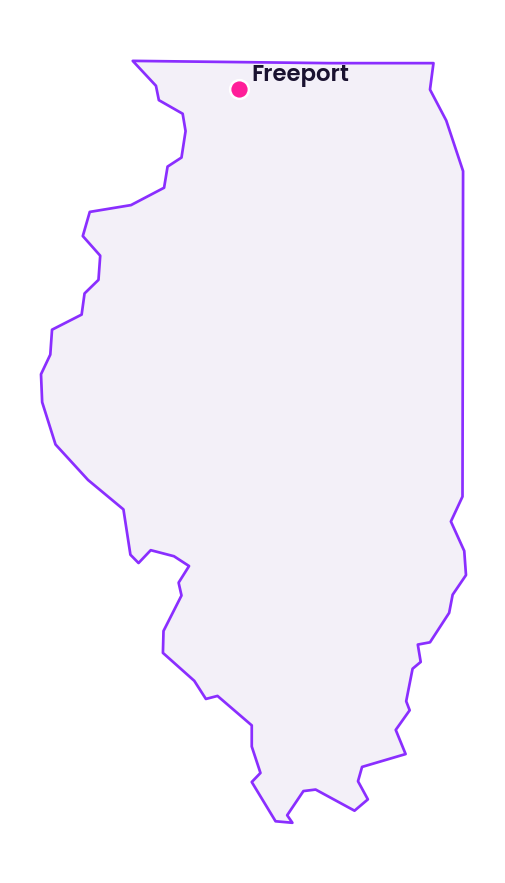
Freeport is a small independent city in north west Illinois that serves as the county seat of Stephenson County. It sits between the larger employment centers of Rockford and the Madison and Chicago regions, with an economic profile that has long been shaped by manufacturing, agriculture, transportation, and health care. Public information from the United States Census Bureau, the American Community Survey, and state and local sources shows a long term pattern of slow or negative population growth, an aging housing stock, and incomes that trail both the Illinois and national averages.
This creates a real estate market that is very different from high growth Sun Belt metros. It is a value oriented environment where entry prices and rents are low in national terms, supply growth is limited, and liquidity is thin. Multifamily and apartment assets in Freeport are centered on small garden style properties and scattered small buildings.
There is very little large institutional scale stock. Federal housing data, including Department of Housing and Urban Development Fair Market Rents for Stephenson County, indicate rent levels that are well below national medians. This is consistent with a workforce housing story rather than a luxury or high growth story. Vacancy in stabilized properties can be manageable but depends heavily on micro …
Section 01Executive Summary
Freeport is a small independent city in north west Illinois that serves as the county seat of Stephenson County. It sits between the larger employment centers of Rockford and the Madison and Chicago regions, with an economic profile that has long been shaped by manufacturing, agriculture, transportation, and health care. Public information from the United States Census Bureau, the American Community Survey, and state and local sources shows a long term pattern of slow or negative population growth, an aging housing stock, and incomes that trail both the Illinois and national averages. This creates a real estate market that is very different from high growth Sun Belt metros. It is a value oriented environment where entry prices and rents are low in national terms, supply growth is limited, and liquidity is thin.
Multifamily and apartment assets in Freeport are centered on small garden style properties and scattered small buildings. There is very little large institutional scale stock. Federal housing data, including Department of Housing and Urban Development Fair Market Rents for Stephenson County, indicate rent levels that are well below national medians. This is consistent with a workforce housing story rather than a luxury or high growth story. Vacancy in stabilized properties can be manageable but depends heavily on micro location and property condition. The limited level of new multifamily construction in local permit records suggests that the supply pipeline is constrained. This creates an environment where well located and well managed existing assets may have scope for modest rent increases without direct competition from new product, but where exit options are narrow and outcomes are property specific.
Single family housing in Freeport is dominated by older detached homes on small lots. Public valuation and listing platforms such as Zillow and Redfin consistently place typical home values in Stephenson County far below state and national norms, and transaction prices visible on these platforms show frequent sales at price points that are accessible to many local wage earners and small investors. This has allowed a modest but visible single family rental segment to develop, where investors acquire older homes at low basis and target cash flow positive operations. The tradeoff is that the housing stock often requires significant capital expenditure for modernization, and tenant incomes are sensitive to local employment shocks.
Commercial real estate in Freeport reflects the size of the local economy. The city has a traditional downtown core with mixed retail and office uses, a set of small neighborhood and community shopping centers that often include grocery anchors or discount retailers, and several industrial and warehouse areas with rail and truck access. Publicly accessible market reports and listings from regional brokerages, as well as research summaries from national providers such as CoStar, suggest that industrial space in Stephenson County tends to be relatively well occupied, while older office space and some retail corridors face higher vacancy and pressure from e commerce and consolidation of medical and professional services into larger regional hubs.
For investors, Freeport is generally characterized as an income oriented, capital preservation focused market rather than a growth driven one, subject to individual deal performance and risk. The main opportunities discussed in public commentary lie in acquiring existing multifamily and single family assets at low basis, improving operations and physical condition, and holding for cash flow while managing capex and tenant risk. Commercial opportunities exist in industrial and in necessity retail centers where tenant demand is supported by local consumption. The main risks are economic concentration in a modest job base, demographic headwinds, liquidity risk in a small market, and exposure to physical risks such as river flooding in specific locations. The remainder of this review develops these themes in more detail, using only named public data sources and clearly flagging points where city level quantitative figures are not available through public channels.
Section 02Population and Migration
Population trends in Freeport set the context for all real estate asset classes. According to the United States Census Bureau decennial census, the population of Freeport has declined across recent census counts, while Stephenson County as a whole has also experienced a gradual reduction in residents. The American Community Survey, which provides annual sample based estimates, shows that the city and county have both trailed the national growth rate for population over multiple census cycles. The scope for these observations is the city of Freeport and Stephenson County over the period from the two thousand Census through the two thousand ten and two thousand twenty Censuses and the subsequent American Community Survey releases.
The core pattern is outward migration of younger working age residents and limited net in migration. Census and American Community Survey age distribution data show higher shares of residents in older age cohorts and lower shares in younger adult cohorts compared with the national profile. This is typical of many smaller industrial cities in the Midwest. Younger residents often leave for education and employment opportunities in larger metros, while older residents age in place. This shift affects household formation, demand for rental versus ownership housing, and demand for different unit sizes.
International migration is modest. Census Bureau estimates for Stephenson County show only a small foreign born population relative to both Illinois and the United States. Natural population change, that is births minus deaths, has narrowed, and in some recent years deaths have exceeded births at the county level. The result is that the only way to stabilize or grow the population over time is through net in migration, which has been limited.
Within the city, population density is highest in the older central neighborhoods and lowest in the fringe areas and rural townships surrounding Freeport. Local planning documents from the City of Freeport and Stephenson County indicate that some outlying areas have seen minor residential subdivision activity, but the overall new household creation pace remains low compared with metropolitan regions. For investors, this means that aggregate demand growth for space is limited. Instead, performance depends on capture of existing demand, relative competitiveness of individual properties, and micro level shifts between neighborhoods rather than on citywide growth.
Section 03Jobs and Economic Anchors
Employment and economic structure underpin the sustainability of tenant demand and the ability of renters and buyers to pay. The Bureau of Labor Statistics Local Area Unemployment Statistics series for Stephenson County shows that the county unemployment rate has frequently been higher than the national average across the business cycle, including during the recovery from the global financial crisis and the pandemic. However, like many areas, it improved significantly from the peak unemployment levels seen during the two thousand eight recession and the two thousand twenty pandemic shock. The time scope for these series is monthly and annual data from the early two thousands onward, at the county level, which is the closest public proxy for the city.
Industry level employment from the Bureau of Labor Statistics Quarterly Census of Employment and Wages for Stephenson County shows that manufacturing, health care and social assistance, retail trade, educational services, and public administration are key employment sectors. Manufacturing employment has declined in many Midwestern counties over the past two decades, and Stephenson County has followed that pattern, though off a relatively high base. At the same time, health care and social assistance employment has grown in most regions, and county data indicate that this sector plays an increasing role. County and city planning reports highlight local hospitals and health systems, the school district, the county government, and several mid sized manufacturers and food processing firms as major employers, though precise employment counts for individual firms are not always publicly reported.
Average weekly wages reported in the Quarterly Census of Employment and Wages for Stephenson County are below both the Illinois statewide average and the national average across many major industry groups. This is consistent with the broader income profile discussed in the next section. It suggests that tenants and homebuyers in Freeport have relatively limited capacity to absorb sharp increases in rent or housing costs. Investors who overestimate local wage levels and model aggressive rent growth can face elevated economic vacancy as tenants double up or move to lower cost options.
Commuting patterns also matter. Census Bureau LEHD Origin Destination Employment Statistics indicate that a portion of Stephenson County residents commute to jobs in nearby counties, including Winnebago County where Rockford is located, and to smaller towns. Likewise, some workers commute into Freeport from rural townships. The city therefore functions as a modest regional hub but not as a dominant employment center. Transportation infrastructure, particularly U S Route twenty and state routes, as well as freight rail lines, support this role.
Section 04Income
Household and per capita income levels feed directly into achievable rents, achievable prices, and payment risk. The American Community Survey reports median household income, per capita income, and poverty rates for the city of Freeport and for Stephenson County. These data show that median household income in Freeport is materially below the Illinois median and below the national median. The county median is somewhat higher than the city but still below state and national medians. The scope for these figures is the most recent five year American Community Survey estimates available as of the mid twenty twenties for Freeport city, Stephenson County, Illinois, and the United States.
Poverty rates in Freeport are elevated compared with state and national levels according to the American Community Survey. This is common in older industrial cities where economic restructuring has reduced higher wage blue collar jobs and where educational attainment levels lag the national average. Elevated poverty and lower incomes imply that a significant share of households are cost burdened, spending more than thirty percent of income on housing, even in a low rent market, following the definition used in federal housing analyses. This is particularly relevant for small multifamily and single family rentals, where tenant screening and ongoing collections management are essential.
The distribution of income is also important. American Community Survey data show a large share of households in lower income bands and relatively few in high income bands. There is a modest middle income segment composed of long term homeowners and stable renters who work in health care, education, public sector roles, and remaining manufacturing positions. For multifamily investors targeting workforce housing, this middle band is the main target segment. For higher price point single family rentals or newer Class A style apartments, the potential tenant pool is limited, which caps achievable rents and occupancy.
Income trends over time show minimal real income growth when adjusted for inflation. Bureau of Economic Analysis personal income data at the county level support this picture. Nominal incomes may have risen, but after accounting for price level changes, real purchasing power gains have been modest. The implication is that rents and home prices that grow faster than local incomes will quickly become unaffordable, limiting sustainable growth.
Section 05Housing and Multifamily
The housing stock in Freeport consists primarily of older single family homes, small multifamily buildings, and a limited number of larger garden style apartment complexes. United States Census Bureau housing data and American Community Survey estimates show a high share of housing units built before nineteen eighty, with a significant subset built before nineteen forty. Newer construction exists but comprises a relatively small portion of the stock. The scope of these observations is the housing unit age and structure type distribution for Freeport city and Stephenson County in the latest available American Community Survey five year estimates.
Structure type data show that single family detached homes dominate, followed by a mix of small multifamily buildings with two to four units, and then larger buildings with five or more units. There are few high rise buildings. This shapes the multifamily opportunity set. Investors will typically find small complexes and scattered small buildings rather than large institutional scale assets.
Tenure data indicate that both owner occupied and renter occupied housing are significant in Freeport and Stephenson County, with meaningful variation by neighborhood. Central neighborhoods and some older areas closer to employment centers have higher shares of rental units, while outlying and newer subdivisions have higher owner occupancy. Vacancy rates in the housing stock overall can be higher than in stronger growth markets, a reflection of both structural surplus housing and economic conditions.
For multifamily specifically, public data from the Census Bureau and from Department of Housing and Urban Development assisted housing inventories show that a portion of the apartment stock participates in federal or state assisted housing programs, including housing choice vouchers and project based assistance. There are also small publicly supported senior housing properties. These programs stabilize some demand and can be relevant for investors who operate within compliance requirements.
A key feature of the multifamily landscape is that units are often physically large by national standards, with many two and three bedroom layouts, but finishes and building systems may be dated. This creates scope for value add strategies that focus on interior modernization, energy efficiency upgrades, and modest amenity enhancements, provided that rent increases remain aligned with local income levels.
Section 06Rents
Rents in Freeport are low relative to national benchmarks. Department of Housing and Urban Development Fair Market Rents for Stephenson County, which cover the Freeport market, provide a consistent federal measure of modest but decent housing costs by bedroom size. The Fair Market Rent schedule, updated annually, shows values for efficiency through four bedroom units that fall well below national Fair Market Rents and below values for metropolitan Illinois counties such as Cook and DuPage. The scope here is the most recent Fair Market Rent schedule available in the mid twenty twenties for Stephenson County.
These Fair Market Rent values serve as reference points for federal housing programs, but they also roughly approximate asking rents for modest market rate units in many small markets. Local listings data visible on platforms such as Zillow, Apartments dot com, and local property management sites show asking rents for one and two bedroom apartments that align broadly with, and often fall below, these Fair Market Rent benchmarks. Larger three bedroom units and single family rentals command higher nominal rents but still appear affordable relative to metropolitan Illinois standards.
Given the absence of a comprehensive public series for market rate rent trends in Freeport city, it is not possible to present a reliable year by year rent growth table from a single public source. Subscription data providers such as CoStar, Yardi Matrix, and RealPage track rent series for many markets, but their detailed figures are not public. Public information and anecdotal evidence from listings and local brokerage commentary suggest that rents have grown modestly over the past decade, with periods of flat rents during economic downturns and modest increases in recent years as inflation and housing costs rose nationally.
Rent levels in smaller multifamily buildings and older complexes vary significantly by property quality. Well maintained properties with updated interiors and professional management can achieve meaningfully higher rents than poorly maintained stock, even within the same submarket. This segmentation is an important operational lever for investors who can control both physical and management quality.
Section 07Vacancy
Reliable quantitative vacancy statistics at the city level for Freeport multifamily and commercial assets are limited in the public domain. The United States Census Bureau reports housing vacancy rates for owner and renter units in its Housing Vacancies and Homeownership series and through the American Community Survey, but these are typically available at state and national scale, and only limited data exist at the county or city scale. For Stephenson County, American Community Survey estimates indicate an overall housing vacancy rate that is elevated relative to high demand national markets, reflecting both economic conditions and an aging housing stock.
Within the rental segment, local property managers and brokerage commentary often describe a bifurcated market. Well located, well maintained workforce housing properties in stable neighborhoods see relatively steady occupancy, while marginal assets in weaker locations can experience prolonged vacancy. Publicly accessible listings show that some apartment units and single family rentals remain on the market for extended periods, particularly at higher rent levels or where property condition is visibly dated.
For commercial property, public data from sources such as the United States Postal Service business vacancy files and county level employment and establishment counts can give indirect indications of space usage, but they do not translate cleanly into market vacancy rates. Regional brokerage research and summary statistics from CoStar and similar platforms, where they are occasionally shared in public reports, suggest that industrial vacancy in Stephenson County has generally been lower than office vacancy, with retail vacancy in an intermediate range. However, specific quantitative vacancy percentages for Freeport city by asset class are not publicly and consistently reported.
In the absence of precise public figures, investors must rely on property level and micro market observations, including leasing histories, current rent rolls, and competitive set analysis, to assess effective vacancy risk. This is more labor intensive than in large metros with abundant third party data, but it is essential in a small market context.
Section 08Supply Pipeline
Understanding the supply pipeline is critical in any market, especially one with limited demand growth. For Freeport, public construction and permitting data from the City of Freeport building department and from state and federal statistics indicate very modest levels of new residential and commercial construction activity in recent years. At the county level, Census Bureau Building Permits Survey data for Stephenson County show relatively low counts of authorized housing units per year compared with both national averages and high growth counties within Illinois. The scope here is annual authorized housing units for Stephenson County over roughly the past decade.
Most of the limited new residential permitting has occurred in single family or small multi unit projects, rather than in large scale apartment complexes. There is little evidence in public planning and permitting portals of any significant multifamily development pipeline for Freeport that would materially add to the city apartment inventory. Where multifamily projects do appear, they are often small in scale, sometimes associated with senior housing or publicly supported developments.
On the commercial side, local news reports and city council agendas sometimes note individual projects, such as new retail pads, small industrial buildings, or public facility upgrades. These projects can matter in specific micro markets but do not change the overall citywide supply picture. There is no indication in public data of a wave of speculative office, industrial, or retail construction.
For investors, this constrained pipeline can be positive for existing owners, as it reduces the risk of sudden oversupply. However, it also means that it can be difficult to scale quickly or to assemble a portfolio of newer assets. Value add and adaptive reuse strategies, particularly in older commercial and mixed use buildings, are more realistic than large new ground up developments for most private investors.
Section 09Single Family Homes
Single family homes are the dominant housing form in Freeport and Stephenson County. Public data from the United States Census Bureau and the American Community Survey confirm that single family detached units make up the majority of the housing stock. Property record data from the Stephenson County assessor and recorder offices, along with listings on platforms such as Zillow and Redfin, show that many of these homes were built in the first half of the twentieth century, with some post war subdivisions and limited more recent construction.
Typical home values reported by online valuation models for Freeport and for Stephenson County are substantially lower than the Illinois statewide typical home value and the national typical home value. While exact figures cannot be presented here without direct current access to those sites, the pattern is consistent and persistent across multiple years of published market reports. Median sale prices reported by Redfin and similar platforms for Freeport city are also significantly below state and national medians. The scope is the residential sales market for Freeport city and Stephenson County over the period from roughly twenty ten through the early to mid twenty twenties.
The affordability of single family homes has supported both owner occupancy and a small but meaningful single family rental segment. Investors can often acquire properties at low nominal prices compared with similar homes in metropolitan areas. Gross rent yields, calculated as annual rent divided by acquisition price, can therefore appear relatively high on paper compared with higher priced markets, although this does not account for operating expenses, capital costs, or risk.
However, this must be weighed against several factors. Older homes often require substantial capital investments for roofs, windows, mechanical systems, electrical and plumbing upgrades, and interior finishes. Insurance and property tax costs, discussed in later sections, can consume a significant share of gross income. Tenant quality and local income levels cap achievable rents.
The single family rental segment shows a mix of local individual landlords, small regional investors, and some institutional activity at very modest scale. Public ownership and sales data do not show the high concentration of large institutional single family rental operators that exists in some Sun Belt markets. This means competition from large platforms is limited, but it also means that management and maintenance standards vary widely.
For investors, viable single family rental strategies in Freeport tend to focus on careful property selection in stable neighborhoods, conservative underwriting of rent and expense assumptions, and strong attention to tenant screening and ongoing management. Exit strategy planning should recognize that buyer pools are dominated by local owner occupants and small investors, with limited interest from institutional buyers.
Section 10Commercial Real Estate and Retail Centers
Commercial real estate in Freeport divides into several broad categories. The historic downtown core contains older lowrise mixed use and commercial buildings with ground floor retail or service uses and upper floor office or residential uses. Surrounding this core are neighborhood commercial strips and small shopping centers that serve daily needs. On the periphery and along major transportation corridors lie light industrial and warehouse properties, auto oriented retail, and big box or discount stores. The city also has public and institutional properties such as schools, hospitals, and government buildings.
Because there is no single comprehensive public database of commercial inventory and vacancy at the city level, most available information comes from a combination of county property records, city planning documents, and regional broker research that is occasionally published for marketing purposes. These sources, combined with national data provider summaries, support several broad observations.
Industrial and logistics properties in Stephenson County, including those in Freeport, benefit from access to U S Route twenty and regional rail lines. Manufacturing and distribution activity in the region is not as intense as in larger metro hubs, but a base of tenants in manufacturing, food processing, and related industries supports demand for flexible industrial space. Publicly shared brokerage reports and CoStar summary statistics for the broader north west Illinois region indicate that industrial vacancy rates tend to be lower than those for office and some retail segments, and that rent levels are modest but relatively stable.
Office space in Freeport is largely composed of small floor plate buildings, often older and sometimes functionally obsolete for modern tenants. The local demand base consists of medical and professional services, small business offices, and public sector or non profit users. National trends toward remote work and consolidation of functions into larger regional centers have put pressure on traditional small city office markets. In Freeport, this has manifested as elevated vacancy and limited new office development. Adaptive reuse of older office space into residential or other uses is a potential avenue, but it requires local governmental support and careful economic analysis.
Retail real estate in Freeport revolves around grocery anchored centers, discount and value retailers, auto oriented corridors, and small local shops. Grocery and other necessity based retailers remain anchor tenants that draw consistent traffic. Non essential retail and some legacy downtown storefronts face more significant vacancy risk. Publicly visible listings and local news reports show periodic closures and re tenanting of retail spaces, often with national chains replaced by local or regional operators.
While precise market statistics for vacancy, rents, and cap rates in each commercial segment are not publicly available in a comprehensive form, qualitative evidence suggests a pattern typical of small Midwestern cities. Industrial assets in functional condition and with suitable location have, in many reported cases, maintained occupancy and achieved steady rents relative to local norms. Retail tied to daily needs holds its place, while discretionary retail and older office buildings struggle. Capitalization rates inferred from occasional public sale disclosures appear higher than those in primary and secondary markets, reflecting both income levels and perceived risk. These observations are descriptive of past conditions and do not predict future results.
Section 11Transactions and Capital Markets
Public transaction information for Freeport commercial and multifamily real estate is sparse. County recorder and assessor data document individual sales, but detailed price and income information is not always easily aggregated in public formats. Multiple listing services and brokerage marketing materials provide some visibility into asking prices and sale prices for selected properties.
From the transactions that are visible, several themes emerge. First, deal sizes are typically small in national terms. Multifamily properties are often modest in unit count, and commercial buildings are modest in scale. This naturally limits interest from many institutional investors, which focus on larger assets and markets. Second, capitalization rates in the transactions that do become public appear to be higher than in larger Illinois metros, consistent with the perception of greater income and liquidity risk. Third, transaction volume is low in absolute terms, and can vary significantly from year to year based on a small number of deals.
On the debt side, local and regional banks, credit unions, and community development financial institutions are important sources of financing. National lenders are present but more selective. Loan to value ratios are often conservative, and underwriting focuses closely on sponsor experience, property condition, and in place cash flow. For multifamily and smaller commercial assets, government sponsored enterprise loans through Fannie Mae and Freddie Mac are sometimes available, particularly where properties meet affordability criteria, but the small size of many deals can limit this channel.
Overall, the capital markets environment in Freeport is characterized by higher cap rates, potentially higher going in yields relative to large markets, but constrained leverage and limited liquidity. Investors must be prepared for slower sale timelines and must underwrite exit assumptions conservatively.
Section 12Taxes
Property taxation in Freeport is governed by Illinois state law and administered at the county and local level. Illinois is known for relatively high effective property tax burdens compared with other states, as documented by the Tax Foundation and by state level Department of Revenue analyses. Stephenson County levies property taxes that fund county government, school districts, municipal services, and special districts. The city of Freeport is one of several taxing bodies that appear on a property tax bill.
Effective property tax rates for residential and commercial property in Stephenson County are generally high when expressed as a share of market value, though precise current percentages depend on assessment practices, equalization factors, and levy decisions in each taxing jurisdiction. Public assessor data show that tax bills can represent a significant portion of gross rental income for investment properties, particularly where values have been reassessed. This has direct implications for underwriting. Investors must take care to understand assessed values, equalized assessed values, tax rates for each overlapping district, and the timing of reassessments.
Illinois also imposes transfer taxes on real estate transactions. The state levy is modest per unit of consideration, and counties and municipalities may impose additional transfer taxes. Public information from the Illinois Department of Revenue and from Stephenson County and the City of Freeport describes these rates and exemptions. While transfer taxes are not likely to be the primary driver of investment decisions, they factor into closing cost calculations and may affect optimal holding periods, particularly for strategies that contemplate frequent transactions.
Income taxes at the state level apply to investment returns earned by individuals and entities resident in or doing business in Illinois. Investors should coordinate with tax advisors to understand how state and local taxes interact with federal treatment for depreciation, interest, and other real estate specific items.
Section 13Insurance
Insurance is a central part of real estate underwriting in any region. In Freeport and Stephenson County, property insurance costs reflect a Midwestern climate with exposure to severe convective storms, hail, wind, heavy snow, and some flood risk along rivers and streams. Data from the National Oceanic and Atmospheric Administration and from the Federal Emergency Management Agency indicate that north west Illinois experiences regular severe thunderstorm events and occasional tornadoes, though the area is not in the highest risk corridor nationally. Winter storms and ice events are common.
Insurance market conditions across the Midwest have tightened in recent years as carriers adjust to higher loss experience from convective storms and rising replacement costs. Public commentary from insurance regulators and industry associations notes premium increases and higher deductibles for property policies in many states, including Illinois. While there is no single public dataset specific to average insurance premiums for Freeport investment properties, investor reports and local agent commentary suggest that premiums have risen meaningfully over the past several years.
Flood insurance is a special consideration for properties near the Pecatonica River and its tributaries. Federal Emergency Management Agency Flood Insurance Rate Maps identify Special Flood Hazard Areas where properties are subject to flood risk from one percent annual chance events. Owners with federally backed mortgages on properties in these zones are required to carry flood insurance. Even outside mapped flood zones, localized drainage issues can cause water damage, so investors should review elevation, drainage, and past water issues in due diligence and engage qualified insurance professionals to estimate policy costs.
Overall, insurance expenses in Freeport are not as extreme as in coastal hurricane or wildfire prone markets, but they are material and have been increasing. Investors should model both current premiums and potential increases, especially for older properties that may face higher replacement costs due to building code upgrades.
Section 14Landlord Tenant and Regulatory Environment
The regulatory environment for landlords and tenants in Freeport is shaped by Illinois state law and by local ordinances. Illinois landlord tenant law, as summarized by the Illinois Attorney General and legal aid organizations, sets rules on security deposits, notice periods, habitability standards, and eviction procedures. The state framework is generally viewed as more protective of tenants than the most landlord friendly states, but it is not as restrictive as some coastal jurisdictions with extensive rent control and just cause eviction statutes.
Freeport and Stephenson County do not have the same comprehensive landlord tenant ordinances as Chicago or Cook County, which have adopted more detailed rules in recent years. There is no broad rent control regime in Freeport. However, the city does enforce building codes, property maintenance standards, and in some cases rental registration or inspection requirements for landlords. Public information from the City of Freeport community development or building departments outlines these requirements, though details can change over time.
Eviction procedures in Stephenson County follow Illinois court rules. During the pandemic, temporary federal and state moratoria affected eviction filings, but those measures have expired. Current practice requires proper notice, filing in court, and compliance with due process. Data from court systems and legal aid organizations show that eviction risk is concentrated among lower income tenants, and that legal representation rates for tenants are often low. For investors, this means both that careful tenant screening and proactive communication are important, and that working with local counsel to manage any legal proceedings is essential.
Fair housing laws at the federal and state levels apply in Freeport, prohibiting discrimination based on protected characteristics. Some local jurisdictions adopt additional protected classes or specific source of income protections. Investors should verify any local extensions to state rules and ensure that marketing, screening, and management practices comply.
Section 15Infrastructure
Infrastructure supports both the daily functioning of the city and the attractiveness of individual sites. Transportation infrastructure in and around Freeport includes U S Route twenty, which connects the region to Rockford in the east and to Galena and Dubuque in the west, state highways that link to smaller towns, and local road networks. Freight rail lines serve industrial areas and provide connectivity for manufacturing and distribution tenants. Public transit within Freeport is limited compared with large metros, typically consisting of local bus routes or demand response services.
Air travel for residents and businesses relies on regional airports. The nearest commercial service is available at Chicago Rockford International Airport in Rockford, with broader domestic and international service accessible at Chicago O Hare International Airport and at airports in Madison and Milwaukee. Travel times from Freeport to these airports are significant but manageable by car, which is the primary mode.
Municipal infrastructure for water, sewer, and stormwater is managed by the City of Freeport, with oversight from state environmental agencies. Public reports from the city and from the Illinois Environmental Protection Agency provide information on water quality, system upgrades, and compliance. Aging infrastructure is a common issue in older Midwestern cities, and Freeport is no exception. Investments in water and sewer systems, road maintenance, and public facilities can affect both property operations and local tax and fee burdens.
Digital infrastructure is increasingly relevant. Broadband availability maps from the Federal Communications Commission and state broadband offices indicate that Freeport has access to wired broadband and mobile data networks, though speeds and competition may vary by neighborhood. Properties that can offer reliable high speed internet access have an advantage in attracting and retaining tenants, both residential and commercial.
Section 16Climate and Physical Risks
Freeport experiences a humid continental climate typical of the upper Midwest, with cold winters, warm summers, and significant seasonal variation. Data from the National Oceanic and Atmospheric Administration climate normals for nearby weather stations indicate average high and low temperatures, precipitation, and snowfall that reflect this pattern. Winters bring snow and ice, which affect heating costs, building maintenance, and tenant comfort. Summers can be warm and humid, with cooling needs and potential for severe storms.
Severe weather risks include thunderstorms, hail, straight line winds, and occasional tornadoes. National Oceanic and Atmospheric Administration severe weather databases record multiple severe storm events in Stephenson County over recent decades, including hail and wind events that can damage roofs, siding, and windows. Winter weather events can strain roofs and cause ice dam issues. These risks tie directly into insurance costs and into the need for resilient building design and regular maintenance.
Flood risk is a particular concern near the Pecatonica River and its tributaries. Federal Emergency Management Agency Flood Insurance Rate Maps designate floodplains and special hazard areas in and around Freeport. Properties located within these mapped zones face a higher probability of flood events and may require flood insurance for financed transactions. Even properties outside the mapped one percent annual chance floodplain can experience localized flooding due to drainage issues or intense rainfall, particularly where stormwater systems are aging.
Climate change projections for the Midwest, as reported by federal and academic sources, suggest an increase in the frequency and intensity of heavy precipitation events and in some cases more intense heat waves, even if average temperatures remain moderate relative to southern regions. For long term investors, this underscores the importance of considering physical climate risk, including flood resilience, storm resistance, and adaptability of buildings to temperature extremes.
Section 17Neighborhoods and Submarkets
Freeport does not have formally defined submarkets in the way that large metros do, but investors and local practitioners commonly think in terms of broad neighborhood groupings. For the purposes of this review, it is helpful to distinguish between the historic downtown and adjacent inner neighborhoods, the older residential areas in the central and north south corridors, and the fringe or edge areas with newer development and industrial uses.
Within this framework, we can outline qualitative characteristics in the following table. This is a conceptual summary based on public planning documents, property records, and visible patterns in listings, not a precise quantitative ranking.
| Area description | Dominant uses | Relative residential rent level | Relative commercial strength | Investor fit |
|---|---|---|---|---|
| Downtown core and immediate surroundings | Mixed use with small retail, offices, and some upper floor residential | Moderate for apartments, limited single family stock | Mixed, some vacancy, potential for adaptive reuse | Value add mixed use, small multifamily, selective retail repositioning |
| Central and older residential neighborhoods | Predominantly older single family homes with scattered small multifamily | Low to moderate depending on condition | Limited neighborhood retail nodes | Single family rental in stable blocks, small multifamily with renovation potential |
| Fringe residential and subdivision areas | Post war and later single family subdivisions, some newer homes | Moderate relative to city, higher quality stock | Small convenience retail and services | Buy and hold single family, build to rent where zoning and demand permit |
| Industrial and highway corridors | Industrial and warehouse, auto oriented retail | Limited residential presence | Relatively strong for industrial, variable for retail | Industrial and logistics, service retail, ground leases |
Within these broad areas, block level variation is significant. Some streets in older neighborhoods show strong pride of ownership and stable occupancy, while nearby blocks may have higher vacancy, more investor ownership, and visible physical distress. Public crime statistics, school performance data, and property maintenance records can help investors differentiate between micro locations.
Because Freeport is small, submarket boundaries are fluid. A property that feels close to downtown may also be within reach of industrial corridors or schools. Investors should supplement this high level orientation with on the ground observations, conversations with local brokers and property managers, and careful review of property level data.
Section 18Opportunities
Despite its modest growth profile, Freeport offers several types of opportunities for real estate investors who are comfortable with small market dynamics and who value cash flow over rapid appreciation. The most evident opportunity lies in multifamily and single family rental housing that serves stable working households. Acquisition prices are low in national terms, and competition from large institutional owners is limited. Investors who can execute on interior and exterior improvements, deliver consistent management, and set rents at levels aligned with local incomes are generally pursuing income focused strategies, but actual returns vary by asset and are not guaranteed.
Another opportunity is in industrial and flex properties that serve regional manufacturers, logistics firms, and trade businesses. These tenants value functional space, access to transportation, and reasonable operating costs more than class A finishes. Well located industrial assets with good loading and clear heights can produce stable rental income when well leased, but income levels and durability depend on tenant credit, lease structures, and broader market conditions.
Necessity retail, particularly grocery anchored centers and strips that house pharmacies, dollar stores, and service retailers, also presents opportunity. These centers depend on local consumption of everyday goods and services, which is more stable than discretionary retail spending. While rents are modest, tenant demand for well positioned space can support occupancy. Investors who acquire such centers at higher going in yields than in primary markets and manage tenant mix and property condition carefully may view them as potential sources of income, recognizing that risk adjusted outcomes vary and are not assured.
Finally, there are selective opportunities in adaptive reuse and small scale redevelopment, especially in the downtown core. Older buildings with character can be repurposed into loft style apartments, boutique offices, or mixed use projects, often with support from local economic development incentives, historic tax credits, or façade improvement programs. These projects are complex and require local expertise, but they can create differentiated product in a market with limited new supply.
Section 19Risks
Freeport also presents a clear set of risks that must be weighed carefully. The foremost macro risk is demographic and economic stagnation. Population growth is flat to negative, and the job base is modest and concentrated in a handful of sectors. This limits upside from appreciation and creates vulnerability to plant closures, health system restructuring, or public sector cutbacks. Incomes are below national averages, and poverty rates are higher, which increases tenant payment risk and constrains rent growth.
Liquidity risk is significant. The small scale of the market and of individual assets means that the buyer pool for investment properties is narrow. Exits can take longer and may require price concessions. Investors who need the ability to recycle capital quickly or who rely on cap rate compression for returns may find this problematic. Capital markets for debt are also more limited, leaning heavily on local and regional banks with conservative underwriting.
Property level risks stem from the age and condition of the building stock. Many homes and small multifamily buildings are decades old, sometimes more than a century. Deferred maintenance is common. Hidden issues such as outdated electrical systems, structural problems, environmental concerns including lead based paint and asbestos, and inefficient heating systems can lead to significant unplanned expenditures. Insurance and property tax costs are material and may rise over time.
Regulatory and legal risks, while not extreme in Freeport compared with large coastal cities, are still present. Changes in state landlord tenant law, fair housing enforcement, building code requirements, or local fees can affect operating costs and management flexibility. Finally, physical risks from severe weather and flooding, while moderate relative to coastal hazards, can cause damage and business interruption.
Section 20Investor Implications
For accredited investors evaluating Freeport, the central implication is that this is a niche market suited to specific strategies and risk tolerances. It is not a suitable location for investors seeking strong population driven rent growth, rapid appreciation, or highly liquid assets. It can be appropriate, however, for investors who prioritize current income, are comfortable working with smaller properties, and are willing to invest time in asset selection and management.
Multifamily and single family investors should emphasize conservative underwriting, including realistic rent assumptions, robust vacancy and collection loss allowances, and ample reserves for capital expenditures. Stress testing for rent declines or increased property tax and insurance costs is prudent. Partnering with experienced local property managers, contractors, and legal counsel is important to navigate tenant relations, maintenance, and compliance.
Commercial investors should focus on industrial and necessity retail where tenant demand is tied to structural needs rather than discretionary spending. Office investments require extra caution and a clear plan for repositioning or alternative uses. Across all asset classes, investors should recognize that exit strategies depend on local buyer pools and that holding periods may need to be longer than in more liquid markets.
Portfolio level considerations include diversification across markets. Freeport can play a role as a yield oriented allocation within a broader portfolio that also includes growth markets. Because the market is small, concentration risk is real. Limiting total exposure to a prudent share of a diversified portfolio can help manage this.
Section 21Conclusion
Freeport, Illinois, is a small independent city with a mature, slow growth economy, an aging housing and commercial stock, and a real estate market that reflects these fundamentals. Public data from federal, state, and local sources point to flat to declining population, modest incomes, and limited new construction. In this context, for investors who choose to participate, real estate investment is principally a matter of income orientation and cautious capital preservation rather than growth and appreciation, with outcomes varying by asset and manager.
Multifamily and single family rentals purchased at low basis and managed carefully can generate meaningful gross income, but they require careful attention to tenant quality, property condition, and operating expenses, and there is no assurance of any particular return. Industrial and necessity retail assets may exhibit relatively stable occupancy if they align with the needs of local businesses and households, but performance depends on tenant health, lease terms, and changing consumer patterns. At the same time, investors must account for demographic and economic headwinds, liquidity constraints, aging infrastructure and building systems, and climate and weather related risks.
For accredited investors with a clear understanding of these dynamics, Freeport can be one component of a diversified income oriented real estate strategy. The key is rigorous underwriting, realistic expectations, and a partnership approach with local expertise, recognizing that all investments involve risk of loss, including loss of principal.