In brief · summary: Greensboro
Greensboro is the largest city in North Carolina's Piedmont Triad region and serves as a logistics, manufacturing, and distribution hub whose surrounding area has attracted major industrial investments, including the Toyota battery plant in nearby Liberty in Randolph County and the Boom Supersonic Overture Superfactory at Piedmont Triad International Airport in Guilford County, which their sponsors have publicly targeted to add several thousand jobs and which are widely expected to increase demand for workforce housing. Census Bureau data show that the City of Greensboro grew from two hundred sixty nine thousand six hundred sixty six residents in 2010 to two hundred ninety nine thousand thirty five residents in 2020, and Census Bureau population estimates reached about three hundred seven thousand by mid 2024 and about three hundred nine thousand by mid 2025, which indicates steady growth that has supported both multifamily and single family rental demand even as new supply enters the market. The Greensboro High Point metropolitan statistical area has posted solid economic output gains, with Bureau of Economic Analysis figures compiled by the Federal Reserve Bank of St Louis showing nominal gross domestic product rising from about fifty billion dollars in 2022 to about fifty two point nine billion dollars in 2023, an increase on the order of …
Section 01Executive Summary
Greensboro is the largest city in North Carolina's Piedmont Triad region and serves as a logistics, manufacturing, and distribution hub whose surrounding area has attracted major industrial investments, including the Toyota battery plant in nearby Liberty in Randolph County and the Boom Supersonic Overture Superfactory at Piedmont Triad International Airport in Guilford County, which their sponsors have publicly targeted to add several thousand jobs and which are widely expected to increase demand for workforce housing. Census Bureau data show that the City of Greensboro grew from two hundred sixty nine thousand six hundred sixty six residents in 2010 to two hundred ninety nine thousand thirty five residents in 2020, and Census Bureau population estimates reached about three hundred seven thousand by mid 2024 and about three hundred nine thousand by mid 2025, which indicates steady growth that has supported both multifamily and single family rental demand even as new supply enters the market.
The Greensboro High Point metropolitan statistical area has posted solid economic output gains, with Bureau of Economic Analysis figures compiled by the Federal Reserve Bank of St Louis showing nominal gross domestic product rising from about fifty billion dollars in 2022 to about fifty two point nine billion dollars in 2023, an increase on the order of five point eight percent in current dollars, reflecting expansion in manufacturing, logistics, and professional services that has historically supported tenant demand across asset classes; past conditions and trends do not assure future results.
On the multifamily side, a local brokerage commentary has projected mid single digit rent growth and higher cap rates for Greensboro workforce housing than in Charlotte or Raleigh, but that commentary attributed its figures to an Origin Investments forecast that does not in fact cover Greensboro, so those specific rent growth and cap rate numbers are unverified rather than established fact. Observed market data from Zillow show an average advertised rent of about one thousand five hundred dollars across all unit types in mid 2026, roughly flat to up about two percent over the prior year, while the yield advantage of secondary Triad markets relative to Charlotte and Raleigh is a widely noted pattern that no verified public cap rate series quantifies for Greensboro. Overall the combination of industrial job growth, relative affordability compared with coastal and larger Sun Belt peers, and generally higher secondary market yields positions Greensboro as a market of interest for value add multifamily and industrial strategies, provided that investors account for the concentration of demand in specific manufacturing corridors and the balanced to moderately tight vacancy conditions described later.
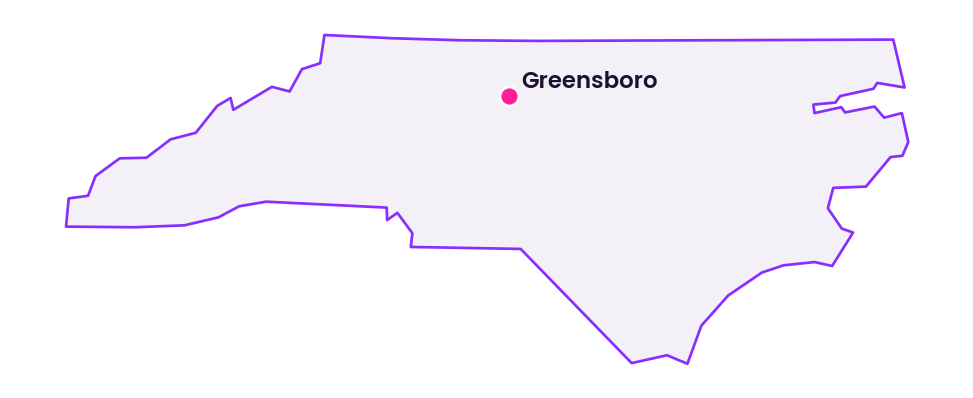
Section 02Population and Migration
Decennial Census data show that the City of Greensboro grew about ten point nine percent between 2010 and 2020, a pace that exceeded the national rate of about seven point four percent and that was driven by both natural increase and net in migration tied to employment opportunities in manufacturing, logistics, and health care. The most recent Census Bureau counts and estimates are shown below.
| Measure | Population |
|---|---|
| Decennial Census, April 2010 | 269,666 |
| Decennial Census, April 2020 | 299,035 |
| American Community Survey five year, 2020 to 2024 | 301,198 |
| Population estimate, July 2024 | 307,381 |
| Population estimate, July 2025 | 308,667 |
Source: United States Census Bureau QuickFacts, Decennial Census, and Population Estimates Program for Greensboro city North Carolina.
Household growth has been concentrated among working age adults and families drawn to the expanding industrial and logistics sectors, a demographic profile that favors both multifamily rentals near employment centers and single family homes in suburban corridors of Guilford County.
Section 03Jobs and Economic Anchors
The Greensboro High Point metropolitan statistical area is anchored by a combination of manufacturing, logistics, health care, and education, with major employers including Cone Health, the University of North Carolina at Greensboro, and a growing cluster of advanced manufacturing and distribution facilities. Toyota Battery Manufacturing North Carolina, located in Liberty in Randolph County on the Greensboro Randolph Megasite, represents a total investment of about thirteen point nine billion dollars and is targeted to create more than five thousand jobs, while Boom Supersonic is building its Overture Superfactory at Piedmont Triad International Airport in Guilford County with a commitment of more than five hundred million dollars in investment and at least one thousand seven hundred fifty jobs by 2030, and these projects are expected to add thousands of direct and indirect jobs and to increase demand for workforce housing in the city and surrounding communities.
Bureau of Labor Statistics data for the Greensboro High Point metropolitan area show that the labor market has been relatively tight in recent years, which is generally supportive of tenant demand and low turnover in professionally managed multifamily and single family rental assets. Annual average unemployment rates for the metropolitan area are shown below.
| Year | Greensboro High Point metropolitan area annual unemployment rate |
|---|---|
| 2021 | 5.4% |
| 2022 | 4.0% |
| 2023 | 3.9% |
| 2024 | 4.0% |
| 2025 | 4.1% |
Source: United States Bureau of Labor Statistics Local Area Unemployment Statistics for the Greensboro High Point North Carolina metropolitan statistical area, annual averages not seasonally adjusted, as compiled in Federal Reserve Bank of St Louis FRED series LAUMT372466000000003A.
At the macro level the region posted solid output gains, with Bureau of Economic Analysis figures showing nominal gross domestic product for the Greensboro High Point metropolitan statistical area rising from about fifty billion dollars in 2022 to about fifty two point nine billion dollars in 2023, implying year over year growth on the order of five point eight percent that reflects both real expansion in manufacturing and logistics and price level effects. This Bureau of Economic Analysis metropolitan output series was discontinued after the 2023 reference year, and it remains a useful benchmark for the multi year output trend.
Section 04Income
Median household income levels in Greensboro sit well below the national average, which underpins demand for workforce housing while also highlighting the importance of affordable and value add product. The Census Bureau American Community Survey figures are shown below.
| Income measure | Value |
|---|---|
| Greensboro median household income, 2023 one year ACS | $58,884 |
| Greensboro median household income, 2020 to 2024 five year ACS | $61,515 |
| United States median household income, 2023 ACS | $78,538 |
| Greensboro as a share of the United States median | About 75% |
Source: United States Census Bureau American Community Survey for Greensboro city North Carolina and the United States.
City median household income has risen only modestly in inflation adjusted terms over the past decade. Because the median figure alone masks a broad distribution of households across income bands, investors should note that a sizable share of working families falls in the thirty percent to eighty percent of area median income range, which forms the core demand for Class B and C multifamily and single family rentals.
Section 05Housing and Multifamily
The City of Greensboro and Guilford County have added meaningful new housing stock over the past decade, yet construction has not fully closed the supply gap created by sustained population and job growth, particularly in workforce segments. A local brokerage commentary has projected continued rent growth for Greensboro in 2026 tied to industrial expansion, but that commentary attributed its projection to an Origin Investments forecast that does not cover Greensboro, so that specific projected percentage is unverified, and the observed Zillow rent level appears in the Rents section. Census Bureau permit data compiled by the Federal Reserve Bank of St Louis show that the Greensboro High Point metropolitan area authorized about four thousand nine hundred fifty five new private housing units in 2024, about three thousand eight hundred sixty in 2025, and about four thousand twenty seven units in the twelve months ending June 2026, a pace that includes both single family and multifamily projects across the metro. American Community Survey estimates indicate that of about one hundred twenty four thousand occupied housing units in the city, renters account for roughly half, about forty nine point five percent, and recent multifamily construction has been concentrated along major corridors and near employment centers with a mix of garden style and mid rise product targeting working households. The combination of industrial job growth and relative affordability versus larger North Carolina metros has supported continued demand for multifamily product even as new supply stabilizes vacancy.
Section 06Rents
Zillow rental data show that the average advertised rent across all bedrooms and all property types in Greensboro was about one thousand five hundred dollars per month in mid 2026, with a price range from about five hundred seventy five dollars to about five thousand dollars, and that the average changed only marginally over the prior year, an increase of roughly nine dollars, which indicates a broadly flat to modestly rising rent environment. A separate Zillow rent index reading placed the average near one thousand three hundred ninety one dollars with a year over year increase of about one point eight percent against a national average near one thousand nine hundred sixty two dollars, so by either Zillow measure Greensboro rents remain well below the national average and have grown only modestly.
A local brokerage commentary has suggested that Class B and C workforce housing in Greensboro offers cap rates roughly one hundred to one hundred fifty basis points higher than in Raleigh. That figure comes from a single brokerage source and no independent public cap rate series confirms it for Greensboro, so the higher secondary market yield is best treated as an unverified pattern rather than a confirmed numeric range.
Section 07Vacancy
American Community Survey based estimates put the Greensboro rental vacancy rate at about six point seven percent, the overall housing vacancy rate at about eight point six percent, and the homeowner vacancy rate near one point three percent, levels that point to balanced to moderately tight rental conditions rather than broad oversupply. Segment level stabilized apartment vacancy by class and submarket is tracked by commercial brokerages on a Greensboro and Winston Salem basis rather than for the city alone, and the citywide American Community Survey figures above are the most direct public measure for Greensboro, consistent with the tight metropolitan labor market and modest Zillow rent growth.
Section 08Supply Pipeline
City and county permit activity indicates that Greensboro and the surrounding Triad have experienced a sustained wave of multifamily and industrial construction, with the pace widely expected to moderate in 2026 as higher interest rates and construction costs filter projects. Census Bureau data compiled by the Federal Reserve Bank of St Louis show that the Greensboro High Point metropolitan area authorized about four thousand nine hundred fifty five new private housing units in 2024 and about three thousand eight hundred sixty in 2025, with the twelve months ending June 2026 at about four thousand twenty seven units, a modest step down from the 2024 pace that is consistent with the expected moderation in new deliveries. These metropolitan totals include both single family and multifamily projects and therefore exceed the multifamily only pipeline within the city.
Section 09Single Family Homes
The single family home market in Greensboro has remained competitive, with price appreciation supported by limited inventory and demand from families and industrial workers. The key housing indicators from Redfin and Zillow are shown below.
| Housing indicator | Value | Change versus prior year |
|---|---|---|
| Median sale price, all home types (Redfin, three months ending June 2026) | $284,845 | +1.8% |
| Median sale price per square foot (Redfin, three months ending June 2026) | $175 | -2.0% |
| Average advertised rent, all property types (Zillow, mid 2026) | $1,500 | +$9 |
| Zillow observed rent index (Zillow, mid 2026) | $1,391 | +1.8% |
Source: Redfin Greensboro North Carolina housing market page and Zillow rental and home value data for Greensboro North Carolina, mid 2026.
Zillow also reported a comparable citywide median sale price in the range of about two hundred sixty five thousand dollars in mid 2026. Single family rentals form an important segment of the Greensboro housing ecosystem, with investor owned homes competing directly with small multifamily product for working households, and the combination of job growth in manufacturing and logistics has supported stable occupancy in this segment even as new apartment supply comes online.
Section 10Commercial Real Estate and Retail Centers
National brokerages track the Greensboro commercial market on a combined Greensboro and Winston Salem basis, and the most recent figures for 2026 are shown below.
| Commercial segment | Overall vacancy rate | Recent net absorption |
|---|---|---|
| Industrial | 7.1% | +343,000 square feet in Q2 2026 |
| Office | 12.7% | +315,000 square feet in Q2 2026 |
| Retail | Mid to high single digits | Positive |
Source: CBRE Greensboro and Winston Salem industrial and office figures for the second quarter of 2026, Cushman and Wakefield Greensboro and Winston Salem office MarketBeat for early 2026, and NAI Piedmont Triad market reports for early 2026.
Industrial vacancy of about seven point one percent in the second quarter of 2026 was down about one hundred ninety basis points from a year earlier, reflecting demand tied to the region's megaprojects and distribution base, and industrial asking rents rose on the order of four percent over the same period. Office vacancy of about twelve point seven percent was better than the national average but pressured by hybrid work, with the Greensboro central business district lower at about nine point nine percent and average asking rents around twenty two dollars and sixty nine cents per square foot, and CBRE reported office fundamentals improving by about one hundred sixty basis points in the second quarter of 2026. Retail vacancy across the Piedmont Triad stood in the mid to high single digits, with grocery anchored neighborhood centers in growing residential areas showing relatively stable performance while older non grocery strip centers and commodity office space face more structural challenges, and outcomes vary by asset.
Section 11Transactions and Capital Markets
Transaction volume data for Greensboro across all real estate segments are largely housed in commercial data services and local multiple listing services, so this section relies on general market color rather than complete count and volume series for institutional grade assets. Local analyses indicate that institutional capital has shown renewed interest in the Triad as supply growth moderates, with value add multifamily and industrial assets attracting attention due to generally higher yields relative to larger North Carolina markets. Debt capital availability for Greensboro assets is shaped by national credit conditions; as a national reference point, the Freddie Mac average thirty year fixed mortgage rate stood in the mid six percent range in mid 2026, an elevated cost of capital that implies levered buyers must underwrite with conservative assumptions and that some owners may be motivated sellers in segments facing functional obsolescence.
Section 12Taxes
Property taxation in Greensboro is administered by Guilford County as the assessing and collecting authority, with the county and the City of Greensboro each setting rates that together determine the total property tax burden on each parcel, and North Carolina law requires assessment at one hundred percent of appraised value. The combined county and city rate for property inside Greensboro was one dollar and forty point three cents per one hundred dollars of assessed value for the 2024 to 2025 and 2025 to 2026 tax years, and a countywide revaluation effective for the 2026 to 2027 year reset both values and rates, as shown below.
| Taxing jurisdiction | Rate per $100 assessed value, FY 2025 to 2026 | Rate per $100 assessed value, FY 2026 to 2027 |
|---|---|---|
| Guilford County | $0.7305 | $0.7895 |
| City of Greensboro | $0.6725 | $0.7985 |
| Combined for a Greensboro parcel | $1.4030 | $1.5880 |
Source: Guilford County Tax Department jurisdiction rate schedules and North Carolina Department of Revenue county and municipal property tax rate tables, for the 2025 to 2026 and 2026 to 2027 tax years.
Because rates and assessed values change with each revaluation cycle, investors must underwrite property taxes at the parcel level rather than relying on a single average, and North Carolina law shapes the framework including assessment practices and appeal procedures, with experienced tax counsel often engaged for larger commercial properties.
Section 13Insurance
Insurance conditions in Greensboro are shaped by its inland Piedmont location and exposure to heavy rain events, thunderstorms, and occasional winter weather rather than coastal wind or surge. The Federal Emergency Management Agency flood mapping system identifies special flood hazard areas primarily along streams and low lying areas, and although a single citywide percentage of land inside the one hundred year floodplain is not published by FEMA, properties in flood prone watersheds face higher flood risk and are more likely to require flood insurance as a condition of financing. City and county resources on stormwater management emphasize that intense rainfall events have produced localized flooding, which has led to ongoing infrastructure projects that investors should consider when assessing long term capital expenditure budgets.
Section 14Landlord Tenant and Regulatory Environment
North Carolina state law regulates landlord and tenant relationships, and Greensboro as a municipality operates within that state framework while also implementing local regulations related to building codes, zoning, and inspection requirements. North Carolina statutes governing residential tenancies outline notice periods, security deposit rules, and allowable lease terms, and importantly state law preempts local rent control measures, which means that Greensboro does not have rent control ordinances that cap annual rent increases. The City of Greensboro enforces zoning rules, building codes, and inspection standards through its planning and inspections divisions, and investors must review zoning designations and any overlay districts for each targeted parcel to understand allowable uses and density.
Section 15Infrastructure
Greensboro benefits from a well developed highway network including Interstate 40, Interstate 85, and the United States Highway 29 and 220 corridors that support logistics and distribution operations, as well as Piedmont Triad International Airport, which provides commercial air service and cargo facilities important for advanced manufacturing tenants and which now hosts the Boom Supersonic Overture Superfactory. City comprehensive planning documents emphasize ongoing investments in road widening, transit, and bicycle infrastructure that can reshape submarket desirability over time, particularly along corridors that connect residential areas to the expanding industrial and logistics employment centers.
Section 16Climate and Physical Risks
Greensboro has a humid subtropical climate with hot summers, mild winters, and a precipitation profile that includes occasional heavy rain events and thunderstorms. Based on the 1991 to 2020 National Oceanic and Atmospheric Administration climate normals for the Piedmont Triad International Airport station, Greensboro averages about forty three point nine five inches of precipitation and about seven inches of snowfall per year, with the potential for localized flooding during extreme events. Flooding risk is concentrated along streams and in low lying areas, and investors should review both Federal Emergency Management Agency flood maps and local stormwater studies when underwriting specific assets.
Section 17Neighborhoods and Submarkets
Within Greensboro and the surrounding area different neighborhoods and submarkets exhibit distinct demand drivers, rent and price levels, and risk profiles. Broadly the central business district and university adjacent areas tend to command higher rents due to walkability and access to employment and education, while outlying areas near major industrial and logistics facilities offer a mix of newer apartments and single family homes that appeal to working families. Investors evaluating Greensboro assets should therefore consider not only citywide averages but also the specific submarket in terms of tenant mix, access to major employers, flood exposure, and the local planning context.
Section 18Opportunities
For multifamily investors Greensboro offers a combination of strong industrial job growth, generally higher yields relative to larger North Carolina markets, and a renter profile that supports value add and workforce housing strategies. Observed Zillow rents that are well below the national average, combined with the labor demand generated by the Toyota and Boom projects, can support workforce housing near the expanding manufacturing and logistics corridors, particularly for investors who can execute on lease up and operational improvements in well located assets. Single family and small multi unit investors can tap into demand from industrial workers in corridors near new manufacturing facilities, while industrial and logistics assets benefit directly from the Toyota battery plant and Boom Supersonic expansions that are reshaping the regional employment base. Specific projected rent growth and cap rate figures circulating in local brokerage commentary are not independently verified and should be confirmed against current transaction data before being relied upon; these are historical or qualitative characteristics and not a prediction of future occupancy, rents, or returns.
Section 19Risks
Key risks in Greensboro include concentration of demand in manufacturing and logistics sectors that could be sensitive to national economic cycles or trade policy shifts, potential oversupply if the multifamily pipeline remains elevated without corresponding job growth, and climate and flooding exposure in specific watersheds. The rise of new industrial facilities creates strong tailwinds but also means that vacancy and rent performance could vary significantly by submarket proximity to those employers, and investors should underwrite with conservative absorption assumptions. Detailed submarket vacancy and absorption metrics by asset class are available mainly through commercial brokerages on a Greensboro and Winston Salem basis, which underscores the importance of local broker relationships and current transaction data for accurate analysis.
Section 20Investor Implications
For United States accredited investors Greensboro represents a value add oriented market where generally higher yields and industrial job growth have drawn value add investor interest, but where careful submarket selection and attention to supply dynamics matter as much as city level metrics, and where no particular occupancy, rent, cash flow, or investment return is promised or assured. Multifamily strategies that target well located Class B and C assets near the expanding manufacturing and logistics corridors, with unit mixes that appeal to working families, may find support in the region's affordability relative to larger North Carolina metros, while strategies that incorporate industrial or mixed use components may align well with the regional economic transformation and the roughly seven percent industrial vacancy recorded in mid 2026. Across all asset classes the Greensboro climate and flooding profile, the combined property tax rate of about one dollar and forty cents per one hundred dollars of value rising to about one dollar and fifty nine cents after the 2026 revaluation, and the regulatory environment must be integrated into underwriting models, and current transaction data and local expertise remain essential for cap rate and absorption analysis by segment.
Section 21Conclusion
Greensboro North Carolina offers accredited investors a logistics and manufacturing anchored market with steady population growth, strong industrial job creation, and generally higher yields than larger North Carolina metros, all set against a backdrop of active construction and evolving supply conditions. The combination of major regional investments such as the Toyota battery plant in Randolph County and the Boom Supersonic operations at Piedmont Triad International Airport, a sizable renter household base, and relative affordability creates a meaningful set of considerations for long term oriented capital that can navigate submarket nuances and climate considerations. At the same time investors must approach Greensboro with a clear understanding of the concentration of demand in specific employment corridors, the balanced to moderately tight vacancy conditions, and the fact that some rent growth and cap rate figures in circulation are unverified brokerage estimates rather than confirmed public data. For disciplined capital that engages with local stakeholders and underwrites conservatively, Greensboro represents a credible value add market in the Piedmont Triad, but it remains a market where execution and local knowledge are essential, and where no particular investment return is promised or assured.