In brief · summary: Hollywood
Hollywood is a mature, coastal, and densely populated city of roughly 159,073 residents in southeastern Broward County, wedged between Fort Lauderdale to the north and the Miami Dade County line to the south, and it functions as one of the more attainable entry points into the expensive South Florida coastal market. The Census Bureau placed the city at 159,073 as of its 2024 estimate, up 3.9 percent from the 153,067 counted in the 2020 Decennial Census, making Hollywood the third largest city in Broward County and roughly the twelfth largest in Florida.
The investment thesis rests on three pillars. First, Hollywood sits at the center of South Florida's transportation and tourism infrastructure, roughly ten minutes from Fort Lauderdale Hollywood International Airport and Port Everglades, and home to the Seminole Hard Rock Hotel and Casino, a 1.5 billion dollar resort that anchors employment and visitation.
Second, the multifamily market is tight, with Fort Lauderdale metro vacancy near 4.8 percent to 5.1 percent and rent growth in the low to mid single digits, supported by a sharp slowdown in new deliveries that favors existing owners. Third, Florida's tax and regulatory environment, no state income tax and statewide preemption of rent control, continues to draw residents and capital. Against these stand the two …
Section 01Executive Summary
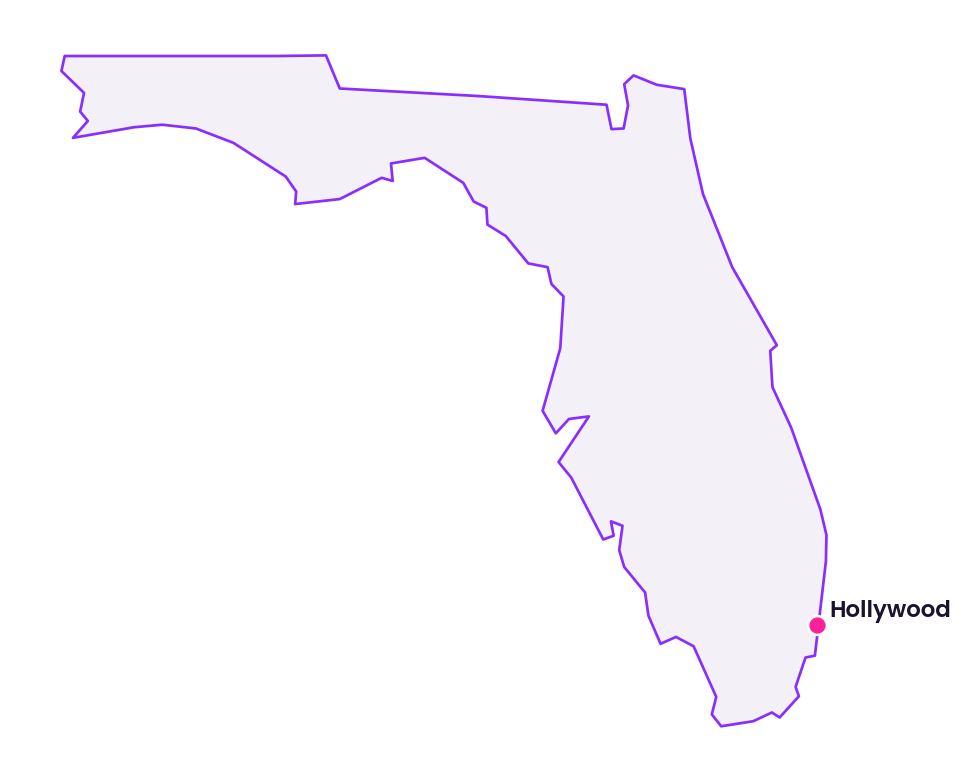
Hollywood is a mature, coastal, and densely populated city of roughly 159,073 residents in southeastern Broward County, wedged between Fort Lauderdale to the north and the Miami Dade County line to the south, and it functions as one of the more attainable entry points into the expensive South Florida coastal market. The Census Bureau placed the city at 159,073 as of its 2024 estimate, up 3.9 percent from the 153,067 counted in the 2020 Decennial Census, making Hollywood the third largest city in Broward County and roughly the twelfth largest in Florida.
The investment thesis rests on three pillars. First, Hollywood sits at the center of South Florida's transportation and tourism infrastructure, roughly ten minutes from Fort Lauderdale Hollywood International Airport and Port Everglades, and home to the Seminole Hard Rock Hotel and Casino, a 1.5 billion dollar resort that anchors employment and visitation. Second, the multifamily market is tight, with Fort Lauderdale metro vacancy near 4.8 percent to 5.1 percent and rent growth in the low to mid single digits, supported by a sharp slowdown in new deliveries that favors existing owners. Third, Florida's tax and regulatory environment, no state income tax and statewide preemption of rent control, continues to draw residents and capital.
Against these stand the two defining risks of coastal Broward: insurance costs that rank among the highest in the nation despite meaningful 2026 relief, and serious physical climate exposure, since Hollywood includes a barrier island and roughly 35 percent of its properties sit in high risk flood zones. Hollywood offers relative value, genuine demand drivers, and tight supply, priced with insurance and climate costs that must be underwritten with discipline.
Section 02Population and Migration
Hollywood is a large, essentially built out coastal city whose growth has been steady but modest, consistent with an established community rather than a greenfield boomtown. The Census Bureau estimated the city at 159,073 residents in 2024, an increase of 3.9 percent over the 153,067 recorded in the 2020 Decennial Census, while the American Community Survey placed the change from 2019 to 2024 at about 1.7 percent. Hollywood ranks as the third largest city in Broward County and roughly the twelfth most populous in Florida.
| Geography | Population or change | Period | Source |
|---|---|---|---|
| Hollywood city | 159,073 | 2024 estimate | U.S. Census Bureau |
| Hollywood city | 153,067 | April 1, 2020 | U.S. Census Bureau |
| Hollywood change since 2020 | +3.9% | 2020 to 2024 | U.S. Census Bureau |
| Hollywood change | +1.7% | 2019 to 2024 | U.S. Census Bureau ACS |
| Rank in Broward County | 3rd largest city | 2024 | U.S. Census Bureau |
The migration story that matters is regional rather than municipal. Broward County is one of Florida's most populous counties and has been a major recipient of domestic in migration from higher tax states, a flow that repeatedly refills renter and buyer demand across South Florida. Hollywood's own growth is constrained by its built out condition on a narrow coastal footprint, so future population gains come principally through redevelopment and densification rather than outward expansion. For an investor, the key point is that Hollywood participates in the powerful South Florida in migration engine while offering more attainable price points than Miami Beach or the wealthier Palm Beach coastal enclaves, which supports both rental demand and a deep pool of workforce and middle income households.
Section 03Jobs and Economic Anchors
The relevant labor market is the Fort Lauderdale, Pompano Beach, and Sunrise metropolitan division, for which the Bureau of Labor Statistics reported nonagricultural employment of 909,100 jobs in June 2026, a decrease of 5,000 jobs, or 0.5 percent, over the year. The year over year decline is notable and warrants monitoring, though it was concentrated in specific sectors while others grew. Broward County unemployment stood at 4.5 percent in June 2026, up from 3.7 percent a year earlier, indicating a labor market that has cooled from very tight conditions. The sectors adding jobs over the year are shown below.
| Sector | Job change, year over year | Period | Source |
|---|---|---|---|
| Education and health services | +3,000 | June 2026 | U.S. BLS |
| Government | +1,300 | June 2026 | U.S. BLS |
| Manufacturing | +200 | June 2026 | U.S. BLS |
| Total nonagricultural | -5,000 (-0.5%) | June 2026 | U.S. BLS |
The conclusion is a metro economy where healthcare, education, and government provided the growth while other sectors, likely including some office using and trade categories, gave it back, netting a small overall decline. Broward's largest employers span several industries: AutoNation, a Fortune 500 company headquartered in Fort Lauderdale with more than 21,000 employees nationwide and the largest automotive retailer in the country; Broward Health, a major public hospital system; Citrix, a software firm; and Spirit Airlines, based in nearby Miramar. Within Hollywood specifically, the Seminole Hard Rock Hotel and Casino is a dominant employment and tourism anchor, and the city hosts significant healthcare employment. The economic base is anchored by healthcare, tourism and hospitality, aviation and logistics tied to the airport and port, and a growing professional and financial services presence spilling over from the broader South Florida relocation wave. For an investor, the diversity is a strength, but the recent net job loss and cooling unemployment argue for conservative demand assumptions.
Section 04Income
Household income in Hollywood is best proxied by Broward County figures, since granular current city level income is not published in a consistent public series. Broward County reported a median household income of about 76,024 dollars in the Census 2023 American Community Survey one year estimate, with a poverty rate around 12 percent, and incomes have been rising modestly year over year. Hollywood, as an established coastal city with a mix of workforce neighborhoods, waterfront estates, and tourism districts, spans a wide income range, and its typical household income sits broadly in line with the county rather than at the wealthy extremes seen in Palm Beach or the affluent northern Broward enclaves.
The practical implication is that Hollywood is fundamentally a workforce and middle income housing market, where affordability, wages, and financing costs genuinely govern demand, in contrast to the ultra wealthy island markets elsewhere in South Florida. A median household income near 76,000 dollars against the home values and rents discussed below means that affordability is stretched, which supports rental demand because homeownership is out of reach for many households, and it caps the pace of for sale price appreciation to what local incomes and in migrating buyers can sustain. Modest income growth partially offsets the affordability pressure, but the gap between local incomes and coastal South Florida housing costs remains the central affordability constraint in this market.
Section 05Housing and Multifamily
The multifamily market for Hollywood is best understood through Fort Lauderdale metro and Broward County data, and the picture is one of tight occupancy and moderating rent growth. Metro multifamily vacancy held around 5.1 percent with rent growth of about 4.2 percent year over year, and a more recent reading showed vacancy falling 30 basis points year over year to 4.8 percent in March 2026. In Hollywood specifically, average asking rents ran approximately 1,790 dollars for a one bedroom apartment and 2,444 dollars for a two bedroom, while the Broward County median rent sat near 2,515 dollars per month as of mid 2026.
| Metric | Value | Geography and period | Source |
|---|---|---|---|
| Multifamily vacancy | 4.8% | Fort Lauderdale metro, March 2026 | RealPage / Marcus and Millichap |
| Multifamily vacancy | 5.1% | Fort Lauderdale metro, 2026 | market data |
| Rent growth, year over year | +4.2% | Fort Lauderdale metro, 2026 | market data |
| Average one bedroom rent | 1,790 dollars | Hollywood, 2026 | Rent / RentCafe |
| Average two bedroom rent | 2,444 dollars | Hollywood, 2026 | Rent / RentCafe |
| Broward median rent | 2,515 dollars | Broward County, mid 2026 | market data |
The defining feature of this market, in sharp contrast to the oversupplied downtown cores elsewhere in Florida, is a scarcity of new supply. The metro is delivering relatively few units, which supports occupancy and pricing power for existing owners. Employment in financial and professional services is expected to bolster apartment demand despite broader economic headwinds. The conclusion for an investor is that Hollywood and the Fort Lauderdale metro offer one of the more favorable supply and demand balances in South Florida, with vacancy below 5 percent, positive rent growth, and a thin construction pipeline, which is a materially more attractive setup than markets facing delivery waves.
Section 06Rents
Hollywood rents reflect its position as a relatively attainable coastal submarket within an expensive region. The one bedroom average near 1,790 dollars and two bedroom average near 2,444 dollars sit below the pricier Fort Lauderdale figures, where apartments ranged from roughly 1,924 dollars to 2,695 dollars in 2026, and below the Broward county median of 2,515 dollars. This relative affordability is a competitive advantage: Hollywood captures renters priced out of Fort Lauderdale, Miami Beach, and Aventura who still want coastal access and proximity to the airport and employment centers.
Rent growth in the metro, near 4.2 percent year over year, has normalized from the extraordinary double digit pace of 2021 and 2022 to a healthier and more sustainable rate that still exceeds national norms. This moderation reflects the market digesting demand against a constrained supply pipeline rather than any weakness. The rent gradient within Hollywood is meaningful: the barrier island and beachfront command premiums driven by lifestyle and tourism demand, downtown and transit adjacent locations attract younger professional renters, and inland workforce neighborhoods offer the most attainable pricing. For an investor, the rent thesis rests on Hollywood's relative value proposition within South Florida, its steady in migration driven demand, and a supply pipeline too thin to threaten pricing power, balanced against the affordability ceiling imposed by local incomes near 76,000 dollars.
Section 07Vacancy
Multifamily vacancy in the Fort Lauderdale metro has remained tight, sitting near 4.8 percent to 5.1 percent through early and mid 2026, below national apartment vacancy averages and confirming robust underlying demand. The 30 basis point year over year decline to 4.8 percent in March 2026 indicates the market was tightening rather than loosening, a direct consequence of the thin construction pipeline. This is a favorable vacancy environment for owners and stands in contrast to the elevated vacancy seen in markets absorbing large delivery waves.
Across other asset classes, vacancy conditions diverge sharply. Broward County office vacancy was reported at 18.6 percent in the first quarter of 2026 by one major brokerage measuring the broad metro across all classes, while another brokerage using a different inventory definition placed it near 12.3 percent for 2025, a reminder that office vacancy figures depend heavily on methodology and geography. Broward industrial vacancy stood at 7.2 percent in the first quarter of 2026, and Broward retail vacancy was just 4.0 percent at the end of the first quarter of 2026. The overall vacancy picture is a tight multifamily and retail market, a moderately soft industrial market absorbing recent deliveries, and a genuinely soft office market, particularly in commodity space.
Section 08Supply Pipeline
The supply pipeline is a key strength of the Hollywood and Fort Lauderdale multifamily market. Metro multifamily deliveries were projected to total roughly 3,300 units, the smallest annual figure since 2022, and total units under construction fell close to 6,000, the lowest level in Broward County since 2020. This sharp pullback in construction, driven by high financing costs and a slowdown in new project starts, means the market will receive little near term relief to its supply shortfall, which supports continued tightening of vacancy and sustained rent growth. Net absorption declined about 30 percent over the prior year, but this was modest relative to other Florida metros and reflects a demand slowdown rather than a collapse.
Hollywood itself, as a built out coastal city, adds new supply principally through infill and redevelopment, including transit adjacent and downtown mixed use projects, rather than large scale greenfield construction. On the commercial side, Broward industrial delivered roughly 1.0 million square feet in a single recent quarter, which pushed industrial vacancy up as the market worked to absorb it, while office and retail construction has been more limited. The conclusion for an investor is that the thin multifamily pipeline is the single most favorable structural feature of this market, protecting existing assets from the lease up and concession pressure that burdens oversupplied Florida submarkets, and making well located existing multifamily in Hollywood an attractive proposition on supply grounds alone.
Section 09Single Family Homes
The Hollywood single family market has been in a mild correction after the pandemic era surge, with values softening modestly while remaining well above pre pandemic levels. Zillow placed the typical Hollywood home value at about 444,344 dollars as of 2026, down roughly 4 percent over the prior year. Neighborhood level data shows the wide range within the city: the historic, high end Hollywood Lakes neighborhood carried a median sale price near 700,000 dollars, essentially flat year over year, while Hollywood Hills sat near 636,000 dollars, down 2.8 percent. Various listing measures placed the city median list price near 643,000 dollars in August 2026 against 557,500 dollars a year earlier, and MLS based median sale figures clustered in the high 400,000s to around 500,000 dollars.
| Measure | Value | Change | Period and source |
|---|---|---|---|
| Zillow typical home value | 444,344 dollars | -4.1% | 2026, Zillow |
| Hollywood Lakes median sale | 700,000 dollars | roughly flat | mid 2026, Redfin |
| Hollywood Hills median sale | 636,000 dollars | -2.8% | mid 2026, Redfin |
| Median list price | 643,000 dollars | up from 557,500 dollars | August 2026, listing data |
| MLS median sale price | 499,900 dollars | recent | August 2026, MLS |
The divergence between a rising median list price and a softening Zillow value index reflects a market where sellers remain optimistic while transaction values moderate, a common signal of a market rebalancing toward buyers. The single family rental angle is compelling in Hollywood: with a county median household income near 76,000 dollars and home values near or above 444,000 dollars, homeownership is unaffordable for many households, which sustains deep demand for single family rentals and supports the build to rent and scattered site rental strategies. High entry basis and elevated financing costs compress gross yields, so the single family rental case rests on steady rental demand and long term South Florida appreciation rather than on immediate cash flow, and buyers must underwrite the post sale property tax reset and high insurance costs that weigh heavily on single family carrying costs.
Section 10Commercial Real Estate and Retail Centers
The commercial sectors in Broward County, the best proxy for Hollywood, show a clear hierarchy with retail tight, industrial moderately soft, and office genuinely weak. Retail is the strongest sector, with Broward County overall retail vacancy at just 4.0 percent at the end of the first quarter of 2026, up a modest 30 basis points year over year, driven by some net occupancy losses paired with a two year high in quarterly deliveries. Grocery anchored and neighborhood centers benefit directly from the dense residential base and steady consumer spending, and this segment remains the most defensible commercial exposure in the market.
| Sector | Vacancy | Asking rent | Geography and period | Source |
|---|---|---|---|---|
| Retail | 4.0% | market rate | Broward County, Q1 2026 | Colliers |
| Industrial | 7.2% | 17.34 dollars per SF NNN (+0.7% YoY) | Broward County, Q1 2026 | Colliers |
| Office (broad metro, all classes) | 18.6% | 28.16 dollars per SF (+6.9% YoY) | Broward County, Q1 2026 | CBRE |
| Office (alternate inventory) | 12.3% | rising | Broward County, 2025 | Colliers |
Industrial is moderately soft but fundamentally sound. Broward saw 1.4 million square feet leased in the first quarter of 2026, but net absorption remained negative at about 303,000 square feet, extending a downward trend, and a surge of roughly 1.0 million square feet delivered in a single quarter pushed vacancy to 7.2 percent, with asking rents stabilizing at 17.34 dollars per square foot triple net, up a slim 0.7 percent year over year. South Florida industrial cap rates expanded to an average near 6.3 percent to offset higher borrowing costs. Office is the weakest sector: one brokerage measured broad Broward metro office vacancy at 18.6 percent in the first quarter of 2026, up 30 basis points quarter over quarter, even as asking rents climbed to 28.16 dollars per square foot, up 6.9 percent year over year, while another brokerage recorded five straight quarters of negative absorption totaling about 762,813 square feet in 2025. The conclusion is that investors should favor grocery anchored retail and well located industrial, treat commodity office with real caution, and recognize that Hollywood's commercial fundamentals track the broader Broward pattern.
Section 11Transactions and Capital Markets
Granular multifamily transaction data specific to Hollywood, such as price per unit and deal volume, is not published in a consistent public series, so this section relies on the South Florida cap rate environment that public data do establish. Industrial cap rates in South Florida expanded to an average near 6.3 percent in the current environment as buyers repriced for higher borrowing costs. Multifamily in coastal Broward trades tighter than industrial, consistent with the broader South Florida pattern where in migration, rent growth, and coastal scarcity command a premium, though a specific current Broward multifamily cap rate is not published in a consistent public series and should be confirmed against current transaction comparables.
The broad capital markets picture is one of a market that has repriced from the peak but continues to attract national and international capital drawn by South Florida's demographic and tax story. Higher interest rates have widened cap rates and slowed transaction velocity across all asset classes, making sales more selective, but the underlying investor appetite for South Florida coastal assets remains strong. For an investor, the implications are that entry yields on multifamily remain compressed relative to inland markets, that industrial offers more accessible yields near 6.3 percent, and that the thin multifamily supply pipeline supports the case for existing apartment assets even at tighter cap rates, because the scarcity of competing new product protects rents. Disciplined underwriting of insurance, taxes, and the recent softening in metro employment is essential given the limited margin that compressed cap rates provide.
Section 12Taxes
Florida's tax structure is the foundational demand driver for all South Florida real estate, and Hollywood benefits from it fully. Florida levies no state personal income tax, the primary magnet drawing high earning households and businesses from higher tax states. On property, the Broward County Commission lowered the countywide millage rate to 5.6658 mills for fiscal year 2026, the first reduction since 2018, though most owners still saw higher bills because rising assessed values outpaced the rate cut. The countywide millage is only one component; the combined effective rate stacks the county, the city of Hollywood, the Broward County school district, and any special districts, producing effective property tax rates that range roughly from 0.85 percent to 2.02 percent depending on the parcel's location and local levies.
| Tax feature | Value | Scope | Source |
|---|---|---|---|
| Countywide millage | 5.6658 mills | Broward County, FY2026 | Broward County |
| Effective property tax rate range | 0.85% to 2.02% | Broward County parcels | Broward County Property Appraiser |
| State personal income tax | None | Florida | Florida Constitution |
| Homestead exemption | 50,722 dollars | Primary residences, 2025 | Broward County Property Appraiser |
| Save Our Homes assessment cap | 3% or CPI, whichever is lower | Homestead property | Florida Department of Revenue |
Florida's homestead protections apply only to primary residences, which limits their relevance for investors and for second home owners. The homestead exemption was set at 50,722 dollars following voter approval of Amendment 5 in November 2024, and the Save Our Homes cap limits annual increases in a homesteaded property's assessed value to 3 percent or the change in the Consumer Price Index, whichever is lower. Crucially for investors, when a property sells, the buyer loses the seller's Save Our Homes benefit and the property is reassessed at market value, which frequently produces a substantial step up in the tax bill after acquisition. The essential discipline is to underwrite property taxes on the post sale reassessed value rather than on the seller's historical bill, because a long held homesteaded property can carry a tax figure far below what a new owner will pay.
Section 13Insurance
Property insurance is the defining cost risk of investing in coastal Broward County, and Hollywood sits squarely in the high cost, high exposure zone. Broward County's average annual homeowners premium including wind coverage was about 6,220 dollars for 2026, the third most expensive county in Florida behind Monroe and Palm Beach, with actual premiums ranging widely from roughly 4,000 dollars to 8,000 dollars per year depending on location, roof age, construction type, and proximity to water. Coastal and barrier island properties in Hollywood run at the upper end of these ranges or beyond, given wind exposure and property values at risk.
| Insurance measure | Value | Scope and period | Source |
|---|---|---|---|
| Average annual homeowners premium | about 6,220 dollars | Broward County, 2026, third highest in Florida | Florida OIR |
| Typical premium range | 4,000 to 8,000 dollars | Broward County, 2026 | industry data |
| NFIP flood premium, single family | 1,200 to 2,500 dollars | Broward County, 2026 | industry data |
| Citizens rate reduction | -14.1% | about 27,000 Broward homes, 2026 | Florida OIR |
| Statewide average premium | about 2,520 dollars | Florida, 2021 | industry data |
| Statewide average premium | about 4,480 dollars | Florida, 2024 | industry data |
| Statewide premium change | +78% | Florida, 2021 to 2024 | industry data |
Flood insurance is a separate and substantial cost, because standard homeowners policies exclude flood damage everywhere in Florida. Under FEMA's Risk Rating 2.0 system, the average National Flood Insurance Program premium in Broward County runs roughly 1,200 dollars to 2,500 dollars per year for a single family home, with properties in the high risk AE and VE zones paying more. The market has, however, seen genuine relief: Citizens Property Insurance approved an average reduction of 14.1 percent for roughly 27,000 Broward County policyholders in 2026, part of a statewide improvement in which the average premium had previously surged from about 2,520 dollars to 4,480 dollars between 2021 and 2024, a rise of roughly 78 percent, before conditions stabilized. For an investor, insurance remains a first order underwriting line that can materially compress net operating income, and the combined wind and flood cost for a Hollywood coastal asset must be modeled conservatively despite the welcome 2026 relief.
Section 14Landlord Tenant and Regulatory Environment
Florida is among the most landlord friendly regulatory environments in the country, and Hollywood operates under that uniform statewide regime. The governing framework is Chapter 83, Part II of the Florida Statutes, the Residential Landlord and Tenant Act. In 2023 the legislature enacted House Bill 1,417, creating Section 83.425 and preempting to the state the entire regulation of residential tenancies, effective July 1, 2023. This law rendered null and void the local tenant protection ordinances that had been adopted across roughly 35 cities and counties in Florida, with advocates estimating that about 46 local ordinances were preempted, including rent stabilization measures, tenants bills of rights, and source of income protections. The result is a uniform statewide regime with no local rent control and no local layering of additional tenant protections.
| Provision | Florida rule | Basis |
|---|---|---|
| Rent control | Preempted; effectively prohibited | HB 1,417, Section 83.425 |
| Local tenant ordinances | Preempted statewide | HB 1,417 (2023) |
| Month to month termination notice | 30 days | HB 1,417, raised from 15 |
| State income tax | None | Florida Constitution |
| Governing statute | Chapter 83, Part II | Florida Statutes |
The one modestly tenant favorable change from HB 1,417 was raising the notice period to terminate a month to month tenancy from 15 days to 30 days. This regulatory clarity and predictability is a genuine structural advantage relative to jurisdictions in the Northeast and on the West Coast, and it is a significant part of why national multifamily capital has concentrated in Florida and in coastal Broward specifically.
Section 15Infrastructure
Hollywood's infrastructure position is one of its strongest attributes, because the city sits at the crossroads of South Florida's aviation, seaport, and rail networks. Fort Lauderdale Hollywood International Airport, one of the busiest airports in the nation, is roughly ten minutes from the city, and Port Everglades, a major cruise and cargo seaport, is a similar distance, giving Hollywood direct exposure to the aviation, logistics, and tourism economy that these facilities generate. The Seminole Hard Rock Hotel and Casino in Hollywood, following a 1.5 billion dollar expansion completed in 2019 that added a 450 foot guitar shaped hotel tower with 638 luxury rooms, 3,100 slot machines, 195 table games, and about 600,000 square feet of resort space, is a nationally recognized destination that anchors both employment and visitor spending.
The transformational infrastructure development is passenger rail. Brightline, the higher speed intercity rail service, operates stations immediately north in Fort Lauderdale and immediately south in Aventura in Miami Dade County, though not yet in Hollywood itself. More significant for Hollywood is the planned Commuter Rail South project, an 11.5 mile line on the Florida East Coast corridor between Aventura and Fort Lauderdale, with capital costs estimated near 317 million dollars by the Florida Department of Transportation, that would add stations in Hollywood, at the airport, and on Fort Lauderdale's south side near Port Everglades, with related transit plans targeting completion later in the decade. Combined with the Interstate 95 corridor, Florida's Turnpike, US Highway 1, and the Tri Rail commuter system, this rail investment positions Hollywood for transit oriented development that would enhance the value of downtown and station adjacent multifamily. For an investor, the connectivity is a durable competitive advantage and a catalyst for infill densification.
Section 16Climate and Physical Risks
Physical climate risk is the most serious long term threat to Hollywood real estate and must be underwritten explicitly. Hollywood includes a barrier island, Hollywood Beach, and the city's flood exposure is substantial: roughly 35 percent of Hollywood properties sit in high risk flood zones, and the most common FEMA designations in the city are Zone AE, the high risk zone subject to base flood elevations, Zone VE, the coastal high hazard zone accounting for breaking wave action along the oceanfront, and Zone X for lower risk areas. Hollywood's hurricane evacuation zones reflect this exposure, with Zone A covering the barrier island and Zone B running from the Intracoastal Waterway to Federal Highway, both established using storm surge and FEMA flood modeling.
The hazard set is dominated by coastal flooding: hurricane storm surge, tidal flooding, king tides, and wave action, with VE zone properties facing the most severe exposure. The sea level rise trajectory is stark. Hollywood currently experiences sunny day, or tidal, flooding on fewer than 8 days per year, but the city projects that with sea level rise exceeding 2 feet by 2,060, that frequency could rise to 226 days per year, which would fundamentally alter the usability and insurability of low lying coastal property. The city has responded with mitigation, updating its seawall ordinance in February 2022 to establish tidal flood protection standards and construction requirements that account for projected sea level rise. For an investor, the imperative is to examine each asset's specific flood zone, elevation, and construction standard, to price both wind and flood insurance realistically, and to recognize that the barrier island and low lying eastern neighborhoods carry the highest physical risk, a tension that sits at the heart of any Hollywood coastal investment.
Section 17Neighborhoods and Submarkets
Hollywood divides into distinct submarkets with very different risk and return profiles. Hollywood Beach, the barrier island, is a tourism and lifestyle market anchored by the historic Broadwalk, dominated by condominiums, vacation rentals, and beachfront product, carrying the highest rents and values but also the greatest flood and wind exposure in VE and AE zones. Hollywood Lakes, an established waterfront neighborhood, is the city's high end single family market, with median sale prices near 700,000 dollars, while Hollywood Hills offers slightly more attainable single family product near 636,000 dollars. Downtown Hollywood, centered on the arts district and the ArtsPark, is the walkable urban core and the focus of infill multifamily and mixed use redevelopment, positioned to benefit from the planned commuter rail station.
The inland and North Central neighborhoods provide the city's more attainable workforce housing, where affordability pressure is most acute given local incomes, and where single family rental demand is deepest. Adjacent submarkets shape Hollywood's competitive position: Fort Lauderdale to the north commands higher rents and anchors the metro office market, Hallandale Beach and Aventura to the south offer competing coastal condo and rental product, and inland Pembroke Pines and Miramar provide newer suburban housing. The investor conclusion is that Hollywood Beach is a lifestyle and tourism play with elevated climate risk, Hollywood Lakes and Hollywood Hills are established single family markets, downtown is the transit driven growth and redevelopment play, and the inland neighborhoods carry the workforce affordability and single family rental opportunities.
Section 18Opportunities
The clearest opportunity is well located multifamily in a market where vacancy sits below 5 percent and the construction pipeline has fallen to its lowest level in Broward County since 2020, a supply and demand balance that protects rents and occupancy far better than the oversupplied downtown cores elsewhere in Florida. A second opportunity is transit oriented and downtown infill development positioned to capture value from the planned Commuter Rail South station in Hollywood, since walkable, transit served locations command durable premiums. A third is the single family rental and build to rent segment in the inland workforce neighborhoods, where a county median household income near 76,000 dollars against home values near or above 444,000 dollars keeps homeownership out of reach and sustains deep rental demand. A fourth is grocery anchored retail, where Broward vacancy near 4.0 percent and a dense, spending resident base support stable income. Underpinning all of these is Florida's zero income tax regime and landlord friendly, rent control free legal environment, which continue to draw residents and capital to South Florida.
Section 19Risks
The foremost risk is insurance and climate, which are intertwined. Broward County premiums among the highest in the nation, combined with the reality that roughly 35 percent of Hollywood properties sit in high risk flood zones and the city projects tidal flooding could reach 226 days per year by 2,060, mean that insurance and climate are first order costs that can compress returns and, in a severe storm, threaten asset value directly. The 2026 rate relief is welcome but does not reverse the long run trajectory of a warming, surge exposed coast. The second risk is the recent softening in metro employment, with nonagricultural jobs down 0.5 percent year over year and unemployment ticking up, which could temper the demand that supports the tight multifamily market. The third is affordability and valuation, since local incomes constrain both for sale price appreciation and rent growth, and compressed cap rates leave thin margin for error. The fourth is the post sale property tax reset, since Save Our Homes protections vanish on transfer and reassessment at market value can sharply raise the tax bill a buyer inherits. The fifth is the office sector's genuine weakness, with broad metro vacancy measured as high as 18.6 percent and sustained negative absorption, which argues against commodity office exposure.
Section 20Investor Implications
For an accredited investor, Hollywood offers relative value and a favorable supply picture within an expensive, high demand region, and it rewards a disciplined, asset specific approach. Multifamily is the most attractive core strategy, supported by sub 5 percent vacancy, positive rent growth, and a construction pipeline at multiyear lows, with the strongest risk adjusted returns in well located existing assets insulated from flood exposure. Downtown and transit adjacent infill positioned for the planned commuter rail is a compelling value add and development angle. Single family rental and build to rent in the inland workforce neighborhoods capture the deep pool of renters priced out of ownership. Grocery anchored retail offers stable income, while commodity office should be avoided given persistent weakness. Across every asset class, three disciplines are non negotiable: underwrite insurance, both wind and flood, at realistic and conservative levels; underwrite property taxes on the post sale reassessed value; and examine each asset's specific flood zone, elevation, and construction standard, favoring higher elevation and hardened product over the most exposed barrier island and low lying assets. The Florida tax and regulatory environment, no state income tax and no rent control, is a genuine and durable structural advantage.
Section 21Conclusion
Hollywood is a large, mature, coastal South Florida city that offers investors relative affordability, genuine infrastructure and tourism demand drivers, and one of the tightest multifamily supply and demand balances in the region, with metro vacancy below 5 percent and a construction pipeline at its lowest level in Broward County since 2020. Its economy is anchored by healthcare, tourism led by the Seminole Hard Rock resort, aviation and logistics tied to the airport and Port Everglades, and a growing professional base, and its position at the crossroads of South Florida's rail, road, air, and sea networks, soon to be enhanced by commuter rail, is a durable advantage. These strengths are counterbalanced by the defining coastal realities of expensive insurance and serious physical climate risk, since Hollywood includes a barrier island and roughly 35 percent of its properties sit in high risk flood zones, and by a recent softening in metro employment and the affordability ceiling imposed by local incomes. The market rewards disciplined entry, honest underwriting of insurance, taxes, and climate, and a clear preference for well located, higher elevation, and hardened assets.