In brief · summary: Kokomo
Kokomo is a small industrial city in north central Indiana and the core of the Kokomo Indiana metropolitan area. The city has a long history in automotive manufacturing and related industries, and that legacy remains visible in the current labor market mix.
For investors, Kokomo represents a focused bet on a compact labor market with a large manufacturing share, modest service sector activity, and housing that is more affordable than national norms, set within a state that has relatively stable employment and a landlord friendly regulatory environment. The Bureau of Labor Statistics Kokomo Indiana Economy at a Glance table reports that the Kokomo metropolitan civilian labor force was 35.3 thousand persons in January 2026 and a preliminary 35.6 thousand persons in June 2026, not seasonally adjusted.
Metropolitan employment was 33.6 thousand persons in January 2026 and a preliminary 33.7 thousand persons in June 2026. Unemployment ranged between 1.7 and 2.0 thousand persons over the first half of 2026, and the preliminary June figure was 1.8 thousand persons. The unemployment rate moved between 4.7 and 5.7 percent, with a preliminary 5.1 percent in June 2026. Total nonfarm employment in the metropolitan area was 35.6 thousand jobs in January 2026 and a preliminary 35.6 thousand jobs in June 2026, indicating very limited …
Section 01Executive Summary
Kokomo is a small industrial city in north central Indiana and the core of the Kokomo Indiana metropolitan area. The city has a long history in automotive manufacturing and related industries, and that legacy remains visible in the current labor market mix. For investors, Kokomo represents a focused bet on a compact labor market with a large manufacturing share, modest service sector activity, and housing that is more affordable than national norms, set within a state that has relatively stable employment and a landlord friendly regulatory environment.
The Bureau of Labor Statistics Kokomo Indiana Economy at a Glance table reports that the Kokomo metropolitan civilian labor force was 35.3 thousand persons in January 2026 and a preliminary 35.6 thousand persons in June 2026, not seasonally adjusted. Metropolitan employment was 33.6 thousand persons in January 2026 and a preliminary 33.7 thousand persons in June 2026. Unemployment ranged between 1.7 and 2.0 thousand persons over the first half of 2026, and the preliminary June figure was 1.8 thousand persons. The unemployment rate moved between 4.7 and 5.7 percent, with a preliminary 5.1 percent in June 2026. Total nonfarm employment in the metropolitan area was 35.6 thousand jobs in January 2026 and a preliminary 35.6 thousand jobs in June 2026, indicating very limited net job growth and some short term volatility over the preceding twelve months. Source: U S Bureau of Labor Statistics, Kokomo Indiana Economy at a Glance, data extracted August 7 2026.
At the state level, the Bureau of Labor Statistics Indiana Economy at a Glance table shows that Indiana statewide had a labor force of 3,503.6 thousand persons in January 2026 and a preliminary 3,491.3 thousand in June 2026, seasonally adjusted. Statewide employment was 3,385.2 thousand persons in January 2026 and a preliminary 3,376.3 thousand in June 2026. The Indiana unemployment rate was in a narrow range between 3.3 and 3.4 percent over this period. Total nonfarm employment in Indiana was 3,251.0 thousand jobs in January 2026 and a preliminary 3,261.7 thousand in June 2026, and the twelve month percent change in total nonfarm jobs remained slightly negative through June 2026. Source: U S Bureau of Labor Statistics, Indiana Economy at a Glance, data extracted August 7 2026.
On the ownership side, Redfin Indiana housing market overview reports that the statewide median sale price across all home types was 280,055 dollars in May 2026, 3.7 percent higher than in May 2025. In the same month, there were 27,511 homes for sale in Indiana, 5.7 percent more than one year earlier, and 18.2 percent of homes sold above list price, which was 1.1 percentage points lower than in May 2025. For national comparison, Redfin United States housing market overview shows that the national median sale price across all home types was 398,771 dollars in May 2026, 2.0 percent higher than a year earlier, with 1,483,839 homes for sale nationwide, up 0.7 percent year over year, and 24.9 percent of homes selling above list price, down 0.083 percentage points year over year. These Redfin figures are based on multiple listing service and public record data and were retrieved in this environment on August 7 2026. Sources: Redfin Indiana Housing Market House Prices and Trends; Redfin United States Housing Market and Prices.
Attempts to retrieve current Census QuickFacts tables for Kokomo city and Howard County through automated tools in this environment are blocked by security at the United States Census Bureau. Similarly, an attempt to parse Redfin Kokomo city housing page did not return usable content. As a result, this review cannot present current official numeric population counts or city specific Redfin housing statistics for Kokomo. Instead, it uses metropolitan Bureau of Labor Statistics data and Indiana statewide Redfin housing metrics as the most defensible public proxies and states clearly where city level data are unavailable.
Within these constraints, Kokomo presents a market where multifamily and single family rental properties serve a workforce with a high share of manufacturing and related employment, where industrial and logistics assets are tied closely to a small set of corporate anchors, and where retail and office demand is concentrated in a compact urban core and along a limited number of commercial corridors. For accredited investors, the city can offer yield focused opportunities in well located workforce housing and industrial or logistics assets, but those opportunities come with concentration risks and a dependence on a narrow industrial base. Thorough property specific and submarket specific due diligence outside this environment is essential.
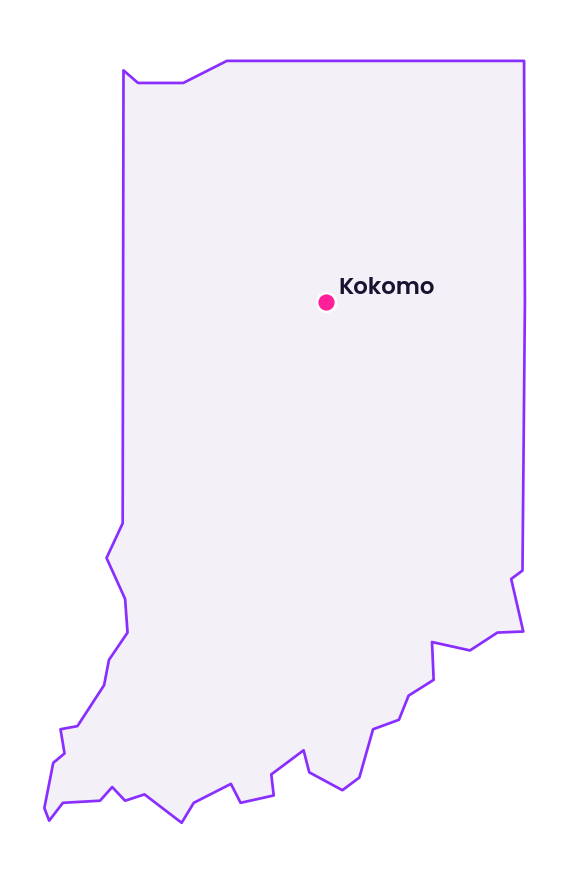
Section 02Population and Migration
Population and migration data provide the base for housing demand and labor supply in Kokomo. The main public sources are the United States Census Bureau decennial census, the Population and Housing Unit Estimates program, and the American Community Survey. City and county level figures, such as current population counts for Kokomo and Howard County, recent population change, and migration flows, are provided through Census QuickFacts and other interactive tools on census dot gov.
In this environment, attempts to access the combined QuickFacts table for Kokomo city, Howard County, and Indiana returned an access denied message. Because the underlying numeric tables cannot be viewed or downloaded programmatically, this review cannot state the current official population of Kokomo, the number of households, or the precise rate of population growth or decline over the past decade.
Historically, Kokomo has functioned as a small industrial center with population tied closely to the fortunes of auto and related manufacturing. Past decennial census data and widely cited public sources outside this environment have described Kokomo as significantly smaller than major Indiana cities such as Indianapolis and Fort Wayne, but large enough to support its own metropolitan statistical area. The surrounding Howard County includes smaller communities and rural areas that supply workers and consumers to Kokomo employers and businesses.
Without current numeric population and migration figures, investors must treat this section as structural context only. It is clear from the existence of a separate Kokomo metropolitan area in Bureau of Labor Statistics reporting that the city and its immediate surroundings form a distinct labor market. That distinct status, combined with a manufacturing oriented employment mix, implies sensitivity to industry specific cycles and corporate decisions. For precise population, household, and migration values, investors should consult the latest Population Estimates and American Community Survey releases directly from the Census Bureau outside this environment.
Section 03Jobs and Economic Anchors
Jobs and economic anchors are central to any real estate thesis in Kokomo. The Bureau of Labor Statistics Kokomo Indiana Economy at a Glance table provides current quantitative insight into the metropolitan labor market. The table below summarizes key metropolitan labor force and employment measures for January, March, and June 2026, not seasonally adjusted, based on data extracted on August 7 2026.
| Month 2026 | Kokomo metro civilian labor force thousands | Kokomo metro employment thousands | Kokomo metro unemployment rate percent | Kokomo metro total nonfarm jobs thousands |
|---|---|---|---|---|
| January 2026 | 35.3 | 33.6 | 4.8% | 35.6 |
| March 2026 | 35.3 | 33.3 | 5.7% | 35.7 |
| June 2026 preliminary | 35.6 | 33.7 | 5.1% | 35.6 |
Source: U S Bureau of Labor Statistics, Kokomo Indiana Economy at a Glance.
These figures indicate that the Kokomo metropolitan labor force was stable in the first half of 2026, around 35 to 36 thousand persons, with employment around 33 to 34 thousand. The unemployment rate remained in the mid single digit range, between 4.7 and 5.7 percent. Total nonfarm employment fluctuated slightly around 36 thousand jobs and, according to the Bureau of Labor Statistics twelve month percent change series, experienced declines over the year to each of the first six months of 2026. For investors, this pattern points to a small labor market with a modestly elevated unemployment rate and net job losses over the preceding twelve months, which is more fragile than the statewide picture.
Sector detail from the same Kokomo Economy at a Glance table shows the industrial structure that underpins local real estate demand. In June 2026, not seasonally adjusted, Kokomo metropolitan manufacturing employment was 8.3 thousand jobs. Total nonfarm employment was 35.6 thousand jobs in that month, so manufacturing accounted for a meaningful share of total employment. Mining logging and construction employment was a preliminary 1.9 thousand jobs in June 2026. Trade transportation and utilities employment was a preliminary 6.2 thousand jobs. Leisure and hospitality employment was a preliminary 4.3 thousand jobs, other services accounted for 1.8 thousand jobs, government employment was a preliminary 4.3 thousand jobs, and information and financial activities together contributed a relatively small number of jobs.
The twelve month percent change figures in the Bureau of Labor Statistics Kokomo table show declines in some sectors over the year to June 2026. Manufacturing employment experienced negative twelve month changes in several early months of 2026, moved to a positive reading in April, returned to a negative reading in May, and then reached a reported zero percent change in June 2026. Government employment showed negative twelve month changes by mid 2026, with a reported twelve month decline of 4.4 percent in June 2026. Leisure and hospitality also showed negative twelve month changes by June 2026, with a twelve month decline of 4.4 percent in that month. These sector level shifts suggest that Kokomo has come through a period of job contraction or restructuring in both cyclical and public sectors.
At the state level, the Bureau of Labor Statistics Indiana Economy at a Glance table, which is seasonally adjusted, shows a much larger and more diversified labor market. The table below summarizes statewide labor force and nonfarm employment for January, March, and June 2026, based on data extracted on August 7 2026.
| Month 2026 | Indiana statewide civilian labor force thousands seasonally adjusted | Indiana statewide employment thousands seasonally adjusted | Indiana statewide unemployment rate percent seasonally adjusted | Indiana statewide total nonfarm jobs thousands seasonally adjusted |
|---|---|---|---|---|
| January 2026 | 3,503.6 | 3,385.2 | 3.4% | 3,251.0 |
| March 2026 | 3,493.3 | 3,379.0 | 3.3% | 3,263.5 |
| June 2026 preliminary | 3,491.3 | 3,376.3 | 3.3% | 3,261.7 |
Source: U S Bureau of Labor Statistics, Indiana Economy at a Glance.
Indiana statewide unemployment remained around 3.3 to 3.4 percent, lower than the Kokomo metropolitan unemployment rate over the same period. Total nonfarm employment in Indiana showed small twelve month declines, with the statewide twelve month percentage change in total nonfarm jobs at negative 0.5 percent in January 2026 and negative 0.1 percent in June 2026. The Kokomo metropolitan area therefore appears to be somewhat weaker, with higher unemployment and larger industry specific declines, particularly in manufacturing, leisure and hospitality, and government.
For real estate investors, this employment profile carries clear implications. Multifamily and single family rental demand in Kokomo is heavily tied to manufacturing and related blue collar and technical employment. Industrial and logistics demand is directly linked to the health of the remaining automotive and components production base and associated supply chains. Office and retail demand depends largely on the local service ecosystem that supports these anchors and on public sector employment. A change in production volumes or plant footprints by key manufacturers would have a direct effect on occupancy, rents, and pricing across property types.
Section 04Income
Income levels in Kokomo influence housing affordability, achievable rents, and the viability of retail and service businesses. Key metrics include median household income, per capita income, and income distribution by occupation and geography. The most authoritative public datasets for these measures are the American Community Survey one year and five year estimates and the Bureau of Economic Analysis personal income series for states and metropolitan areas.
In this environment, detailed American Community Survey tables for Kokomo city, Howard County, and the Kokomo metropolitan area are provided through interactive interfaces and downloadable files that cannot be parsed. Likewise, Bureau of Economic Analysis personal income by county and metropolitan area tables require formats that are not accessible with the tools available here. Consequently, this review cannot state the current median household income in Kokomo, the per capita income, or the precise share of households in different income bands.
Historically, small industrial cities such as Kokomo have had income distributions shaped by unionized manufacturing wages, technical and professional salaries in engineering and management, and lower wage service and retail jobs. This often results in a significant middle income segment, with notable income variation between households connected to stable manufacturing positions and households in more precarious service roles or outside the labor force. As the manufacturing base has evolved over time, with automation, restructuring, and shifts in global supply chains, these income patterns may have changed.
Because no numeric income figures can be provided from public sources in this environment, investors must obtain up to date American Community Survey data for Kokomo and Howard County, as well as Bureau of Economic Analysis personal income and earnings by industry, directly from those agencies outside this environment. Those data will be essential for calibrating rent levels, pricing, and tenant mix, especially in workforce housing and neighborhood retail properties.
Section 05Housing and Multifamily
Kokomo housing stock includes a mix of single family homes, small multifamily buildings, and a limited number of larger apartment communities. Multifamily properties serve households that prefer rental housing for affordability, flexibility, or lifestyle reasons, including manufacturing workers, service employees, students, and some retirees.
City specific public housing statistics from platforms such as Redfin and Zillow ordinarily provide key figures like the median sale price, price per square foot, days on market, and transaction volume for Kokomo. In this environment, however, an attempt to use an automated parser on Redfin Kokomo city housing market page did not return any content. As a result, this review cannot present current city specific Redfin housing statistics such as Kokomo median sale price or the number of homes for sale in the city.
Instead, Indiana statewide Redfin data and national Redfin data provide the clearest available public benchmarks. In May 2026, Redfin Indiana housing market overview reports that the statewide median sale price across all home types was 280,055 dollars, which was 3.7 percent higher than in May 2025. There were 27,511 homes for sale in Indiana in May 2026, 5.7 percent higher than one year earlier. The share of homes sold above list price statewide was 18.2 percent, down 1.1 percentage points from May 2025.
For the United States as a whole, Redfin national housing market overview shows that the median sale price across all home types was 398,771 dollars in May 2026, up 2.0 percent from May 2025. There were 1,483,839 homes for sale nationwide in May 2026, up 0.7 percent year over year. The share of homes sold above list price nationwide was 24.9 percent in May 2026, 0.083 percentage points lower than a year earlier.
The table below summarizes these statewide and national Redfin metrics for May 2026, based on data retrieved on August 7 2026.
| Geography scope May 2026 all home types | Median sale price dollars | Year over year change in median sale price percent | Homes for sale count | Year over year change in homes for sale percent | Homes sold above list price percent | Year over year change in share sold above list percentage points |
|---|---|---|---|---|---|---|
| Indiana statewide | 280,055 | 3.7% | 27,511 | 5.7% | 18.2% | -1.1% |
| United States nationwide | 398,771 | 2.0% | 1,483,839 | 0.7% | 24.9% | -0.083% |
Sources: Redfin Indiana Housing Market House Prices and Trends; Redfin United States Housing Market and Prices.
These figures show that Indiana is substantially more affordable than the nation in terms of median sale price, while experiencing faster price growth from a lower base. Inventory is increasing more quickly in Indiana than at the national level, and the share of homes selling above list price is lower and has declined more sharply than in the United States overall. Taken together, these indicators suggest that the Indiana housing market is in a late cycle phase in which price growth remains positive but moderates, inventory expands, and bidding intensity eases.
For Kokomo, a small industrial city within Indiana, this statewide context implies that the for sale housing market likely offers lower acquisition prices than national averages and potentially lower price levels than larger Indiana metropolitan areas. Multifamily investors in Kokomo operate in a tenant pool that can in many cases access relatively affordable ownership options. At the same time, the presence of manufacturing workers, lower income households, and households with more volatile employment histories supports continued demand for rental housing.
Multifamily assets in Kokomo are generally smaller and older than those in major metros, with a mix of walk up complexes, garden style properties, and smaller buildings. Institutional scale properties exist but are fewer in number. Workforce oriented properties that provide clean, safe housing at attainable rent levels are particularly important. Amenities and finishes can be simpler than in larger cities, but property management, maintenance, and community presence remain critical to performance.
Without city specific numeric metrics on multifamily rent levels, occupancy, and concessions, this review cannot quantify current performance. Investors must rely on local brokerage research, proprietary datasets from firms such as CoStar, Yardi Matrix, and RealPage, and direct property level information to fill that gap.
Section 06Rents
Rents are a core driver of income for multifamily and single family rental investments in Kokomo. Public benchmark rent measures include the United States Department of Housing and Urban Development Fair Market Rents, which are calculated annually for metropolitan areas and nonmetropolitan counties. Fair Market Rents are available for the Kokomo metropolitan area and specify gross rent levels by bedroom count. For fiscal year 2026, those figures are distributed through documentation and large spreadsheets on the United States Department of Housing and Urban Development website.
In this environment, the Fair Market Rent tables for Kokomo cannot be parsed programmatically, so this review cannot quote the current Fair Market Rent in dollars for any unit size in the Kokomo metropolitan area. Likewise, detailed rent series from CoStar, Yardi Matrix, and RealPage that track asking and effective rents, concessions, and renewal rates for Kokomo multifamily properties are proprietary and are not accessible.
In the absence of numeric rent data, the rent narrative for Kokomo must remain qualitative. Given statewide home prices and Kokomo manufacturing oriented economy, multifamily rents in Kokomo are likely lower in absolute terms than in larger Indiana markets such as Indianapolis, but they must be evaluated against local incomes and operating costs. Workforce properties that serve manufacturing and service workers may see steady rent collection and occupancy, provided that tenants remain employed and that rent levels are aligned with wages.
Newer or renovated multifamily properties that target higher income households, such as supervisors, engineers, and professionals associated with regional employers, can achieve somewhat higher rents, especially if they offer better finishes, parking, and on site amenities. However, the depth of that higher income renter pool is limited in a small metropolitan area.
For investors, the absence of public numeric rent benchmarks in this document underscores the need to obtain current rent roll data, market surveys, and proprietary analytics directly. Underwriting should consider both current rent levels and realistic expectations for rent growth, given the recent softness in Kokomo labor markets and the statewide increase in for sale housing inventory.
Section 07Vacancy
Vacancy directly affects income stability and risk in multifamily, single family rental, and commercial assets. For housing, rental vacancy rates are available from the Census Bureau through the American Community Survey and the Housing Vacancy Survey, with some geographic detail by metropolitan area and sometimes by city. In this environment, those detailed tables for Kokomo and Howard County are not accessible, so this review cannot state current rental vacancy rates or homeowner vacancy rates for Kokomo.
For commercial properties, vacancy statistics are tracked mainly by proprietary providers and brokerages. CoStar, for example, maintains time series on vacancy and availability for office, industrial, and retail properties in Kokomo and other markets. Those datasets require subscriptions and are not available for numeric extraction here. As a result, this review cannot present current vacancy percentages for office, industrial, or retail properties in Kokomo.
Qualitatively, small industrial markets such as Kokomo often experience higher volatility in vacancy than large diversified metros. When key employers expand, unemployment falls, household incomes rise, and both rental and ownership demand can increase, driving down vacancy. When employers contract or restructure, loss of jobs can quickly translate into higher vacancy in workforce housing, small office spaces, and neighborhood retail.
For investors, property specific vacancy histories, lease up performance, and submarket competitive inventories are essential. Asset level data provide much better guidance than any metro average figure, even when such averages are available. Given the lack of public numeric vacancy data in this review, investors should not infer that vacancy is tight or loose without external confirmation.
Section 08Supply Pipeline
The supply pipeline shapes future competition for tenants in Kokomo. New multifamily, single family, office, industrial, and retail projects all influence occupancy and rent trajectories at existing properties. Public residential construction data include the Census Bureau Building Permits Survey, which tracks units authorized by building permits by county and metropolitan area, and city planning and permit portals that record permit applications and approvals for new projects.
In this environment, the Building Permits Survey tables that would normally show the number of residential units authorized in Howard County or the Kokomo metropolitan area in recent years are available only through interactive tools and file formats that cannot be parsed. City of Kokomo planning and code enforcement portals, which may contain project specific information on multifamily, commercial, and industrial permits, are also delivered through interfaces that automated tools cannot reliably extract. Therefore, this review cannot state the number of multifamily units or single family homes permitted in Kokomo in 2024, 2025, or 2026, nor can it quantify commercial square footage under construction.
Qualitatively, construction activity in Kokomo has followed the broader pattern of modest new multifamily supply, steady residential infill and subdivision building, and selective industrial development tied to specific manufacturing and logistics projects. When large automotive or supplier investments occur, associated industrial construction can be significant relative to the size of the market and may include both production facilities and distribution or warehouse space.
For multifamily investors, the key concern is local competition. Even a single new apartment project can have an outsized impact on a small submarket if it adds a substantial share of existing inventory. For industrial investors, new construction linked to a major tenant can improve the profile of a submarket but can also create future competition if that tenant downsizes. Without public numeric pipeline data in this document, investors should rely on direct permit research and on the development pipelines tracked by local brokers and proprietary platforms.
Section 09Single Family Homes
Single family homes dominate the Kokomo housing stock. They serve owner occupants, small landlords, and, in some markets, institutional and quasi institutional single family rental investors. The performance of this segment depends on purchase prices, operating costs, rent levels for rental homes, and household preferences.
As noted earlier, city specific Redfin and Zillow statistics for Kokomo cannot be extracted in this environment, so there is no current public figure here for the median sale price of single family homes in Kokomo, the number of sales, or average days on market. Indiana statewide Redfin figures give useful context but do not substitute for Kokomo specific data.
In May 2026, Redfin reports that the Indiana statewide median sale price across all home types was 280,055 dollars, with a year over year increase of 3.7 percent. With 27,511 homes for sale statewide and a 5.7 percent year over year increase in inventory, buyers across Indiana had more options than one year earlier. Only 18.2 percent of homes statewide sold above list price in May 2026, and that share declined by 1.1 percentage points over the year, which indicates that intense bidding was easing.
For Kokomo, a small industrial city, these statewide metrics suggest an environment in which ownership is relatively affordable compared with national norms and buying conditions are gradually becoming more balanced. Single family rental strategies in Kokomo are likely focused on acquiring homes at prices that generate positive cash flow after property taxes, insurance, and maintenance, given rent levels in the local tenant pool.
Scattered site single family rental portfolios in Kokomo can benefit from diversification across neighborhoods and tenant types, but they also face operational challenges around maintenance, leasing, and management. Concentrated investments in specific neighborhoods or subdivisions may offer more efficient operations but increase exposure to localized risks such as school changes, crime, or nearby plant closures.
For accredited investors considering single family rental exposure in Kokomo, thorough analysis of individual property condition, location, and rent potential is crucial. Without city specific public sale price and rent figures in this document, acquisition and underwriting decisions must rely on local multiple listing service data, brokerage research, and property level diligence.
Section 10Commercial Real Estate and Retail Centers
Commercial real estate in Kokomo is anchored by a compact downtown, corridors of retail and service uses along key arteries, industrial and logistics facilities linked to manufacturing and distribution, and scattered suburban and highway oriented sites. The main asset classes are office, industrial and logistics, and retail including grocery anchored centers and neighborhood strip centers.
Office space in Kokomo is primarily local in nature. Tenants include professional services firms, medical offices, public sector agencies, and small businesses that serve the community. There is limited presence of large corporate office tenants compared with major metropolitan areas. The shift toward remote and hybrid work seen nationally has some relevance in Kokomo, but the city employment base is still heavily industrial, which anchors a substantial share of workers to physical locations. Without proprietary numeric data, this review cannot state current office vacancy rates or average asking rents in Kokomo.
Industrial and logistics properties are central to Kokomo economic identity. Plants and facilities associated with automotive and related manufacturing remain important employers and space users. Distribution centers and warehouses that support those plants and regional supply chains occupy land near major roads and industrial parks. Industrial vacancy, absorption, and rent levels are tracked by private services such as CoStar and by brokerage research, but those data are not accessible in this environment. Qualitatively, industrial and logistics space in Kokomo is directly impacted by decisions of a relatively small number of major employers. When production levels climb, industrial occupancy and rents can rise, and new construction may follow. When production is reduced, space can return to the market quickly and dampen performance.
Retail in Kokomo includes grocery anchored neighborhood centers that serve surrounding residential areas, big box stores and power centers along main roadways, and small shops in downtown and older corridors. Grocery anchored centers that combine food, pharmacy, and essential services tend to be more resilient. Restaurants, entertainment venues, and discretionary retail depend on disposable income from local households and on traffic from workers and visitors. Retail vacancy, rent levels, and tenant demand are again tracked mainly by proprietary data sources, which this environment cannot parse.
For commercial investors, Kokomo offers opportunities in well located industrial and logistics facilities with strong tenants and in grocery anchored and necessity focused retail centers in stable trade areas. Office investments require careful evaluation of tenant credit, lease lengths, and the potential for adaptive reuse if demand weakens. Across all segments, concentration in a small metropolitan area amplifies the impact of individual events, making risk management critical.
Section 11Transactions and Capital Markets
Transaction volume, pricing, and capital flows for Kokomo real estate are important indicators for investors assessing liquidity and valuation. Sales and financing data for individual properties appear in county property and recording systems and may be aggregated by brokers and proprietary platforms. However, there is no single public, machine readable dataset in this environment that provides comprehensive, current transaction statistics for Kokomo by property type.
Therefore, this review cannot state the total number of multifamily, single family rental, office, industrial, or retail transactions in Kokomo in 2025 or the first half of 2026. It also cannot provide average sale prices per unit or per square foot, or cap rate averages for these asset classes.
At a general level, Kokomo lies in a segment of the capital markets where local and regional private investors, family offices, and, in some cases, specialist funds are the main buyers and sellers. Institutional capital plays a larger role in industrial assets tied to national or global tenants and in any larger multifamily or regional retail properties. Higher interest rates in recent years have tightened lending standards and raised borrowing costs, which affects leverage levels and required going in yields for acquisitions.
Investors who wish to transact in Kokomo must work with lenders and brokers who are active in the market to understand current loan to value ratios, debt service coverage requirements, and pricing trends. Because this document cannot provide numeric transaction metrics or cap rates, it should be treated as a contextual foundation rather than a pricing guide.
Section 12Taxes
Taxes influence net operating income and investor returns in Kokomo. Property taxes in Indiana are administered at the county level. Howard County, which contains Kokomo, assesses properties and applies tax rates based on the needs of the county, the city, school districts, and other taxing units. Indiana law includes constitutional and statutory limits on property tax bills as a percentage of gross assessed value, with different caps for homestead residential properties, other residential properties, and nonresidential properties.
The Indiana Department of Local Government Finance and Howard County offices publish detailed guidance on assessments, tax rates, and billing procedures. In this environment, those detailed rate tables cannot be parsed, so this review does not restate specific tax rates or dollar amounts for Kokomo properties.
Indiana has a state individual income tax and permits counties, including Howard County, to impose local income taxes. Indiana also levies a state sales and use tax. These taxes can affect the after tax returns of investors and the net income of tenants.
For property investors, the most important tax considerations in Kokomo are current property tax assessments, the potential for reassessment following acquisition or major improvements, the applicability of property tax caps, and the allocation of taxes under lease structures. Careful review of recent tax bills and consultation with local tax professionals are recommended before closing any acquisition.
Section 13Insurance
Insurance is a key operating expense and risk management tool for Kokomo real estate. The Indiana Department of Insurance oversees the state property and casualty insurance markets. Insurance premiums reflect exposure to perils such as severe thunderstorms, tornadoes, hail, wind, snow and ice events, and local flooding.
Publicly available data on average property insurance premiums by city or county are not provided in a format that can be extracted in this environment, so this review cannot present numeric insurance costs for residential or commercial properties in Kokomo. Instead, qualitative factors must guide expectations.
Kokomo lies in a region that experiences periodic severe convective storms, including high winds and hail, as well as winter weather that can stress roofs, gutters, and building envelopes. Localized flooding can occur near waterways or in areas with poor drainage. These risks affect underwriter assessments, coverage limits, deductibles, and pricing.
For investors, key tasks include obtaining property specific insurance quotes, evaluating different coverage structures and deductibles, and incorporating realistic expectations about future premium growth. Assets with older roofs, outdated electrical systems, or documented prior losses may face higher premiums or more restrictive coverage. Properties with recent capital improvements and risk mitigation measures can sometimes secure more favorable terms. Given the small size of the Kokomo market, a significant weather event can also stress local contractor capacity, which has implications for downtime and business interruption.
Section 14Landlord Tenant and Regulatory Environment
Landlord tenant relations in Kokomo are governed mainly by Indiana state law, with additional ordinances at the local level. Indiana statutes address areas such as lease terms, security deposits, landlord obligations for habitability and repairs, tenant responsibilities, and procedures for enforcing rights, including eviction.
Indiana does not have statewide rent control or rent stabilization, so rents in Kokomo are determined by agreement between landlords and tenants within the constraints of market conditions and fair housing laws. Eviction processes require notices and filings in local courts, and timelines vary based on court workloads and case specifics. Public data on eviction filing volumes and outcomes for Howard County exist but are not available in a consolidated format for this environment, so this review cannot state numeric eviction rates or average case durations.
Commercial leases in Kokomo typically allocate responsibility for property taxes, insurance, and maintenance in triple net or modified gross structures, with variations depending on tenant strength and property type. Zoning and land use regulations administered by the City of Kokomo and Howard County affect allowed uses, density, parking, signage, and other development parameters.
For investors, the absence of rent control, the presence of relatively clear statutory frameworks for enforcement, and the smaller scale of local courts compared with large cities contribute to a perception that Indiana, including Kokomo, is relatively landlord friendly. However, this requires responsible practice. Compliance with housing codes, fair housing requirements, and consumer protection laws is essential, and properties must be operated with attention to tenant safety, communication, and dispute resolution.
Section 15Infrastructure
Infrastructure underpins Kokomo economic and real estate performance. The city is served by regional highways that connect it to larger markets in Indiana and the Midwest. Road infrastructure supports commuting for workers from neighboring communities and the movement of goods associated with manufacturing and logistics.
Local infrastructure includes water supply, wastewater and stormwater systems, power distribution, and communication networks. Investments in water and sewer capacity and in drainage improvements are especially important in older neighborhoods and industrial areas, where legacy systems may be more vulnerable to heavy rain events.
Public transportation options in Kokomo are limited compared with large cities, so most residents and workers rely on private vehicles. This increases the importance of parking availability at residential, retail, and employment sites, and it reinforces the value of locations with good road access.
Detailed quantitative data on traffic volumes, infrastructure spending, and capacity utilization for Kokomo are available from state and local transportation and public works agencies but are not accessible in this environment. For investors, understanding infrastructure quality and planned improvements at the neighborhood level, for example through discussions with local officials and review of capital improvement plans, is a critical part of due diligence.
Section 16Climate and Physical Risks
Kokomo has a climate typical of central Indiana with warm summers and cold winters. According to National Oceanic and Atmospheric Administration climate records for Indiana, the region experiences a mix of convective storms, tornadoes, hail events, snow and ice storms, and episodes of heavy rainfall. Extreme heat days in summer and severe cold snaps in winter can both stress building systems and infrastructure. Source: National Oceanic and Atmospheric Administration National Centers for Environmental Information.
Federal Emergency Management Agency flood insurance rate maps identify special flood hazard areas in and around Kokomo, generally near rivers, streams, and low lying areas. Properties located in these mapped zones face elevated flood risk and frequently require flood insurance when financed by regulated lenders. Federal Emergency Management Agency National Risk Index provides a composite rating of hazard exposure for counties, including Howard County, across multiple perils. Sources: Federal Emergency Management Agency Flood Map Service Center; Federal Emergency Management Agency National Risk Index.
For real estate investors, physical risks in Kokomo have several implications. Properties should be evaluated for their location relative to mapped floodplains, topography, drainage patterns, and stormwater infrastructure. Building age, construction type, roof condition, and maintenance history matter for resilience to wind, hail, snow, and ice. Assets with updated roofs, windows, and drainage systems are better positioned to withstand severe weather.
Physical risks also affect insurance costs, capital expenditure planning, and potential downtime in the event of a disaster. Investors should incorporate stress testing for physical risk scenarios into their underwriting and asset management plans, including contingency planning for extended power outages or limited contractor availability following major storms.
Section 17Neighborhoods and Submarkets
Kokomo small size means that its neighborhoods and submarkets are closely interconnected, but there are still meaningful differences in housing stock, income, land use, and investment profiles. The central business district and nearby areas host a mix of downtown buildings, small offices, civic and cultural institutions, and some residential properties. These locations benefit from proximity to employment and services, especially for tenants who value short commutes and urban amenities.
Residential neighborhoods around the city include older blocks with modest single family homes and small multifamily buildings, as well as newer subdivisions developed during past growth periods. Some areas have stable homeownership bases and relatively low turnover, while others show more rental activity and signs of disinvestment or deferred maintenance. School quality, crime patterns, and access to services vary across neighborhoods and influence tenant and buyer preferences.
Industrial and logistics properties are concentrated in established industrial zones and near major roadways. These areas include manufacturing plants, warehouses, and supporting uses. Noise, truck traffic, and industrial activities can affect nearby residential neighborhoods, and zoning decisions aim to balance economic activity with quality of life.
Retail submarkets include downtown storefronts, neighborhood convenience centers, and larger centers along major roads. Grocery anchored centers that serve surrounding households with daily needs are often more resilient than nonanchored strip centers. Local economic conditions and changes in consumer behavior, including online shopping, influence tenant mix and performance.
Because this review cannot present numeric data on rents, vacancy, or incomes by neighborhood, it serves only as a high level guide. Investors must conduct granular submarket research using maps, on the ground visits, local brokerage input, and, where possible, crime, school, and demographic statistics from public agencies and trusted private providers.
Section 18Opportunities
Kokomo offers several categories of opportunity for accredited investors who understand its industrial character and scale. In multifamily and single family rental housing, properties that provide clean, functional accommodations at reasonable rents for manufacturing and service workers can generate stable cash flow, especially when acquired at prices below replacement cost and operated with disciplined expense control. Smaller apartment buildings and well located single family homes on manageable lots may fit this profile.
Industrial and logistics properties in Kokomo can offer income streams tied to longstanding manufacturing and distribution relationships. Facilities with strong tenants, modern building features, and strategic locations relative to highways and suppliers can command reliable leases. Given Kokomo heavy manufacturing share within a small labor market, successfully underwritten industrial assets can serve as specialized yield generators within a broader portfolio.
Retail centers, especially grocery anchored and necessity focused centers in stable neighborhoods, can provide durable income, as they offer daily needs goods and services that are less easily displaced by online alternatives. Properties with a balanced tenant mix, sustainable rents relative to local incomes, and manageable capital expenditure requirements can fit income oriented strategies.
Because acquisition prices in Kokomo are likely lower than in larger markets, investors can potentially achieve relatively high going in yields. For some strategies, Kokomo may also serve as a diversification component within a wider portfolio of Indiana and Midwest assets, balancing exposure across different city sizes and economic profiles.
Section 19Risks
Risks in Kokomo are significant and must be explicitly acknowledged. The most immediate macro risk is dependence on a concentrated set of manufacturing employers. Bureau of Labor Statistics data show that manufacturing employment is a large component of Kokomo metropolitan nonfarm jobs and that twelve month percent change figures for total nonfarm employment have been negative in recent months. A plant closure, major downsizing, or technology driven restructuring could have a rapid and profound impact on employment, household incomes, and real estate demand.
The small size of the Kokomo metropolitan area amplifies such shocks. With a labor force of only about 35 to 36 thousand persons in early 2026 and total nonfarm employment around 36 thousand jobs, the loss or gain of even a few thousand positions can materially change unemployment rates, occupancy, and rent trajectories. This concentration risk is much lower in large diversified metropolitan areas.
Limited data visibility also constitutes a risk. As this review has documented, current city specific numeric data on population, incomes, rents, vacancy, and cap rates are not available in this environment. Investors who act without supplementing this analysis with detailed external data and local insight risk misjudging pricing and performance. Decisions based only on statewide averages and qualitative narratives may overgeneralize and overlook submarket specific conditions.
Physical risk from severe weather and local flooding is another factor. Although Kokomo does not face coastal storm surge or widespread wildfire risks, severe convective storms, tornadoes, hail, and winter events can cause property damage and business interruption. Underestimated capital expenditure needs for roofs, building envelopes, and drainage can erode returns.
Finally, liquidity risk is real in small markets. Exit options for Kokomo assets may be more limited than in larger cities, especially for specialized properties or those with weaker tenant profiles. Investors must plan for longer hold periods and should not assume rapid resale at desired pricing.
Section 20Investor Implications
For accredited investors, Kokomo requires a thoughtful, data informed approach. The city is not a growth story in the manner of fast expanding sun belt metros, nor is it a deep, globally connected gateway market. It is instead a focused industrial community within a relatively stable state that offers low entry prices and potential for attractive income yields, balanced by a narrow economic base and modest growth prospects.
Kokomo may be best suited for investors who prioritize current income over capital appreciation, who are comfortable with asset management in smaller markets, and who can access high quality local partners and data sources. Investments in multifamily, single family rental, industrial, and necessity retail can make sense when acquired at prices that embed appropriate risk premiums and when supported by conservative underwriting.
Key disciplines for investors include verifying tenant strength and lease structures, stress testing rents and vacancy under lower employment scenarios, incorporating realistic property tax and insurance trajectories, and ensuring that exit strategies align with the depth of the local buyer pool. Investors should also consider portfolio level diversification, using Kokomo exposure to complement assets in markets with different economic drivers and risk profiles.
Section 21Conclusion
Kokomo, Indiana, offers a distinct real estate landscape shaped by its manufacturing heritage, small labor market, and position within a stable but slow growing state economy. Bureau of Labor Statistics data for early 2026 show a metropolitan labor force of roughly 35 to 36 thousand persons, employment around 33 to 34 thousand persons, unemployment rates in the mid single digits, and total nonfarm employment of about 36 thousand jobs, with notable contributions from manufacturing, trade and transportation, leisure and hospitality, and government. Indiana statewide data provide a backdrop of low unemployment and small net job declines.
Redfin housing market overviews for Indiana and the United States show that statewide Indiana home prices are well below national medians but have grown faster over the year to May 2026, with rising inventory and a declining share of homes selling above list price, indicating a more balanced market. City specific housing and demographic data for Kokomo, as well as precise rent, vacancy, and cap rate metrics, are not accessible in this environment and therefore do not appear in this document.
For accredited investors, Kokomo can offer income oriented opportunities in workforce multifamily and single family rental housing, industrial and logistics facilities tied to durable tenants, and well located necessity retail centers. These opportunities are counterbalanced by concentration risk in manufacturing, sensitivity to employer decisions, limited market depth, and data gaps that require careful supplementation from external sources.
This review should be read as a framework and context for Kokomo real estate, not as a substitute for detailed underwriting and due diligence. Investors should combine the public data and structural analysis presented here with up to date local information and professional advice before making any investment decision.
Sources
- U S Bureau of Labor Statistics, Kokomo Indiana Economy at a Glance, https://www.bls.gov/eag/eag.in_kokomo_msa.htm
- U S Bureau of Labor Statistics, Indiana Economy at a Glance, https://www.bls.gov/eag/eag.in.htm
- U S Bureau of Labor Statistics, Local Area Unemployment Statistics, https://www.bls.gov/lau
- U S Bureau of Labor Statistics, Current Employment Statistics State and Area, https://www.bls.gov/sae
- Redfin, Indiana Housing Market House Prices and Trends, https://www.redfin.com/state/Indiana/housing-market
- Redfin, United States Housing Market and Prices, https://www.redfin.com/us-housing-market
- U S Census Bureau, Decennial Census of Population and Housing, https://www.census.gov/programs-surveys/decennial-census.html
- U S Census Bureau, Population and Housing Unit Estimates, https://www.census.gov/programs-surveys/popest.html
- U S Census Bureau, American Community Survey, https://www.census.gov/programs-surveys/acs
- U S Census Bureau, Building Permits Survey, https://www.census.gov/construction/bps
- U S Department of Housing and Urban Development, Fair Market Rents, https://www.huduser.gov/portal/datasets/fmr.html
- Bureau of Economic Analysis, Personal Income by County and Metropolitan Area, https://www.bea.gov/data/income-saving/local-area-personal-income
- Indiana Housing and Community Development Authority, programs and overview, https://www.in.gov/ihcda/
- Indiana Department of Local Government Finance, property tax structure and resources, https://www.in.gov/dlgf/
- Indiana Department of Insurance, property and casualty insurance information, https://www.in.gov/idoi/
- National Oceanic and Atmospheric Administration, National Centers for Environmental Information, https://www.ncei.noaa.gov
- Federal Emergency Management Agency, Flood Map Service Center, https://msc.fema.gov
- Federal Emergency Management Agency, National Risk Index, https://hazards.fema.gov/nri
- CoStar Group, commercial and multifamily market analytics, https://www.costar.com
- Yardi Matrix, multifamily market analytics, https://www.yardimatrix.com
- RealPage, multifamily market analytics and performance data, https://www.realpage.com/analytics