In brief · summary: Portland
Portland is the compact coastal core of the Portland South Portland Maine metro, a small city whose housing market is priced like a much larger East Coast gateway. The American Community Survey 2024 1 year estimates, published through Census Reporter, put the city population at 68,854, Cumberland County at 308,827, and the Portland South Portland metro at 562,843. The city is a renter majority place.
Of 32,965 occupied units in the city, 17,520 are renter occupied and 15,445 are owner occupied. The same survey reports a city median household income of 79,540 dollars, a city median gross rent of 1,577 dollars, and a city median owner occupied home value of 489,600 dollars. Those three figures together describe a high cost, income constrained rental core sitting inside a richer county.
The labor market is unusually tight. The United States Bureau of Labor Statistics metropolitan unemployment ranking for June 2026 lists the Portland South Portland Maine metropolitan statistical area at 2.3 percent, tied for the third lowest jobless rate among all United States metros. The same June 2026 national metropolitan release put the United States rate at 4.4 percent, not seasonally adjusted. A full Bureau of Labor Statistics Economy at a Glance payroll table for the Portland South Portland Biddeford New England …
Section 01Executive Summary
Portland is the compact coastal core of the Portland South Portland Maine metro, a small city whose housing market is priced like a much larger East Coast gateway. The American Community Survey 2024 1 year estimates, published through Census Reporter, put the city population at 68,854, Cumberland County at 308,827, and the Portland South Portland metro at 562,843. The city is a renter majority place. Of 32,965 occupied units in the city, 17,520 are renter occupied and 15,445 are owner occupied. The same survey reports a city median household income of 79,540 dollars, a city median gross rent of 1,577 dollars, and a city median owner occupied home value of 489,600 dollars. Those three figures together describe a high cost, income constrained rental core sitting inside a richer county.
The labor market is unusually tight. The United States Bureau of Labor Statistics metropolitan unemployment ranking for June 2026 lists the Portland South Portland Maine metropolitan statistical area at 2.3 percent, tied for the third lowest jobless rate among all United States metros. The same June 2026 national metropolitan release put the United States rate at 4.4 percent, not seasonally adjusted. A full Bureau of Labor Statistics Economy at a Glance payroll table for the Portland South Portland Biddeford New England city and town area did not render in usable form for this review. Maine statewide payrolls, extracted 13 August 2026, were 660,400 in June 2026, down 0.1 percent from a year earlier, with a seasonally adjusted state unemployment rate of 3.1 percent. The city is tighter than the state, and the state is tighter than the country.
House prices have already moved a long way. The Federal Housing Finance Agency all transactions house price index for the Portland South Portland metro stood at 507.98 in the first quarter of 2026 on a 1995 first quarter equals 100 basis, compared with 489.26 in the first quarter of 2025 and 283.14 in the first quarter of 2020. Calculated from those official index points, the metro is about 3.8 percent higher than a year earlier and about 79.4 percent higher than early 2020. That is a completed revaluation, not an early cycle.
The investable story is scarcity plus in migration plus a renter majority, set against old housing, high values, and a regulatory regime that is more tenant protective than most of the South. The American Community Survey 2024 1 year mobility file counts 4,768 city residents who moved from a different state in the prior year, a large flow for a city of this size. The same vintage structure file shows 18,394 of 39,175 city units were built in 1939 or earlier. Demand is real. The stock is old. Official public multifamily vacancy, cap rates, and a named unit pipeline were not retrieved. Those gaps are left as gaps.
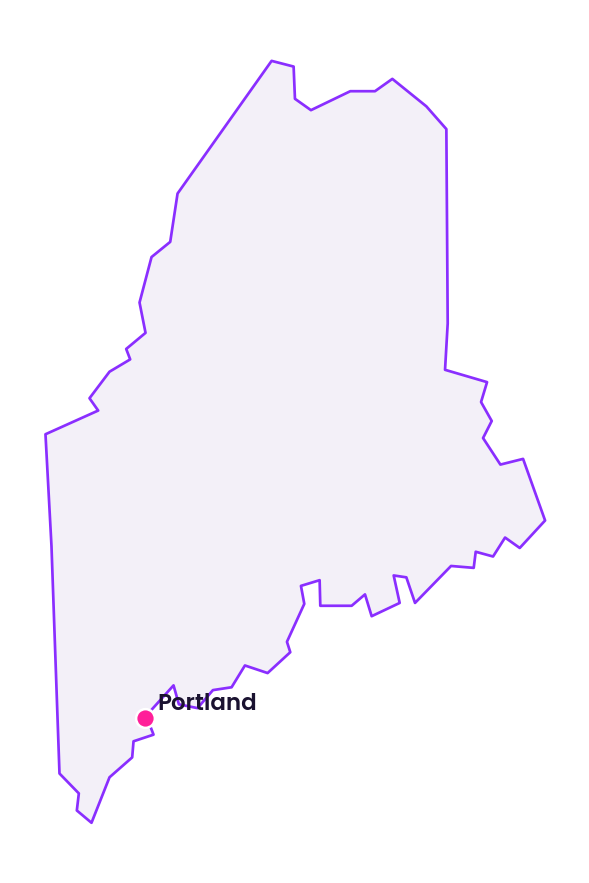
Section 02Population and Migration
The American Community Survey 2024 1 year estimates report 68,854 people in the city of Portland, 308,827 in Cumberland County, and 562,843 in the Portland South Portland metro. Calculated from those three ACS counts, the city is about 22.3 percent of the county and about 12.2 percent of the metro. Portland is the brand and the rental engine. Most of the region’s people and owners live outside the city line in South Portland, Westbrook, Scarborough, Falmouth, and the rest of Cumberland and York Counties.
Race and ethnicity counts from the same 2024 1 year file show a city that is less White than the county and still far less Hispanic than many coastal metros.
| Geography (ACS 2024 1 year) | Total population | White alone | Black or African American alone | Asian alone | Some other race alone | Two or more races | Hispanic or Latino (any race) |
|---|---|---|---|---|---|---|---|
| Portland city | 68,854 | 53,725 | 6,385 | 2,689 | 866 | 5,099 | 2,152 |
| Cumberland County | 308,827 | 266,236 | 10,699 | 6,792 | 2,682 | 21,778 | 8,682 |
| Portland South Portland metro | 562,843 | 497,318 | 13,305 | 9,359 | 5,148 | 36,616 | 14,140 |
The city’s Black population of 6,385 is a much larger share of local residents than the metro share. The Hispanic or Latino count of 2,152 in the city and 14,140 in the metro is modest by national coastal standards. Demographic change in Portland is less about a single ethnic wave and more about New England in movers, refugee and immigrant communities already present, and a White plurality that still dominates the suburbs.
Geographic mobility is the demand tell. The American Community Survey 2024 1 year estimates cover 68,886 city residents age one year and over.
| Mobility status, city of Portland (ACS 2024 1 year, population 1 year and over) | People |
|---|---|
| Same house 1 year ago | 58,010 |
| Moved within Cumberland County | 4,438 |
| Moved from a different Maine county | 1,225 |
| Moved from a different state | 4,768 |
| Moved from abroad | 445 |
The same house share is 58,010 of 68,886, or about 84.2 percent, calculated from those ACS counts. The striking cell is the 4,768 interstate in movers. That flow is large relative to a city of 68,854 people. It is the public statistical footprint of the Boston overflow, remote work, and lifestyle migration story that local brokers describe in words. The 4,438 within county movers are the churn that fills existing apartments. The 445 arrivals from abroad are smaller but real.
Cumberland County’s 2024 1 year mobility file shows 10,126 people who moved from a different state and 4,043 who moved from abroad, among 311,444 residents age one year and over. The metro file shows 17,109 interstate movers among 567,726 people age one year and over. Portland is capturing a thick slice of a regional in migration stream, not inventing one.
Investors should not convert the single 2024 ACS snapshot into a precise growth rate. The 2024 levels already show a small city absorbing a large interstate flow.
Section 03Jobs and Economic Anchors
The Bureau of Labor Statistics metropolitan unemployment ranking for June 2026, not seasonally adjusted, places Portland South Portland Maine at 2.3 percent, tied for third lowest in the United States with the Portland South Portland Maine area listed alongside other sub 3.0 percent markets. The United States rate in that same release was 4.4 percent. Fifteen metros had rates below 3.0 percent. Portland is in that scarce group.
A complete current payroll table by supersector for the Portland South Portland Biddeford New England city and town area was not retrieved. The Bureau of Labor Statistics Maine Economy at a Glance table, extracted 13 August 2026, is the closest official payroll proxy and must be read as a state series, not a city series.
| Maine statewide sector (BLS, June 2026 preliminary, seasonally adjusted) | Jobs (thousands) | 12 month change |
|---|---|---|
| Total nonfarm | 660.4 | -0.1% |
| Mining and logging | 1.9 | -5.0% |
| Construction | 35.0 | -1.4% |
| Manufacturing | 51.6 | +0.6% |
| Trade, transportation, and utilities | 119.2 | +0.1% |
| Information | 7.7 | -4.9% |
| Financial activities | 33.2 | +0.9% |
| Professional and business services | 76.6 | -1.8% |
| Education and health services | 138.4 | +0.4% |
| Leisure and hospitality | 70.1 | -0.3% |
| Other services | 23.1 | +1.8% |
| Government | 103.6 | +0.2% |
Maine’s job machine is not expanding in 2026. Education and health services is the largest supersector at 138,400 jobs. Trade, transportation, and utilities is second. Professional and business services is shrinking. Leisure and hospitality, the coastal tourist engine, was down 0.3 percent in June after a stronger winter and spring. Construction is down 1.4 percent. The state is fully employed and not adding many net jobs.
That combination is the Portland paradox. A 2.3 percent metro unemployment rate means employers cannot staff easily. A flat to slightly down state payroll means demand growth must come from people moving in, from wage gains, and from the city’s role as the service, hospital, port, and professional hub, not from a Sun Belt style hiring boom. MaineHealth, the University of Southern Maine and other colleges, the Port of Portland, insurance and professional firms, and the visitor economy are the named local anchors in ordinary public discussion.
The ACS 2024 1 year commute file shows how the city works. Of 44,924 city workers, 25,536 drove alone, 2,797 carpooled, 711 used public transportation, 4,922 walked, 905 biked, and 9,346 worked from home. Drive alone is 25,536 of 44,924, or about 56.8 percent. Work from home is 9,346 of 44,924, or about 20.8 percent. Walking is 4,922 of 44,924, or about 11.0 percent. Those walk and work from home shares are high for a United States city of this size and they support downtown and peninsula rents.
Section 04Income
The American Community Survey 2024 1 year median household income was 79,540 dollars in Portland, 95,677 dollars in Cumberland County, and 92,175 dollars in the metro. Per capita income was 52,781 dollars in the city, 55,739 dollars in the county, and 52,055 dollars in the metro. The city is poorer than its county on a household basis and close to the metro on a per capita basis, which is what a renter heavy, smaller household city looks like.
Tenure splits income the way it does in other high cost cores. City owner occupied median household income was 117,921 dollars. City renter occupied median household income was 54,776 dollars. In Cumberland County the owner median was 115,022 dollars and the renter median was 59,461 dollars.
| Income measure (ACS 2024 1 year) | Portland city | Cumberland County | Metro |
|---|---|---|---|
| Median household income (all households) | $79,540 | $95,677 | $92,175 |
| Per capita income | $52,781 | $55,739 | $52,055 |
| Median household income, owner occupied | $117,921 | $115,022 | no complete metro figure was retrieved |
| Median household income, renter occupied | $54,776 | $59,461 | no complete metro figure was retrieved |
Calculated from the two city ACS medians, owner households report about 2.2 times the income of renter households. A 54,776 dollar renter median against a 1,577 dollar city median gross rent is the affordability bind. Twelve months of that median rent is 18,924 dollars, which is 18,924 of 54,776, or about 34.5 percent of the median renter household income before other utilities that are not in rent. The typical renter is already near a conventional burden threshold at the stock median, before any new lease premium.
Poverty is higher in the city than in the suburbs, but not at Sun Belt inner city levels. The ACS 2024 1 year poverty universe is 67,363 people in the city, of whom 7,553 had income below poverty, or about 11.2 percent, calculated from those counts. Cumberland County is 21,990 of 299,280, or about 7.3 percent. The metro is 42,023 of 549,610, or about 7.6 percent. Portland has a real low income renter population living next to a high value owner population. That is a collections and property operations fact, not only a social fact.
No official Bureau of Economic Analysis county personal income reprint for Cumberland County was retrieved in usable form. The ACS series above is the current public income baseline.
Section 05Housing and Multifamily
Portland is a renter majority city inside an owner majority region. The American Community Survey 2024 1 year occupancy extract used for tenure counts 36,559 housing units in the city, of which 32,965 are occupied and 3,594 are vacant. Of the occupied units, 15,445 are owner occupied and 17,520 are renter occupied. The renter share is 17,520 of 32,965, or about 53.1 percent, calculated from those ACS counts. Cumberland County has 153,286 units, 132,168 occupied, 92,265 owner, and 39,903 renter. The metro has 287,616 units, 240,027 occupied, 175,751 owner, and 64,276 renter. The metro renter share is 64,276 of 240,027, or about 26.8 percent. The city is where the region’s renters live.
A separate American Community Survey 2024 1 year structure table reports 39,175 city housing units. That table is not forced into the same inventory total as the occupancy extract. It is the right source for building type and age.
| Units in structure, city of Portland (ACS 2024 1 year) | Housing units |
|---|---|
| 1 unit detached | 13,209 |
| 1 unit attached | 1,860 |
| 2 units | 3,692 |
| 3 or 4 units | 6,567 |
| 5 to 9 units | 4,371 |
| 10 to 19 units | 3,378 |
| 20 to 49 units | 2,883 |
| 50 or more units | 3,215 |
| Total | 39,175 |
The New England triple decker and small walk up is the city’s true multifamily stock. Buildings with two, three, or four units total 3,692 plus 6,567, or 10,259 units. Buildings with five or more units total 4,371 plus 3,378 plus 2,883 plus 3,215, or 13,847 units. Detached houses are only 13,209 of 39,175, or about 33.7 percent of the structure file. This is not a garden apartment Sun Belt city. It is a peninsula of wood frame small buildings, with a thinner layer of larger elevator product.
Age makes that stock expensive to keep.
| Year built, city of Portland (ACS 2024 1 year) | Housing units |
|---|---|
| 2020 or later | 903 |
| 2010 to 2019 | 2,685 |
| 2000 to 2009 | 2,435 |
| 1990 to 1999 | 1,795 |
| 1980 to 1989 | 3,323 |
| 1970 to 1979 | 2,311 |
| 1960 to 1969 | 2,212 |
| 1950 to 1959 | 2,767 |
| 1940 to 1949 | 2,350 |
| 1939 or earlier | 18,394 |
Units built in 1939 or earlier are 18,394 of 39,175, or about 46.9 percent of the structure file. Units built in 2020 or later are only 903. The city added some 2010s product, but the dominant capital expenditure story is prewar wood frame, lead paint, old wiring, old boilers, and coastal moisture. That is a barrier to new supply and a tax on existing landlords.
For investors the housing system is three products. Small two to four unit buildings are the local specialty and the natural single family rental adjacent strategy. Conventional multifamily of five or more units exists but is not the majority of the rental inventory. Detached houses are a minority of the city stock and a majority of the suburban stock, which is where a regional single family rental bid would actually scale.
Section 06Rents
The official public rent set retrieved for this review is the American Community Survey 2024 1 year median gross rent. A fiscal year 2026 HUD Fair Market Rent table for the Portland South Portland area did not return usable bedroom values in the documentation system queries attempted for this review. ACS is therefore the rent baseline, and it should be read as occupied stock, including long tenured leases, not as a new lease survey.
Median gross rent was 1,577 dollars in the city, 1,589 dollars in Cumberland County, and 1,485 dollars in the metro. The city rents above the metro. That is the opposite of many Sun Belt cores, where the city median is pulled down by older stock. In Portland the city is the expensive product.
| Median gross rent by bedrooms (ACS 2024 1 year) | Portland city | Cumberland County | Metro |
|---|---|---|---|
| All units paying cash rent | $1,577 | $1,589 | $1,485 |
| No bedroom | $1,076 | $1,093 | $1,089 |
| 1 bedroom | $1,443 | $1,359 | $1,211 |
| 2 bedrooms | $1,711 | $1,741 | $1,608 |
| 3 bedrooms | $2,067 | $2022 | $1,859 |
| 4 bedrooms | $1,421 | $2,164 | $2,101 |
| 5 or more bedrooms | $1,199 | $2,152 | $1,750 |
The city one bedroom median of 1,443 dollars and two bedroom median of 1,711 dollars are the underwriting marks for peninsula apartments. The city three bedroom median of 2,067 dollars is the small building and family rental mark. The city four bedroom and five bedroom medians sit below the three bedroom median. That inversion is what a student house, a subdivided old building, or a thin sample looks like in ACS, and it should not be used as a four bedroom asking rent forecast.
Apartment List’s July 2026 national rent report put the United States median rent at 1,388 dollars, down 1.1 percent from a year earlier, with national multifamily vacancy at 7.2 percent. Portland’s ACS city median of 1,577 dollars is above that national median. The Apartment List report did not publish a usable Portland city median in the retrieved text. No CoStar, Yardi Matrix, or RealPage asking rent for Portland was retrieved.
Rent burden is severe. The ACS 2024 1 year table on gross rent as a share of income covers 19,935 city renter households.
| Gross rent as a percent of household income, Portland city (ACS 2024 1 year) | Renter households |
|---|---|
| Less than 10.0 percent | 614 |
| 10.0 to 14.9 percent | 1,495 |
| 15.0 to 19.9 percent | 1,644 |
| 20.0 to 24.9 percent | 2,815 |
| 25.0 to 29.9 percent | 1911 |
| 30.0 to 34.9 percent | 1960 |
| 35.0 to 39.9 percent | 2,844 |
| 40.0 to 49.9 percent | 1,700 |
| 50.0 percent or more | 3,479 |
| Not computed | 1,473 |
Excluding the 1,473 units without a computed ratio leaves 18,462 households. Of those, 1960 plus 2,844 plus 1,700 plus 3,479, or 9,983 households, pay 30 percent or more of income toward gross rent. That is 9,983 of 18,462, or about 54.1 percent. Households paying 50 percent or more are 3,479 of 18,462, or about 18.8 percent. More than half of city renter households with a computed ratio are cost burdened. That supports occupancy. It does not support a thesis of easy annual rent increases.
Section 07Vacancy
The ACS 2024 1 year vacant housing count is 3,594 of 36,559 city units in the occupancy extract, 21,118 of 153,286 county units, and 47,589 of 287,616 metro units. Calculated vacancy rates from those counts are about 9.8 percent in the city, 13.8 percent in the county, and 16.5 percent in the metro. Those county and metro rates are not a soft apartment market. They are the statistical signature of a coastal second home and seasonal region. ACS vacancy includes units held for seasonal or recreational use. Cumberland County’s vacant count of 21,118 is larger than the city’s entire vacant plus a large share of its occupied rental stock.
City vacancy of about 9.8 percent on the ACS definition is the more relevant local number and is still not a professionally managed apartment vacancy rate. It includes units rented or sold but not occupied, other vacant houses, and seasonal units on the peninsula and islands. A current named public multifamily vacancy rate from CoStar, Yardi Matrix, RealPage, or MaineHousing was not retrieved. Apartment List’s 7.2 percent national vacancy in July 2026 is a United States figure, not a Portland figure.
Absorption is unpublished in official form. The ACS occupied count is a stock measure. The 4,768 interstate in movers are a demand flow, not a unit absorption total. Investors should not convert either number into a false lease up pace.
Section 08Supply Pipeline
No official public count of multifamily units under construction, units permitted, or units in site plan review was retrieved from the City of Portland planning portal or from a Census Bureau building permit reprint. The ACS 2024 1 year count of 903 city units built in 2020 or later is completed stock, not a pipeline. Maine statewide construction employment of 35,000 in June 2026, down 1.4 percent year over year, is a labor capacity signal, not a Portland unit count.
The age of the stock is itself a supply fact. When nearly half of city units predate 1940 and only 903 units in the ACS file were built in 2020 or later, the city is not delivering its way out of scarcity quickly. Until a permit extract is in hand, the pipeline should be treated as unknown rather than as proven tight or proven loose.
Section 09Single Family Homes
The Federal Housing Finance Agency all transactions house price index for the Portland South Portland metro is the official price history.
| Period (FHFA all transactions HPI, 1995 Q1 = 100, metro) | Index |
|---|---|
| 2020 Q1 | 283.14 |
| 2021 Q1 | 314.07 |
| 2022 Q1 | 378.89 |
| 2023 Q1 | 423.80 |
| 2024 Q1 | 460.02 |
| 2025 Q1 | 489.26 |
| 2025 Q4 | 507.38 |
| 2026 Q1 | 507.98 |
From the first quarter of 2025 to the first quarter of 2026 the index rose from 489.26 to 507.98, a gain of 18.72 points, or about 3.8 percent, calculated from the FHFA figures. From the first quarter of 2020 to the first quarter of 2026 the gain was 224.84 points, or about 79.4 percent. The first quarter of 2026 is only a small step above the fourth quarter of 2025. The violent part of the move is over. The level remains historically high.
The ACS 2024 1 year median value of owner occupied units was 489,600 dollars in the city, 451,200 dollars in Cumberland County, and 420,000 dollars in the metro. The city is the expensive node. A city owner household median income of 117,921 dollars can carry that value more easily than a renter household median of 54,776 dollars can buy it. That is why the renter share stays above half.
Single family rental inside the city is mostly the two to four unit building, not the suburban detached house. Detached units are 13,209 in the 2024 1 year structure file. Two unit buildings are 3,692 and three or four unit buildings are 6,567. The three bedroom city median gross rent of 2,067 dollars is the public rent marker for that product. It does note that the building typology already is small multifamily, which is why Portland landlords have always been house hackers and triple decker operators.
The FHFA index and the ACS median value are the official public price set.
Section 10Commercial Real Estate and Retail Centers
No official public vacancy rate, asking rent, absorption total, or cap rate for office, industrial, or retail in Portland was retrieved from CoStar, Yardi Matrix, RealPage, or a local assessor commercial survey. The discussion is limited to public demand drivers and to an honest statement of what is missing.
Office demand is supported by the city’s professional role and by a 20.8 percent work from home share among city workers. Maine statewide professional and business services employment is 76,600 and falling at a 1.8 percent annual rate. Financial activities are 33,200 and slightly up. That mix argues for a selective downtown office market, not a broad leasing boom. Conventional office occupancy should be treated as unknown until a named survey is in hand.
Industrial and logistics demand follows the port, Interstate 95, Interstate 295, and the trade, transportation, and utilities supersector, which employs 119,200 people statewide and was essentially flat in June 2026. Portland’s working waterfront and the suburban warehouse ring are the two industrial geographies. No official industrial vacancy was retrieved.
Retail, including grocery anchored centers, follows residents, workers, and visitors. Leisure and hospitality employs 70,100 people statewide and was down 0.3 percent in June 2026 after earlier year over year gains. The Old Port and peninsula food and beverage cluster is the high rent retail form. Grocery and necessity retail in Deering, Riverton, and the South Portland fringe is the more defensive form. No official grocery vacancy or sales per square foot series was retrieved.
Section 11Transactions and Capital Markets
No official public tally of 2025 or 2026 commercial or multifamily transaction volume, median cap rate, or debt pricing for Portland was retrieved. The FHFA house price index and the ACS rent and value medians are asset pricing facts. They are not a closed deal sample.
What the public tape shows is a market that has already been bid up. Metro house prices are about 79.4 percent above early 2020. City median owner value is 489,600 dollars. City median gross rent is 1,577 dollars. Those levels usually mean lower going in yields than a Midwestern peer and stronger seller expectations. Whether 2026 buyers have paid those expectations is not in the public set used here.
Section 12Taxes
A current official millage rate, assessment ratio, or typical tax bill for a Portland parcel was not retrieved from the City of Portland assessor or from the Cumberland County registry.
Section 13Insurance
No official public average homeowners, landlord, or flood insurance premium for Portland or Cumberland County was retrieved. Portland is a North Atlantic coastal city. The insurance conversation is winter storm, freeze, coastal flood, and wind, not a Florida style hurricane pool. FEMA flood maps apply along the harbor, Back Cove, the Fore River, and low peninsula blocks. A Washington County style numeric FEMA National Risk Index score for Cumberland County was not retrieved. Parcel level flood zone status must come from the current FEMA map and the lender’s determination.
Section 14Landlord Tenant and Regulatory Environment
Maine residential tenancies at will are governed by Title 14, section 6,002 of the Maine Revised Statutes. The current official text retrieved for this review requires a minimum of 30 days written notice to terminate a tenancy at will, with specified exceptions. A 7 day written notice is available when the landlord can show, among other listed grounds, that the tenant is 7 days or more in arrears in rent, that the tenant caused substantial unrepaired damage, that the tenant caused or permitted a nuisance or made the unit unfit for habitation, or that certain violence or unauthorized occupancy grounds apply. If a tenant who is 7 days or more in arrears pays the full rent due before the 7 day notice expires, that notice is void. After the notice expires, payment of all arrears, current rent, and the landlord’s actual filing and service fees before issuance of a writ of possession reinstates the tenancy. The statute also recognizes habitability as an affirmative defense in a rent arrearage case and provides separate notice paths for victims of domestic violence, sexual assault, or stalking.
Those state rules are more protective of the tenant’s ability to cure than a pure pay or quit regime. They belong in every Portland underwriting model.
The City of Portland maintains a rental housing regulatory page. Investors must read the current city ordinance and licensing rules directly.
Federal fair housing law applies. A peninsula with a large renter share, a real poverty population, and a high share of old small buildings is a compliance intensive operating environment.
Section 15Infrastructure
Portland sits on Casco Bay at the junction of Interstate 295 and the broader Interstate 95 Maine Turnpike system, with US Route 1 as the local coastal arterial. The Port of Portland is a working cargo and ferry port. Portland International Jetport is the commercial airfield. The peninsula is walkable. The ACS 2024 1 year file already showed 4,922 city workers walking and 905 biking.
No official public count of reserved sewer capacity, a named transit expansion’s ridership, or a jetport passenger total was retrieved. The city’s small land area and water on three sides of the peninsula are themselves infrastructure facts. Horizontal expansion inside the city line is limited. Growth has to go up, into old buildings, or into the suburbs.
Section 16Climate and Physical Risks
A NOAA climate normals table for the Portland jetport station was not retrieved. A FEMA National Risk Index numeric score for Cumberland County was not retrieved. The physical risk section is therefore qualitative and bounded.
Portland has a long, cold, wet winter, freeze thaw cycles that break roofs and masonry, and coastal storms that bring wind, rain, and harbor flooding. Summer is milder than the Mid Atlantic. Heat is not the primary design load. Moisture, ice, and flood are. Wood frame buildings from 1939 or earlier are the inventory most exposed to those perils.
Section 17Neighborhoods and Submarkets
Official ACS figures in this review are city, county, and metro. They are not neighborhood medians. The following geography is descriptive.
The peninsula is the renter and visitor core: the Old Port, the West End, the East End, Munjoy Hill, Bayside, and Parkside. Walking shares and one bedroom rents live here. Values are the reason the city ACS median owner value of 489,600 dollars exceeds the metro median of 420,000 dollars. Operations are old building operations.
Deering, Riverton, North Deering, and the edges toward Westbrook and Falmouth are the more auto oriented city neighborhoods, with more detached stock and more three bedroom product at the 2,067 dollar ACS city median.
The islands and the immediate coastal towns explain the high ACS vacant counts at the county and metro scale. Those vacant units are not Class A apartment vacancy.
South Portland, Westbrook, Scarborough, and the rest of the metro are the owner majority, newer, and more family oriented complements. An investor who needs the region and not only the peninsula should underwrite those towns with their own extracts.
No official public rent or vacancy series was retrieved for these submarkets.
Section 18Opportunities
The public data support a narrow opportunity set.
First, the city is structurally renter majority, with 17,520 renter households against 15,445 owner households in the ACS occupancy extract. That is durable in a peninsula that cannot sprawl.
Second, the labor market is among the tightest in the country. A 2.3 percent June 2026 metro unemployment rate is a staffing constraint for employers and an occupancy support for landlords.
Third, interstate in migration is large. The ACS counts 4,768 city residents who arrived from another state in the prior year. That is a bid for one bedroom and two bedroom product at the 1,443 dollar and 1,711 dollar ACS medians.
Fourth, the two to four unit stock is deep. Combined, those buildings total 10,259 units in the 2024 1 year structure file. That is the local asset class.
Fifth, new supply since 2020 is thin in the ACS file at 903 units. Scarcity is the city’s friend if demand holds.
Section 19Risks
The same files define the risks.
Rents are already high relative to renter incomes. About 54.1 percent of city renter households with a computed ratio pay 30 percent or more of income in gross rent. The renter income median is 54,776 dollars.
The stock is old. About 46.9 percent of units in the structure file predate 1940. Capital expenditure, insurance, and code risk are not theoretical.
House prices have already rerated. An FHFA metro increase of about 79.4 percent since early 2020 leaves less room for multiple expansion. The latest quarter is nearly flat.
State payrolls are not growing. Maine nonfarm jobs were down 0.1 percent year over year in June 2026. Portland cannot lean on a statewide hiring boom.
Regulation is real. Maine’s 30 day and 7 day notice statute, including the right to cure rent arrears, lengthens the path to possession.
Commercial and capital markets data are missing. So are tax millage, insurance premiums, HUD Fair Market Rents, and the pipeline. Underwriting from this review alone would be incomplete.
Seasonal vacancy at the county and metro scale can fool a careless reader into thinking apartments are empty. They are not the same statistic.
Section 20Investor Implications
Portland is best understood as a small, expensive, renter majority coastal city with a tight labor market and an old housing stock, not as a high growth Sun Belt metro and not as a cheap New England leftover. The Bureau of Labor Statistics says unemployment is among the lowest in the country. The ACS says renters are the majority and are already burdened. FHFA says ownership already repriced. The structure file says the product is small wood frame buildings.
Implications follow those facts. Strategies that depend on occupancy, in migration, and scarce peninsula land have public support. Strategies that depend on large unpaid rent growth among households earning 54,776 dollars do not. Two to four unit buildings are the native asset class. Conventional multifamily exists but is not the whole market. Commercial real estate requires a data room this public review could not fill. Tax, insurance, flood, and city ordinance files are parcel work.
This is a framing document. Entry, basis, and asset selection remain decisions for principals.
Section 21Conclusion
Portland in August 2026 is a city of 68,854 people inside a 562,843 person metro with a 2.3 percent June 2026 unemployment rate. City median gross rent is 1,577 dollars, city median owner value is 489,600 dollars, and about half of city renter households with a computed rent to income ratio are cost burdened. House prices on the FHFA metro index are far above 2020 and only slightly above late 2025. The housing stock is old and the interstate in mover stream is large. The missing vacancy, pipeline, cap rate, HUD, tax, and insurance series show why a site visit, a city ordinance read, and a parcel record pull are not optional. The market is scarce and expensive. The public tape is incomplete. That is the honest close.