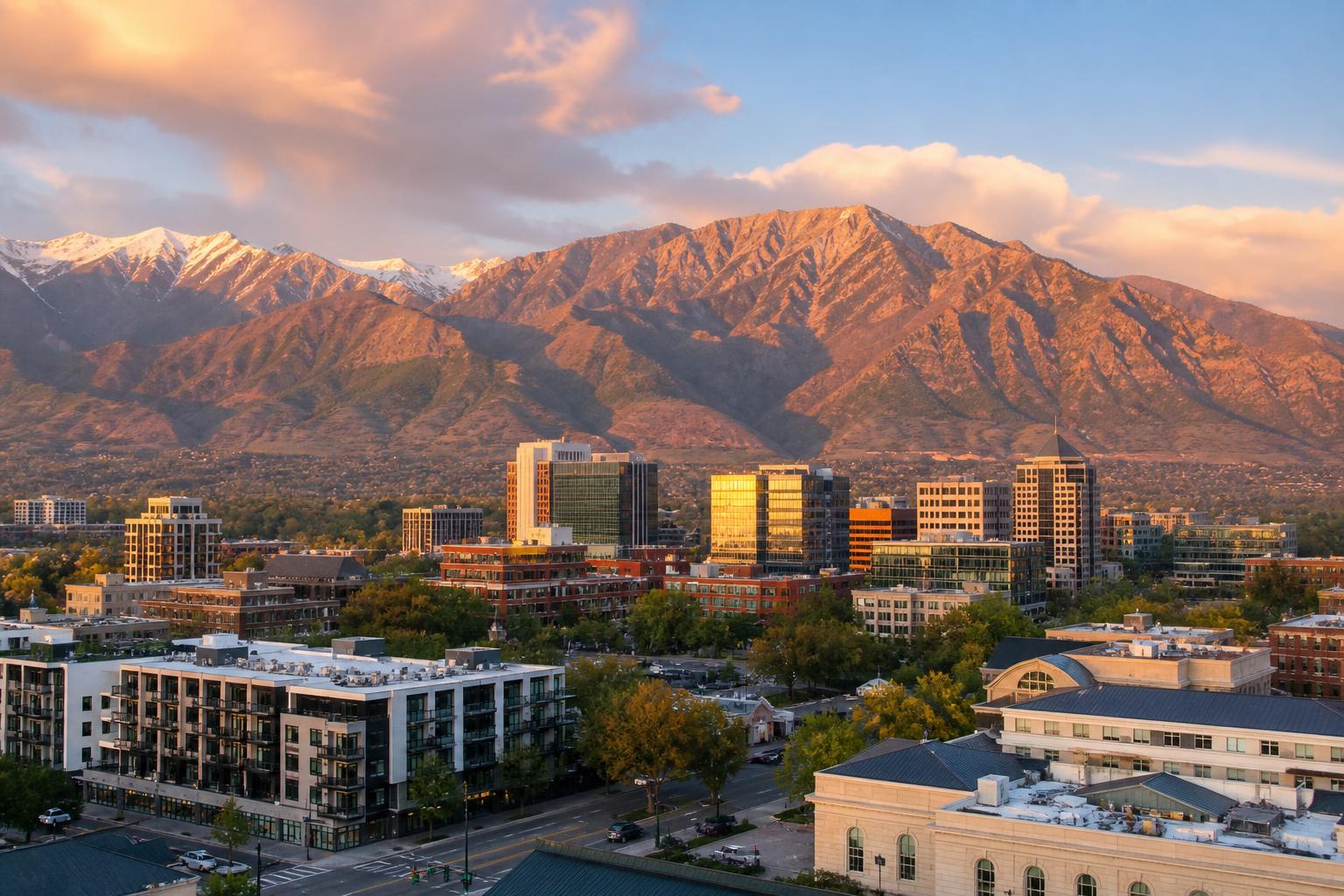
In brief · summary: Provo
Provo is the anchor city of Utah County, home to Brigham Young University and a fast growing technology corridor known locally as Silicon Slopes, and the metropolitan area that bears its name, renamed by federal statisticians to Provo-Orem-Lehi in recognition of Lehi's growth, was ranked the number one large metro area in the country for economic growth in the Brookings Institution's 2025 Metro Monitor, as reported by the BYU-Idaho Scroll in 2025. That growth shows up directly in real estate fundamentals: a commercial mortgage brokerage's March 2026 Provo market report put multifamily vacancy at just 5.0 percent with rent growth of 4.6 percent year over year, and industrial vacancy at an exceptionally tight 3.8 percent.
The market's defining feature for an investor is its dual demand base. Brigham Young University enrolled 35,873 students in the 2024-2025 academic year according to enrollment data compiled by Univstats, and that population drives a distinct, seasonal rental cycle layered on top of a growing base of software and technology employment from firms such as Qualtrics, Vivint, Nu Skin, Domo, and Podium. Single family home values are comparatively soft and diverging by data source, office vacancy is elevated in the broader Salt Lake City-Provo submarket even as the Provo-specific reading looks tighter, and the market carries two physical risks that are unusual among the cities in this series: the Wasatch fault, one of the most studied active fault systems in the country, and newly effective FEMA flood maps along the Provo River.
Section 01Executive Summary
Provo sits about 45 miles south of Salt Lake City at the base of the Wasatch Range, and it is both a college town and an increasingly important node in Utah's technology economy. The Brookings Institution's 2025 Metro Monitor ranked the Provo, Orem, and Lehi metropolitan cluster number one in the nation in economic growth among large metro areas, a finding reported by the BYU-Idaho Scroll in 2025, and the Kem C. Gardner Policy Institute's growth rankings, as covered by KSL.com, have repeatedly placed Utah County cities among the fastest growing in the state. That growth has translated into a multifamily market with genuinely tight fundamentals: a commercial real estate financing report published by CLS CRE on March 26, 2026 measured Provo multifamily vacancy at 5.0 percent and year over year rent growth of 4.6 percent, alongside industrial vacancy of just 3.8 percent, both well inside what most operators would consider a landlord favorable range.
The city's demand base is unusual among American metros because it is anchored so heavily by a single university. Brigham Young University, a private institution operated by The Church of Jesus Christ of Latter-day Saints, enrolled 35,873 students in the 2024-2025 academic year according to enrollment figures compiled by Univstats, inside a city whose total population is only around 115,000 according to the Census Bureau's American Community Survey as reported by Data USA. That ratio means Provo's rental market moves on an academic calendar as much as an economic one, with the heaviest leasing activity concentrated in July and August ahead of the fall semester, a pattern described in Homie's 2026 Provo housing market analysis. Layered on top of the university economy is a genuine technology cluster, commonly branded Silicon Slopes, that includes Qualtrics, Vivint Smart Home, Nu Skin, Domo, Podium, doTERRA, and Young Living, several of which were founded locally.
The offsetting facts an investor needs to weigh are a single family housing market that shows real divergence across data sources, an office market that looks considerably softer when measured at the combined Salt Lake City-Provo level than in Provo-specific commercial reporting, and physical risk factors that are structural to the Wasatch Front: active fault rupture risk and newly effective flood maps along the Provo River. Property taxes and Utah's flat state income tax are both moderate by national standards, but homeowners insurance premiums have risen sharply and a new state wildfire mitigation fee took effect in 2026. On balance, Provo offers a smaller, thinner, but genuinely undersupplied market where operational fluency with student housing rules and hazard underwriting matter more than in most of the other cities in this series.
Section 02Population and Migration
Provo city itself is a mid-sized municipality inside a much larger and faster growing county. The Census Bureau's American Community Survey, as compiled by Data USA using 2024 data, put the city of Provo's population at approximately 114,766, while a separate compilation from Census Reporter using the 2024 one-year American Community Survey estimate put it slightly higher at about 115,496. Utah County, the broader jurisdiction that contains Provo, Orem, Lehi, and a wide ring of fast growing suburbs, had an estimated resident population of roughly 759,859 as of 2025 according to Federal Reserve Bank of St. Louis data sourced from the Census Bureau. The Office of Management and Budget renamed the metropolitan statistical area from Provo-Orem to Provo-Orem-Lehi in its 2023 delineation update, a change that reflects how much of the county's recent growth has occurred in Lehi at the metro's northern edge, a shift documented on Wikipedia's metropolitan area pages that cite the underlying OMB delineation notices.
The growth signal is unusually strong relative to the rest of the country. The Brookings Institution's 2025 Metro Monitor ranked the Provo-Orem-Lehi area first in the nation in overall economic growth among metro areas with between 500,000 and 1 million residents, a result reported by the BYU-Idaho Scroll in 2025. KSL.com, drawing on growth data associated with the University of Utah and the state's demographic researchers, reported in 2025 on which Utah cities grew fastest, consistently placing Utah County communities such as Lehi, Saratoga Springs, and Eagle Mountain near the top of the state list even as core cities like Provo and Orem showed smaller or slightly negative single-year city-level changes according to some estimates. That pattern, in which the county as a whole grows quickly while the core cities grow more slowly or even lose a small number of residents in a given year, is consistent with growth concentrating in newer suburban development at the county's edges rather than infill in Provo and Orem themselves.
| Geography | Population | Scope and source |
|---|---|---|
| City of Provo | ~114,766 to ~115,496 | 2024 ACS, Data USA and Census Reporter |
| Utah County | ~759,859 | 2025 estimate, Census Bureau via FRED |
| Provo-Orem-Lehi metropolitan area | ranked #1 in growth, large metros | 2025, Brookings Metro Monitor via BYU-Idaho Scroll |
The conclusion for an investor is that Provo city is a comparatively small, dense, and largely built out core inside a metropolitan county that continues to rank among the fastest growing in the nation, and that the growth engine of the metro, the technology and university economy, is centered in Provo even where the newest housing construction is occurring elsewhere in the county.
Section 03Jobs and Economic Anchors
Employment in the Provo-Orem metropolitan area continues to expand at a moderate pace with an unemployment rate that remains among the lowest of any major metro in the country. The Bureau of Labor Statistics Economy at a Glance data for the Provo-Orem MSA, for July 2026 on a preliminary basis, reported total nonfarm employment of about 316,600, up 1.3 percent year over year, and an unemployment rate of 3.7 percent. USAFacts, citing BLS data for June 2026, separately reported an unemployment rate of 3.8 percent, down 0.1 percentage point from a year earlier, and noted that among 108 metro areas with a labor force above 250,000, Provo ranked 31st lowest in unemployment, a solidly healthy standing.
| Indicator, Provo-Orem metro | Value | Change | Scope and source |
|---|---|---|---|
| Total nonfarm employment | 316,600 | +1.3% | July 2026 preliminary, BLS Economy at a Glance |
| Unemployment rate | 3.7% | preliminary | July 2026, BLS Economy at a Glance |
| Unemployment rate | 3.8% | -0.1 pt YoY | June 2026, USAFacts via BLS |
| Professional and business services | 47,900 | +1.7% | July 2026 preliminary, BLS |
| Education and health services | 67,500 | +1.2% | July 2026 preliminary, BLS |
| Mining, logging, and construction | 32,900 | +2.2% | July 2026 preliminary, BLS |
The economic base behind these figures is unusually concentrated for a metro of this size. Brigham Young University and Utah Valley University, a large public institution based in neighboring Orem, together enroll well over 70,000 students and are among the area's largest employers, with BYU alone reporting 35,873 students in the 2024-2025 academic year per Univstats' compilation of enrollment data. Alongside the universities and Intermountain Healthcare's hospital and clinical network, the technology cluster branded Silicon Slopes has become the area's principal growth engine: CLS CRE's March 2026 Provo market report named Adobe, Qualtrics, Ancestry, Vivint Smart Home, Domo, Podium, Young Living Essential Oils, and doTERRA as key economic drivers in the market, several of which were founded in Provo or Utah County. For real estate, the combination of a large, stable institutional employment base with a fast growing software sector supports both steady student and workforce rental demand and rising incomes among a segment of higher wage tech workers.
Section 04Income
Household income in Provo itself is modest, held down by the large student population that reports little or no income, while income in the surrounding county is considerably higher and closer to the national norm. Data USA's compilation of Census Bureau American Community Survey data put Provo's median household income at $64,171 in 2024, up 2.18 percent from $62,800 the prior year, while Census Reporter's estimate using the 2024 one-year ACS, which carries a wider margin of error for a city this size, put the figure lower at about $60,139. Utah County as a whole reports very different numbers: Federal Reserve Bank of St. Louis data sourced from the Census Bureau put Utah County's median household income at $100,671 for 2024, about 5.8 percent above the Utah state median and roughly 25 percent above the national median.
| Geography | Median household income | Scope and source |
|---|---|---|
| City of Provo | $60,139 to $64,171 | 2024 ACS, Census Reporter and Data USA |
| Utah County | $100,671 | 2024, Census Bureau via FRED |
The gap between the city and county figures is the single most important income fact for an investor to internalize. It reflects the presence of tens of thousands of BYU students who live in the city but report little income, alongside a genuinely affluent surrounding county driven by tech and professional wages. Data USA also reported that Provo's poverty rate rose to about 23 percent in 2024, up from the prior year, a figure that should be read in the context of the student population rather than as a pure measure of local economic distress. For a real estate investor this means Provo city rental income is anchored less by resident wages and more by parental contribution, student loans, and roommate cost sharing, while assets in the surrounding county are supported by a materially higher and more conventional income base.
Section 05Housing and Multifamily
Provo's apartment market is genuinely tight by national standards. CLS CRE, a nationwide commercial mortgage brokerage, published a Provo commercial real estate market report on March 26, 2026 that measured multifamily vacancy at 5.0 percent with year over year rent growth of 4.6 percent, a median asking rent of $1,895, and multifamily cap rates ranging from 4.75 to 5.50 percent. That report attributed the strength directly to population growth, high software sector wages, and substantial student housing demand anchored by BYU. A separate consumer rent tracking source, Rent., reported a lower average asking rent range for the broader market of between $1,199 for studios and $1,521 for two bedroom units in 2026, a difference that likely reflects a broader and less institutionally focused property sample than the CLS CRE figure.
| Series and scope | Level or reading | Change | Period and source |
|---|---|---|---|
| Multifamily vacancy, Provo | 5.0% | tight | March 2026, CLS CRE |
| Multifamily rent growth, Provo | +4.6% YoY | not stated | March 2026, CLS CRE |
| Median asking rent, Provo | $1,895 | not stated | March 2026, CLS CRE |
| Average rent, studio to 2BR, broader market | $1,199 to $1,521 | not stated | 2026, Rent. |
| HUD Fair Market Rent, 2BR, Utah County | $1,253 | not stated | 2026, HUD Office of Policy Development and Research |
The BYU academic calendar is described by Homie's 2026 Provo housing market analysis as the single biggest seasonal force in the rental market, with the peak demand window landing in roughly July and August as students secure housing ahead of the fall semester, and student oriented two bedroom units near campus commanding $1,400 to $1,800 while three bedroom units run $1,800 to $2,400, well above the market-wide averages. For an investor, the practical read is that Provo multifamily fundamentals are tight and improving on a market-wide basis, but that returns on any individual asset depend heavily on whether it is licensed and configured for student occupancy, a distinction covered in the regulatory section below.
Section 06Rents
Rent growth in Provo has been running ahead of the national average even as the absolute rent level remains moderate. The CLS CRE market report's 4.6 percent year over year rent growth figure for March 2026 is a healthy pace for a market of this size, consistent with vacancy in the low single digits, and the U.S. Department of Housing and Urban Development's 2026 Fair Market Rent schedule for Utah County, which underpins federal housing voucher payment standards, set the two bedroom standard at $1,253, with a studio at $1,086, one bedroom at $1,093, three bedroom at $1,766, and four bedroom at $2,126.
The most important structural fact about Provo rents is the bifurcation between the student housing submarket, concentrated in properties licensed for multiple unrelated occupants near BYU and priced at a clear premium as documented above, and the conventional family and workforce rental stock elsewhere in the city and county, which trades closer to the broader market average. An investor comparing a quoted asking rent to the market averages in this section should first establish which submarket, and which occupancy license, the property in question falls into, because the two segments do not behave as a single fungible market the way they typically would in a large metro without a major university.
Section 07Vacancy
Vacancy is low across most Provo property types, though the picture diverges sharply by sector and by the geographic scope of the reporting source. CLS CRE's March 2026 report measured multifamily vacancy at 5.0 percent and industrial vacancy at an especially tight 3.8 percent, both figures that would be considered landlord favorable in almost any American metro. Retail vacancy in the same report was 4.2 percent, also tight. Office is the clear outlier and the sector where the choice of geography matters most: CLS CRE's Provo-specific figure put office vacancy at 10.5 percent, while CBRE's Salt Lake City-Provo office figures for the first quarter of 2026 reported vacancy of 22.8 percent and total availability of 23.2 percent for the combined submarket, with CBRE noting that fundamentals continued to improve on steady leasing activity, positive net absorption, and rent growth.
The gap between the 10.5 percent Provo-specific office reading and the 22.8 percent combined Salt Lake City-Provo reading is large enough that it should not be treated as a simple discrepancy; it more likely reflects the fact that the Salt Lake City portion of that combined market carries a much larger stock of older, post-pandemic-vacated office space than Provo's smaller and newer office inventory. An investor underwriting a Provo office asset should treat the Provo-specific figure as directionally more relevant to that submarket but should still expect the broader regional office overhang to weigh on rent growth and lease-up timelines for any building that competes for regional tenants.
Section 08Supply Pipeline
Provo's forward supply pipeline is constrained by both geography and policy relative to many faster-building Sun Belt peers. The city sits in a narrow valley bounded by the Wasatch Range to the east and Utah Lake to the west, which physically limits the land available for large-scale greenfield apartment development within city limits, pushing much of the county's newest multifamily construction toward Lehi, Saratoga Springs, and other communities at the county's edges, consistent with the population growth pattern described in the population section. The City of Provo maintains a public, searchable database of building permits, updated weekly, through its Building Division, and its residential projects page lists ongoing affordable housing efforts including the Provo Scattered Sites project, a 228-unit acquisition and rehabilitation initiative developed by the Provo City Housing Authority and Good Housing Partnership.
State policy is also beginning to affect the supply picture at the margin. Utah Code Section 10-21-304, effective October 1, 2026, requires cities over 5,000 residents, including Provo, to permit detached accessory dwelling units on lots of 11,000 square feet or larger, a change covered by Provo.com in 2026 that could add incremental rental supply on existing single family lots over time, though it is unlikely to materially change the market's overall tightness in the near term given the modest scale of individual ADU projects. The combination of geographic constraint, university-driven demand that is largely inelastic to price, and a supply pipeline that is thinner than the metro's population growth would otherwise suggest is the fundamental reason CLS CRE's vacancy readings across multifamily, industrial, and retail are all in the low single digits.
Section 09Single Family Homes
Provo's single family market shows some of the widest divergence across data sources of any market in this series, which itself is informative: it signals a market small enough that monthly sale counts are volatile and that different indices are capturing different slices of the same underlying inventory. Zillow's home value measure put the typical Provo home value at $489,807 as of June 30, 2026, up 1.7 percent over the prior year. Redfin, measuring median sale price over a trailing three month window through May 2026, reported $485,000, down 0.98 percent from the same period a year earlier. Homie's 2026 Provo housing market analysis described a notably softer picture, citing a median price in the mid-$420,000s in early 2026, down meaningfully from a year earlier, alongside a shift toward buyer favorable conditions: days on market approaching triple digits in the second quarter of 2026 compared with roughly a two-month pace a year prior. Data USA's compilation of Census data put the median property value at $467,200 in 2024, up 6.89 percent from $437,100 in 2023, a figure that predates the more recent softening described by Homie and Redfin.
| Metric and scope | Value | Change | Period and source |
|---|---|---|---|
| Typical home value | $489,807 | +1.7% YoY | June 2026, Zillow |
| Median sale price, trailing 3 months | $485,000 | -0.98% YoY | Through May 2026, Redfin |
| Median price, early 2026 | ~$420,000s | down meaningfully YoY | Early 2026, Homie |
| Median property value | $467,200 | +6.89% YoY | 2024, Data USA via Census ACS |
Taken together, these readings should be interpreted as describing a market that appreciated through 2024 and into early 2025, then cooled meaningfully into 2026, with days on market lengthening from roughly two months to nearly triple digits according to Homie, even though the Zillow index still shows a small year over year gain because it smooths values across a longer window. Homeownership in Provo is also comparatively low, at about 39.4 percent according to Data USA's 2024 compilation, a figure depressed by the large renting student population, which reinforces why rental demand rather than owner-occupant demand is the dominant force in Provo housing economics. The practical conclusion for an investor is that entry pricing on Provo single family and small multifamily product has softened modestly from recent peaks, that days on market now require patience, and that the same demographic and geographic constraints supporting tight apartment vacancy also support a durable base of rental demand for single family rental and house-hacking style investment strategies near the university.
Section 10Commercial Real Estate and Retail Centers
Provo's commercial sectors mirror the residential story: industrial is tight, retail is stable, and office is the laggard, though the degree of the office weakness depends heavily on geographic scope as discussed above. CLS CRE's March 2026 report placed industrial vacancy at 3.8 percent with cap rates of 5.00 to 5.75 percent, and retail vacancy at 4.2 percent with cap rates of 5.50 to 6.50 percent, both readings consistent with a well occupied, income producing commercial base. Office vacancy in the same Provo-specific report was 10.5 percent with cap rates of 6.25 to 7.50 percent, while CBRE's broader Salt Lake City-Provo office figures for the first quarter of 2026 put vacancy at 22.8 percent and availability at 23.2 percent, describing steady leasing activity, positive net absorption, and rent growth across the combined submarket.
Retail in the Provo-Orem area is anchored by large mixed-use redevelopment rather than traditional enclosed malls. University Place in neighboring Orem, a 120-acre mixed-use hub with roughly one million square feet of retail alongside nearly 1,000 apartment units, office space, a hotel, and public green space, has absorbed a reported $500 million redevelopment investment from owner Woodbury Corporation, transforming what began as University Mall into a walkable town center, according to Woodbury Corporation's own project materials and coverage by Provo.com in 2026. By contrast, Provo Towne Centre, the traditional enclosed mall on the city's west side, illustrates the broader national retreat of mall-format retail even in a growing market. Neighborhood and grocery-anchored retail transaction activity continues at a smaller scale: Hanley Investment Group announced the off-market sale of two multi-tenant retail pad buildings at a CVS-anchored shopping center in Provo in an announcement dated October 30, 2025, an example of the steady demand for well-located, credit-tenant neighborhood retail in the market.
| Sector and scope | Vacancy | Cap rate range | Period and source |
|---|---|---|---|
| Industrial, Provo | 3.8% | 5.00%-5.75% | March 2026, CLS CRE |
| Retail, Provo | 4.2% | 5.50%-6.50% | March 2026, CLS CRE |
| Office, Provo | 10.5% | 6.25%-7.50% | March 2026, CLS CRE |
| Office, Salt Lake City-Provo combined | 22.8%, 23.2% availability | not stated | Q1 2026, CBRE |
The unifying commercial conclusion is that industrial and retail assets in Provo can be underwritten with genuine confidence given consistently tight vacancy across independent reporting, while office requires the most caveats of any sector in this market: an investor should treat the Provo-specific 10.5 percent figure as the more relevant read for a well-located, smaller Provo building, but should still model rent growth conservatively given the much larger regional overhang that CBRE's combined submarket data makes clear.
Section 11Transactions and Capital Markets
Institutional-scale transaction data specific to Provo is thinner than in larger metros, which is itself a useful signal about the market's size and liquidity. Northmarq's Salt Lake City multifamily market report for the second quarter of 2026 noted that private buyers continued to anchor deal volume in older Class C properties built before 1990, with half of the quarter's transactions involving such assets, most trading below $4 million and spread across secondary markets including Logan, Provo, and Ogden, a pattern that indicates Provo multifamily trades primarily as a private, smaller-lot-size market rather than one dominated by large institutional portfolio transactions.
CLS CRE's March 2026 report supplies the clearest available cap rate ranges specific to Provo: 4.75 to 5.50 percent for multifamily, 5.00 to 5.75 percent for industrial, 6.25 to 7.50 percent for office, and 5.50 to 6.50 percent for retail. These ranges are broadly consistent with a market where debt costs remain elevated nationally but where in-place fundamentals, particularly for multifamily and industrial, are strong enough to support pricing at the tighter end of each range for well-located, well-leased assets. Retail transaction activity, exemplified by Hanley Investment Group's October 2025 sale of CVS-anchored pad buildings in Provo, suggests continued investor appetite for stabilized, credit-anchored neighborhood retail even as broader retail construction nationally remains muted.
Section 12Taxes
Utah imposes a flat personal income tax, which the Utah State Tax Commission set at 4.55 percent under 2024's House Bill 54 according to a 2026 compilation by the Tax Foundation, a moderate burden relative to many high-growth states and notably lower than the graduated rates found in coastal markets. Property taxes are administered locally and are comparatively light nationally: a 2026 compilation by World Population Review put Utah's statewide median annual property tax at $2,412 on a median home value of $455,000, for an effective rate of about 0.53 percent, while Ownwell's tracking of Utah County specifically put the county's median effective property tax rate at approximately 0.50 percent.
| Item | Value | Scope and source |
|---|---|---|
| Utah flat personal income tax rate | 4.55% | 2024 HB 54, via Tax Foundation 2026 |
| Utah statewide effective property tax rate | ~0.53% | 2026, World Population Review |
| Utah County median effective property tax rate | ~0.50% | 2026, Ownwell |
Utah County's own Truth in Taxation materials, published on the county government website, describe a process implemented statewide in 1985 that requires counties to publish parcel-specific notices, advertise publicly, and hold a public hearing before adopting any tax rate that would raise more revenue than the prior year, a genuinely transparent process compared with many states. The county's materials also disclose that operating costs rose nearly $37 million, or 39 percent, since 2020, driven substantially by criminal justice and public safety spending that the county says now accounts for more than 77 percent of its annual general fund budget, a structural pressure that suggests further rate increases are more likely than decreases in coming years even though Utah County currently ranks among the lower-taxed counties in the state. For an investor, the combined effect of a moderate flat income tax and low effective property tax rates is a genuine carrying-cost advantage relative to many faster-growing states, though rates should be modeled with an expectation of gradual upward pressure rather than assumed to be static.
Section 13Insurance
Insurance costs in Utah have risen sharply and a new state wildfire policy took effect at the start of 2026. Reporting on findings from the Utah Office of the Legislative Fiscal Analyst, as covered by Beinsure and Utah News Dispatch in late 2025, found that homeowners insurance premiums statewide have increased 59 percent since 2021. Utah Insurance Commissioner Jon Pike was quoted attributing the increases primarily to wildfire risk, though he noted inflation and industry-wide reassessment of Western wildfire exposure also contributed. Utah built the second most homes in high fire risk areas in the American West between 2011 and 2020, according to the same reporting, adding more than 6,000 homes in at-risk areas over that period, a pattern that includes wildland-urban interface growth in the foothill communities that ring Utah County.
| Item, statewide | Value | Scope and source |
|---|---|---|
| Homeowners premium increase since 2021 | +59% | 2025, Utah Office of the Legislative Fiscal Analyst via Beinsure and Utah News Dispatch |
| Structures newly designated high wildfire risk (WUI) | ~60,000 | Effective 2026, Utah HB 48 |
| New wildfire mitigation fee, 2026-2027 | $20-$100 per structure | Utah HB 48, effective January 1, 2026 |
Utah's House Bill 48, which went into effect January 1, 2026, introduced updated statewide wildfire risk maps designating roughly 60,000 structures as sitting within high-risk Wildland Urban Interface zones, and it phases in a new mitigation fee of $20 to $100 per structure for 2026 and 2027 based on the square footage of taxable structures, moving to individualized, lot-based assessments starting in 2028 that can be reduced through documented mitigation actions, according to coverage by the Standard-Examiner and the Insurance Box in late 2025 and early 2026. The same legislation includes a consumer protection requiring insurers to provide notice and justification if they raise a policyholder's rates by 20 percent or more, or drop coverage, specifically due to wildfire risk. For a Provo investor, the clear implication is that any asset in the foothill neighborhoods along the Wasatch bench, discussed further in the neighborhoods section, should be underwritten with a specific, current insurance quote rather than a citywide average, and that flood coverage for properties near the Provo River, discussed next, is a separate and additional cost.
Section 14Landlord Tenant and Regulatory Environment
Utah is a landlord-favorable state overall, with a fast statutory eviction process and a firm statewide prohibition on local rent control, but Provo layers on a distinctive local regulatory feature tied directly to its student population that materially affects how any given property can legally be leased. Residential evictions in Utah proceed as unlawful detainer actions under Utah Code Title 78B, Chapter 6, Part 8, which the Legislature amended in both its 2025 and 2026 general sessions. Utah's core notice periods are short: three business days to cure or vacate for nonpayment of rent, and three calendar days for most curable lease violations, with longer notice required for holdover periodic tenancies. Two 2025 changes are worth noting specifically: House Bill 182 now requires 60 days' notice for any rent increase exceeding 10 percent, and House Bill 480 gives evicted tenants the right to retrieve essential items such as identification, medication, and documents within five business days after an eviction.
Rent control is preempted statewide. Utah Code Section 57-20-1 provides that a county, city, or town may not enact an ordinance or resolution controlling rents or fees on private residential property without the express approval of the state Legislature, a preemption confirmed in the Utah Office of Property Rights Ombudsman's Advisory Opinion 165 and by multiple legal summaries of the statute. Provo's most distinctive local regulation, however, is its occupancy ordinance, in place since 1973, which limits most single family zoned houses to occupancy by one family or a maximum of three unrelated, single persons, while properties zoned specifically for apartments can house up to six unrelated singles. The Provo City Council in 2017 raised the penalty for knowing violations of this ordinance to a criminal misdemeanor, according to reporting by the BYU Daily Universe, and enforcement has periodically escalated, including a 2024 city effort, covered by KUTV, to declare certain overcrowded rentals a public nuisance. Provo also requires rental property owners to obtain a rental dwelling license and undergo periodic inspection under Chapter 6.26 of the Provo Municipal Code.
The investor conclusion is straightforward but important: Utah's state-level framework, fast evictions, no rent control, a flat and moderate income tax, is genuinely favorable to landlords, but any Provo acquisition near the university must be diligenced specifically against the city's occupancy zoning and rental licensing rules, because a property's legal maximum occupancy, and therefore its achievable rent, depends entirely on its zoning classification rather than simply its physical bedroom count.
Section 15Infrastructure
Provo's infrastructure is built around the Interstate 15 corridor that links it to Salt Lake City and the rest of the Wasatch Front, alongside a rapidly maturing public transit network. The Utah Transit Authority's FrontRunner commuter rail line connects Provo to Salt Lake City and Ogden, while the Utah Valley Express, a bus rapid transit line that opened in 2018 connecting Provo and Orem via BYU and Utah Valley University, has become a meaningful driver of transit-oriented development interest along its corridor. Brigham Young University and Utah Valley University together function as major infrastructure anchors in their own right, generating enormous daily trip demand, dedicated parking and transit investment, and localized retail and housing demand along their perimeters.
The broader Silicon Slopes tech corridor that runs along the I-15 spine from Salt Lake City through Lehi and into Provo has driven substantial private investment in office and flex space at the county's northern edge, even as Provo's own commercial development remains more constrained by its narrow valley geography. For an investor, the infrastructure takeaway is that Provo's transit and highway connections to the rest of the Wasatch Front support both commuting workforce demand and logistics access, and that continued investment in transit-oriented corridors such as the Utah Valley Express line is likely to keep supporting redevelopment interest in the parcels that sit closest to its stations.
Section 16Climate and Physical Risks
Provo carries two physical risk factors that are distinctive among the cities covered in this series: active fault rupture risk and river flood risk, rather than the hurricane or wildfire-storm exposure that dominates many other regional reviews. The Wasatch fault, one of the most extensively studied active normal faults in the United States, runs directly along the base of the mountains bordering Utah Valley, with a mapped segment, the Provo segment, extending from the Traverse Mountains south to Payson Canyon according to a Utah Geological Survey special study. The U.S. Geological Survey's regional hazard assessment for the Wasatch Front estimates an 18 percent probability of one or more magnitude 6.75 or greater earthquakes somewhere along the fault system within the next 50 years, reporting cited by Temblor and ABC4, and a hypothetical rupture on the Salt Lake City segment could produce strong to severe shaking as far south as Provo, roughly 45 miles away, according to the same USGS-sourced reporting.
Flood risk is a separate, more localized concern tied to the Provo River and Utah Lake. Updated FEMA Flood Insurance Rate Maps took effect in Provo on June 23, 2026, according to Provo.com's 2026 coverage, moving some properties into a newly designated Special Flood Hazard Area. The underlying driver, reported by the Daily Herald in January 2025, is that the levees along the lower Provo River and Utah Lake, built in the 1980s, no longer meet current federal structural and operational certification standards, with the area between Geneva Road and Utah Lake identified as seeing the most significant increase in mapped risk. Provo's own flood risk materials also note that the city faces both slow-onset spring snowmelt flooding along the Provo River and fast-onset flash flooding in canyon-adjacent foothill neighborhoods where intense rainfall can overwhelm drainage with little warning.
The investor implications are specific rather than generic. First, any Provo asset should be checked against the FEMA maps that took effect in June 2026 rather than older, pre-update maps, particularly for parcels between Geneva Road and Utah Lake or elsewhere near the Provo River. Second, foothill and bench neighborhoods along the base of the mountains carry both the wildfire-adjacent insurance considerations discussed above and, to a lesser degree, proximity to mapped fault traces, and should be diligenced accordingly. Third, while a major Wasatch fault rupture is a low-annual-probability event, the region's building codes and any given property's age and construction type should be understood as part of underwriting, particularly for older unreinforced masonry structures common in some historic parts of the city.
Section 17Neighborhoods and Submarkets
Provo's neighborhoods are organized by the city into 34 named neighborhoods grouped into five districts that meet regularly to discuss community issues, according to the City of Provo's own neighborhood program materials. The Riverbottoms neighborhood, situated along the Provo River near Brigham Young University, is widely described in local real estate coverage as the city's most prestigious and highest-value neighborhood. The East Bench area, encompassing Edgemont, Oak Hills, and Rock Canyon, sits along the base of the mountains and is considered one of the most desirable parts of the city for its views, trail access, and strong school reputations, though these same foothill locations carry the wildfire and, at the margin, fault-proximity considerations discussed above.
Near-campus neighborhoods carry the highest rental premiums in the city but are also the areas most tightly governed by Provo's occupancy ordinance, meaning achievable rents depend heavily on a given property's zoning and rental license status rather than simply its location. East Bay, part of the city's Central District, functions as a mixed retail and light industrial submarket. South Provo, a family-zoned area, has historically been a focal point for the city's occupancy ordinance enforcement given periodic conversion of single family homes into unlicensed high-occupancy student rentals, according to BYU Daily Universe and KUTV coverage of enforcement actions. The submarket conclusion for an investor is that the highest and most stable pricing power sits in the East Bench and Riverbottoms areas, that the highest gross rental yields are theoretically available in properly licensed near-campus student housing, and that South Provo and similar family-zoned areas require the most careful diligence against occupancy rules before any student-oriented rental strategy is pursued.
Section 18Opportunities
The clearest opportunity in Provo is the combination of tight, well-documented multifamily and industrial fundamentals with a market that remains small enough to be under-covered by large institutional capital. CLS CRE's March 2026 vacancy readings of 5.0 percent for multifamily and 3.8 percent for industrial, alongside 4.6 percent multifamily rent growth, describe a market that is tighter than most of the larger metros in this review series, yet Northmarq's transaction commentary suggests Provo multifamily continues to trade primarily among private buyers in smaller deal sizes, which can mean less competition from large institutional funds for well-located assets.
Properly licensed student housing near Brigham Young University is a second, more specialized opportunity, given the premium rents documented in the rents section and BYU's stable, even growing, enrollment base of nearly 36,000 students. Grocery-anchored and credit-tenant neighborhood retail, exemplified by the continued transaction activity around CVS-anchored centers and the ongoing $500 million reinvention of University Place in neighboring Orem, offers a third avenue tied to the county's durable population growth. Finally, Utah's moderate flat income tax, comparatively low effective property tax rates, fast eviction process, and statewide prohibition on rent control together create a regulatory environment that rewards operational execution, provided an investor first masters the city's occupancy zoning rules that govern student-oriented product.
Section 19Risks
The risks in Provo are concrete and, in several cases, distinctive to this market. Physical risk is the first and most structurally unusual: the Wasatch fault carries a documented, USGS-assessed probability of a significant earthquake along the broader fault system within a 50-year window, and newly effective FEMA flood maps along the Provo River, driven by levees that no longer meet federal certification standards, are actively reclassifying some parcels into higher-risk flood zones as of June 2026. Insurance cost inflation is the second: statewide homeowners premiums have risen 59 percent since 2021 according to the Utah Office of the Legislative Fiscal Analyst, and the new wildfire mitigation fee structure that took effect under House Bill 48 in January 2026 adds a further, if currently modest, recurring cost for properties in designated high-risk zones.
Regulatory and market-structure risk is the third and most Provo-specific concern. The city's occupancy ordinance, in force since 1973 and enforced with criminal misdemeanor penalties since 2017, means that a rental strategy premised on maximizing bedroom count for student tenants can expose an owner to fines or criminal enforcement if the property is not properly zoned and licensed, a risk that does not exist in most other markets in this series. Data source divergence in single family housing, with readings ranging from a rising $489,807 Zillow figure to a declining mid-$420,000s figure from Homie for essentially the same window, signals a market thin enough that pricing conclusions should be drawn cautiously and confirmed with local, transaction-level data rather than any single index. Finally, the office sector's wide range of reported vacancy, from 10.5 percent in Provo-specific data to 22.8 percent in the combined Salt Lake City-Provo submarket, means office is the one sector in this market that should be underwritten with meaningful conservatism regardless of which figure an investor finds most locally relevant.
Section 20Investor Implications
For an investor evaluating Provo, the evidence supports a constructive view of multifamily, industrial, and well-located neighborhood retail, paired with real caution around single family timing, office exposure, and physical hazard underwriting. The market's tight vacancy across CLS CRE's March 2026 readings, 5.0 percent multifamily and 3.8 percent industrial, sits inside a metropolitan area that Brookings ranked first in the nation for growth among large metros in its 2025 Metro Monitor, a combination that historically supports continued rent growth once any incremental new supply, most of which is occurring outside Provo's own narrow, geographically constrained city limits, is absorbed.
The discipline required is specific to this market. Every Provo multifamily deal near the university should be underwritten against the city's occupancy zoning and rental licensing rules before assuming any student-premium rent roll, every asset should carry a current, hazard-specific insurance quote rather than a statewide average given the 59 percent premium increase since 2021 and the new wildfire fee structure, and every parcel near the Provo River should be checked against the FEMA maps that took effect in June 2026. Office exposure should be sized conservatively given the wide divergence between Provo-specific and combined-submarket vacancy data. Investors comfortable pricing fault, flood, insurance, and zoning risk explicitly are being offered access to one of the tightest, fastest-growing small metros in the country; those who are not should look to the market's industrial and stabilized retail assets, where the underwriting variables are more straightforward.
Section 21Conclusion
Provo in the second half of 2026 is a small but genuinely undersupplied market riding a university and technology-driven growth engine that Brookings has ranked first in the nation among large metro areas. Multifamily and industrial vacancy are both in the low single digits, rent growth is running at a healthy 4.6 percent annually according to CLS CRE, and the metropolitan county continues to add population faster than most of the country even as growth increasingly concentrates in newer communities at the county's edges rather than in Provo itself. Single family home prices show real divergence across data sources and appear to have cooled from a 2024 peak, office remains the clearly weaker commercial sector with vacancy that varies widely depending on geographic scope, and the market carries two structurally unusual physical risks, active fault rupture along the Wasatch Front and reclassified flood zones along the Provo River, that must be priced explicitly rather than assumed away. Layered on top of all of this is Provo's distinctive occupancy zoning regime, a genuine regulatory variable that has no close analog in most other American rental markets. For patient capital willing to master these local specifics, Provo offers scarcity value, favorable state-level tax and landlord policy, and a demand base anchored by an institution, Brigham Young University, that shows no sign of shrinking.
Sources
- U.S. Census Bureau American Community Survey data via Data USA, Provo, UT profile, https://datausa.io/profile/geo/provo-ut/
- Census Reporter, Provo, UT profile (2024 ACS 1-year estimates), http://censusreporter.org/profiles/16000US4962470-provo-ut/
- Federal Reserve Bank of St. Louis (FRED), Resident Population in Utah County, UT, https://fred.stlouisfed.org/series/UTUTAH9POP
- Federal Reserve Bank of St. Louis (FRED), Estimate of Median Household Income for Utah County, UT, https://fred.stlouisfed.org/series/MHIUT49049A052NCEN
- BYU-Idaho Scroll, 2025 Brookings Metro Monitor ranks Provo, Utah, No. 1 in growth, https://byuiscroll.org/2025-brookings-metro-monitor-ranks-provo-utah-no-1-in-growth/
- KSL.com, These were Utah's fastest-growing cities in 2025, according to the University of Utah, https://www.ksl.com/article/51493329/these-were-utahs-fastest-growing-cities-in-2025-according-to-the-university-of-utah
- Wikipedia, Provo-Orem-Lehi metropolitan area (OMB delineation), https://en.wikipedia.org/wiki/Provo%E2%80%93Orem%E2%80%93Lehi_metropolitan_area
- U.S. Bureau of Labor Statistics, Provo-Orem, UT Economy at a Glance, https://www.bls.gov/eag/eag.ut_provo_msa.htm
- USAFacts, What is the unemployment rate in the Provo, UT area right now?, https://usafacts.org/answers/what-is-the-unemployment-rate/metro-area/provo-ut/
- Univstats, Brigham Young University Student Population and Demographics, https://www.univstats.com/colleges/brigham-young-university-provo/student-population/
- CLS CRE, Provo Commercial Real Estate Market 2026 (Cap Rates), published March 26, 2026, https://clscre.com/blog/cre-market-report-provo-2026.html
- Rent., Rental Market Trends and Average Rent in Provo, UT, https://www.rent.com/utah/provo-apartments/rent-trends
- U.S. Department of Housing and Urban Development, Fair Market Rents (FMRs) By State, County, and Metropolitan Areas, https://www.huduser.gov/portal/datasets/fmr.html
- Homie, Provo, Utah Housing Market 2026: Prices, BYU Rental Demand, and Where Buyers Are Looking, https://www.homie.com/provo-utah-housing-market-2026-prices-byu-rental-demand-and-where-buyers-are-looking/
- Zillow, Provo, UT Housing Market: Home Prices and Trends, https://www.zillow.com/home-values/20071/provo-ut/
- Redfin, Provo Housing Market, https://www.redfin.com/city/16042/UT/Provo/housing-market
- CBRE, Salt Lake City-Provo Office Figures, Q1 2026, https://www.cbre.com/insights/figures/salt-lake-city-provo-office-figures-q1-2026
- Northmarq, Salt Lake City Multifamily Market Report, Q2 2026, https://www.northmarq.com/insights/insights/salt-lake-city-multifamily-market-demand-outpaces-supply-first-half-q2-2026
- Woodbury Corporation, University Place project overview, https://www.woodburycorp.com/portfolio/university-place/
- Provo.com, University Place: The Complete Guide to Orem's Reinvented Mall, https://provo.com/things-to-do/university-place-guide/
- Hanley Investment Group, sale of CVS-anchored shopping center pad buildings in Provo, Utah, October 30, 2025, https://markets.financialcontent.com/stocks/article/abnewswire-2025-10-30-hanley-investment-group-arranges-off-market-sale-of-two-multi-tenant-retail-pad-buildings-at-cvs-anchored-shopping-center-in-provo-utah
- Tax Foundation, 2026 Utah Tax Rates and Rankings, https://taxfoundation.org/location/utah/
- World Population Review, Utah Property Tax Rates 2026, https://worldpopulationreview.com/states/utah/property-tax
- Ownwell, Utah County, Utah Property Taxes, https://www.ownwell.com/trends/utah/utah-county
- Utah County Government, Truth in Taxation, https://www.utahcounty.gov/truth-in-taxation
- Beinsure, Utah home insurance premiums rise as wildfire risk grows, https://beinsure.com/news/utah-home-insurance-premiums-rise-as-wildfire-risk-grows/
- Utah News Dispatch, Utah to start assessing fees on properties in "high risk" wildfire areas to encourage prevention, https://utahnewsdispatch.com/briefs/utah-to-start-assessing-fees-on-properties-in-high-risk-wildfire-areas-to-encourage-prevention/
- Standard-Examiner, Utah to start assessing fees on properties in "high risk" wildfire areas, https://www.standard.net/news/2025/dec/25/utah-to-start-assessing-fees-on-properties-in-high-risk-wildfire-areas-to-encourage-prevention/
- Utah Code Title 78B, Chapter 6, Part 8, Forcible Entry and Detainer, via TenantCloud and iPropertyManagement 2026 summaries, https://ipropertymanagement.com/laws/utah-eviction-process
- Utah Code Title 57, Chapter 20, Local Rent Control Prohibition, via Justia, https://law.justia.com/codes/utah/title-57/chapter-20/
- Utah Office of the Property Rights Ombudsman, Advisory Opinion 165, https://propertyrights.utah.gov/advisory-opinions/advisory-opinion-165/
- BYU Daily Universe, Provo cracks down on occupancy ordinance / Provo City Council passes harsher zoning enforcement law, https://universe.byu.edu/2017/11/15/provo-city-council-passes-harsher-zoning-enforcement-law/
- KUTV, Provo declares crowded rentals a public nuisance to take on defiant landlords, https://kutv.com/news/local/provo-cracks-down-on-crowded-rentals-causing-parking-problems
- Provo.com, Utah Detached ADU Law Oct 1: Where Provo, Orem and Lehi Stand, https://provo.com/news/detached-adu-sb284-october-1-provo/
- City of Provo, Building and Residential Projects, https://www.provo.org/city-services/build-in-provo/residential-projects
- Provo.com, New FEMA flood maps take effect in Provo on June 23, https://provo.com/news/fema-flood-maps-provo-2026/
- Daily Herald (heraldextra.com), FEMA's proposed updated flood maps could impact some Provo residents, January 2025, https://www.heraldextra.com/news/local/2025/jan/08/femas-proposed-updated-flood-maps-could-impact-some-provo-residents/
- Utah Geological Survey, surficial geologic mapping and special studies of the Wasatch Fault Zone (Provo segment), https://ugspub.nr.utah.gov/publications/special_studies/SS-75.pdf
- Temblor, Wasatch corridor in Utah prone to big quakes and shakes, https://temblor.net/earthquake-insights/understanding-utah-seismic-hazard-14847/
- ABC4, The chance of a damaging earthquake on the Wasatch Front in your lifetime is pretty high, new data shows, https://www.abc4.com/news/wasatch-front/the-chance-of-a-damaging-earthquake-on-the-wasatch-front-in-your-lifetime-is-pretty-high-new-data-shows/
- City of Provo, Neighborhood District Program, https://www.provo.gov/282/Neighborhood-District-Program