In brief · summary: Scottsdale
Scottsdale sits within the Phoenix Mesa Chandler metropolitan area and functions as one of the premier residential and lifestyle submarkets in the desert Southwest. While this review cannot provide current population or income figures for the city because the United States Census Bureau QuickFacts page for Scottsdale is blocked in this environment by a Cloudflare security screen, other public sources give a clear picture of the regional economy and housing market that support real estate investment.
Labor market data from the United States Bureau of Labor Statistics show that the Phoenix Mesa Chandler metropolitan area had a civilian labor force of 2,666.9 thousand people in June 2026, not seasonally adjusted, with 2,536.4 thousand employed and 130.5 thousand unemployed, for a regional unemployment rate of 4.9 percent. Total nonfarm employment in the metro area was 2,451.1 thousand jobs in June 2026, and the BLS twelve month percent change figure for total nonfarm employment was 1.4 percent, indicating modest job growth over the prior year.
Within that total, the education and health services sector accounted for 427.0 thousand jobs in June 2026 and had a twelve month employment growth rate of 4.8 percent, while professional and business services employed 389.3 thousand workers and grew 3.1 percent over the year. These sectors, along …
Section 01Executive Summary
Scottsdale sits within the Phoenix Mesa Chandler metropolitan area and functions as one of the premier residential and lifestyle submarkets in the desert Southwest. While this review cannot provide current population or income figures for the city because the United States Census Bureau QuickFacts page for Scottsdale is blocked in this environment by a Cloudflare security screen, other public sources give a clear picture of the regional economy and housing market that support real estate investment.
Labor market data from the United States Bureau of Labor Statistics show that the Phoenix Mesa Chandler metropolitan area had a civilian labor force of 2,666.9 thousand people in June 2026, not seasonally adjusted, with 2,536.4 thousand employed and 130.5 thousand unemployed, for a regional unemployment rate of 4.9 percent. Total nonfarm employment in the metro area was 2,451.1 thousand jobs in June 2026, and the BLS twelve month percent change figure for total nonfarm employment was 1.4 percent, indicating modest job growth over the prior year. Within that total, the education and health services sector accounted for 427.0 thousand jobs in June 2026 and had a twelve month employment growth rate of 4.8 percent, while professional and business services employed 389.3 thousand workers and grew 3.1 percent over the year. These sectors, along with trade, transportation, utilities, and financial activities, form the economic base that drives demand for housing, office, medical, and retail space in Scottsdale.
At the statewide level, BLS reports that Arizona's seasonally adjusted unemployment rate was 4.9 percent in June 2026, based on a civilian labor force of 3,724.3 thousand people and employment of 3,543.4 thousand. Total nonfarm employment in Arizona was 3,283.2 thousand jobs in June 2026, with a twelve month growth rate of 0.7 percent. Education and health services employment statewide was 568.1 thousand jobs with a twelve month growth rate of 3.7 percent, and professional and business services had 469.7 thousand jobs with 2.2 percent growth. The Phoenix region anchors much of this activity, and Scottsdale participates in these trends as a high amenity node within the metro.
On the for sale housing side, Redfin reports that the median sale price across all home types in Arizona was 448,407 dollars in May 2026, an increase of 0.8 percent compared with May 2025. There were 48,346 homes for sale statewide in May 2026, a decline of 2.6 percent from a year earlier, and 13.3 percent of homes sold above list price, an increase of 0.3 percentage points year over year. In national context, Redfin's United States summary shows a median sale price of 398,771 dollars in May 2026, up 2.0 percent year over year, with 1,483,839 homes for sale and 24.9 percent of sales closing above list price. Arizona therefore has higher median sale prices than the national median but a somewhat smaller share of above list transactions. Within Arizona, Scottsdale stands out: Redfin's list of top ten Arizona metros by sales price growth shows Scottsdale with an 8.8 percent year over year increase in sale prices as of May 2026, placing it among the fastest appreciating markets in the state.
At the city level, an attempt to load Redfin's Scottsdale housing market page using the Scottsdale city identifier redirected instead to a Poipu, Hawaii housing market page, which clearly does not reflect conditions in Arizona. Because of this misrouting, this review does not use any city level Redfin price or demand metrics for Scottsdale beyond the statewide list of fastest price growth metros. Instead, it relies on Arizona statewide housing indicators as a proxy and interprets Scottsdale's role qualitatively as a high growth, high price segment within that state context.
Public series for rents, vacancy, and capitalization rates at the city or metro level are not available from nonproprietary sources in this environment. The HUD Fair Market Rent interface for fiscal year 2024 shows only a geography selection prompt and does not display dollar rent values in the readable text. American Community Survey tables and proprietary datasets are not accessible here, so this review does not state current median rents, rent growth, or multifamily vacancy rates for Scottsdale or the Phoenix metro. Instead, it discusses these dimensions qualitatively and emphasizes the need for property level and subscription data in underwriting.
Climate and physical risks are material in this region. FEMA emphasizes that any area with at least a one percent annual chance of flooding has at least a one in four chance of flooding during a thirty year mortgage. While Scottsdale is in a desert environment, intense rainfall events, washes, and urban drainage can still create flood risks that must be evaluated at the parcel level. The National Centers for Environmental Information maintains one of the most significant environmental data archives in the world, and long term climate trends in the Southwest include increasing heat stress and variability in precipitation, which affect building performance and operating costs.
The sections that follow work within these data constraints to analyze the Scottsdale market for multifamily, single family, and commercial real estate, using explicit figures where public data exist, and clearly stating when numeric information is unavailable.
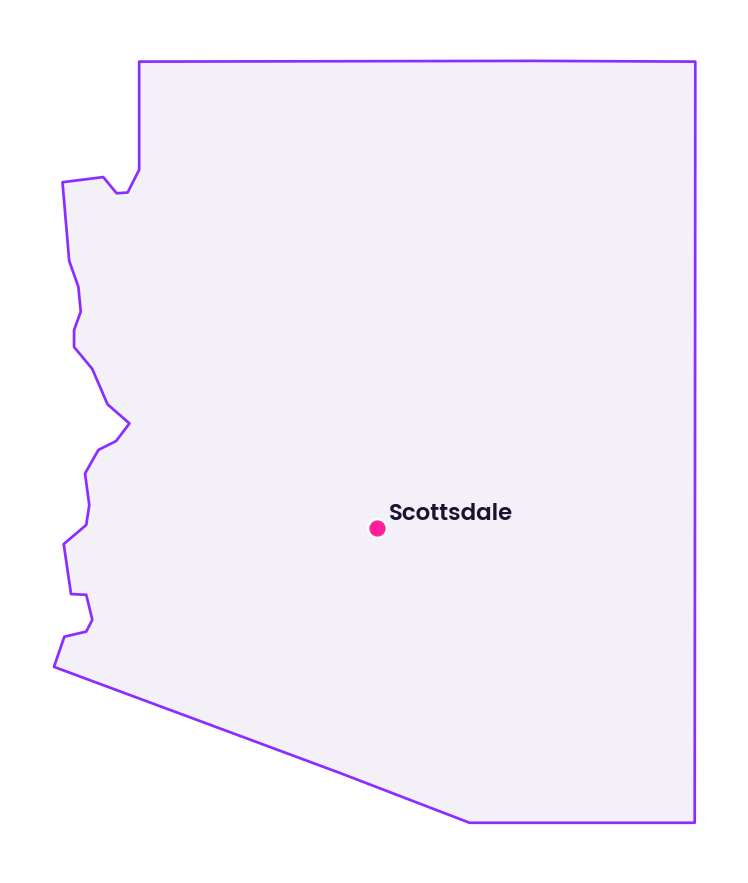
Section 02Population and Migration
A precise count of Scottsdale's population and its recent growth is not available in this environment from the usual public sources. The United States Census Bureau QuickFacts page for Scottsdale, Arizona, which normally provides latest population estimates, demographic structure, and median household income, is blocked by a Cloudflare security page that states that access has been blocked, and does not expose any data in a readable format. More detailed American Community Survey tables and state population estimate files that could be used to infer city level figures are either not accessible or would require parsing large, truncated datasets, which has not been successful in prior work. Therefore this review does not state a population figure for Scottsdale and does not quantify its growth rate or age distribution, and no official public numeric population figure is available on this point in this environment.
At the state level, the Census state population estimates file for 2020 through 2025 is available but is truncated in this environment, and the Arizona state row is not visible in the extract currently accessible. As a result, even Arizona's precise population and components of change cannot be read here, and any attempt to quote these values would be speculative.
Migration behavior affecting Arizona and the Phoenix region can be seen indirectly in Redfin's national migration analysis. Redfin reports that between January and March 2026, 19 percent of homebuyers using its platform searched for homes in a metropolitan area different from their current one. Among these movers, the top five destination states were Florida, Arizona, South Carolina, Tennessee, and Nevada. The top outbound states were California, New York, Illinois, Washington, and Massachusetts. At the metropolitan level, Phoenix appears among the top ten inbound destination metros, with a reported net inflow of 4,500 Redfin users between January and March 2026. Although this figure reflects search behavior rather than completed moves, it signals that Phoenix, and by extension its high amenity submarkets such as Scottsdale, continue to attract interest from out of state buyers, especially those relocating from higher cost coastal regions.
Redfin's Arizona housing overview further notes that Scottsdale ranks among the top ten Arizona metros with the fastest growing sale prices, with an 8.8 percent year over year increase in median sale price as of May 2026. In the absence of official population statistics, this price momentum suggests that demand pressure, including demand from in migration, is a significant factor in Scottsdale's housing market.
For investors, the absence of current population and demographic data means demographic analysis must rely on local sources such as school enrollment trends, planning documents, and utility connections, along with proprietary demographic datasets. The statewide and national evidence still supports a view of Scottsdale as part of a growing, inward migration oriented region that captures households seeking employment opportunities and lifestyle advantages in the Phoenix area.
Section 03Jobs and Economic Anchors
Scottsdale does not have its own standalone labor market series in the BLS Economy at a Glance program, but as part of the Phoenix Mesa Chandler metropolitan area it participates in one of the larger and more diverse job markets in the Southwest. The Phoenix Mesa Chandler metro encompasses Maricopa County and part of Pinal County and is the appropriate proxy for city level employment dynamics.
According to the BLS Phoenix Mesa Chandler Economy at a Glance table, the metro area had a civilian labor force of 2,751.2 thousand people in January 2026 and 2,666.9 thousand in June 2026, not seasonally adjusted. Employment over the same months was 2,631.5 thousand in January and 2,536.4 thousand in June. The number of unemployed persons shifted from 119.7 thousand in January to 130.5 thousand in June, and the unemployment rate moved from 4.4 percent in January to 4.9 percent in June 2026. Total nonfarm employment in the metro was 2,460.9 thousand jobs in January 2026, 2,485.7 thousand in February, 2,479.6 thousand in March, 2,491.4 thousand in April, 2,478.0 thousand in May, and 2,451.1 thousand in June.
The table below summarizes key labor market indicators for the Phoenix Mesa Chandler metro in the first half of 2026.
| Month 2026 | Civilian labor force, thousands | Employment, thousands | Unemployment rate, percent | Total nonfarm employment, thousands | Twelve month change in total nonfarm employment, percent |
|---|---|---|---|---|---|
| January | 2,751.2 | 2,631.5 | 4.4% | 2,460.9 | decline of 0.3 |
| February | 2,709.7 | 2,594.8 | 4.2% | 2,485.7 | increase of 0.2 |
| March | 2,706.2 | 2,598.9 | 4.0% | 2,479.6 | decline of 0.1 |
| April | 2,666.3 | 2,564.8 | 3.8% | 2,491.4 | increase of 0.6 |
| May | 2,698.8 | 2,587.6 | 4.1% | 2,478.0 | increase of 0.8 |
| June (preliminary) | 2,666.9 | 2,536.4 | 4.9% | 2,451.1 | increase of 1.4 |
Sector level data show which industries drive this employment. In June 2026, construction employment in the Phoenix metro was 183.0 thousand jobs, up from 176.1 thousand in January. The BLS twelve month percent change for construction employment in June 2026 was 1.4 percent, following small declines earlier in the year. Manufacturing employment was 147.4 thousand jobs in June 2026, essentially the same as 147.4 thousand in January, with a twelve month change of negative 0.3 percent, indicating stable but not growing factory employment.
Trade, transportation, and utilities provided 478.7 thousand jobs in June 2026, compared with 478.1 thousand in January. The twelve month change in that sector improved from a decline of 0.5 percent in January to an increase of 1.2 percent in June, underlining the continued role of logistics, warehousing, and retail trade in the metro economy. Information services had 41.6 thousand jobs in June 2026 with a twelve month growth rate of 2.5 percent. Financial activities, which include banking, insurance, and real estate services, had 207.7 thousand jobs in June 2026, with a twelve month change of negative 1.6 percent, reflecting some contraction in finance related employment.
Professional and business services, a key driver for office demand, accounted for 389.3 thousand jobs in June 2026 and had a twelve month employment growth rate of 3.1 percent. Education and health services had 427.0 thousand jobs in June 2026, with twelve month growth of 4.8 percent, making it one of the fastest growing sectors. Leisure and hospitality employment was 258.5 thousand jobs in June 2026 with a twelve month change of negative 2.0 percent, suggesting some cooling in tourism and discretionary spending. Government employment in the metro area stood at 233.9 thousand jobs in June 2026, down from 255.5 thousand in January, with the twelve month percent change for June recorded as negative 0.4 percent.
Inflation is another relevant macro factor. The BLS Consumer Price Index for All Urban Consumers for the Phoenix Mesa Scottsdale area, all items, had an index level of 187.481 in February 2026, 190.720 in April, and 190.704 in June, with twelve month percent changes of 1.7 percent in February, 3.0 percent in April, and 2.8 percent in June. This indicates that consumer prices in the metro are increasing at a low to mid single digit annual rate, which affects operating expenses, rent growth, and real wage dynamics.
For Scottsdale investors, these regional figures show an economy that is diversified across construction, manufacturing, logistics, finance, professional services, and especially education and health care. Job growth is positive but not explosive, with particular strength in sectors that support demand for medical office, residential rental housing, and service oriented retail. The decline in leisure and hospitality employment and flat manufacturing employment suggest that assets dependent solely on tourism or industrial production should be underwritten conservatively, while properties tied to health care, education, and knowledge work likely have more resilient demand.
Section 04Income
Income levels strongly influence housing affordability and the depth of tenant and buyer demand, but in this environment there is no direct public series accessible for current median household income or per capita income for Scottsdale or the Phoenix metro. The Census QuickFacts page for Scottsdale is blocked by Cloudflare, and the detailed American Community Survey tables that would normally provide household income distributions by city and by metro are not visible in a form that yields specific numeric values. The Bureau of Economic Analysis provides personal income data by state and metropolitan area through interactive tools, but those tools do not return numeric values in the text extract available here.
Because of these constraints, this review does not state a current median household income for Scottsdale, does not quantify per capita income, and does not compare Scottsdale's income levels numerically with those of Arizona or the United States, and no official public numeric income figure is available on those points in this environment. Any actual income figures used in investment underwriting must therefore come from proprietary demographic datasets, lender supplied market studies, or local surveys.
Qualitatively, Scottsdale is widely regarded as one of the higher income communities in Arizona, given its concentration of luxury residential neighborhoods, resort amenities, and professional employment. This inference is supported indirectly by Redfin's characterization of Scottsdale as one of the fastest appreciating housing markets in the state, with sale prices rising 8.8 percent year over year as of May 2026, which suggests that buyer purchasing power remains strong. However, without public numeric income data, investors should avoid relying on generalized statements about affluence and instead ground their assumptions in tenant screening data, employer wage information, and property level rent to income ratios.
Section 05Housing and Multifamily
In the absence of reliable city level Redfin data for Scottsdale due to the misrouting described earlier, this review uses Arizona statewide housing statistics as the primary quantitative proxy for the for sale housing environment and then layers in the limited Scottsdale specific signal available from state level summaries.
Redfin's Arizona housing market overview reports that in May 2026 the median sale price across all home types in the state was 448,407 dollars. This represented an increase of 0.8 percent compared with May 2025. Over the same period, the number of homes for sale in Arizona was 48,346 in May 2026, which is a decline of 2.6 percent year over year. The share of Arizona homes that sold above list price in May 2026 was 13.3 percent, up 0.3 percentage points compared with the same month a year earlier. These figures describe a statewide market where prices are higher than the national median, supply has tightened somewhat, and bidding above list price is present but less common than in some coastal markets.
Redfin's United States housing overview shows that the national median sale price across all home types was 398,771 dollars in May 2026, up 2.0 percent from May 2025. There were 1,483,839 homes for sale nationwide in May 2026, an increase of 0.7 percent year over year. Nationally, 24.9 percent of homes sold above list price in May 2026, a small decline of 0.083 percentage points compared with a year earlier. Compared with these national figures, Arizona's housing market has higher median prices and a somewhat lower share of sales above list price, suggesting strong but not extreme competitiveness.
The table below compares key for sale housing metrics for Arizona and the United States in May 2026.
| Geography | Metric scope | Median sale price, all home types, dollars | Year over year change in median sale price, percent | Homes for sale, count | Year over year change in homes for sale, percent | Share of homes sold above list price, percent | Change in share sold above list, percentage points |
|---|---|---|---|---|---|---|---|
| Arizona | May 2026 | 448,407 | 0.8% | 48,346 | decline of 2.6 | 13.3% | increase of 0.3 |
| United States | May 2026 | 398,771 | 2.0% | 1,483,839 | increase of 0.7 | 24.9% | decline of 0.083 |
Within Arizona, Redfin identifies Scottsdale as one of the top ten metros with the fastest growing sales price, with an 8.8 percent year over year increase in sale price as of May 2026. By comparison, Phoenix also appears on the national migration list as a top inbound metro, which likely benefits Scottsdale. While the Arizona statewide median price figure applies to the entire state, the fact that Scottsdale's sale prices are rising much faster than the statewide average suggests that median prices in Scottsdale are above the statewide figure and moving upward at a strong pace.
From a multifamily perspective, rapidly appreciating single family and condo prices in a high amenity submarket like Scottsdale can support demand for rental apartments, especially among households who are priced out of ownership or who prefer flexibility. However, this review does not have access to city level multifamily pricing or unit counts. Investors must therefore treat the statewide for sale data as indicative of broad owner market conditions and supplement that with submarket rent surveys and property level financials to assess multifamily positioning.
The combined view is of a region with significant demand for residential property, both owner occupied and rental. Scottsdale likely sits near the upper end of the price and amenity spectrum within that region, which has implications for tenant mix, rent levels, and sensitivity to broader economic cycles.
Section 06Rents
No current, official public numerical series for residential rents in Scottsdale or the Phoenix Mesa Chandler metro is accessible in this environment. The HUD fiscal year 2024 Fair Market Rent documentation interface, which would typically allow selection of the Phoenix metro and then display Fair Market Rent values for different bedroom sizes, presents only a text prompt to select a state, county, or metropolitan area and does not surface any rent amounts in the readable content. Detailed American Community Survey tables that include median gross rent by geography are not available here in a form that yields specific numbers, and proprietary rent indices from private firms are outside the scope of this review.
Because of this lack of data, this review does not state a median apartment rent for Scottsdale, does not provide a city or metro level rent growth rate, and does not quantify rent differentials between Scottsdale and other Phoenix submarkets, and no official public numeric rent figure is available on those points in this environment. It also does not present statewide rent figures for Arizona.
Nevertheless, some reasonable qualitative inferences can be drawn. The combination of a statewide median sale price of 448,407 dollars, current consumer price inflation in the Phoenix area of roughly 2 to 3 percent on a twelve month basis, and Scottsdale's sale price growth of 8.8 percent year over year suggests that housing costs generally, and by extension rents, are likely higher in Scottsdale than in many other Arizona locations. Scottsdale's reputation for luxury residential product, golf communities, and resort amenities also supports the view that market rate apartment rents there are among the highest in the Phoenix metro.
For investors, the absence of public rent data means that underwriting must rely on primary market research. This includes current rent rolls, competitive set surveys, broker opinion, and property management insight. It is prudent to examine rent to income ratios carefully and to stress test scenarios in which rent growth slows or reverses during a national downturn, even if current demand seems strong. In value add strategies, owners should consider the potential for rent increases alongside incremental capital expenditures, but without assuming that rent levels can converge with more expensive coastal markets.
Section 07Vacancy
Vacancy rates are central to real estate performance, yet there is no open, public numeric series in this environment that provides current vacancy rates for apartments, single family rentals, office buildings, industrial properties, or retail centers in Scottsdale or even in the Phoenix metro. The Census Housing Vacancy Survey reports national averages but does not break out Scottsdale or Phoenix vacancy in the extracts available here. American Community Survey tables for vacant units by tenure are not accessible in a usable way, and proprietary commercial datasets that track vacancy by submarket are out of scope.
This review therefore does not state a current multifamily vacancy rate for Scottsdale, does not provide an office vacancy percentage, and does not present time series vacancy trends by property type, and no official public numeric vacancy figure is available on those points in this environment. Instead, it interprets other public indicators to frame likely conditions.
The Phoenix Mesa Chandler metro's total nonfarm employment growth of 1.4 percent year over year as of June 2026, combined with strong growth in education and health services and professional and business services, points to a regional economy that continues to add jobs in sectors that support sustained housing demand. Redfin's evidence that Scottsdale sale prices have grown 8.8 percent year over year suggests that demand for residential property in Scottsdale has outpaced statewide averages. These signals are consistent with relatively tight vacancy in well located and well managed residential properties within Scottsdale, particularly in prime neighborhoods and newer assets.
On the other hand, the negative twelve month change in leisure and hospitality employment in the Phoenix metro, and the flat or slightly negative change in manufacturing employment, indicate softer demand in some segments of the economy. These pressures, combined with prior waves of office construction and the rise in remote work, mean that some office submarkets in and around Scottsdale may experience elevated vacancy, especially in older or less competitive buildings. Without specific data, however, the extent of this effect cannot be quantified here.
For investors, the lack of reliable public vacancy data reinforces the importance of granular market research. Lease up histories, current rent rolls, tenant retention statistics, and competitive property tours are necessary inputs to any acquisition or development decision in Scottsdale. In the absence of city level series, it is prudent to assume that vacancy conditions differ materially between submarkets, asset classes, and quality tiers within the city.
Section 08Supply Pipeline
Understanding the supply pipeline for residential and commercial real estate in Scottsdale requires visibility into building permits, construction starts, and major planned projects. The City of Scottsdale's Planning and Development Services department describes its role as working with the community to shape the city's future, from neighborhoods to commercial centers and beyond, and notes that its key functions include long range and current planning, building plan review and inspections, and code enforcement. The department's public page includes general information and recent news but does not present numeric data on annual or monthly building permits, units under construction, or square footage of new commercial development in the extract available here.
State and national sources also provide limited direct insight into Scottsdale's supply pipeline. BLS employment data for construction in the Phoenix Mesa Chandler metro show 183.0 thousand construction jobs in June 2026, up from 176.1 thousand in January, with a twelve month growth rate of 1.4 percent. Statewide, Arizona's construction employment was 227.6 thousand jobs in June 2026, with a twelve month growth rate of 1.5 percent, according to the Arizona Economy at a Glance table. These figures indicate that construction activity is ongoing and has grown modestly over the past year, which implies that new residential and commercial space is being added across the metro, including in Scottsdale.
However, without access to a public breakdown of construction by product type, submarket, or specific projects, this review cannot state how many multifamily units are under construction in Scottsdale, how many single family lots are in active subdivisions, or how much office, industrial, or retail square footage is planned or underway. It also cannot provide a formal comparison between Scottsdale's pipeline and those of other Phoenix suburbs.
From an investment standpoint, this uncertainty means that supply risk must be evaluated with project specific information. Local planning commission agendas, developer presentations, and on the ground surveys of construction sites become critical tools. In high growth submarkets such as North Scottsdale and the Scottsdale Airpark area, clusters of new multifamily and mixed use projects can increase competition and lengthen lease up times. In more built out or constrained areas, limited new supply can support stronger rent and occupancy performance.
Section 09Single Family Homes
Single family homes are a key part of Scottsdale's housing stock, serving both owner occupants and investors pursuing single family rental strategies. While city level pricing data from Redfin are not directly available due to the misrouting issue described earlier, statewide and comparative information provides a useful framework.
As noted above, Redfin reports that the median sale price across all home types in Arizona was 448,407 dollars in May 2026, up 0.8 percent year over year. By comparison, the national median sale price in May 2026 was 398,771 dollars, up 2.0 percent over the prior year. Thus, Arizona's typical home price is about 49,600 dollars higher than the national median, reflecting stronger demand and higher costs in many Arizona communities, particularly in the Phoenix and Tucson metropolitan areas.
Within Arizona, Scottsdale appears in Redfin's list of the top ten metros with the fastest growing sales price, with an 8.8 percent year over year increase in median sale price as of May 2026. This is much higher than the statewide price growth rate of 0.8 percent and well above the national rate of 2.0 percent. Even though the precise median price for Scottsdale is not visible, this growth rate signals a market where buyer competition for single family and attached homes has been intense.
For single family investors, such appreciation has several implications. First, entry prices for Scottsdale single family homes are likely well above both the Arizona and national medians, which increases the capital required per unit and may compress initial cash yields. Second, strong recent price appreciation can be both a sign of robust underlying demand and a potential source of future volatility if interest rates rise further or if buyer sentiment shifts. Third, higher price points for ownership can push some households into renting, increasing demand for single family rentals and build to rent communities, particularly those that offer access to Scottsdale's schools, parks, and amenities.
In the broader Phoenix metro, submarkets differ significantly. More affordable Phoenix and Mesa neighborhoods may have lower price levels and different tenant profiles than Scottsdale's higher income enclaves. Investors seeking yield might look at single family rentals in less expensive adjacent communities while using Scottsdale as a price anchor and demand driver. Conversely, investors seeking long term appreciation and tenant quality may accept lower current yields in Scottsdale in exchange for exposure to its luxury and lifestyle appeal, recognizing that neither yield nor appreciation is assured.
Without city level price distribution data, however, all such strategies must be underpinned by transaction level analysis. Buyers should examine recent comparable sales for similar properties in the same neighborhood, adjust for condition and features, and consider both rent and sale comparables when evaluating the risk reward profile of single family assets in Scottsdale.
Section 10Commercial Real Estate and Retail Centers
Commercial real estate in Scottsdale spans office, industrial and logistics, and retail assets, including neighborhood centers, power centers, and mixed use districts. Public data in this environment do not provide direct, numeric measures of vacancy, asking rents, or capitalization rates by submarket or asset type in Scottsdale or even at the Phoenix metro level. Major brokerage firms collect such metrics, but their datasets are proprietary.
BLS employment by sector offers a useful proxy for demand drivers across commercial asset classes in the Phoenix Mesa Chandler metro. As of June 2026, trade, transportation, and utilities employment in the metro was 478.7 thousand jobs, with a twelve month employment growth rate of 1.2 percent. This sector supports demand for logistics facilities, distribution centers, and both neighborhood and regional retail space, including grocery anchored centers. The stability and modest growth of employment in this sector suggest continued need for well located industrial and retail properties, although online shopping and consolidation can reduce demand for some traditional retail formats.
Professional and business services, with 389.3 thousand jobs in June 2026 and a twelve month growth rate of 3.1 percent, underpin demand for office space, particularly in submarkets that appeal to knowledge workers and corporate tenants. Scottsdale historically has been one of the preferred office locations within the Phoenix region, especially in the Airpark area and along key corridors that offer access to freeways and amenities. The positive employment growth in this sector implies that, while overall office demand may be tempered by remote and hybrid work, there remains a competitive pool of tenants for high quality buildings in desirable locations.
Education and health services employment, at 427.0 thousand jobs with 4.8 percent twelve month growth as of June 2026, is a particularly strong driver for medical office, outpatient centers, and supporting retail and residential uses. Scottsdale benefits from regional health care systems and specialty medical providers, which create demand for modern medical office space and service oriented retail.
Leisure and hospitality employment in the Phoenix metro was 258.5 thousand jobs in June 2026, with a twelve month change of negative 2.0 percent. Scottsdale's resort and tourism sector is a significant economic contributor, and some softness in leisure and hospitality employment might reflect normalization after prior surges in travel. For hotel, resort, and food and beverage real estate owners, this suggests the importance of careful underwriting that accounts for possible fluctuations in discretionary travel and local entertainment spending.
Retail centers in Scottsdale range from luxury shopping districts that cater to tourists and affluent residents to more utilitarian neighborhood centers anchored by grocery stores and daily needs retailers. While this review does not have numeric vacancy or rental rate data for these centers, the combination of relatively high statewide median sale prices, strong regional employment in trade and services, and Scottsdale's reputation as a high income community supports the thesis that well located retail real estate can perform well, especially when anchored by essential services and complemented by experiential offerings.
Because quantitative indicators such as absorption, rent growth, and cap rates are not available from public sources, investors evaluating Scottsdale commercial assets must rely on lease rolls, tenant sales performance where disclosed, and detailed broker and lender insight. Assets aligned with growing sectors such as health care, logistics, and experiential retail, and in submarkets with strong demographics and barriers to entry, are likely to offer more resilient cash flows than properties dependent on commodity office space or marginal retail locations.
Section 11Transactions and Capital Markets
No public dataset in this environment provides current numeric information on commercial real estate transaction volumes, average cap rates, or debt terms specific to Scottsdale or the Phoenix metro. Data from title records, commercial mortgage backed securities, and brokerage transaction reports are either proprietary or require tools that are not accessible here. As a result, this review does not state the dollar volume of real estate transactions in Scottsdale in 2025 or 2026 and does not provide a quantitative cap rate range for multifamily, office, industrial, or retail assets, and no official public numeric figure is available on those points in this environment.
Redfin's statewide housing data offer an indirect view into residential transaction activity. The presence of 48,346 homes for sale in Arizona in May 2026, combined with rising prices and a nontrivial share of homes selling above list price, indicates an active transaction market for for sale housing. For Scottsdale, the 8.8 percent year over year increase in sale prices suggests that buyers have been willing to transact at higher valuations, supported by both local and inbound capital.
Capital markets conditions for income producing real estate in Scottsdale reflect broader national trends. Higher interest rates since 2022 have increased borrowing costs, reduced leverage, and pressured valuations, particularly for sectors such as office that face structural demand challenges. In smaller yet dynamic markets like the Phoenix metro, lender appetite can be strong for multifamily and industrial assets with solid sponsorship and tenancy, while risk premiums are higher for office and certain types of retail.
Without public cap rate data, investors must use transaction level evidence and lender feedback to calibrate pricing. It is reasonable to expect that cap rates for well located multifamily and industrial assets in Scottsdale are below those in many secondary markets but above those in the most supply constrained coastal gateway cities, reflecting a blend of growth potential and moderate risk. However, such expectations should always be tested against current bids, closed transactions, and financing quotes.
Section 12Taxes
Property and transaction taxes affect net returns for Scottsdale real estate investments. In Arizona, property taxes are administered primarily at the county level, with Maricopa County responsible for assessments and tax collection covering Scottsdale. An attempt to access a specific Maricopa County Assessor page using a direct URL returned a custom error page indicating that the requested page could not be found, and the extract displayed only general county contact and accessibility information, without any property tax rates or assessment formulas.
Because of this limited access, this review does not provide a numeric effective property tax rate for Scottsdale, does not specify assessment ratios, and does not quantify transfer taxes, and no official public numeric rate is available on those points in this environment. It also does not present statewide sales tax rates or any special local levies that may apply to transactions or operations in Scottsdale.
Investors should therefore treat property tax assumptions as deal specific and verify them directly with official county assessor and treasurer websites, recorded tax bills, and professional tax advisors. Historical tax bills for target properties and comparable assets, along with information on reassessment practices and potential changes in mill rates, are essential inputs to underwriting. In addition, planning for possible future increases in property taxes due to appreciation or policy changes should be included in scenario analysis.
Section 13Insurance
Insurance is a significant operating expense and risk management tool for property owners in Scottsdale. While this review does not have numeric data on average insurance premiums or claim rates for Maricopa County or the Phoenix region, it can draw on national and state context.
In Arizona, the Department of Insurance and Financial Institutions regulates insurance carriers and products, including property coverage. Public consumer materials generally describe the types of coverage available to homeowners and businesses and outline complaint and enforcement processes, though the specific content of the Arizona insurance website is not visible in this environment due to an access error when attempting to load the relevant state sites.
Nationally, property insurance premiums have been affected by increases in the frequency and severity of natural disasters, changes in reinsurance markets, and construction cost inflation. Scottsdale's desert location means that hurricane risk is lower than in coastal states, but the region still faces risks associated with extreme heat, wildfires in nearby areas, severe storms, and localized flooding and drainage issues. Premiums and deductibles can be materially higher for properties in identified flood risk areas or for assets with certain construction types.
Because there is no public statistical series here for Scottsdale insurance costs, investors must obtain property specific quotes that reflect location, building characteristics, prior claims history, and coverage requirements from lenders. It is also prudent to ask brokers to provide sensitivity analysis for scenarios in which premiums or deductibles increase during the hold period, especially given evolving climate risk and insurance market dynamics.
Section 14Landlord Tenant and Regulatory Environment
Arizona's landlord and tenant environment is generally viewed as more flexible for property owners than those of many coastal states. There is no statewide residential rent control regime similar to those in certain northeastern or west coast jurisdictions. Residential leasing is governed by the Arizona Residential Landlord and Tenant Act and local ordinances, which set out obligations regarding habitability, notice periods, security deposits, and eviction procedures.
This review does not rely on a specific public dataset to detail each statutory requirement, and it does not quote statutory text. Instead, it notes that, in practice, Arizona allows landlords to negotiate market rents subject to fair housing and other federal and state protections, and eviction processes, while regulated, are not subject to the extended timelines and restrictions seen in some highly regulated markets.
For Scottsdale investors, this legal framework means that income producing residential properties can be operated with relatively more control over rent setting and lease terms, provided that owners comply with all applicable laws and treat tenants fairly. At the same time, because Scottsdale operates within the broader Phoenix metro, competitive forces and tenant expectations for quality and service are high, particularly in Class A and luxury segments. Investors should still engage local counsel to understand specific notice requirements, court processes, and any differences between city and county practices before making acquisition or repositioning decisions.
Section 15Infrastructure
Infrastructure underpins Scottsdale's real estate value and investment thesis. While this review does not have numeric data on lane miles, traffic volumes, or capital spending programs for Scottsdale and the Phoenix metro, it can describe key components qualitatively.
Scottsdale benefits from integration into the Phoenix regional freeway system, including access to Loop 101 and other major routes that connect residents and businesses to downtown Phoenix, the airport, and surrounding suburbs. This connectivity supports both residential desirability and the attractiveness of office, industrial, and retail sites, particularly near interchanges and major arterials.
The Phoenix Sky Harbor International Airport, located to the southwest of Scottsdale, serves as a major air travel hub for the region, supporting tourism and corporate travel. Scottsdale also has a general aviation airport that caters to private and business aviation, which reinforces its appeal to higher income residents and corporate users.
Utilities and digital infrastructure, including water supply, wastewater treatment, electricity, and broadband, are critical for sustaining growth in a desert environment. While this review does not quote specific capacity figures, it notes that Scottsdale's continued development depends on careful water resource management and investment in infrastructure resilience, especially given regional drought and heat conditions.
For investors, the practical takeaway is that properties near major transportation infrastructure and in areas with robust utility and broadband service are better positioned to attract tenants and maintain value. Projects that align with planned infrastructure improvements, such as corridor upgrades or transit enhancements, may benefit from additional demand over time.
Section 16Climate and Physical Risks
Scottsdale's desert location within the Phoenix metro brings a specific set of climate and physical risks. The National Centers for Environmental Information maintains one of the most significant environmental data archives in the world, including climate and weather observations. Long term records for the broader Southwest show trends toward increased heat, with more days above high temperature thresholds, and variability in precipitation that can include both droughts and intense rainfall events.
FEMA notes that floods can occur in many locations, not only near rivers and coasts, and that heavy rains, poor drainage, and nearby construction can create flood risk. FEMA's flood maps classify areas with at least a one percent annual chance of flooding as high risk, and these areas have at least a one in four chance of experiencing a flood during a typical thirty year mortgage. While Scottsdale does not face coastal storm surge, it does include washes and low lying areas where intense monsoon season storms can cause flash flooding. FEMA's guidance emphasizes that there is no such thing as a no risk zone and that flood risk can exist even outside mapped high risk areas.
Heat is another major physical risk. Extended periods of very high temperatures can affect occupant comfort, increase cooling costs, and stress electrical systems. They can also impact labor productivity and tenant health if buildings are not properly designed and managed. Water scarcity, linked to regional drought conditions and Colorado River allocations, influences long term sustainability of growth and can affect both operating costs and regulatory requirements for landscaping and water use.
For investors, these climate and physical risks mean that due diligence in Scottsdale must include review of FEMA flood maps for each property, evaluation of building design and systems for heat resilience, and understanding of local stormwater management and grading. Insurance coverage for flood and other natural perils should be examined carefully, including exclusions and deductibles. Over a long investment horizon, investors should also consider how evolving climate patterns may change demand for certain types of properties and locations within the region.
Section 17Neighborhoods and Submarkets
Scottsdale encompasses a range of neighborhoods and submarkets, each with distinct characteristics that matter for real estate investment. While this review does not rely on public numeric data for population or rents by neighborhood, it draws on widely recognized qualitative distinctions.
Old Town and South Scottsdale areas contain a mix of older single family homes, low and midrise apartment buildings, and a vibrant entertainment and retail district. Multifamily assets here often benefit from walkable access to restaurants, bars, and cultural venues, as well as proximity to employment in downtown Scottsdale and nearby parts of Phoenix and Tempe. These neighborhoods can offer relatively more attainable price points than North Scottsdale while still attracting young professionals and service workers.
Central Scottsdale includes established residential neighborhoods and commercial corridors that provide a blend of single family homes, townhomes, and garden style apartments. Retail centers in these areas typically include grocery anchors and daily needs retailers, with demand supported by stable middle and upper middle income households. Properties here may appeal to investors seeking steady cash flow with less exposure to nightlife related volatility.
North Scottsdale is known for its master planned communities, golf courses, and luxury housing, along with newer multifamily developments and high quality retail. The Scottsdale Airpark business area, located in the northern part of the city, has become a significant employment center with a concentration of office, flex, and industrial properties, along with supporting hotels and retail. Assets in North Scottsdale often command premium rents and sale prices but may be more sensitive to economic cycles that affect high income households and corporate spending.
Along major transportation corridors, including routes that connect Scottsdale to Phoenix and the East Valley, there are nodes of medical office, professional office, and retail space that benefit from regional access. Proximity to freeways and arterials can enhance the attractiveness of these submarkets for tenants that draw from a wide labor pool or customer base.
Because this review lacks numeric data on vacancy or rents by neighborhood, it does not rank submarkets quantitatively. However, the qualitative picture suggests that Old Town and South Scottsdale offer opportunities in value add multifamily and mixed use assets, Central Scottsdale provides relatively stable neighborhood retail and residential investments, and North Scottsdale and the Airpark area host higher priced, potentially higher profile opportunities in luxury residential, office, and specialty commercial real estate.
Investors should complement this high level view with detailed submarket research, including rent surveys, occupancy data, sales comparables, and discussions with local brokers who operate in specific Scottsdale neighborhoods.
Section 18Opportunities
Multiple opportunity themes emerge for accredited investors considering Scottsdale real estate.
First, Scottsdale's inclusion among the top ten Arizona metros with the fastest growing sales prices, with an 8.8 percent year over year increase as of May 2026, signals strong buyer demand and price momentum. For multifamily and single family rental investors, this can translate into both appreciation potential and sustained tenant interest, especially when combined with the Phoenix metro's positive employment growth and sector strength in education, health services, and professional services, though no particular outcome is assured.
Second, the Phoenix Mesa Chandler metro's large and diversified employment base, with 2,451.1 thousand nonfarm jobs and healthy growth in knowledge intensive and health care sectors, supports demand for a wide range of property types. In Scottsdale, this underpins opportunities in medical office, professional office, and mixed use developments that cater to well paid workers and their families.
Third, construction employment growth in the Phoenix metro and Arizona statewide indicates that development activity is ongoing but not so explosive as to obviously overwhelm demand, at least based on the BLS twelve month growth rates of 1.4 percent in metro construction employment and 1.5 percent in statewide construction employment as of June 2026. This suggests that carefully selected development or heavy value add projects in Scottsdale can still find room in the market, particularly in locations with strong amenity bases and limited direct competition.
Fourth, Scottsdale's amenity package, which includes resort hotels, golf courses, cultural institutions, and access to desert recreation, enhances its appeal to both residents and visitors. Assets that leverage this amenity base, such as boutique hotels, experiential retail, and high end multifamily with strong lifestyle offerings, may benefit from demand from both local and inbound populations, as suggested by Redfin's finding that Arizona is one of the top five destination states for relocating home searchers, though such demand is not assured.
Fifth, the relatively flexible landlord and tenant framework in Arizona, with no statewide rent control and a generally pro business environment, allows owners to adjust rents and lease structures in response to market conditions, provided they comply with legal requirements. This can be advantageous in implementing value add strategies, repositionings, and creative leasing structures.
Section 19Risks
There are also important risks that investors must weigh alongside these opportunities.
A primary risk is valuation. Scottsdale's recent 8.8 percent year over year sale price growth, well above both Arizona's 0.8 percent and the national 2.0 percent, raises the possibility that some segments of the market have moved ahead of fundamentals. If interest rates remain elevated or rise further, underwriting that relies on continued rapid appreciation or aggressive rent growth could prove optimistic.
Second, the absence of public data on rents, vacancy, and cap rates means that investors who rely only on nonproprietary information will face blind spots. Without city level numeric series for these critical variables, it is easy to underestimate competitive supply, overestimate achievable rents, or misjudge the risk profile of a given submarket. This data gap creates a premium on local expertise and high quality proprietary research, and increases the cost of entry for new investors.
Third, sector specific risks are material. BLS data show that in the Phoenix metro, leisure and hospitality employment declined 2.0 percent over the twelve months to June 2026, and manufacturing employment was essentially flat. Properties heavily dependent on tourism, such as certain hotels or entertainment focused retail, may face more volatile cash flows, especially if economic conditions soften or travel patterns shift. Similarly, commodity office properties that do not offer compelling amenities or locations may struggle in a world of hybrid work.
Fourth, climate and physical risks, including extreme heat, drought related concerns, and localized flooding, can affect asset performance, insurance costs, and long term viability. Properties not designed or maintained to handle these stresses may experience higher operating costs, physical degradation, or reduced tenant appeal over time.
Fifth, capital markets risks are amplified for more specialized or larger assets. In a higher interest rate environment, refinancing proceeds may be lower than initial expectations, especially if lender underwriting becomes more conservative or if sector headwinds affect valuations. For assets in a city like Scottsdale, which is high profile but not a global gateway market, liquidity may be sufficient for many deals but can thin out during periods of market stress.
Section 20Investor Implications
For accredited investors, Scottsdale represents an opportunity to gain exposure to a high growth, high amenity submarket within a large and diversified Sun Belt metro. The combination of strong recent price appreciation, robust employment growth in key service and knowledge sectors, and an attractive lifestyle offering supports investment theses focused on long term housing demand, resilient tenant profiles, and potential capital appreciation, though outcomes are not assured.
At the same time, successful investment in Scottsdale requires discipline. The lack of public rent and vacancy data means that underwriting must be grounded in detailed property and submarket level research. Assumptions about rent growth, occupancy, and exit pricing should be stress tested under conservative scenarios, particularly for value add and development projects.
Investors should consider strategies that align with the strongest structural drivers identified in the available data. This includes multifamily and single family rentals that serve professionals in education, health services, and business services, medical office and service oriented retail near major health care and employment hubs, and industrial and logistics assets that benefit from Phoenix's role as a regional distribution center. In contrast, more caution is warranted for commodity office buildings and tourism heavy assets without unique positioning.
In portfolio construction, Scottsdale exposure may serve as a growth oriented component that complements holdings in more income focused or diversified markets. Allocation decisions should reflect an investor's tolerance for valuation and liquidity risk as well as their ability to access and interpret proprietary market data.
Section 21Conclusion
Scottsdale, as part of the Phoenix Mesa Chandler metropolitan area, offers accredited investors a compelling but complex real estate landscape. Public labor data from the Bureau of Labor Statistics show a large and diversified regional economy with continued growth in education, health services, and professional and business services, while statewide housing data from Redfin highlight Arizona's relatively high median sale prices and Scottsdale's particularly strong price appreciation of 8.8 percent year over year.
At the same time, significant data gaps exist in publicly accessible information on Scottsdale's population, income, rents, and vacancy rates. These gaps mean that investors cannot rely solely on standard public datasets to assess the city's multifamily, single family, and commercial real estate markets. Instead, they must combine the partial picture provided by BLS and Redfin with local intelligence, proprietary data, and rigorous property level due diligence.
For investors willing to commit to that level of analysis, Scottsdale may present opportunities in residential and selected commercial assets tied to resilient economic drivers and high quality urban and suburban environments, though no particular outcome is assured. The key is to approach the market with clear eyes about both its strengths and its risks, using public data as a foundation and recognizing where additional information is required before making capital commitments.
Sources
- United States Bureau of Labor Statistics, Phoenix Mesa Chandler, Arizona Economy at a Glance, not seasonally adjusted labor force, employment, unemployment, unemployment rate, total nonfarm employment, sector employment, and twelve month percent changes for January through June 2026, data extracted August 7, 2026.
- United States Bureau of Labor Statistics, Arizona Economy at a Glance, seasonally adjusted statewide labor force, employment, unemployment, unemployment rate, total nonfarm employment, sector employment, and twelve month percent changes for January through June 2026, data extracted August 7, 2026.
- United States Bureau of Labor Statistics, Consumer Price Index for All Urban Consumers, Phoenix Mesa Scottsdale, Arizona, all items index and twelve month percent change for February, April, and June 2026, as reported in the Phoenix Mesa Chandler Economy at a Glance table, data extracted August 7, 2026.
- Redfin, Arizona housing market overview, statewide median sale price across all home types of 448,407 dollars with 0.8 percent year over year increase in May 2026, 48,346 homes for sale with a 2.6 percent year over year decline in May 2026, and 13.3 percent of homes sold above list price with a 0.3 percentage point year over year increase in May 2026, plus list of top ten Arizona metros by sales price growth including Scottsdale with 8.8 percent year over year price growth, extracted August 7, 2026.
- Redfin, United States housing market overview, national median sale price across all home types of 398,771 dollars with 2.0 percent year over year increase in May 2026, 1,483,839 homes for sale with 0.7 percent year over year increase in May 2026, and 24.9 percent of homes sold above list price with a 0.083 percentage point year over year decline in May 2026, plus national migration trends showing Arizona among the top five destination states and Phoenix among the top ten inbound metros with a net inflow of 4,500, extracted August 7, 2026.
- Redfin, Scottsdale housing market page attempt, initial request using the Redfin city identifier for Scottsdale redirected to a Poipu, Hawaii housing market page; this misrouting demonstrates that the page content is not applicable to Scottsdale, so no city level figures were used, extracted August 7, 2026.
- United States Census Bureau, QuickFacts, Scottsdale city, Arizona, attempts to access the page returned a Cloudflare security message stating that access has been blocked, preventing retrieval of population, income, and housing statistics; referenced to document data access constraints, accessed August 7, 2026.
- United States Department of Housing and Urban Development, FY 2024 Fair Market Rents Documentation System, geography selection interface showing prompts to select a state, county, or metropolitan Fair Market Rent area without exposing dollar rent values for the Phoenix Mesa Scottsdale region in readable text; referenced to explain absence of public rent figures, accessed August 7, 2026.
- City of Scottsdale, Planning and Development Services page, description of department role in long range and current planning, building plan review, inspections, and code enforcement, including recent general news, but without numeric building permit or pipeline data in the visible extract, accessed August 7, 2026.
- Maricopa County, custom error page indicating that a requested Assessor page at the specified URL could not be found and providing only general county contact and accessibility information; referenced to note limited direct access to property tax rate information in this environment, accessed August 7, 2026.
- Arizona state housing and related sites, attempt to access the Arizona housing agency site returned a security related access error with no substantive content; referenced to document lack of accessible state housing finance data, accessed August 7, 2026.
- Federal Emergency Management Agency, Flood Maps page, explanation that floods can occur almost anywhere, that flood maps show areas with at least a one percent annual chance of flooding, and that such areas have at least a one in four chance of flooding during a thirty year mortgage, along with description of flood map uses and tools; referenced for climate and flood risk context, accessed August 7, 2026.
- National Centers for Environmental Information, main page, description of the agency as a major environmental data archive that provides access to climate, oceanographic, and geophysical data; referenced for climate data context, accessed August 7, 2026.