In brief · summary: Tallahassee
Tallahassee is the capital of Florida and the core of the Tallahassee metropolitan area, with an economy anchored by state government, two large public universities, and a regional health care and services base. Public data for the city are mixed.
United States Census Bureau QuickFacts tables for Tallahassee city and Leon County are blocked by a Cloudflare security screen in this environment, which prevents retrieval of current official population and income figures. By contrast, labor market data from the Bureau of Labor Statistics and statewide housing metrics from Redfin are accessible and provide a clear quantitative frame for investors.
According to the Bureau of Labor Statistics Tallahassee metropolitan area Economy at a Glance table, the metro civilian labor force was two hundred four point nine thousand people in May 2026 and a preliminary two hundred six point two thousand in June 2026, not seasonally adjusted. Employment was one hundred ninety four point nine thousand in May and a preliminary one hundred ninety six point zero thousand in June, while unemployment remained around ten thousand people, with rates between four point seven and five point one percent from January through June 2026. Total nonfarm employment stood at two hundred point one thousand jobs in May and a preliminary one hundred ninety …
Section 01Executive Summary
Tallahassee is the capital of Florida and the core of the Tallahassee metropolitan area, with an economy anchored by state government, two large public universities, and a regional health care and services base. Public data for the city are mixed. United States Census Bureau QuickFacts tables for Tallahassee city and Leon County are blocked by a Cloudflare security screen in this environment, which prevents retrieval of current official population and income figures. By contrast, labor market data from the Bureau of Labor Statistics and statewide housing metrics from Redfin are accessible and provide a clear quantitative frame for investors.
According to the Bureau of Labor Statistics Tallahassee metropolitan area Economy at a Glance table, the metro civilian labor force was two hundred four point nine thousand people in May 2026 and a preliminary two hundred six point two thousand in June 2026, not seasonally adjusted. Employment was one hundred ninety four point nine thousand in May and a preliminary one hundred ninety six point zero thousand in June, while unemployment remained around ten thousand people, with rates between four point seven and five point one percent from January through June 2026. Total nonfarm employment stood at two hundred point one thousand jobs in May and a preliminary one hundred ninety eight point six thousand in June, with the twelve month percent change in total nonfarm employment fluctuating between a small decline of about two tenths of a percent in January and a modest gain of about one half of a percent in preliminary June. These figures describe a relatively small regional labor market with stable employment and unemployment rates in the mid single digits, with only modest year over year job growth.
On the housing side, an attempt to access the Redfin Tallahassee housing market page resolved instead to a housing market page for Summersville in Missouri. That misrouted page reports a median sale price of one hundred forty thousand dollars over the three months ending May 2026, up forty nine point five percent from a year earlier, with one home sold, but those values clearly apply to Summersville and not to Tallahassee. Because of this misrouting, no city level Redfin metrics can be used for Tallahassee in this review. Instead, statewide Florida data and national Redfin data serve as the main public price and supply benchmarks. Redfin reports that in May 2026 the median sale price across all home types in Florida was three hundred ninety five thousand five hundred ninety five dollars, up one point seven percent compared with May 2025. There were two hundred thousand five hundred twenty four homes for sale statewide, down nine point eight nine percent year over year, and nine point nine percent of homes sold above list price, up zero point two percentage points from a year earlier. Nationally, Redfin reports a median sale price of three hundred ninety eight thousand seven hundred seventy one dollars in May 2026, up two point zero percent year over year, with one million four hundred eighty three thousand eight hundred thirty nine homes for sale and twenty four point nine percent of homes selling above list price. These statewide and national metrics frame Tallahassee as part of a state that remains in demand, with modest price growth, declining inventory, and more limited bidding intensity than the national average.
At the property level, the Leon County Property Appraiser reports that there are one hundred twelve thousand five hundred twenty six parcels in Leon County. Of these, seventy six thousand one hundred five are categorized as single family residential, six thousand seven hundred eighty eight as mobile homes, two thousand three hundred thirty seven as multi family, three hundred eighty one as apartments, and four thousand nine hundred twelve as condominiums. On the commercial side, there are nine hundred twenty one vacant commercial parcels and four thousand one hundred twenty two improved commercial parcels. These counts come from the Leon County 2025 Certified Tax Roll. Because Tallahassee is the principal city in Leon County and the seat of county government, these county level parcel counts provide a practical proxy for the urban housing and commercial stock that underpins Tallahassee real estate.
From a risk perspective, Tallahassee sits inland in the Florida panhandle but is still exposed to the effects of tropical storms and hurricanes that track across the Gulf of Mexico, to heavy rainfall and urban flooding, and to severe thunderstorms. Federal Emergency Management Agency flood maps and National Centers for Environmental Information climate archives emphasize that flood and storm risks are present even away from immediate coastlines and that environmental data should inform property level due diligence.
The absence of current public numeric data for Tallahassee population, household income, market rents, and vacancy rates means that this review cannot quantify those measures on a current basis and must focus instead on labor market indicators, statewide housing metrics, parcel inventories, and qualitative assessments of neighborhoods, institutions, and risk. For accredited investors, Tallahassee offers an institutional employment base, a diverse local housing stock, and a state context of continued in migration and relatively active housing demand, set against the challenges of limited public data, Florida insurance and tax complexity, and climate and storm exposure.
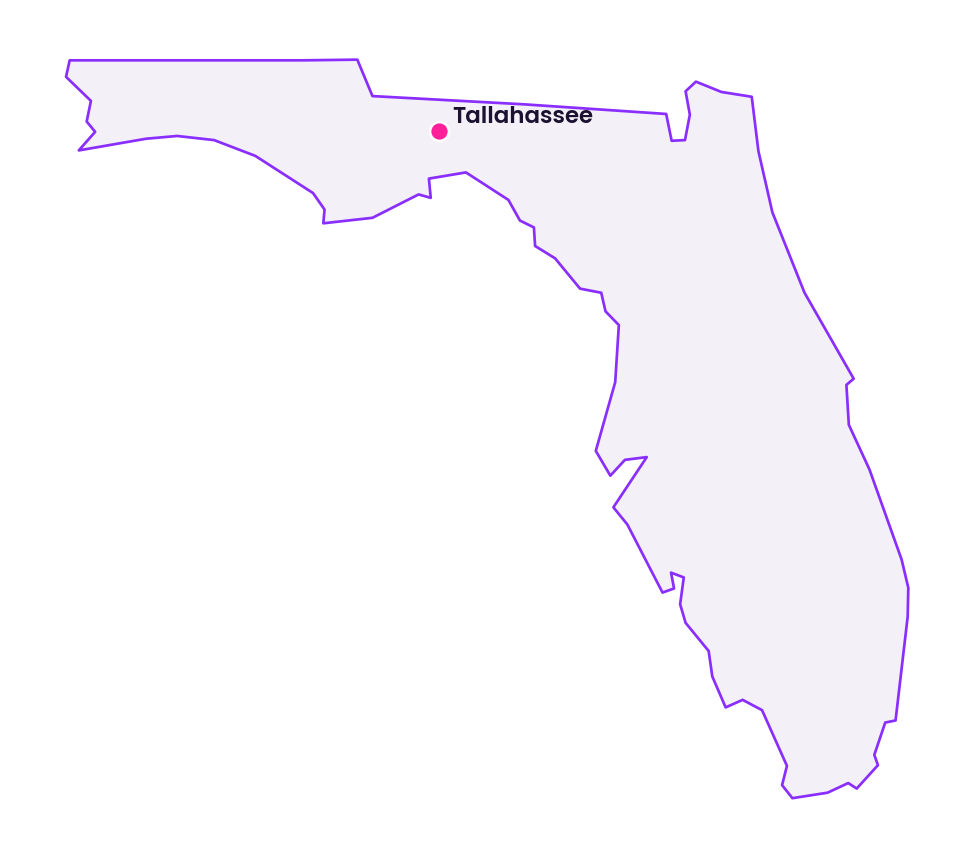
Section 02Population and Migration
In this environment, there is no accessible current Census or American Community Survey numeric table for Tallahassee or Leon County. Attempts to access the United States Census Bureau QuickFacts page for Tallahassee city Florida and the QuickFacts page for Leon County Florida both result in a Cloudflare message that states that access to the site is blocked due to a security service. The message explains that the action taken triggered a security solution and that the requested content cannot be displayed. Because the QuickFacts tables are blocked, this review cannot present a current official population figure for Tallahassee, cannot state current population growth or decline over time, and cannot provide current demographic breakdowns by age, race, or household type.
The Leon County Property Appraiser website does, however, display a demographics panel drawn from Census QuickFacts that lists a Leon County 2021 population estimate of two hundred ninety two thousand eight hundred seventeen people and a median age of thirty one years. Because these are county level figures from 2021 rather than current city level counts, they are treated here only as dated context and not as a current population measure for Tallahassee. Beyond that panel, county and metro population estimates from other Census products and detailed American Community Survey tables for Tallahassee are provided through interactive tools that do not expose readable current numeric values in this environment. As a result, any attempt to state the current number of residents in Tallahassee, the share of student population, the proportion of renters, or median age at the city level would rely on information that is not verifiable here from named public sources and therefore is not included.
Migration patterns can only be inferred indirectly from Redfin statewide and national housing migration statistics. Redfin reports that between January and March 2026, nineteen percent of homebuyers using its platform searched for homes in a different metropolitan area than their current one. The top five states that homebuyers searched to move to in that period were Florida, Arizona, South Carolina, Tennessee, and Nevada, while the top five states they searched to move from were California, New York, Illinois, Washington, and Massachusetts. Within those flows, Orlando, Sarasota, Miami, and Cape Coral appear as leading destination metros. Tallahassee does not appear among the top ten inbound or outbound metros in these Redfin national migration tables, which suggests that it is not one of the largest net gain or net loss markets in the United States within that dataset.
For Tallahassee and Leon County specifically, the Leon County Property Appraiser parcel summary shows a sizable residential and commercial property base, but its parcel counts do not describe recent net migration. That means investors considering Tallahassee assets must obtain current population and demographic profiles from other sources outside this environment, such as investor grade demographic providers, local planning documents that are not accessible here, or direct data from Census or American Community Survey tables accessed through other means.
Qualitatively, Tallahassee functions as a mid sized capital city with a substantial student presence due to Florida State University and Florida Agricultural and Mechanical University, and a large public sector employment base. Those roles suggest a population with a mix of students, state employees, university faculty and staff, health care workers, and service sector workers, but without current numeric data this profile must remain descriptive rather than measured.
Section 03Jobs and Economic Anchors
The Bureau of Labor Statistics Tallahassee metropolitan area Economy at a Glance table provides a detailed view of labor market conditions for the first half of 2026. The Tallahassee metropolitan figures are not seasonally adjusted, while the Florida statewide figures drawn from the Florida Economy at a Glance table are seasonally adjusted, and all are expressed in thousands of persons or jobs.
The following table compares selected May 2026 labor market indicators for the Tallahassee metropolitan area and for Florida statewide.
| Geography and series, May 2026 | Civilian labor force, thousands | Employment, thousands | Unemployment, thousands | Unemployment rate, percent | Total nonfarm employment, thousands | Twelve month percent change in total nonfarm employment |
|---|---|---|---|---|---|---|
| Tallahassee metropolitan area, not seasonally adjusted | 204.9 | 194.9 | 10.1 | 4.9% | 200.1 | 0.3% |
| Florida statewide, seasonally adjusted | 11,144.6 | 10,613.2 | 531.4 | 4.8% | 10,022.2 | 0.1% |
In the Tallahassee metropolitan area, the civilian labor force declined from 207.6 thousand in January 2026 to 204.9 thousand in May 2026 and a preliminary 206.2 thousand in June 2026. Employment followed a similar pattern, at 197.0 thousand in January, 194.9 thousand in May, and a preliminary 196.0 thousand in June. Unemployment was between 9.8 and 10.6 thousand persons over the same months, and the unemployment rate ranged between 4.7 and 5.1 percent, with a preliminary rate of 5.0 percent in June. Total nonfarm employment was 202.6 thousand jobs in January, 200.1 thousand in May, and a preliminary 198.6 thousand in June. The twelve month percent change in total nonfarm employment was negative 0.2 percent in January, zero in February, positive 0.5 percent in March, negative 0.3 percent in April, positive 0.3 percent in May, and a preliminary positive 0.5 percent in June. These figures indicate that the Tallahassee labor market is relatively tight, with unemployment modestly above four percent and total employment showing small but positive year over year gains by late spring 2026.
Within the Tallahassee metropolitan area, sector data for mining, logging, and construction highlight the role of building and resource related activity. The mining, logging, and construction sector employed 10.1 thousand people in January 2026, increasing to 10.4 thousand in May and a preliminary 10.5 thousand in June. The twelve month percent change in that sector was negative 1.9 percent in January through March, improved to negative 0.9 percent in April, negative 1.0 percent in May, and then a preliminary zero in June. This pattern suggests that construction and resource related employment remained stable to slightly weaker compared with a year earlier, even as total nonfarm employment edged higher.
For Florida statewide, the BLS Economy at a Glance table shows a much larger labor market with similar unemployment rates. The Florida civilian labor force was 11,144.6 thousand people in May 2026, with 10,613.2 thousand employed and 531.4 thousand unemployed, for an unemployment rate of 4.8 percent. Total nonfarm employment in Florida was 10,022.2 thousand jobs in May 2026, with a twelve month percent change of 0.1 percent. That statewide context reinforces that Tallahassee operates in a labor market environment where both the metro and the state have low single digit unemployment and modest job growth, although Tallahassee is growing slightly faster than the state as a whole on a twelve month basis as of preliminary June.
The composition of employment in Tallahassee is shaped by its role as the Florida capital, with a significant share of jobs in state government, local government, education, health services, and professional and business services tied to regulation, lobbying, and legal work. Florida State University and Florida Agricultural and Mechanical University are major employers and drive a continual inflow of students and faculty, creating demand for student housing, faculty housing, and related retail and services. Health care systems and regional medical centers contribute to stable employment in health services, while trade, transportation, and utilities support the broader regional economy.
These anchors mean that Tallahassee employment is less dependent on tourism than many coastal Florida metros, and more tied to state government budgets, university enrollments, and service sector trends. For investors, this mix can provide some resilience during economic cycles, though it also ties local performance to public sector funding and higher education dynamics.
Section 04Income
There is currently no accessible public numeric series in this environment that provides current income statistics for Tallahassee or Leon County. As noted earlier, United States Census Bureau QuickFacts tables that would normally list median household income, per capita income, and poverty rates for Tallahassee city and Leon County are blocked by Cloudflare, and detailed American Community Survey tables that contain income distributions and wage data by geography are not accessible in a readable format. The Bureau of Economic Analysis publishes personal income data at the state and metropolitan levels, but those are delivered through interactive tools that do not expose current specific values in the text available here.
The Leon County Property Appraiser website displays, from the same Census QuickFacts demographics panel, a Leon County median household income of fifty four thousand six hundred seventy five dollars from 2021. Because that figure is several years old and applies to the county rather than to Tallahassee city specifically, it is noted here only as dated context rather than as a current income measure. Beyond that dated figure, this review cannot state a current median household income for Tallahassee or Leon County, cannot compare current Tallahassee incomes to statewide or national medians, and cannot quantify income growth over time. It also cannot provide income by occupation, sector, or neighborhood.
Qualitatively, income levels in Tallahassee reflect its position as a government and university town. State government workers, university faculty and staff, health professionals, legal and professional services workers, and service sector employees in retail and hospitality all contribute to the local income distribution. The unemployment rate in the Tallahassee metropolitan area, which stayed near five percent in the first half of 2026, indicates that most residents who want to work are employed, but it does not reveal earnings.
For investors, the absence of current public income statistics means that underwriting assumptions about rent affordability, retail spending power, and office tenant credit must rely on property level rent rolls, tenant financials where available, broker opinion, and proprietary demographic data. In particular, when planning multifamily projects that target workforce or affordable segments, it is essential to benchmark proposed rents against actual incomes in target submarkets using sources outside this environment.
Section 05Housing and Multifamily
Without a working Redfin Tallahassee housing market page or Census housing tables, the most reliable quantitative housing data for this review are at the state and county levels. As noted earlier, a request for the Redfin Tallahassee city housing market resolved to a page for Summersville in Missouri, which reports a median sale price of one hundred forty thousand dollars over the prior three months with a year over year increase of forty nine point five percent and only one home sold. Because those figures clearly describe a very small market in Missouri rather than Tallahassee, they are not used in any way to characterize Tallahassee housing and serve only as evidence of misrouting.
Instead, statewide Florida metrics from Redfin and parcel level counts from the Leon County Property Appraiser provide the best public frame for Tallahassee housing and multifamily.
Redfin summarizes the Florida housing market in May 2026 as follows. The median sale price across all home types was three hundred ninety five thousand five hundred ninety five dollars, up one point seven percent compared with May 2025. There were two hundred thousand five hundred twenty four homes for sale, which represents a decline of nine point eight nine percent in the number of homes for sale compared with a year earlier. In terms of demand pressure, nine point nine percent of homes in Florida sold above list price in May 2026, which is an increase of zero point two percentage points over the prior year. For context, Redfin reports that across the United States, the median sale price across all home types was three hundred ninety eight thousand seven hundred seventy one dollars in May 2026, up two point zero percent year over year, with one million four hundred eighty three thousand eight hundred thirty nine homes for sale, up zero point seven percent, and twenty four point nine percent of homes selling above list price, down zero point zero eight three percentage points from a year earlier.
The table below compares these key metrics for Florida and the United States.
| Geography, May 2026, all home types | Median sale price, dollars | Year over year change in median sale price, percent | Homes for sale, count | Year over year change in homes for sale, percent | Share of homes sold above list price, percent | Change in share sold above list price, percentage points |
|---|---|---|---|---|---|---|
| Florida statewide | 395,595 | 1.7% | 200,524 | negative 9.89 | 9.9% | +0.2% |
| United States | 398,771 | 2.0% | 1,483,839 | 0.7% | 24.9% | 0.083 decline |
These statewide figures show that Florida home prices are very close to the national median in absolute terms, with slightly slower price growth than the nation as a whole. The significant decline in the number of homes for sale suggests tightening supply across the state. The share of homes selling above list price is well below the national figure, which indicates that while Florida remains a leading migration destination, many of its markets are not experiencing the same intensity of bidding wars seen in certain coastal or technology driven metros.
For Tallahassee specifically, Leon County parcel data help quantify the structure of the housing stock. The Leon County Property Appraiser parcel summary reports the following counts, drawn from the Leon County 2025 Certified Tax Roll.
| Leon County parcel category | Parcel count |
|---|---|
| Total parcels | 112,526 |
| Vacant residential land | 8,959 |
| Single family residential | 76,105 |
| Mobile homes | 6,788 |
| Multi family | 2,337 |
| Apartments | 381 |
| Condominiums | 4,912 |
| Vacant commercial | 921 |
| Improved commercial | 4,122 |
These numbers show that single family residential parcels account for the majority of the housing stock in Leon County, followed by mobile homes and condominiums. The counts for multi family parcels and apartments indicate a meaningful but smaller stock of larger rental properties. Because Tallahassee is the county seat and primary urban area, a large share of these parcels likely falls within or immediately around the city, making this a reasonable proxy for the structural mix of Tallahassee housing.
For multifamily investors, the parcel counts suggest that while the single family and condominium sectors dominate by number of parcels, there is a nontrivial base of purpose built apartments and multi family parcels that serve students, workforce households, and government and university employees. The state role of Tallahassee and the presence of two universities create ongoing demand for rental housing, particularly in neighborhoods near campuses, downtown, and employment centers, even though precise rent and vacancy data are not available in public sources here.
Section 06Rents
There is no public numeric dataset in this environment that provides current rent levels for Tallahassee or Leon County. The United States Department of Housing and Urban Development fiscal year 2024 Fair Market Rent geography selection tool prompts users to choose a state and a county or metropolitan Fair Market Rent area, but in this environment the interface does not display any rent values in dollars in readable text, only geography selection prompts. American Community Survey tables that would list median gross rent by geography are not accessible. Proprietary rent indices from private providers are outside the scope of permitted public sources for this analysis.
As a result, this review cannot state a median rent for Tallahassee, cannot provide rent levels by bedroom count, and cannot quantify year over year rent growth for either market rate or subsidized properties, and no official public numeric rent figure is available on those points in this environment. It also cannot present rent distributions or ratios of rent to income.
In the absence of city level rent statistics, investors must rely on property level information. For stabilized assets, historical rent rolls and current asking rents at competing properties remain the best guide to achievable rents and rent growth. For new developments, preleasing performance, concessions, and effective rents in nearby projects are critical benchmarks. The statewide housing context from Redfin, with modest price growth and declining for sale inventory, suggests continued housing demand in Florida, which usually supports rental demand as well, but that signal remains broad.
Given Tallahassee's employment anchors in state government and higher education, and its inland location in a state with high housing demand along the coasts and in tourism driven metros, it is reasonable to expect that rents in Tallahassee reflect a balance between student demand near campuses, professional and government demand near downtown, and more suburban demand in neighborhoods farther from the core. Without numeric data, however, investors should avoid assuming specific rent levels based on statewide or national averages and instead ground assumptions in on the ground competitive analysis.
Section 07Vacancy
Public data in this environment do not provide vacancy rates for apartments, single family rentals, or commercial properties in Tallahassee or Leon County. Census housing vacancy surveys and American Community Survey tables that would normally supply rental and homeowner vacancy rates by metropolitan area are not available in a readable form. Nor are there public series that track office, industrial, or retail vacancy rates and absorptions for Tallahassee.
Consequently, this review cannot state a current vacancy rate for Tallahassee apartments or for any other property type, nor can it show vacancy trends over time, and no official public numeric vacancy figure is available on those points in this environment. It also cannot quantify net absorption or new deliveries in square feet.
Nevertheless, the BLS labor market data and statewide Redfin housing metrics provide some indirect information about occupancy conditions. In the Tallahassee metropolitan area, unemployment rates between four point seven and five point one percent during the first half of 2026 suggest that most people seeking work are employed, which usually supports steady residential and commercial space occupancy. At the state level, the nine point eight nine percent decline in the number of homes for sale and modest price appreciation point to housing markets where listings are being absorbed. The national picture, with higher shares of homes selling above list price, suggests that many markets outside Tallahassee are even more competitive.
In Tallahassee specifically, the presence of state government agencies, universities, and health systems tends to create fairly stable demand for housing and office space, with some cyclicality linked to academic calendars and legislative sessions. However, without measured vacancy rates, investors cannot assume that stability translates into low vacancy across all submarkets. Property level due diligence must therefore include a close review of historical occupancy, leasing activity, and local supply pipelines to understand vacancy risk.
Section 08Supply Pipeline
A full view of the Tallahassee real estate supply pipeline would normally draw on building permit data, planning approvals, and development reports from city and county agencies. In this environment, those sources are difficult to access in a structured way.
An attempt to access a City of Tallahassee growth management department page at a specific growth management address returned a page not found message that directed users back to the city home page and popular links but did not offer permit counts or development statistics. The main City of Tallahassee website displays links to current projects such as the Market District project, a tree inventory effort, and the Centerville electric project, but the summary text does not include numeric counts of housing units, commercial square footage, or permit volumes. Leon County and state planning pages are not accessible as structured data sources here.
As a result, this review cannot state how many multifamily units, single family homes, or square feet of office, industrial, or retail space are currently under construction or in the pipeline in Tallahassee or Leon County. It also cannot provide historical permit counts that might reveal cyclical patterns in development.
In the absence of those data, investors must assess supply risk through alternative channels. On the ground field work, direct contact with planning and building departments, broker and developer interviews, and proprietary development databases are critical. Tallahassee's role as a state capital and university center means that there is a continual flow of public and institutional projects, including educational buildings, government facilities, and infrastructure improvements, alongside private multifamily, student housing, and commercial developments. Without quantified permit volumes, the key risk is local oversupply in specific submarkets, particularly in student oriented housing near large campuses or in suburban single family communities, which must be evaluated asset by asset.
Section 09Single Family Homes
Single family homes are the backbone of the Leon County residential property base and a major component of Tallahassee housing. As noted earlier, the Leon County Property Appraiser reports seventy six thousand one hundred five single family residential parcels and six thousand seven hundred eighty eight mobile home parcels out of one hundred twelve thousand five hundred twenty six total parcels. The significant count of single family parcels indicates both a large owner occupied base and a potential pool of single family rental properties.
Statewide Redfin data provide important context for the pricing and supply environment faced by single family buyers and investors in Florida. A median sale price across all home types of three hundred ninety five thousand five hundred ninety five dollars in May 2026, with a year over year increase of one point seven percent, suggests that Florida home values are growing, but not at the double digit rates seen in earlier phases of the housing cycle. The decline of nine point eight nine percent in the number of homes for sale indicates tighter supply, which generally supports pricing. The share of homes sold above list price, at nine point nine percent, shows that while some homes receive multiple offers, the share of bidding wars is far lower than the twenty four point nine percent share at the national level.
For Tallahassee, which is not among the most competitive or fastest growing price metros in Redfin statewide lists, this likely translates into a market where single family buyers and investors face competition, but not extreme bidding intensity. As a result, purchasing single family rental properties or scattered site portfolios in Tallahassee may offer a balance of acquisition cost and demand, particularly in established neighborhoods with proximity to employment centers, schools, and amenities.
Single family rentals in Tallahassee serve several demand segments. University students and young professionals may rent single family homes near campus or in adjacent neighborhoods. Government employees and families may prefer single family homes in midtown, northeast Tallahassee, or master planned communities such as Southwood, where schools and amenities are attractive. The significant mobile home parcel count indicates an additional pool of lower cost housing, often serving households with more limited incomes or in more rural parts of the county.
Because this review does not have access to Tallahassee specific price per square foot, days on market, or months of supply metrics for single family homes, it cannot quantify liquidity or depth of demand beyond the statewide signals. Investors must therefore combine this statewide context with local broker intelligence, multiple listing service data, and careful comparable sale analysis when evaluating single family acquisitions in Tallahassee.
Section 10Commercial Real Estate and Retail Centers
Public sources in this environment do not provide numeric vacancy rates, rents, or capitalization rates for office, industrial, or retail properties in Tallahassee. Commercial performance metrics are normally supplied by proprietary data providers and are not part of the permitted public dataset set for this analysis. However, the economic structure of the Tallahassee metropolitan area allows for a qualitative assessment of commercial demand drivers.
Office demand in Tallahassee is heavily influenced by state government and higher education. State agencies and departments require office space throughout the downtown core and nearby districts, while Florida State University and Florida Agricultural and Mechanical University support office and research facilities on and near their campuses. Professional services, legal firms, and associations that interact with the legislature and executive agencies also locate office space nearby. This concentration implies a relatively stable base of office tenants tied to public sector budgets and higher education cycles rather than to purely private sector swings.
Industrial and logistics demand is more modest than in coastal port cities or interstate logistics hubs, but the Tallahassee region still requires warehouse, distribution, and light industrial space to serve regional retail, construction, and services. The BLS data for mining, logging, and construction employment, at more than ten thousand jobs in early 2026, suggests ongoing activity in construction and related trades that rely on industrial properties for equipment storage, materials, and fabrication. Light manufacturing, utilities, and infrastructure also contribute to industrial space needs.
Retail in Tallahassee encompasses downtown retail, neighborhood and community centers, and regional shopping corridors. Grocery anchored centers, neighborhood service centers, and lifestyle retail near major residential communities and campuses serve a mix of students, government workers, and families. Traffic volumes and consumer spending are influenced by academic calendars and legislative sessions, with potential seasonal variations.
Without measured vacancy or rent levels, investors must rely on property level financial statements, rent rolls, and leasing reports to assess commercial performance. The stability of government and education tenants, the presence of health care and essential retail, and the relatively modest size of the metro suggest that well located office, retail, and industrial assets with strong tenants and limited local competition can deliver stable cash flows. Conversely, aging commodity office buildings or retail centers without anchor tenants in weaker trade areas may see higher vacancy and weaker rent growth, consistent with national trends.
Section 11Transactions and Capital Markets
No public dataset in this environment aggregates real estate transaction volumes, cap rates, or pricing multiples for Tallahassee across asset classes. County recorder and property appraiser offices record deeds and property values parcel by parcel, but those records are not compiled here into time series suitable for macro level analysis. Similarly, statewide or metro wide cap rate series are not available from public sources.
Nevertheless, statewide Redfin housing data and local public finance indicators provide some insight. At the residential level, the combination of a one point seven percent year over year increase in the median sale price, a nearly ten percent decline in the number of homes for sale, and a modest share of homes selling above list price in Florida indicates that transaction volumes are happening at prices slightly above the prior year, but within a more balanced market than at the national level. For Tallahassee, which is not one of the top price growth or most competitive metros, this suggests a transaction environment where buyers can still negotiate but face sufficient competition to support pricing.
On the municipal finance side, the City of Tallahassee website highlights a recent Fitch Ratings affirmation of the city's AA plus credit rating with a stable outlook. While this rating concerns the credit quality of city debt rather than private real estate directly, it signals that investors in capital markets view the city's financial position as strong and stable. That fiscal stability supports city services and infrastructure that underpin real estate performance.
In the private capital markets, interest rate levels, lender risk appetite, and investor risk premiums determine available leverage and pricing. In a higher rate environment than in earlier years, lenders may be more selective, particularly in secondary markets like Tallahassee. This can translate into somewhat higher cap rates and lower loan proceeds compared with prime coastal metros, but also potentially stronger going in yields for investors willing to accept smaller market liquidity.
Given the absence of cap rate and transaction price series, investors must rely on actual closed sale comparables, broker opinion of value, and lender feedback to triangulate appropriate pricing and leverage for specific assets in Tallahassee.
Section 12Taxes
Property taxation in Tallahassee is administered at the county level within the Florida statutory framework. The Leon County Property Appraiser describes its mission as providing accurate assessments and exceptional service, with values, exemptions, and classifications applied fairly and transparently. The office communicates a buyers checklist that encourages new homeowners to file for homestead exemption, check for additional exemptions, submit portability applications, and obtain estimates of property taxes. These messages highlight key features of Florida property tax law, including the homestead exemption for primary residences and the ability to transfer certain assessment benefits when moving within the state, which can materially affect tax burdens for owner occupied properties. The property appraiser also notes that a proposed constitutional amendment could change several aspects of Florida's property tax system, which introduces future uncertainty for tax burdens.
The Leon County Property Appraiser also reports parcel counts by property type, which help investors understand the breadth of the tax base. However, the site does not provide countywide millage rates or effective tax rates in the accessible summary text. The Leon County Tax Collector site offers online payment and information services for property taxes, motor vehicles, driver licenses, and other functions, and links to a property tax brochure, but the readable extract does not list specific property tax rates either.
At the state level, Florida property taxes are levied by local governments subject to state guidelines, with the Florida Department of Revenue playing a role in oversight and administration. However, this review does not rely on specific rate tables or effective tax burden statistics, because those have not been exposed in the current environment, and no official public numeric rate is available on those points in this environment.
For investors in Tallahassee, this means that while the legal framework for property taxation, including homestead and other exemptions, is clear in broad terms, the specific tax expense for any property must be determined from county assessment and tax bill data and from professional tax advisors. Multifamily, commercial, and nonhomestead residential properties do not receive the same benefits as homesteaded properties and may experience different assessment and tax dynamics over time. Any underwriting should therefore incorporate realistic assumptions about initial tax loads and potential reassessments following acquisitions or significant improvements.
Section 13Insurance
Insurance is a critical cost component for real estate in Florida, given exposure to hurricanes, heavy rains, and other hazards. In this environment, there is no public dataset that provides average homeowners or commercial property insurance premiums specific to Tallahassee or Leon County, nor any table that lists loss ratios or claim frequencies by area. State insurance regulators oversee markets and respond to consumer issues, but for Florida, this review does not have a readable extract from the Florida Office of Insurance Regulation site, so no Tallahassee specific premium or loss data are available on this point in this environment.
In the absence of Tallahassee specific premium data, investors must treat insurance costs as a property specific underwriting item, informed by quotes from multiple carriers or brokers, and by an understanding of each property's hazard profile. For properties in Tallahassee, hurricane and tropical storm wind, heavy rainfall, and possible tornado and severe thunderstorm risks are central considerations, although Tallahassee's inland location typically moderates storm surge exposures compared with coastal markets.
Recent years have seen notable stress in Florida property insurance markets, with some insurers reducing exposure, adjusting underwriting criteria, and increasing premiums, particularly in coastal and high loss areas. While Tallahassee may be less exposed to some of those pressures than coastal metros, investors should assume that insurance costs may be higher and more volatile than in inland markets outside Florida, and should stress test financial models to account for potential premium increases over time.
A careful review of building construction quality, roofs, flood exposure, and mitigation features such as shutters, reinforced openings, and elevation is important, not only for physical resilience but also for eligibility for favorable insurance terms.
Section 14Landlord Tenant and Regulatory Environment
Florida landlord tenant law governs leases, security deposits, habitability, and eviction procedures across the state, including Tallahassee. In this environment, there is no single publicly accessible landlord tenant guide in text form comparable to consumer booklets in some other states, but Florida statutes and court rules establish the legal framework.
Qualitatively, Florida generally allows rental terms to be set by contract between landlords and tenants, subject to fair housing and consumer protection laws. There is no statewide rent control regime that limits rent levels or rent increases for private rental housing. Local governments in Florida face state legal constraints on establishing their own rent control measures, which has historically limited rent regulation efforts outside of certain emergency or narrowly defined contexts.
Eviction procedures for nonpayment of rent or other lease violations typically involve notice requirements, followed by filings in county courts if issues are not resolved. Security deposit handling and return timelines are also defined by statute. However, this review does not list specific notice periods or statutory sections, because those details are not summarized in accessible public consumer guides in this environment.
For Tallahassee investors, the practical picture is that Florida's landlord tenant framework is often considered more favorable to property owners than regimes in some larger coastal states, but that legal compliance and local court practices still matter greatly. Investors should consult Florida landlord tenant statutes and local legal counsel to understand procedural requirements, timelines, and risks, particularly when planning value add strategies that involve significant tenant turnover or repositioning.
Section 15Infrastructure
Tallahassee's infrastructure connects the city to the broader region and supports its role as a state capital and service hub. Major roadways, including Interstate routes and state highways, provide east west and north south connectivity across the panhandle and into neighboring states. These corridors support commuter flows for state workers, university staff and students, and regional trade and logistics.
Public transportation includes the city transit system, which the City of Tallahassee site references through its StarMetro service link. While this review does not have numeric ridership or route coverage data, the presence of a municipal transit operator supports mobility within the city for students, workers, and residents without cars.
Tallahassee International Airport offers passenger flights that link the city to other Florida cities and national hubs, facilitating business and governmental travel. The city website references the airport among its top destinations, though without numeric passenger volumes in the readable extract.
Utilities, including electricity, water, wastewater, and broadband, are provided through city and regional systems. The City of Tallahassee site highlights projects such as the Market District stormwater project and electric system improvements, indicating ongoing investments in infrastructure resilience and capacity.
For investors, key infrastructure questions relate to property proximity to major roads and transit, the reliability and capacity of utilities, and the quality of civic infrastructure such as schools and health care facilities. Well located properties with good infrastructure access near employment centers and campuses are better positioned to attract tenants and retain value over time.
Section 16Climate and Physical Risks
Tallahassee experiences a humid subtropical climate with hot summers, mild winters, and significant rainfall, particularly during the warm season. While this review does not provide numeric climate statistics, public information from federal agencies underscores important aspects of physical risk.
The Federal Emergency Management Agency explains that floods occur naturally and can happen almost anywhere, not only near rivers and coasts. Heavy rains, poor drainage, and nearby construction can put properties at risk of flood damage, even outside obvious floodplains. FEMA notes that flood maps show how likely it is for an area to flood and that any area with at least a one percent chance of experiencing a flood in a given year is considered high risk. Such areas have at least a one in four chance of flooding during a thirty year mortgage period. FEMA emphasizes that floods do not follow city limits or property lines. For Tallahassee, this implies that even inland neighborhoods can face significant flood risk during intense rain events, especially where drainage is inadequate.
The National Centers for Environmental Information maintain one of the most significant environmental data archives, and provide access to records of temperature, precipitation, storms, and other climate variables across the United States. Although this review does not extract Tallahassee specific climate numbers from those archives, the existence of such detailed archives means that hazard history and climate trends for the region are well documented and should be consulted in detailed due diligence.
Tallahassee's inland position moderates direct storm surge risk compared with coastal Florida cities, but it remains vulnerable to high winds, heavy rainfall, and tornadoes associated with tropical storms and hurricanes that make landfall on the Gulf Coast and then track inland. Tree cover in many neighborhoods contributes to quality of life but also introduces wind and falling tree risks during severe storms.
For investors, climate and physical risk analysis in Tallahassee should include review of FEMA flood maps for specific parcels, knowledge of local drainage and flood history, assessment of building construction and roof conditions, and consideration of potential future changes in precipitation and storm intensity. Properties that incorporate resilient design and mitigation measures may have an advantage in both risk management and insurability.
Section 17Neighborhoods and Submarkets
Without Census or parcel level neighborhood maps in this environment, this section provides a qualitative overview of major Tallahassee neighborhoods and submarkets as they relate to real estate investment.
Downtown Tallahassee is the political and civic core, with state government buildings, courthouses, and associated office space. Residential options in and near downtown include apartment buildings and condominiums that appeal to professionals who work in government, law, and associated services. Retail and hospitality assets in this area benefit from legislative sessions, government events, and business travel.
The areas around Florida State University and Florida Agricultural and Mechanical University form a student and faculty oriented submarket. Here, multifamily properties, student specific housing, and single family homes converted to student rentals serve a large and renewing tenant base. Rents and vacancy in these submarkets are closely tied to enrollment levels, academic calendars, and the balance between on campus and off campus housing supply.
Midtown Tallahassee, located between downtown and the northeastern suburbs, has evolved into a mixed use area with restaurants, bars, shops, and mid density housing. It often appeals to young professionals and households seeking a walkable environment with amenities. Retail and office properties here may enjoy more lifestyle driven demand, while multifamily assets benefit from proximity to both downtown employment and university activity.
Northeast Tallahassee includes several established residential neighborhoods and master planned communities that attract families and professionals seeking larger homes, good schools, and suburban amenities. Single family homes and townhouses dominate, with supporting retail centers and schools. These areas are important for single family rental strategies that target stable family tenants.
The Southwood community in southeast Tallahassee is a planned neighborhood with a mix of housing types, green space, and community amenities. It illustrates the potential of master planned communities to create cohesive submarkets with distinctive character and housing stock.
Southern and western parts of Tallahassee and Leon County include more mixed residential and commercial areas, with some lower income neighborhoods, mobile home communities, and industrial or logistics uses. These submarkets may offer value add opportunities in both residential and commercial real estate but require careful assessment of tenant demand, crime, and infrastructure.
For investors, understanding these submarkets helps align asset strategies with local demand drivers. Student housing requires expertise in leasing cycles and management, downtown and midtown assets depend on government and service sector employment, while suburban and master planned communities support longer term family tenancies and stable retail demand.
Section 18Opportunities
Several opportunity themes emerge for accredited investors considering Tallahassee.
First, the labor market data show a metro area with a civilian labor force slightly above two hundred thousand people, low single digit unemployment, and modest positive job growth. Statewide Florida unemployment and employment trends are similar. This employment stability, anchored in government and education, supports steady demand for housing and certain types of commercial space, particularly offices tied to public administration and services, and retail serving stable resident populations.
Second, statewide housing metrics from Redfin indicate a Florida housing market with a median sale price very close to the national median, modest year over year price growth, and a notable decline in homes for sale, but with a much lower share of homes selling above list price than nationally. For Tallahassee, which is not among the most competitive metros in state rankings, this suggests room for disciplined acquisition strategies that avoid extreme bidding while still participating in an overall state environment of in migration and housing demand.
Third, Leon County parcel data reveal a large base of single family residential parcels and a meaningful stock of multi family and apartment parcels. This mix provides opportunities in both single family rental strategies and multifamily investments. Student and workforce demand near universities and downtown, and family oriented demand in northeast and master planned submarkets, create multiple rental product niches.
Fourth, the presence of state government, universities, and health care institutions supports demand for office, medical office, and specialized facilities that can be structured around long term leases with creditworthy tenants. While numeric cap rate data are unavailable, well leased institutional or quasi institutional assets in Tallahassee may offer relatively stable income streams compared with purely private sector assets in more cyclical markets, though returns are not assured.
Finally, Tallahassee's inland location in a coastal state provides a relative climate risk diversification compared with properties directly exposed to storm surge and coastal flooding, even though wind and rainfall risks remain significant. For portfolios concentrated in Florida coastal metros, Tallahassee assets can offer geographic diversification within the state.
Section 19Risks
Balanced against these opportunities are several important risks.
The first is data opacity. With current Census QuickFacts and American Community Survey tables inaccessible, and no city level housing metrics from Redfin, there is no current public numeric view in this environment of Tallahassee population, income, rents, vacancies, or detailed housing characteristics. Investors cannot cross check underwriting assumptions against broad based public benchmarks and must rely heavily on property level and proprietary data. This increases model uncertainty and requires more intensive due diligence.
A second risk is market size and liquidity. With total nonfarm employment of roughly two hundred thousand jobs and a labor force just above two hundred thousand people, the Tallahassee metropolitan area is small relative to national metros. This can translate into thinner buyer pools, fewer institutional transactions, and potentially longer marketing times for larger assets. Exit strategies must account for this narrower investor base.
A third risk involves sector concentration in government and education. While those sectors offer stability, they also expose the market to policy decisions, budget constraints, and higher education trends such as changes in enrollment, funding, or delivery models. Any significant retrenchment in state government employment or university operations could affect housing demand and office occupancy in Tallahassee more directly than in diversified private sector metros.
Insurance and climate risks present another layer of risk. Even though Tallahassee is inland, wind, rainfall, and flood hazards associated with tropical systems and severe storms can drive insurance costs and potential physical damage. Without public premium data, investors must assume that insurance expenses may rise and that coverage may tighten over time, especially after significant events.
Finally, regulatory and political changes at the state level may affect property taxation, landlord tenant law, and development processes. The Leon County Property Appraiser notes that property tax reform has been a prominent topic in Florida, with proposals to change homestead exemptions and broader reforms affecting local funding. While the property appraiser states that none of those measures passed during the most recent regular legislative session, continued discussion introduces uncertainty for future tax burdens and valuations.
Section 20Investor Implications
For accredited investors, Tallahassee is best viewed as a targeted allocation within a broader portfolio, suited to strategies that value stable employment anchors, diversified housing stock, and moderate climate risk within Florida, but that can tolerate smaller market liquidity and data limitations.
Multifamily and student housing opportunities near Florida State University and Florida Agricultural and Mechanical University can provide resilient occupancy and income tied to enrollment and academic cycles. Workforce oriented multifamily in employment accessible neighborhoods around downtown and midtown can benefit from state worker and service sector tenant bases. Single family rental strategies can be effective in northeast Tallahassee and master planned communities where family tenants seek quality schools and amenities.
Office and mixed use assets in downtown and midtown submarkets that serve government, legal, and professional tenants can offer stable cash flows, particularly when leased to creditworthy occupiers on long term leases. Retail centers anchored by groceries and essential services in established neighborhoods and along key corridors can perform well if tenants align with local demand.
Given the absence of current public rent, vacancy, and cap rate data, underwriting should be conservative and grounded in verified property level information and multiple independent data sources where possible. Scenario analysis that tests downside cases for occupancy, rent growth, and insurance and tax costs is essential. Leverage levels, covenants, and financing structures should recognize the smaller scale and potentially thinner liquidity of the Tallahassee market.
Investors should also view Tallahassee's inland location and climate risk profile as a component of broader Florida exposure management, balancing assets here with those in more exposed coastal metros. Engagement with local professionals, including property managers, brokers, and legal counsel, is critical to navigate the landlord tenant framework, tax and regulatory environment, and on the ground realities of each submarket.
Section 21Conclusion
Tallahassee stands out within Florida as a capital city and university hub rather than a tourism or coastal growth story. Public data constraints in this environment prevent precise current measurement of population, income, rents, and vacancy, but the Bureau of Labor Statistics and Redfin statewide data, together with Leon County parcel statistics and local public information, allow for a coherent investment frame.
The Tallahassee metropolitan area has a civilian labor force just above two hundred thousand people, unemployment around five percent, and modest positive job growth. Florida as a whole exhibits home prices close to the national median, modest statewide price gains, declining for sale inventory, and relatively low but slightly rising shares of homes selling above list price compared with national figures. Leon County parcel counts confirm a housing stock dominated by single family homes and condominiums, with a meaningful but smaller stock of multi family and apartment parcels.
For accredited investors, Tallahassee offers opportunities in multifamily, single family rentals, student housing, office, retail, and selected industrial assets that align with its government and university employment base. At the same time, investors must contend with limited current public market data, small market size, climate and insurance risks, and evolving tax and regulatory conditions. Those who are prepared to invest in thorough due diligence, rely on property level evidence, and structure transactions and leverage prudently may position Tallahassee assets as an income oriented component of a diversified real estate portfolio, though no particular outcome is assured.