In brief · summary: Waco
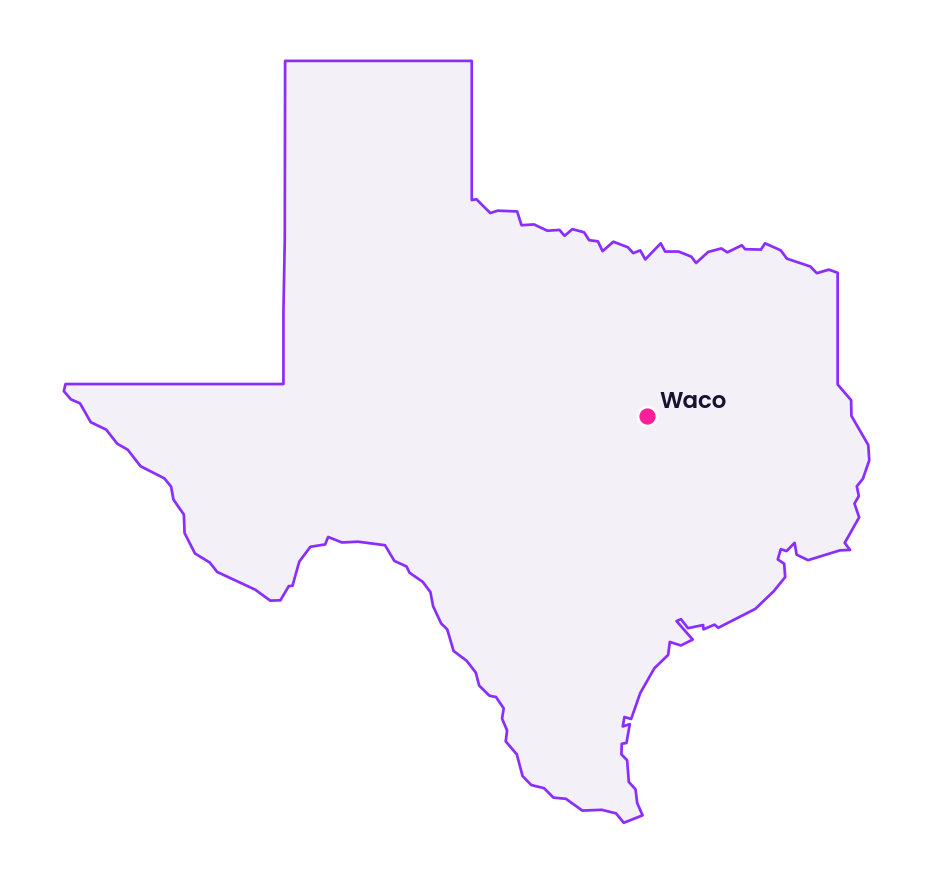
Waco sits at the geographic midpoint of the Interstate 35 growth corridor that connects the Dallas Fort Worth metroplex to Austin and San Antonio, roughly 90 miles south of Dallas and about 100 miles north of Austin. That location, once a reason investors passed the city over, is now the central argument for it.
The city recorded a July 1, 2025 population estimate of 147,788 residents from the United States Census Bureau, up 5.5 percent from the Bureau's April 1, 2020 estimates base of 140,113, and McLennan County, the anchor of the Waco metropolitan statistical area, reached 270,348 residents in 2024 according to Census Bureau population estimates. Waco is a slower and steadier growth story than Austin or Dallas, and for a certain kind of investor that is the appeal: cheaper entry, an anchored employment base led by Baylor University and two hospital systems, and a housing stock that remains materially below the national price level.
The counterweight to the growth thesis is affordability of a different sort. The city median household income was $54,365 measured in 2024 dollars over the 2020 to 2024 American Community Survey period, roughly two thirds of the Texas figure, and the persons in poverty rate was 23.1 percent. That income ceiling caps how far …
Section 01Executive Summary
Waco sits at the geographic midpoint of the Interstate 35 growth corridor that connects the Dallas Fort Worth metroplex to Austin and San Antonio, roughly 90 miles south of Dallas and about 100 miles north of Austin. That location, once a reason investors passed the city over, is now the central argument for it. The city recorded a July 1, 2025 population estimate of 147,788 residents from the United States Census Bureau, up 5.5 percent from the Bureau's April 1, 2020 estimates base of 140,113, and McLennan County, the anchor of the Waco metropolitan statistical area, reached 270,348 residents in 2024 according to Census Bureau population estimates. Waco is a slower and steadier growth story than Austin or Dallas, and for a certain kind of investor that is the appeal: cheaper entry, an anchored employment base led by Baylor University and two hospital systems, and a housing stock that remains materially below the national price level.
The counterweight to the growth thesis is affordability of a different sort. The city median household income was $54,365 measured in 2024 dollars over the 2020 to 2024 American Community Survey period, roughly two thirds of the Texas figure, and the persons in poverty rate was 23.1 percent. That income ceiling caps how far rents and home prices can run before demand thins, and the market is already feeling it. The Redfin median sale price for a Waco home was $270,353 over the three months ending June 2026, down 3.6 percent year over year, and the local multifamily market carried a vacancy rate near 9 to 10 percent through the first half of 2026 as a wave of new apartments met a population that grows but does not surge.
Section 02Population and Migration
Waco has grown consistently but modestly for more than a decade. The city added residents in every intercensal period on record, moving from 124,805 in the 2010 census to 138,486 in the 2020 census and then to the 147,788 estimate for July 1, 2025. Measured against the Census Bureau's April 1, 2020 estimates base of 140,113, which sits slightly above the census day count, that is a 5.5 percent gain across roughly five years, a healthy pace for a mid sized Texas city, though it is a fraction of the double digit surges recorded in the Austin and Dallas suburbs over the same window.
| Measure | Population | Scope |
|---|---|---|
| Waco city, 2010 census | 124,805 | April 1, 2010 |
| Waco city, 2020 census | 138,486 | April 1, 2020 |
| Waco city, 2020 estimates base | 140,113 | April 1, 2020, V2025 |
| Waco city, 2025 estimate | 147,788 | July 1, 2025, V2025 |
| Waco city change, estimates base to 2025 | +5.5% | April 2020 base to July 2025 |
| McLennan County, 2024 estimate | 270,348 | July 1, 2024 |
The metro area is built on McLennan County, which the Census Bureau population estimates placed at 270,348 residents in 2024, with Falls County adding the balance of the two county statistical area. The demographic composition tells investors who the renter and buyer pool actually is.
| Demographic measure (Waco city) | Value | Scope |
|---|---|---|
| Persons under 18 years | 22.8% | 2020 to 2024, Census Bureau |
| Persons 65 years and over | 13.4% | 2020 to 2024, Census Bureau |
| White alone, not Hispanic or Latino | 44.2% | 2020 to 2024, Census Bureau |
| Hispanic or Latino of any race | 30.6% | 2020 to 2024, Census Bureau |
| Black alone | 19.8% | 2020 to 2024, Census Bureau |
| Living in the same house one year earlier | 79.1% | 2020 to 2024, Census Bureau |
The working age middle is large, the population is diverse, and the high share of residents who lived in the same house one year earlier is a marker of household stability that tends to support steady occupancy rather than churn. No official public information is available on precise net domestic migration counts specific to the city for the most recent year, so the county estimate stands as the most defensible proxy for the direction of flows, which remains positive.
Section 03Jobs and Economic Anchors
The Waco metro labor market is defined by institutions that do not leave. The Texas Workforce Commission reported a Waco metro civilian labor force of about 147,700 in February 2026 with roughly 141,500 employed and an unemployment rate of 4.2 percent, a touch below the Texas seasonally adjusted rate of 4.5 percent recorded for July 2026 and above the national rate of 4.1 percent for July 2026 published by the Bureau of Labor Statistics. Total nonfarm employment in the Waco metro stood at about 142,700 jobs in July 2026 according to Bureau of Labor Statistics data distributed through the Federal Reserve Economic Data service.
The employer base is anchored by education and health care, the two sectors that historically hold up best through downturns, supplemented by a meaningful aerospace and advanced manufacturing presence.
| Employer | Approximate employees | Sector |
|---|---|---|
| Baylor University | 3,253 | Higher education |
| Waco Independent School District | 2,373 | Public education |
| Ascension Providence Hospital | 2,300 | Health care |
| HEB | 2,000 | Grocery retail |
| Baylor Scott and White Medical Center Hillcrest | 1,736 | Health care |
| Texas State Technical College Waco | 1,706 | Higher education and workforce training |
| L3Harris Technologies | 774 | Aerospace manufacturing |
Source: Heart of Texas Council of Governments major employers listing. The concentration is the story here. Baylor University alone employs more than 3,200 people and drives a student population that underpins the rental market, while Ascension Providence and Baylor Scott and White Hillcrest together employ more than 4,000 in health care, a sector the Bureau of Labor Statistics identified nationally as the one that continued to add jobs through mid 2026 even as other sectors flattened. Texas State Technical College and McLennan Community College feed a workforce training pipeline that has helped Waco attract distribution and manufacturing tenants. The presence of L3Harris in aerospace, along with food processing and consumer goods operations in the county, gives the economy a tradable goods leg that pure college towns lack. The vulnerability is the flip side of the same coin: an economy this dependent on a single university and two hospital networks is exposed to state higher education funding and to hospital system consolidation decisions made outside Waco.
Section 04Income
Income is the governor on this market, and it is the single most important number for underwriting Waco rents. The Census Bureau reported a Waco city median household income of $54,365 in 2024 dollars over the 2020 to 2024 period and a per capita income of $30,942. Both figures sit well below the Texas median household income of $79,721 recorded in the 2024 one year American Community Survey and reported through the Texas nonprofit Every Texan. The gap is partly a college town artifact, because a large student population depresses the measured household median, but it is also real: the persons in poverty rate was 23.1 percent and the share of residents under age 65 without health insurance was 17.2 percent.
| Geography | Median household income | Per capita income | Persons in poverty |
|---|---|---|---|
| Waco city | $54,365 | $30,942 | 23.1% |
| Waco metro area | $67,792 | no comparable public figure | not separately reported |
| Texas | $79,721 | not reported here | not reported here |
The metro figure of $67,792, drawn from American Community Survey tabulations, is the more useful number for investors evaluating suburban McLennan County product, because it strips out some of the student effect concentrated inside the city limits. The practical takeaway is that a household earning the metro median can support a rent in the range of roughly $1,600 to $1,700 per month at the common 30 percent of income standard, which places the current average asking apartment rent comfortably inside reach but leaves limited runway for aggressive rent increases before affordability becomes binding. Educational attainment supports gradual income growth: 28.7 percent of adults 25 and over held a bachelor's degree or higher, close to typical for a Texas metro of this size.
Section 05Housing and Multifamily
Waco is a renter heavy city by Texas standards, with slightly more than half of occupied homes rented against a statewide ownership rate closer to 63 percent. The Census Bureau housing profile for the 2020 to 2024 period is summarized below.
| Housing measure (Waco city) | Value | Scope |
|---|---|---|
| Owner occupied housing unit rate | 49.4% | 2020 to 2024, Census Bureau |
| Households | 53,906 | 2020 to 2024, Census Bureau |
| Persons per household | 2.51 | 2020 to 2024, Census Bureau |
| Median gross rent | $1,165 | 2020 to 2024, Census Bureau |
| Median value of owner occupied home | $221,700 | 2020 to 2024, Census Bureau |
The median owner occupied home value of $221,700 trails current sale prices because the American Community Survey blends five years of data and includes older and lower value stock.
The multifamily market entered 2026 in a digestion phase. According to Matthews Real Estate Investment Services, drawing on CoStar data, the Waco apartment market closed the first quarter of 2026 with a vacancy rate of 9.1 percent and average asking rents of $1,240 per unit, then reported second quarter 2026 asking rents of $1,375 per unit with vacancy near 10 percent. The quarter to quarter jump in the reported rent figure is large enough that investors should treat the exact level with caution and focus on the trend, which is soft positive rent growth against elevated but stable vacancy. Third party listing aggregators frame the same market differently: Apartments.com reported an average Waco asking rent of about $1,093 per month across active listings, while Zillow reported an average of about $1,450 across all bedroom counts and property types. The spread reflects methodology, not contradiction, and the honest reading is a market where typical apartment rents cluster between roughly $1,100 and $1,400 depending on unit mix and vintage.
Section 06Rents
Rent growth in Waco is best described as flat to slightly positive, consistent with the broader Texas apartment picture. The Texas Real Estate Research Center at Texas A and M University projected in its 2025 forecast that statewide multifamily rent growth would be little to none through much of the year, with rents negative in the most overbuilt markets and flat to perhaps 0.5 percent positive statewide, as a large inventory met slower population growth. Waco tracked that thesis. The Matthews reports show year over year rent growth of 0.6 percent in the first quarter of 2026 improving toward 2.3 percent by the second quarter, and the Census Bureau median gross rent of $1,165 for the city sits below the metro average asking level because it includes tenants on older leases and in older buildings.
| Rent measure | Value | Scope and source |
|---|---|---|
| Median gross rent, Waco city | $1,165 | 2020 to 2024, Census Bureau |
| Average asking rent, metro apartments | $1,240 | Q1 2026, Matthews and CoStar |
| Average asking rent, metro apartments | $1,375 | Q2 2026, Matthews and CoStar |
| Average asking rent, listing aggregator | $1,093 | 2026, Apartments.com |
| Average rent, all types | $1,450 | 2026, Zillow |
The investor conclusion is that Waco does not offer the rapid rent acceleration story of a supply constrained coastal market, nor the deep rent declines of the most overbuilt Sun Belt metros. It offers modest, income constrained rent growth in the low single digits, which rewards operators who buy at a sensible basis and control expenses rather than those underwriting aggressive rent bumps.
Section 07Vacancy
Vacancy is the clearest sign that supply has run slightly ahead of demand. The metro apartment vacancy rate of 9.1 percent in the first quarter of 2026 rising toward 10 percent in the second quarter, as reported by Matthews using CoStar data, is elevated relative to a healthy stabilized market, which typically runs in the 5 to 7 percent range. The cause is not weak demand so much as timing: several thousand units delivered into the market over the prior two years while population grew at its steady but unspectacular pace, and it takes time to absorb that inventory. Because the newest lease up communities carry the highest vacancy, blended figures overstate the softness at stabilized older properties, many of which continue to run tighter. No official public figure isolates city limit apartment vacancy from the broader metro, so the metro number is the most defensible proxy and it points to a renter's market in the near term, with concessions likely on new deliveries and limited pricing power for landlords until the excess is absorbed.
Section 08Supply Pipeline
The pipeline is the reason vacancy is elevated and also the reason the medium term outlook is more constructive. Matthews reported that Waco had roughly 1,100 apartment units under construction as of the first quarter of 2026 with no new deliveries recorded that quarter, and about 906 units under construction as of the second quarter of 2026. The direction of the state pipeline is decisively downward. The Texas Real Estate Research Center projected statewide 2025 apartment deliveries at roughly half the 2024 total of over 116,000 units, falling toward about 55,000 units, and the same source noted that Texas apartment inventories continued to grow into 2026 even as the under construction pipeline shrank.
For Waco the implication is favorable on a two to three year horizon. A metro that is currently absorbing an oversupply, but has a thinning construction pipeline behind it, is set up for vacancy to tighten and rent growth to firm once the current deliveries lease up, provided the population continues to expand at its recent pace. The risk to that thesis is a resumption of speculative construction if capital returns quickly, and single family building activity offers a caution: the National Association of Home Builders, using Census Bureau permit data, reported Texas issued 140,002 single family permits in 2025, down 11.7 percent from 2024, a signal that builders across the state have already pulled back.
Section 09Single Family Homes
The Waco for sale housing market cooled through 2026 after several years of strong appreciation, which improves entry economics for buyers and single family rental investors while signaling that the easy appreciation gains are over. Redfin reported a Waco median sale price of $270,353 over the three months ending June 2026, down 3.6 percent year over year, with a median price per square foot of $172, up 0.6 percent, and homes going pending in roughly 48 to 53 days at about 3 percent below list price. The softening was sharper in specific submarkets: Redfin data for ZIP code 76,708 on the north and west side showed a median around $278,000, down 8.8 percent year over year, and ZIP code 76,706 near Baylor and south Waco showed a median around $252,000, down 7.2 percent.
| Area | Median sale price | Year over year |
|---|---|---|
| Waco city, all home types | $270,353 | -3.6% |
| ZIP 76,708 (north and west Waco) | $278,000 | -8.8% |
| ZIP 76,706 (south Waco and Baylor area) | $252,000 | -7.2% |
Source: Redfin, three months ending June 2026. The single family rental angle is the more interesting institutional story. Waco home prices remain roughly a third below the national median sale price, which Redfin put above $400,000 in mid 2026, and rents have held up better than sale prices. That combination compresses the gap between the cost to own and the income a rental produces, which is favorable for build to rent and scattered site rental strategies, particularly in the growing suburbs. The offsetting pressure is the carrying cost stack described in the taxes and insurance sections below, which in Texas can consume a large share of gross rent and must be underwritten explicitly rather than assumed.
Section 10Commercial Real Estate and Retail Centers
City specific commercial vacancy and rent series for Waco are not consistently available in public sources, so the most defensible approach is to combine the statewide sector forecasts from the Texas Real Estate Research Center with the national trajectory from CoStar and to say plainly where Waco specific data does not exist. Across the three major commercial sectors the Texas outlook for 2025 and into 2026 was one of positive but decelerating rent growth with rising vacancy in industrial.
| Sector | Texas 2025 rent outlook | Demand and vacancy signal |
|---|---|---|
| Office | +1.5% asking rents across classes | Net absorption about -0.5%, older class B and C giving up space |
| Industrial | +3% rent growth | Vacancy rising toward 8.5% statewide as deliveries outran absorption |
| Retail | +3% rent growth | Net absorption under 1% of inventory, pipeline slowing |
Source: Texas Real Estate Research Center 2025 forecast and Fall 2025 commercial update. On the industrial side, CoStar projected the national industrial vacancy rate would rise from 7.5 percent in late 2025 to a peak near 7.9 percent in the third quarter of 2026 before improving, with national rent growth near a 13 year low around 1.0 percent. Waco's position on the Interstate 35 logistics spine, with rail access and available land at a lower basis than Dallas or Austin, makes it a credible beneficiary of the longer term reshoring and distribution trend even as the sector digests near term oversupply. Office is the weakest sector nationally and Waco is a small office market without a large corporate footprint, so office exposure here should be limited to well located medical office and small owner user buildings rather than speculative multitenant space. Retail is the relative bright spot for a growing residential market: grocery anchored neighborhood centers benefit directly from household growth and from a large grocery employer base, and Waco city recorded total retail sales of about $3.44 billion in 2022 per the Census Bureau, or roughly $24,004 per capita, evidence of a functioning consumer economy that supports necessity based retail.
Section 11Transactions and Capital Markets
Transaction pricing in Waco reflects a higher interest rate environment and a market that institutional capital treats as tertiary, which means wider capitalization rates and a thinner buyer pool than primary Texas metros. Matthews reported that Waco multifamily capitalization rates had settled around 7.1 percent in the first quarter of 2026, materially above the sub 5 percent rates that defined the market at the 2021 peak. That repricing is the central capital markets fact for the city: it lowers acquisition prices and improves going in yields for cash buyers and low leverage investors, while it strains sellers who bought at peak pricing and financed with short term or floating rate debt now resetting higher.
Deal volume specific to Waco is not published in a comprehensive public series, so precise annual transaction dollar figures are not available, and investors should treat any single quarter's cap rate as indicative rather than precise given the small number of trades. The structural point holds regardless of the exact figure: at cap rates near 7 percent and prices below replacement cost in many older assets, Waco is a market where disciplined value oriented buyers can find positive leverage more easily than in Austin or Dallas, at the cost of lower liquidity when it is time to sell. Building permit activity, tracked for McLennan County through Census Bureau data in the Federal Reserve Economic Data service, is the cleanest public proxy for the direction of new investment, and it has moderated in line with the statewide pullback.
Section 12Taxes
Property taxes are the defining carrying cost in Texas and the reason underwriting here differs from lower tax states. Texas levies no state personal income tax and funds local government through property and sales taxes, which pushes effective property tax rates well above the national norm. The property analytics firm Ownwell reported a McLennan County effective property tax rate of about 1.89 percent against a median home value of about $233,860, compared with a national median effective rate near 1.02 percent. On a $270,000 Waco home that implies an annual property tax bill in the range of roughly $5,000, a figure that must be modeled directly into any single family rental or small multifamily proforma because it can consume a fifth or more of gross rent.
The rate itself is a stack of overlapping jurisdictions. McLennan County published its 2025 county tax rate near $0.33 per $100 of valuation, and layered on top are city of Waco, school district, community college, and special district levies that together produce the effective rate above. Rapid appraisal growth has been the recent flashpoint: local reporting noted county homeowners were told to expect average appraisal increases of roughly 30 percent in a recent year, a reminder that in Texas the taxable value, not just the rate, drives the bill, and that the state's homestead exemptions and appraisal caps protect owner occupants far more than they protect investor owned rental property, which does not qualify for the homestead cap.
Section 13Insurance
Property insurance has moved from a minor line item to a material underwriting variable across Texas, and Waco is not exempt. NerdWallet reported an average Texas homeowners insurance cost of about $4,915 per year, or roughly $410 per month, for 2026, among the highest in the nation, driven by the state's exposure to hail, wind, and tornado losses. LendingTree reported that annual premium increases across the country accelerated to a peak of 12.7 percent in 2024 before easing to a still significant 6.0 percent in 2025, and research from the Kinder Institute at Rice University found that rising premiums consumed a growing share of household income for Texans, climbing from 3.7 percent to 5.8 percent of annual income for lower and moderate income residents.
| Insurance group | Texas homeowners market share |
|---|---|
| State Farm Group | 19.10% |
| Allstate Insurance Group | 16.79% |
| United Services Automobile Association Group | 11.22% |
| Liberty Mutual Group | 6.05% |
Source: Texas Department of Insurance market overview. The market remains competitive at the top, which helps, but the trajectory of premiums is the concern. For a Waco investor the practical guidance is to obtain firm insurance quotes before closing rather than relying on trailing figures, because central Texas hail exposure can push commercial multifamily premiums up sharply at renewal and a stale insurance assumption is one of the most common ways a Texas proforma turns out wrong.
Section 14Landlord Tenant and Regulatory Environment
Texas is a landlord favorable state and Waco operates fully within that framework, which is a genuine advantage for owners relative to tenant protective states. Texas has no statewide rent control, and state law preempts local governments from enacting rent control except in narrowly defined housing emergencies, so investors do not face the rent regulation risk present in some other large states. Eviction procedures under the Texas Property Code are comparatively fast and defined, and there is no statewide cap on security deposits. This regulatory posture is a structural positive that supports the state's continued attraction of rental housing capital.
The offsetting considerations are local rather than statewide. The city of Waco administers housing and community development programs and standard building and permitting requirements, and investors in the older housing stock near the urban core should budget for code compliance and habitability standards. No official public information indicates that Waco has adopted unusual local landlord tenant ordinances beyond the standard Texas framework, so the base case is a stable, owner friendly legal environment. The regulatory risk that does warrant monitoring is at the state and county level on appraisal and tax policy rather than on tenancy, because changes to homestead exemptions and appraisal caps directly reshape the after tax returns on rental property.
Section 15Infrastructure
Infrastructure is Waco's clearest structural asset and the physical basis for the growth thesis. The city straddles Interstate 35, the primary highway artery of Texas, which carries the freight and commuter flows linking Dallas Fort Worth to Austin and San Antonio, and the ongoing multiyear expansion of Interstate 35 through the Waco area is enlarging capacity along that corridor. That position gives Waco genuine logistics relevance for distribution and manufacturing tenants seeking a lower cost location within a half day drive of most of the Texas population. The mean travel time to work for Waco residents was just 18.7 minutes over the 2020 to 2024 period per the Census Bureau, evidence of a compact, low congestion metro that remains easy to live and operate in even as it grows.
Beyond the highway, Waco is served by Waco Regional Airport for commercial and general aviation, by freight rail including Class one service through the region, and by the water and utility systems of a mid sized city with room to expand. Baylor University and the Texas State Technical College campus supply not only employment but the research, training, and cultural infrastructure that help retain young workers. Broadband access is solid, with the Census Bureau reporting 88.9 percent of households holding a broadband subscription. The infrastructure story is not one of scarcity driving values, as in a constrained coastal city, but of adequacy and connectivity supporting steady expansion at a manageable cost, which is exactly the profile that suits patient capital.
Section 16Climate and Physical Risks
Waco's physical risk profile is dominated by severe convective weather and by riverine flooding, and both must be priced into insurance and site selection. The city lies within the central Texas belt exposed to tornadoes and large hail, and the risk analytics firm Augurisk characterized Waco as facing severe risk from hail storms and severe risk from tornadoes, even while the aggregate storm score screened as moderate. The memory of the catastrophic 1953 Waco tornado remains part of the local risk consciousness, and hail in particular is the peril most likely to generate repeated insurance claims on roofs and exteriors, which feeds directly into the elevated premiums discussed above.
Flooding is the second material hazard. The Brazos River runs through Waco, gauged by the National Oceanic and Atmospheric Administration's National Water Prediction Service at the Brazos River at Waco station, and the river has a documented history of flooding low lying and poorly drained areas during heavy central Texas thunderstorms. The Federal Emergency Management Agency's flood maps and the National Flood Hazard Layer define the regulated floodplain, and property level analytics such as First Street show meaningful flood exposure for riverfront neighborhoods. The practical investor discipline is straightforward: pull the FEMA flood zone determination for any specific parcel before acquisition, because flood risk in Waco is highly localized to the river corridor and drainage ways, and a property outside the mapped floodplain carries materially different insurance and resale characteristics than one inside it.
Section 17Neighborhoods and Submarkets
Waco is not a single market but a set of distinct submarkets with wide price dispersion, and understanding that dispersion is where local knowledge earns its return. The urban core around downtown and the Baylor University campus is the rental engine, driven by student and young professional demand, and it has been the focus of revitalization investment. The suburban ring to the west and southwest, including Woodway, Hewitt, Robinson, Lorena, and China Spring, is where owner occupant demand and higher price points concentrate, while the eastern and northern areas such as Bellmead offer lower entry prices and higher yields at higher management intensity.
| Area | Median home price | Source |
|---|---|---|
| Austin Avenue corridor | $425,000 | Homes.com |
| Woodway | $374,438 | Zillow |
| Hewitt | $300,655 | Zillow |
| Downtown Waco | $287,000 | Homes.com |
| China Spring | $259,500 | Homes.com |
The pattern is a spread of well over $150,000 between the higher end established neighborhoods and the entry level suburbs, and a further step down into the older core and eastern neighborhoods. For rental investors the tradeoff runs along that same axis: the western suburbs like Woodway and Hewitt deliver stronger appreciation and more stable owner occupant demand at lower gross yields, while the core and east side offer higher current yield at the cost of more turnover, more maintenance, and more sensitivity to the income constraints discussed earlier. China Spring and the outer suburbs capture the household formation moving out from the core and remain the most active new construction submarkets.
Section 18Opportunities
The clearest opportunity is basis. Waco offers entry prices well below the primary Texas metros, with a median home sale price around $270,000 and multifamily cap rates near 7 percent, in a market with a stable, institutionally anchored employment base and steady population growth. For a patient buyer, the combination of a thinning construction pipeline, elevated but improving vacancy, and repriced acquisition values sets up a favorable medium term entry point, because the excess supply now depressing rents is finite and the demand behind it is durable. Value oriented multifamily, where an operator can buy an older asset below replacement cost, improve management, and hold through the current absorption phase, is the most defensible strategy.
The single family rental and build to rent angle is a second real opportunity, supported by home prices a third below the national level, rents that have held up better than sale prices, and continued household formation in the western suburbs. Necessity based retail, especially grocery anchored neighborhood centers serving the growing suburban rooftops, benefits directly from population growth and from Waco's substantial per capita retail sales. Industrial and logistics on the Interstate 35 corridor is a longer horizon opportunity that rewards investors willing to underwrite through the current national industrial oversupply to the structural advantage of Waco's location and land cost.
Section 19Risks
The dominant risk is the income ceiling. With a city median household income of $54,365 and a metro figure of $67,792, both below the Texas median, and a poverty rate of 23.1 percent, there is limited room for rents and prices to rise before affordability becomes binding, and the recent home price declines and elevated apartment vacancy show that ceiling is already exerting pressure. Overbuilding is the near term expression of that risk: the metro apartment vacancy near 9 to 10 percent reflects supply that ran ahead of demand, and while the pipeline is thinning, a premature return of speculative construction would prolong the soft patch.
The carrying cost stack is the second major risk and the one most often underestimated. Property taxes at an effective rate near 1.89 percent, homeowners insurance averaging near $4,915 per year statewide and rising, and the loss of homestead protections on investor owned property together consume a large share of gross rent and can turn an apparently attractive yield into a thin one. Concentration risk is the third: an economy anchored by one university and two hospital systems is exposed to decisions and funding cycles outside local control. Physical risk from hail, tornado, and Brazos River flooding is the fourth, feeding directly into insurance costs and requiring parcel level diligence. Finally, liquidity is a structural risk, because Waco is a tertiary market where the buyer pool thins in a downturn and exit timing is less flexible than in a primary metro.
Section 20Investor Implications
The synthesis is that Waco rewards a specific investor and penalizes another. It rewards the patient, adequately capitalized, value oriented buyer who acquires at a sensible basis near current repriced levels, underwrites the full Texas carrying cost stack of taxes and insurance honestly, plans to hold through the current absorption phase, and does not depend on rapid rent growth or quick liquidity to make the deal work. For that investor the case is coherent: a growing, low cost, institutionally anchored market on the main corridor of the fastest growing large state, available at a discount to its bigger neighbors.
It penalizes the investor who underwrites aggressive rent increases, who assumes primary market liquidity, who models trailing insurance figures, or who relies on near term appreciation, because the income ceiling, the elevated vacancy, the softening for sale market, and the rising carrying costs will each work against those assumptions. The disciplined path is to demand a going in yield wide enough to absorb the tax and insurance load with margin to spare, to obtain firm insurance quotes and FEMA flood determinations before closing, to favor stabilized or clearly value add multifamily and suburban single family rental over speculative office or unanchored retail, and to size leverage conservatively given the tertiary market's thinner exit.
Section 21Conclusion
Waco is a steady rather than spectacular market, and its investment case rests on location, affordability of entry, and an anchored economy rather than on momentum. The public data through mid 2026 describes a city of 147,788 people growing at a measured 5.5 percent from its 2020 estimates base over five years, anchored by Baylor University, two hospital systems, and a logistics friendly position on Interstate 35, with a median home price near $270,000 that has cooled modestly and an apartment market absorbing recent supply at a vacancy near 9 to 10 percent. The constraints are equally clear: incomes below the Texas median, a poverty rate above 23 percent, elevated property taxes and rising insurance, concentration in a handful of institutions, and real physical risk from hail and Brazos River flooding. For investors who match their strategy to that profile, buying at a fair basis and underwriting the full cost stack, Waco offers a credible, lower cost entry into Texas growth. For those seeking rapid appreciation, deep liquidity, or aggressive rent growth, it does not. The honest conclusion is neither a buy signal nor a warning but a description of a market that pays disciplined capital and disappoints undisciplined capital.
Sources
- United States Census Bureau, QuickFacts, Waco city, Texas, https://www.census.gov/quickfacts/fact/table/wacocitytexas/PST045225
- United States Census Bureau population estimates for McLennan County, Texas, via Federal Reserve Economic Data, https://fred.stlouisfed.org/series/TXMCLE9POP
- Bureau of Labor Statistics, Waco, Texas Economy at a Glance, https://www.bls.gov/eag/eag.tx_waco_msa.htm
- Bureau of Labor Statistics, All Employees Total Nonfarm in Waco, Texas metro, via Federal Reserve Economic Data, https://fred.stlouisfed.org/series/WACO348NAN
- Bureau of Labor Statistics, Employment Situation Summary, July 2026, https://www.bls.gov/news.release/empsit.nr0.htm
- Texas Workforce Commission and Texas Labor Market Information, https://texaslmi.com/
- Heart of Texas Council of Governments, Major Employers in the Heart of Texas, https://www.hotcogtx.gov/hotedd/workforce/major-employers
- Every Texan, New Census Data on income and poverty in Texas, https://everytexan.org/2025/09/11/new-census-data-reflect-rising-challenges-in-texas-on-health-insurance-poverty-and-income-inequality/
- Census Reporter, Waco, Texas profile, http://censusreporter.org/profiles/16000US4876000-waco-tx/
- Matthews Real Estate Investment Services, Waco, Texas Multifamily Market Report Q2 2026, https://www.matthews.com/insights/waco-tx-multifamily-market-report-q2-2026/
- Matthews Real Estate Investment Services, Waco, Texas Multifamily Market Report Q1 2026, https://www.matthews.com/insights/waco-tx-multifamily-q1-2026
- Apartments.com, Average Rent in Waco, Texas, https://www.apartments.com/rent-market-trends/waco-tx/
- Zillow, Average Rental Price in Waco, Texas, https://www.zillow.com/rental-manager/market-trends/waco-tx/
- Redfin, Waco, Texas Housing Market, https://www.redfin.com/city/19250/TX/Waco/housing-market
- Redfin, 76,708 and 76,706 Housing Market, https://www.redfin.com/zipcode/76708/housing-market
- Homes.com, Waco, Texas neighborhood prices, https://www.homes.com/waco-tx/
- Zillow, McLennan County, Texas home values, https://www.zillow.com/mclennan-county-tx/
- Texas Real Estate Research Center at Texas A and M University, 2025 Texas Real Estate Forecast, https://trerc.tamu.edu/reports/2025-texas-real-estate-forecast/
- Texas Real Estate Research Center, Commercial Fall 2025, https://trerc.tamu.edu/article/commercial-fall-2025/
- CoStar, United States industrial vacancy projections, https://www.costargroup.com/press-room/2026/costar-expects-us-industrial-vacancy-peak-year-rent-growth-remains-unchanged
- National Association of Home Builders, Building Permits by State and Metro Area, https://www.nahb.org/news-and-economics/housing-economics/state-and-local-data/building-permits-by-state-and-metro-area
- McLennan County, Texas Tax Rates, https://www.mclennan.gov/224/Tax-Rates
- Ownwell, McLennan County, Texas Property Taxes, https://www.ownwell.com/trends/texas/mclennan-county
- Texas Department of Insurance, Texas homeowners insurance market overview, https://www.tdi.texas.gov/general/texas-homeowners-insurance-market-overview.html
- NerdWallet, Average Homeowners Insurance Cost 2026, https://www.nerdwallet.com/insurance/homeowners/learn/average-homeowners-insurance-cost
- LendingTree, State of Home Insurance 2026, https://www.lendingtree.com/insurance/state-of-home-insurance/
- Kinder Institute at Rice University, homeowners insurance premiums, https://kinder.rice.edu/urbanedge/homeowners-insurance-premiums-continue-spike-these-texans-pay-biggest-price
- National Oceanic and Atmospheric Administration, National Water Prediction Service, Brazos River at Waco, https://water.noaa.gov/gauges/08096500
- Federal Emergency Management Agency, Flood Maps, https://www.fema.gov/flood-maps
- Augurisk, Flood and Storm risk in Waco, Texas, https://www.augurisk.com/city/texas/waco/31.558829434517538/-97.1883734182386