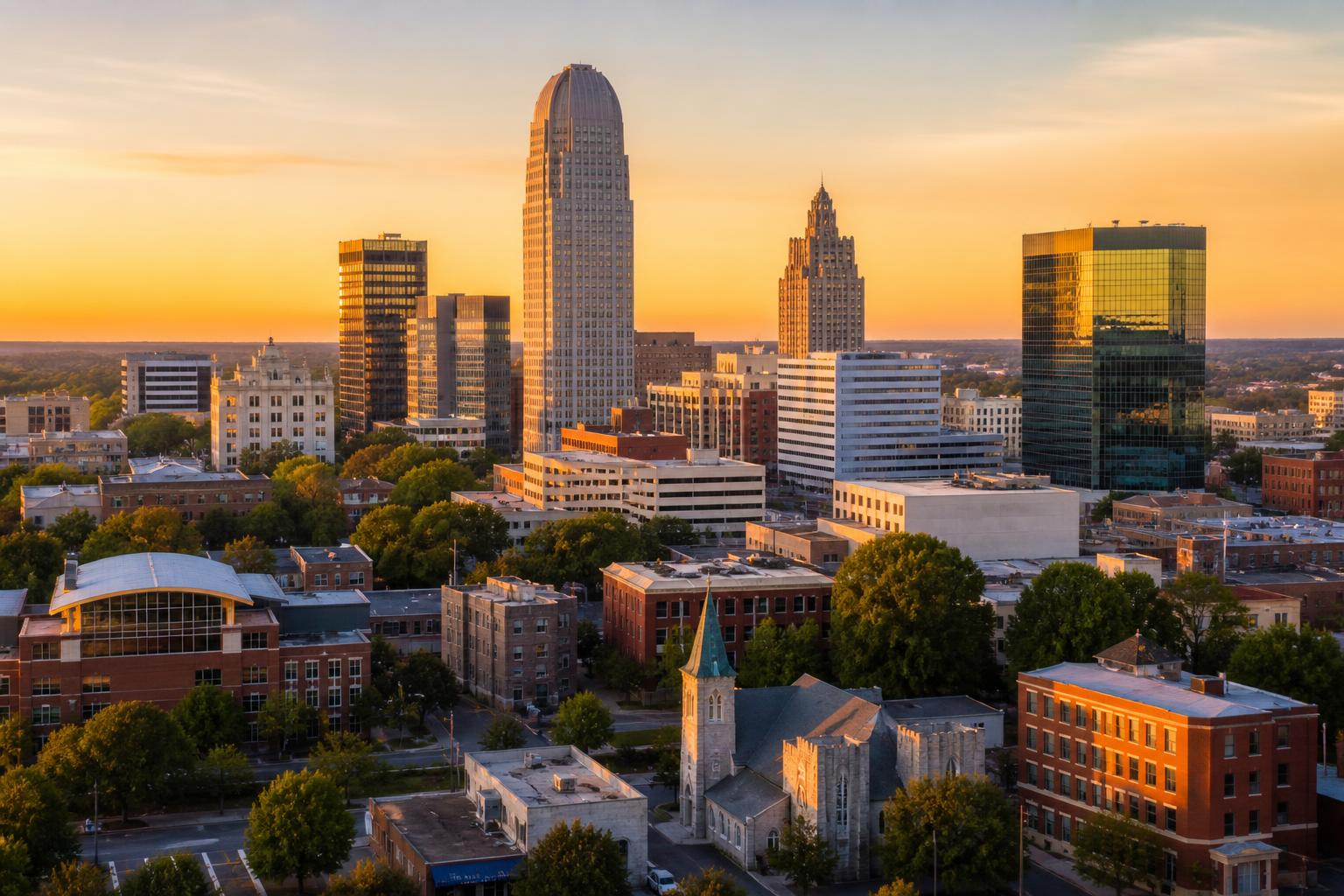
In brief · summary: Winston-Salem
Winston-Salem is the county seat of Forsyth County and the anchor city of the Piedmont Triad region of North Carolina, sitting between Charlotte and Raleigh but growing far more slowly than either. The city had an estimated population of 257,271 in 2025, the fifth largest in North Carolina, according to the Census Bureau Vintage 2025 population estimate as compiled by EveryCityInTheUSA and World Population Review, while the broader Winston-Salem metropolitan statistical area reached about 712,206 residents in 2025, per Census Bureau data hosted by the Federal Reserve Bank of St. Louis. Growth has been steady rather than explosive, with the city adding only about 3.1 percent of population since the 2020 census.
The defining fact of the local economy is Atrium Health Wake Forest Baptist, Forsyth County's largest employer with more than 18,500 workers, anchoring both a large healthcare sector and the Innovation Quarter, a downtown life sciences and regenerative medicine district that the district itself says generates about 2 billion dollars in annual economic impact. The city's historic tobacco and textile base, built by R.J. Reynolds and Hanes, persists through Reynolds American and Hanesbrands but now employs a much smaller share of the workforce than healthcare, financial services through Truist and Wells Fargo, and the growing biotech cluster.
For real estate, the story is affordability paired with softening apartment fundamentals and a landlord friendly legal environment. Multifamily vacancy sits in the 6 to 9 percent range depending on the data source, average advertised rents run from roughly 1,100 to 1,400 dollars a month, and single family home prices, at a median in the high 280,000s to low 300,000s according to Redfin, remain well below both the Charlotte and Raleigh medians. Property taxes are moderate after a 2025 countywide revaluation, North Carolina has no rent control and a fast, landlord favorable eviction process, and the risks an investor must underwrite include a genuinely high inland flood exposure from Salem Creek and Muddy Creek, rising statewide homeowners insurance premiums, and an economy still working through the consolidation of its legacy manufacturing employers.
Section 01Executive Summary
Winston-Salem is the county seat of Forsyth County and the historical capital of the Piedmont Triad, the three city cluster it forms with Greensboro and High Point in north central North Carolina. The city's 2025 population was estimated at 257,271, the fifth largest in the state, according to the Census Bureau's Vintage 2025 population estimate as reported by EveryCityInTheUSA and World Population Review, both of which cite the Census Bureau directly. The metropolitan statistical area, which includes Forsyth, Davidson, Davie, Stokes, and Yadkin counties, reached an estimated 712,206 residents in 2025, according to Census Bureau data hosted on the Federal Reserve Bank of St. Louis FRED database. Growth has been modest and steady rather than rapid: the city added about 7,722 residents, or 3.1 percent, between the April 2020 census and the July 2025 estimate.
The single most important structural fact for an investor is the depth and diversification of the local employment base around healthcare and life sciences. Atrium Health Wake Forest Baptist, an academic medical center that is part of Advocate Health, the third largest nonprofit health system in the United States, is Forsyth County's largest employer with more than 18,500 workers, according to 6AMCity's compilation of major employer data and confirmed by Wikipedia's sourced figure of over 19,220 employees across 198 buildings. Around that hospital system, Winston-Salem has built the Innovation Quarter, a 330 acre downtown life sciences and technology district that its operator says generates roughly 2 billion dollars in annual economic impact and supports more than 4,000 direct jobs, with a Phase II expansion of up to 2.7 million square feet of new lab, office, and residential space now under construction planning.
Housing affordability is the second defining fact. Redfin reported a median sale price of 293,853 dollars for the city of Winston-Salem in July 2026, up 2.7 percent year over year, a level that remains well below the medians in Charlotte and Raleigh. Apartment rents are similarly moderate: Zumper measured an average rent of 1,382 dollars a month in August 2026, actually down 5.4 percent from a year earlier, while Apartments.com measured 1,127 dollars, up 2.6 percent, a divergence that reflects different property samples but a consistent picture of a market where rents remain roughly 30 percent below the national average. Multifamily vacancy readings range from about 6 percent for stabilized Class A and B product, per cap rate data sourced from Colliers, up to 8 to 9 percent in broader city wide counts, following a wave of deliveries that peaked around 2024.
The risks that must be underwritten explicitly are a genuinely elevated inland flood risk from Salem Creek and Muddy Creek that FEMA's National Risk Index rates as relatively high for Forsyth County, rising statewide homeowners insurance premiums following a negotiated 15 percent two year rate increase, and an economy still absorbing the consolidation of its legacy tobacco and textile employers even as healthcare, life sciences, and financial services expand to take their place. On balance, Winston-Salem offers a lower cost, lower volatility alternative to the faster growing Charlotte and Raleigh markets, with a landlord favorable regulatory environment and a credible, hospital anchored growth story in life sciences, but without the population momentum that drives outsized rent growth in North Carolina's larger metros.
Section 02Population and Migration
Winston-Salem's population growth is real but unhurried compared with the rest of North Carolina's major metros. The Census Bureau's Vintage 2025 population estimate, as reported by EveryCityInTheUSA and World Population Review, put the city's population at 257,271 as of July 1, 2025, an increase of 1,625 people, or 0.6 percent, from the prior year, and a cumulative gain of 7,722 residents, or 3.1 percent, since the April 2020 census count of 249,545. That places Winston-Salem as the fifth most populous city in North Carolina and the 90th largest in the United States. World Population Review's 2026 projection put the figure slightly higher, at 258,880.
At the county level, Forsyth County reached an estimated 401,718 residents in 2025, a 5.0 percent gain since the 2020 census count of 382,590, according to Wikipedia's sourced Census Bureau figures, while USAFacts separately reported about 401,700 residents in Forsyth County for 2025. At the metropolitan level, which spans five counties including Davidson, Davie, Stokes, and Yadkin alongside Forsyth, the Census Bureau's estimate, hosted on the Federal Reserve Bank of St. Louis FRED database under the series WSAPOP, put the 2025 population at 712,206, consistent with the CityPopulation.de compilation of the same Census Bureau data, which showed the metro growing from 640,595 in 2010 and 675,968 in 2020 to 712,206 in 2025.
| Geography | Population | Scope and source |
|---|---|---|
| City of Winston-Salem | 257,271 | 2025 estimate, Census Bureau via EveryCityInTheUSA |
| Forsyth County | 401,718 | 2025 estimate, Census Bureau via Wikipedia |
| Winston-Salem metropolitan area | 712,206 | 2025 estimate, Census Bureau via FRED (WSAPOP) |
| City population change, 2020 to 2025 | +3.1% | +7,722 residents, Census Bureau via EveryCityInTheUSA |
The pace of growth is the key contrast with peer North Carolina metros: while Charlotte and Raleigh have posted some of the fastest population gains of any large metro in the country in recent years, Winston-Salem's growth has been gradual and driven more by natural increase and modest in migration than by the explosive corporate relocation booms seen further east and south. For an investor, that means Winston-Salem does not offer the same demand tailwind that supports aggressive rent growth assumptions in Charlotte or Raleigh, but it also means the market carries less risk of a supply driven bust, because developers have not chased population growth with the same intensity. The practical takeaway is that Winston-Salem's real estate demand is anchored primarily by its existing institutions, principally Atrium Health Wake Forest Baptist, Wake Forest University, and the Innovation Quarter, rather than by broad based net in migration.
Section 03Jobs and Economic Anchors
Employment in the Winston-Salem metropolitan area has grown modestly and the labor market remains tight by historical standards. The Bureau of Labor Statistics Economy at a Glance data for the Winston-Salem, NC metropolitan statistical area, as reflected in the Federal Reserve Bank of St. Louis FRED series, showed total nonfarm employment of about 279,100 in July 2026, and an unemployment rate of 3.8 percent, not seasonally adjusted, for the same month. That unemployment rate is essentially in line with the statewide North Carolina rate of 3.6 percent in July 2026, itself well below the national rate of 4.1 percent in August 2026, according to BLS Economy at a Glance data. A North Carolina Department of Commerce style economic report covering the first quarter of 2026 found that Winston-Salem metro employment grew 1.0 percent year over year, a moderate but positive pace that trailed faster growing metros such as Wilmington, Raleigh, and Asheville but kept pace with the statewide average.
| Indicator, Winston-Salem metro | Value | Scope and source |
|---|---|---|
| Total nonfarm employment | ~279,100 | July 2026, BLS via FRED (WINS137NAN) |
| Unemployment rate | 3.8% | July 2026 not seasonally adjusted, BLS via FRED (WINS137URN) |
| Year over year employment growth | +1.0% | Q1 2026, NC economic report |
| North Carolina statewide unemployment rate | 3.6% | July 2026 preliminary, BLS |
Behind these aggregate numbers sits an economy in genuine transition. Atrium Health Wake Forest Baptist is Forsyth County's largest employer by a wide margin, with more than 18,500 employees according to 6AMCity's employer compilation and more than 19,220 employees and 198 buildings according to a sourced Wikipedia figure, and it is the academic core of Advocate Health, the third largest nonprofit health system in the United States. Novant Health, the region's other major hospital system, and the Winston-Salem/Forsyth County Schools system, with about 5,500 employees serving more than 53,000 students, round out the largest non financial employers. Financial services remain significant legacy strengths: Truist, formed from the 2019 merger of Winston-Salem based BB&T with SunTrust, employs about 4,000 people locally, and Wells Fargo employs roughly 3,500. The historic tobacco and textile employers, Reynolds American, founded in Winston-Salem in 1875 and now part of British American Tobacco, and Hanesbrands, whose roots in the city date to 1901, employ about 2,500 and 2,400 people respectively, a fraction of their historical local headcounts but still meaningful anchors, according to 6AMCity and MyWinston-Salem employer profiles.
The clearest forward looking growth story is the Innovation Quarter, a 330 acre downtown life sciences, biotechnology, and regenerative medicine district anchored by the Wake Forest School of Medicine and the Wake Forest Institute for Regenerative Medicine. According to the Innovation Quarter's own November 2025 announcement of its Phase II master plan, the district already supports more than 4,000 full time employees and generates an estimated 2 billion dollars in annual economic impact along with nearly 60 million dollars in state and local taxes, and Phase II will add up to 2.7 million square feet of mixed use clinical, lab, office, and residential development on 28 additional acres. Winston-Salem was ranked the seventh fastest growing region in the country for life sciences employment in 2024, according to reporting cited by the Innovation Quarter, and the sector's growth is increasingly moving from research toward manufacturing, with regenerative medicine and cell therapy manufacturing facilities now under construction in the district. For an investor, the economic anchor conclusion is that Winston-Salem's job growth is real but modest in the aggregate, concentrated in healthcare, life sciences, financial services, and education, with the legacy tobacco and apparel manufacturing base now a smaller, still important, supporting pillar rather than the primary driver it once was.
Section 04Income
Household income in Winston-Salem is modest relative to both the state and the nation, a fact that shapes both housing affordability and the ceiling on achievable rents. The Census Bureau's American Community Survey 2020 to 2024 five year estimate put the city of Winston-Salem's median household income at 59,268 dollars, according to compilations by World Population Review and StateDemographics.com that cite the same ACS dataset. Forsyth County as a whole reported a higher median household income of 67,638 dollars for 2024, according to the Federal Reserve Bank of St. Louis FRED series MHINC37067A052NCEN, while the statewide North Carolina median household income was 74,055 dollars for 2024, per the myFutureNC county dashboard.
| Geography | Median household income | Scope and source |
|---|---|---|
| City of Winston-Salem | $59,268 | 2020 to 2024 ACS 5 year estimate |
| Forsyth County | $67,638 | 2024, Census Bureau via FRED |
| North Carolina statewide | $74,055 | 2024, myFutureNC dashboard |
| HUD area median income, family of 4, Winston-Salem MSA | ~$81,900 | 2024, HUD via Winston-Salem/Forsyth Housing Consortium |
The gap between the city figure and the county and metro figures is meaningful and reflects the same pattern seen in most Southern cities: higher income households have disproportionately settled in suburban Forsyth County outside the city limits, while the urban core carries a higher poverty rate, reported at about 17.7 percent for the city of Winston-Salem by World Population Review's compilation of ACS data. For an investor, moderate incomes mean that Winston-Salem's affordability is a genuine structural feature rather than a temporary discount, but it also means that rent growth is capped by what a workforce earning a median household income in the high 50,000s to high 60,000s can sustainably absorb. Rising property taxes and insurance costs, discussed in later sections, compete directly with rent increases for a limited pool of household income, which is part of why several apartment rent series have shown flat to declining rents even as the broader Sun Belt has seen a modest recovery.
Section 05Housing and Multifamily
The Winston-Salem apartment market has moved through a supply wave and is now digesting it, with rent and occupancy readings that vary meaningfully by data source but tell a broadly consistent story of a market in mild oversupply relative to its own history. The most recent HUD Comprehensive Housing Market Analysis, covering the Winston-Salem HMA and dated to 2024 data, described the rental market as balanced, with an overall vacancy rate of 8.7 percent, up slightly from 8.4 percent in April 2020, and an apartment specific vacancy rate of 8.6 percent as of the first quarter of 2024, per CoStar Group data cited in the report, with average apartment rent of 1,173 dollars over the twelve months ending May 2024, up 1 percent year over year. A separate 2024 market summary published by WinstonSalem.com, the region's economic development organization, found that net multifamily deliveries of 1,320 units over the prior year had pushed vacancy to 7.4 percent, still below the reported national rate of 7.7 percent at the time, while asking rents had grown 2.7 percent, an acceleration from 1.1 percent growth a year earlier.
| Series and scope | Level or reading | Change | Period and source |
|---|---|---|---|
| Apartment vacancy rate, HUD CHMA | 8.6% | roughly flat vs 8.5% prior year | Q1 2024, CoStar via HUD |
| Average apartment rent, HUD CHMA | $1,173 | +1% YoY | 12 months ending May 2024, CoStar via HUD |
| Multifamily vacancy, economic development report | 7.4% | below national 7.7% at the time | 2024, WinstonSalem.com |
| Multifamily vacancy, cap rate data | ~6.2% | declining | Q2 2026, Colliers via ApartmentLoanStore |
| Multifamily cap rate, Class A and B | ~5.2% | compressed 5 bps in quarter | Q2 2026, ApartmentLoanStore |
More recent cap rate and vacancy commentary, sourced from Colliers data and compiled by ApartmentLoanStore in reports dated through August 2026, described multifamily vacancy compressing to about 6.2 percent by the second quarter of 2026, with Class A and B cap rates averaging 5.2 percent, down 5 basis points in the quarter, on the back of higher absorption of recently built inventory. That is a meaningfully tighter reading than the HUD and WinstonSalem.com figures from 2024, and the divergence is consistent with a market where the bulk of the post pandemic supply wave has now been absorbed. Consumer facing rent trackers add further texture: Zumper reported an average rent of 1,382 dollars a month across all unit types in August 2026, actually down 5.4 percent year over year, while Apartments.com reported a lower average of 1,127 dollars, up 2.6 percent year over year, for a market it defines more narrowly around traditional apartment communities. The investor takeaway is that Winston-Salem multifamily fundamentals are, at minimum, stable and improving in the institutional grade Class A and B segment, while broader market rent measures show more mixed, even softening, results, a pattern consistent with a mid sized market where a handful of large recent deliveries can move the average considerably.
Section 06Rents
Winston-Salem rents are consistently among the more affordable of any mid sized metro in the Southeast, running roughly 30 percent below national averages across every data source consulted. Apartments.com put the average rent in Winston-Salem at 1,127 dollars a month as of September 2026, which it characterized as 32 percent below the national average rent of 1,665 dollars, with one bedroom units averaging 1,127 dollars, two bedroom units 1,246 dollars, and three bedroom units 1,566 dollars or more. Zumper's broader measure, which includes single family rental houses alongside apartments, put the median rent at 1,382 dollars in August 2026, 27.6 percent below its cited national median of 1,910 dollars, with apartments specifically averaging 995 dollars and single family rental houses averaging a higher 1,695 dollars, reflecting the fact that houses made up a larger 60.8 percent share of Zumper's listed inventory against 30.1 percent for apartments.
| Metric and source | Value | Change | Comparison |
|---|---|---|---|
| Average rent, Apartments.com | $1,127 | +2.6% YoY | 32% below national average |
| Median rent, all types, Zumper | $1,382 | -5.4% YoY | 27.6% below national median |
| Average rent, apartments only, Zumper | $995 | not stated | Below houses in same market |
| HUD Fair Market Rent, 2 bedroom | $1,232 | FY2026 | Winston-Salem HUD Metro FMR Area |
HUD's Fair Market Rents for fiscal year 2026, which set the benchmark payment standards for Housing Choice Voucher recipients across the Winston-Salem HUD Metro FMR Area covering Forsyth, Davidson, Davie, Stokes, and Yadkin counties, put the two bedroom Fair Market Rent at 1,232 dollars a month, with a range from 995 dollars for a studio to 1,898 dollars for a four bedroom unit, and Small Area Fair Market Rents varying by ZIP code from roughly 930 dollars in some outlying areas to more than 1,400 dollars in the highest cost in town ZIP codes such as 27104. The gap between Zumper's reported year over year decline and Apartments.com's reported increase is a reminder that Winston-Salem's rental data is thinner and more volatile than in larger metros, since a small number of new lease ups can swing the average considerably. The consistent signal across every source, however, is that Winston-Salem remains one of the more affordable rental markets among mid sized Southeastern metros, which supports a durable renter base even as it limits the pace at which owners can push rent growth.
Section 07Vacancy
Vacancy readings across property types in Winston-Salem show a market that has largely worked through its post pandemic supply overhang, with the notable exception of office. Multifamily vacancy, per Colliers data compiled by ApartmentLoanStore, averaged about 6.2 percent in the second quarter of 2026, a level broadly consistent with a stabilized, balanced market and a clear improvement from the 7.4 to 8.7 percent range reported in HUD's and WinstonSalem.com's 2024 analyses. Industrial vacancy in the combined Greensboro and Winston-Salem market, as tracked by CBRE, fell 190 basis points year over year to 7.1 percent in the second quarter of 2026, supported by expansions from major tenants including Lenovo and Ecolab, which CBRE credited with 886,498 square feet of net absorption in the fourth quarter of 2025 alone.
| Sector, Greensboro/Winston-Salem market | Vacancy | Change | Period and source |
|---|---|---|---|
| Multifamily | ~6.2% | declining | Q2 2026, Colliers via ApartmentLoanStore |
| Industrial | 7.1% | -190 bps YoY | Q2 2026, CBRE |
| Office | 24.0% | declining QoQ | Q1 2026, CBRE |
| Retail | ~7.8% | declining | Q2 2026, Colliers via ApartmentLoanStore |
Office is the clear laggard. CBRE's Greensboro/Winston-Salem office figures reported vacancy of 24.0 percent in the first quarter of 2026, declining modestly on increased leasing activity and limited move outs, and improving further with 315,000 square feet of positive net absorption in the second quarter of 2026, a swing of nearly 264,000 square feet from the prior quarter. Cushman and Wakefield's parallel Triad office MarketBeat reports show a lower headline vacancy figure of around 12 to 14 percent for a differently scoped submarket set that excludes some suburban product, illustrating how much office vacancy readings can vary by methodology in a mid sized market; both sources agree the trend is one of gradual improvement rather than deterioration. Separately, ApartmentLoanStore's Colliers sourced data described office vacancy falling from a high of 26 percent to about 18 percent by the second quarter of 2026, a more dramatic improvement that should be treated as directional rather than precise given the inconsistency across office data providers. The consistent conclusion across all sources is that industrial, multifamily, and retail vacancy in Winston-Salem are at or below healthy long run levels, while office remains the property type carrying the most structural excess space, concentrated, as in most markets, in older buildings rather than the best located and best amenitized product.
Section 08Supply Pipeline
The forward supply pipeline in Winston-Salem is modest in scale and concentrated in a handful of identifiable projects rather than a broad wave of speculative construction. On the multifamily and residential side, the Winston-Salem/Forsyth County Planning Board recommended approval on August 13, 2026 of four rezoning cases totaling 611 new housing units, the largest being a 336 unit townhome development called Universal at Pecan Lane near the Kernersville edge of the county and a 252 unit apartment project referred to as the New Greensboro Apartments; final rezoning votes were still pending before the Winston-Salem City Council or Forsyth County Board of Commissioners as of that date, and delivery of the first units is not expected before late 2028, according to reporting by HomesInTriadNC.
| Project | Units or value | Type and status |
|---|---|---|
| Universal at Pecan Lane | 336 units | Townhomes, planning board recommended Aug 2026, delivery 2028-2029 |
| New Greensboro Apartments | 252 units | Apartments, planning board recommended Aug 2026 |
| The Grounds mixed use district | $250 million | Retail, condos, office; first phase targeted Aug 2027 |
| Creekside at The Grounds | 229 units / 521 beds | Student housing, under construction, Fall 2027 delivery |
| Choice Neighborhood Initiative, Cleveland Ave. | 114 units (current phases) | Mixed income affordable, completion targeted 2027 |
| City supported multifamily since 2020 | ~1,300 units (540 delivered) | 17 developments, City of Winston-Salem Housing Development office |
Downtown, more than 275 million dollars of confirmed development is moving through the pipeline for 2026 through 2028, according to HomesInTriadNC's compilation of public project data, led by the 250 million dollar Grounds mixed use district adjacent to the Innovation Quarter, whose first residential phase, a 229 unit, 521 bed purpose built student housing project called Creekside developed by Carter and Front Street Capital, broke ground in mid 2025 for a Fall 2027 delivery. A 25 million dollar downtown amphitheater is also under construction, alongside a 244 unit Northeast Winston housing redevelopment tied to the city's broader Choice Neighborhood Initiative for the Cleveland Avenue area, which the city says will eventually replace aging public housing with 406 new mixed income units across six phases, with the current phase two and three groundbreaking, covering 114 units, targeted for completion in 2027, according to WUNC public radio. The City of Winston-Salem's own Housing Development office reported supporting 17 multifamily developments totaling roughly 1,300 units since 2020, of which about 540 have been completed, alongside eight active single family developers building smaller infill projects on city owned lots. HUD's Comprehensive Housing Market Analysis, using 2024 data, found that permitting activity had picked up, with about 3,875 total housing units permitted in the 12 months ending May 2024, up from 3,425 in the prior 12 month period, and projected three year demand for roughly 11,450 additional for sale homes and 1,900 additional rental units through mid 2027. Taken together, the pipeline suggests measured, largely pre leased or pre planned growth rather than a speculative building boom, which limits both the near term upside from a supply constrained thesis and the downside risk from oversupply.
Section 09Single Family Homes
Winston-Salem's for sale housing market has cooled from its pandemic era pace into a steadier, still appreciating market. Redfin reported a median sale price of 293,853 dollars for the city of Winston-Salem for the three months ending July 2026, up 2.7 percent year over year, with a median price per square foot of 168 dollars, down 0.59 percent from a year earlier. Earlier in the year, Redfin's monthly data showed a median sale price of 289,500 dollars in February 2026, up 3.4 percent year over year, with homes taking an average of 69 days to sell, six days longer than a year earlier, according to reporting by HomesInTriadNC. Forsyth County as a whole ran somewhat hotter, with January 2026 closings reaching a 310,000 dollar median, up 12.3 percent year over year, the same report noted, while Freddie Mac's benchmark 30 year fixed mortgage rate stood at 6.11 percent as of March 12, 2026.
| Metric and scope | Value | Change | Period and source |
|---|---|---|---|
| Median sale price, city of Winston-Salem | $293,853 | +2.7% YoY | Trailing 3 months to July 2026, Redfin |
| Median price per square foot, city | $168 | -0.59% YoY | Trailing 3 months to July 2026, Redfin |
| Median sale price, Forsyth County | $310,000 | +12.3% YoY | January 2026 closings, Redfin via HomesInTriadNC |
| 30 year fixed mortgage rate | 6.11% | not stated | March 12, 2026, Freddie Mac |
| Single family home, market dominant product | $275,000 | Q1 2026 | Ownify, citing Redfin |
Property type breakdowns from Ownify's April 2026 market summary, drawing on Redfin data, put the median single family home price at 275,000 dollars, townhomes at 235,000 dollars, and a limited condo inventory of about 44 units trading between 160,000 and 166,200 dollars, underscoring how thin the condo market remains outside the small but growing downtown segment. Price tier data compiled from a January 2026 Redfin snapshot and reported by WSOCTV showed a wide spread from a 100,513 dollar bottom tier median to an 880,694 dollar luxury tier median, alongside a cited local median household income of 72,337 dollars used in that particular analysis, a figure that runs somewhat above the ACS city level median and likely reflects a metro wide or homebuyer specific income sample rather than the citywide ACS figure. The overall picture is one of continued, moderate appreciation, a market that favors sellers on inventory metrics but remains highly affordable by national and even regional standards, supporting a durable base of both owner occupants and single family rental investors.
Section 10Commercial Real Estate and Retail Centers
Winston-Salem's commercial property sectors, tracked jointly with Greensboro under the combined Piedmont Triad market definition used by most national brokerages, show the same bifurcation seen in many mid sized Southeastern metros: industrial and retail are healthy, while office continues to carry structurally high vacancy even as it slowly improves. CBRE's Greensboro/Winston-Salem industrial figures for the second quarter of 2026 showed vacancy declining 190 basis points year over year to 7.1 percent, with 343,000 square feet of positive net absorption in the quarter, building on 886,498 square feet of net absorption in the fourth quarter of 2025 that CBRE attributed specifically to expansions by Lenovo and Ecolab. Cushman and Wakefield's parallel industrial MarketBeat report for the fourth quarter of 2025 showed a similarly improving overall vacancy rate of 5.7 percent for the broader Triad, though the Central Winston-Salem submarket specifically showed a tight 2.5 percent vacancy rate on 3.45 million square feet of inventory.
| Sector and scope | Vacancy | Asking rent | Net absorption | Period and source |
|---|---|---|---|---|
| Office, Winston-Salem CBD | 9.9% overall | $19.92 to $21.65/SF | +46,189 SF QTD | Q1 2026, Cushman & Wakefield |
| Office, Greensboro/Winston-Salem | 24.0% | not stated | improving | Q1 2026, CBRE |
| Office, Greensboro/Winston-Salem | declining further | not stated | +315,000 SF | Q2 2026, CBRE |
| Industrial, Greensboro/Winston-Salem | 7.1% | not stated | +343,000 SF | Q2 2026, CBRE |
| Industrial, Central Winston-Salem | 2.5% | $4.28/SF | -5,000 SF | Q4 2025, Cushman & Wakefield |
| Retail, Winston-Salem | ~7.8% | not stated | not stated | Q2 2026, Colliers via ApartmentLoanStore |
Office fundamentals show the widest gap between data providers, which itself is informative. CBRE's Greensboro/Winston-Salem office figures reported 24.0 percent vacancy in the first quarter of 2026, improving to a further decline of 160 basis points quarter over quarter by the second quarter on 315,000 square feet of positive net absorption, a large swing from the prior quarter's smaller gain. Cushman and Wakefield's narrower Winston-Salem central business district data, by contrast, showed overall vacancy of only 9.9 percent in the first quarter of 2026 for the 5.8 million square foot downtown submarket specifically, with average asking rents of 19.92 dollars per square foot across all classes and 21.65 dollars for Class A space, and cited the relocation of Cook and Boardman's 40,336 square foot headquarters into One West Fourth and Baker Donelson's sublease occupancy at the Wells Fargo Center as evidence of continued flight to quality leasing downtown. Retail fundamentals are comparatively tight, with vacancy around 7.8 percent according to Colliers sourced data compiled by ApartmentLoanStore for the second quarter of 2026, and cap rates for suburban retail running from about 6.1 to 6.9 percent for Class A and B product. The investor conclusion is that industrial space tied to logistics and advanced manufacturing tenants such as Lenovo and Ecolab, along with well located downtown office assets benefiting from the Innovation Quarter's growth, are the more defensible commercial plays, while older, disconnected suburban office product carries the most structural risk.
Section 11Transactions and Capital Markets
Investment sales activity in Winston-Salem is thin relative to Charlotte and Raleigh, consistent with its smaller size, but cap rates have compressed modestly through 2026 as buyers have sought yield in secondary Piedmont Triad markets. ApartmentLoanStore's compilation of cap rate data, citing Colliers, Marcus and Millichap, and CBRE sources, showed multifamily cap rates for Class A and B properties compressing 5 basis points in the second quarter of 2026 to an average of 5.2 percent, alongside industrial cap rates also averaging 5.2 percent, retail at 6.7 percent, office at 7.9 percent, and hotels at 7.5 percent. A broader range compiled in January 2026 by the same source put Winston-Salem Class A luxury metro multifamily cap rates as low as 4.90 to 5.17 percent, with value add acquisitions trading at a considerably higher 6.77 percent, a spread that reflects the premium buyers are demanding for execution risk on unstabilized assets in a market with thinner liquidity than the major metros.
| Asset class | Cap rate range | Period and source |
|---|---|---|
| Multifamily, Class A metro | 4.90% to 5.17% | Jan 2026, ApartmentLoanStore |
| Multifamily, value add acquisition | 6.77% | Jan 2026, ApartmentLoanStore |
| Multifamily, Class A/B blended | 5.2% | Q2 2026, Colliers via ApartmentLoanStore |
| Retail, suburban | 6.14% to 6.59% | Jan 2026, ApartmentLoanStore |
| Industrial | 5.2% to 6.48% | 2026, ApartmentLoanStore |
| Office, Class B/C | 7.9% | Q2 2026, Colliers via ApartmentLoanStore |
Broker commentary cited by RasberryRealty in a January 2026 note on North Carolina cap rate trends characterized Winston-Salem, alongside Fayetteville and Greensboro, as a secondary market commanding higher cap rates than Charlotte or Raleigh, in the range of 5.8 to 7.0 percent for multifamily, reflecting both a genuine risk premium for smaller market liquidity and the potential for outsized yield if fundamentals continue to improve. Individually reported transactions remain modest in size: Northmarq's Charlotte based multifamily investment sales team completed the sale of Sterling Pointe, a 16 unit low rise apartment community, for 1.39 million dollars in December 2025, illustrative of the smaller deal sizes that dominate the Winston-Salem multifamily trading pool relative to the larger institutional portfolios that trade in Charlotte and Raleigh. For an investor, the transaction market conclusion is that Winston-Salem offers a genuine yield premium over North Carolina's largest metros, particularly in Class B and C workforce housing and value add multifamily, but that premium comes with materially thinner transaction volume and fewer comparable sales to underwrite pricing against.
Section 12Taxes
North Carolina's tax structure is comparatively favorable and moving in an investor friendly direction at the state level, even as local property taxes in Forsyth County recently reset higher following a countywide revaluation. The North Carolina Department of Revenue confirmed that the state's flat personal income tax rate fell to 3.99 percent for the 2026 tax year, down from 4.25 percent in 2025 and 4.5 percent in 2024, with a further scheduled reduction to 3.49 percent in 2027 under legislation enacted by the General Assembly; North Carolina has no local personal income tax in any city or county, including Winston-Salem.
| Item | Value | Scope and source |
|---|---|---|
| North Carolina state income tax | flat 3.99%, falling to 3.49% in 2027 | 2026, NC Dept. of Revenue |
| Forsyth County property tax rate | $0.5352 per $100 assessed value | 2025-26, NC Dept. of Revenue |
| City of Winston-Salem property tax rate | $0.5670 per $100 assessed value | FY2025-26, City of Winston-Salem |
| Combined city and county rate | ~$1.1022 per $100 (~1.10%) | FY2025-26, Forsyth County Tax Administration |
| Tax on a $270,000 assessed home, Winston-Salem | ~$2,976 per year | 2026 rates, PropCash analysis |
At the local level, Forsyth County completed a countywide property revaluation effective January 1, 2025, which the city says increased total taxable property values by 51 percent; in response, both jurisdictions cut their nominal tax rates to avoid an equivalent revenue windfall. The Forsyth County rate fell to 53.52 cents per 100 dollars of assessed value from a pre revaluation rate of 67.78 cents, according to the North Carolina Department of Revenue's official 2025-26 county tax rate table, while the City of Winston-Salem's rate fell to 56.70 cents per 100 dollars from 72.5 cents previously, according to the city's own FY2025-26 Property Tax FAQ document. Because the adopted rates in both cases were set a few cents above the calculated revenue neutral rate, most property owners still saw a real dollar increase in their tax bills despite the lower nominal rate; one compiled analysis found the combined annual bill on a representative property rose from roughly 2,317 dollars to about 2,976 dollars, an increase of about 659 dollars a year, even after the rate cuts. The combined city and county rate within Winston-Salem city limits works out to approximately 1.1022 dollars per 100 dollars of assessed value, or about 1.10 percent, which sits in the middle of the range among North Carolina's larger cities. For an investor, the practical implications are that North Carolina's declining flat income tax is a genuine tailwind for individual investors' after tax returns, that Forsyth County reappraises property at least every eight years under the state's Machinery Act with many counties, including Forsyth, opting for a shorter four year cycle, so investors should expect periodic step ups in assessed value and tax bills between now and the next scheduled reappraisal in 2029, and that homestead exemptions available to owner occupants under state law do not apply to investment property.
Section 13Insurance
Homeowners insurance costs are rising across North Carolina, including in Winston-Salem, following a negotiated statewide settlement between the North Carolina Department of Insurance and the industry that has already taken effect. Insurance Commissioner Mike Causey announced in January 2025 that he had negotiated a two step statewide average base rate increase of 7.5 percent effective June 1, 2025 and a further 7.5 percent effective June 1, 2026, for a cumulative average increase of about 15 percent, well below the 42.2 percent average increase, and up to 99.4 percent in some territories, that the North Carolina Rate Bureau had originally requested. The settlement caps any single territory's increase at 35 percent across the two steps and bars the Rate Bureau from filing another statewide rate increase request before June 1, 2027, according to the North Carolina Department of Insurance's own press release and confirmed by subsequent WRAL reporting when the second step took effect in mid 2026.
| Item | Value | Scope and source |
|---|---|---|
| Statewide homeowners base rate increase, step 1 | +7.5% | Effective June 1, 2025, NCDOI settlement |
| Statewide homeowners base rate increase, step 2 | +7.5% | Effective June 1, 2026, NCDOI settlement |
| Cumulative two year increase | ~15% | vs. 42.2% originally requested by NC Rate Bureau |
| Separate dwelling policy rate settlement | +5% per year, two years | Effective Oct 1, 2026 and Oct 1, 2027, NCDOI |
| Estimated NFIP flood premium, Winston-Salem | ~$2,169/yr (range $1,500-$3,500) | 2026, RiskBeforeBuy estimate |
A separate dwelling policy rate case, covering non owner occupied and rental dwelling coverage that is especially relevant to landlords, was also settled by Commissioner Causey in April 2026 at a lower average statewide increase of 5 percent per year for two years, effective October 1, 2026 and October 1, 2027, again well below the industry's original request of 68.3 percent over the same period. Flood insurance is a genuine additional cost in Winston-Salem given the city's inland flood exposure discussed in the next section: RiskBeforeBuy's 2026 risk analysis estimated a directional annual National Flood Insurance Program premium of about 2,169 dollars for a typical Winston-Salem property, within a range of 1,500 to 3,500 dollars, and noted that the average historical flood claim in Forsyth County has been about 77,740 dollars. For an investor, the clear conclusion is that insurance costs, both for standard homeowners and dwelling coverage and for flood coverage in exposed areas, are rising faster than the modest rent growth many Winston-Salem apartment operators have recorded, and should be quoted specifically for each asset rather than assumed from a prior year's premium.
Section 14Landlord Tenant and Regulatory Environment
North Carolina is a landlord favorable state, and Winston-Salem operates under the same statewide framework as the rest of North Carolina, with no local variation permitted on the core rent and eviction rules. Residential landlord tenant relationships are governed by Chapter 42 of the North Carolina General Statutes, with Article 3, covering summary ejectment, and Article 6, the Tenant Security Deposit Act, being the two most operationally important sections for an investor. Critically, North Carolina law prohibits rent control statewide: under N.C.G.S. Section 42-14.1, no county or city, including Winston-Salem or Forsyth County, may regulate the amount of rent charged for privately owned residential property, removing a source of regulatory risk that weighs on many coastal and West Coast markets.
Security deposits are capped by statute under N.C.G.S. Section 42-51: a landlord may collect no more than two weeks' rent for a week to week tenancy, one and a half months' rent for a month to month tenancy, and two months' rent for any tenancy longer than month to month. Deposits must be held in a trust account at a federally insured North Carolina institution or secured by a surety bond, with the tenant notified in writing within 30 days of lease start, and landlords must return the deposit, or an itemized accounting of deductions, within 30 days after the tenancy ends, with an interim accounting within 30 days and a final accounting within 60 days permitted when damages cannot be immediately assessed; willful noncompliance forfeits the landlord's right to retain any portion of the deposit and can expose the landlord to the tenant's attorney's fees.
North Carolina calls its eviction process summary ejectment rather than unlawful detainer or forcible entry and detainer, and the process is fast relative to many states. For nonpayment of rent, N.C.G.S. Section 42-3 requires the landlord to make a written demand for the full amount owed and then wait 10 days before filing suit if the tenant does not pay in full. The landlord then files a Complaint in Summary Ejectment, form AOC-CVM-201, with the clerk of court in the county where the property sits, under N.C.G.S. Section 42-26, and the clerk must schedule a hearing within seven days of the summons being issued, with the tenant served at least two days before that hearing. A magistrate, not a judge, hears the case in the first instance; if the magistrate rules for the landlord, the tenant has 10 days to appeal to district court for a new trial, and must pay the arrears found owed plus court costs to stay the eviction pending appeal. Self help eviction, including changing locks or shutting off utilities without a court order, is prohibited under state law, and a sheriff, not the landlord, physically executes the writ of possession once one is issued. For an investor, the combination of a statutory ban on local rent control, a fast, magistrate level eviction process typically resolved within a matter of weeks for straightforward nonpayment cases, and clear, capped security deposit rules amounts to a genuinely landlord favorable legal environment, provided landlords follow the statutory notice and accounting requirements precisely, since North Carolina courts have shown little tolerance for procedural shortcuts on the deposit and notice rules.
Section 15Infrastructure
Winston-Salem's infrastructure reflects its role as a regional hub within the Piedmont Triad rather than a single dominant national gateway, and its most important infrastructure investment in real estate terms is not physical transportation but the build out of the Innovation Quarter's biomedical and technology campus. That 330 acre downtown district, anchored by the Wake Forest School of Medicine and the Wake Forest Institute for Regenerative Medicine, already comprises 1.9 million square feet of office, laboratory, and educational space and roughly 770 apartments and condominiums within or near its boundaries, according to the district's own description, with the Phase II expansion, whose master plan was updated in November 2025, adding up to 2.7 million additional square feet across eight new buildings alongside 12 acres of publicly accessible green space and a extension of the Long Branch Trail.
Traditional transportation infrastructure includes Piedmont Triad International Airport, shared with Greensboro and located roughly midway between the two cities, and an interstate network built around Interstate 40 and Business 40 running through downtown, along with U.S. Highway 52 connecting north to Interstate 74 and south toward Greensboro. Winston-Salem State University and Forsyth Technical Community College, alongside Wake Forest University and the University of North Carolina School of the Arts, contribute to a genuine higher education cluster that both supports the Innovation Quarter's workforce pipeline and generates its own demand for student and faculty housing near campus. The city's Housing Development office reported a sustained public investment program supporting affordable and mixed income housing since 2020, including the multi phase Choice Neighborhood Initiative redevelopment of the Cleveland Avenue area in Northeast Winston-Salem, which is intended to modernize aging public housing stock while adding new mixed income units through 2028. For an investor, the infrastructure conclusion is that Winston-Salem's growth is being shaped less by new highway or port capacity and more by targeted, institution led development around its medical and biotechnology anchors, which concentrates real estate opportunity geographically around downtown and the Innovation Quarter corridor rather than spreading it broadly across the metro.
Section 16Climate and Physical Risks
Winston-Salem's most significant physical risk is inland flooding rather than the hurricane and storm surge exposure that dominates coastal North Carolina markets, and it is a risk that deserves explicit underwriting attention. FEMA's National Risk Index, as compiled by FludZone's flood zone lookup tool, rates Forsyth County's inland flood risk as relatively high, with an estimated annual loss of 71.9 million dollars, considerably larger than the county's estimated 4.5 million dollar annual loss from hurricane force wind, which the same index rates as only relatively moderate. Flooding in Winston-Salem is driven primarily by the overflow of Salem Creek and Muddy Creek, two urban waterways that run through low lying residential and commercial areas of the city, and heavy rainfall events can cause rapid, localized flooding well away from any coastline.
Flood zone designations vary considerably by specific parcel and ZIP code. FludZone's analysis found the most common FEMA flood zone designations in Winston-Salem to be Zone AE, denoting the mapped 1 percent annual chance, or 100 year, floodplain, and Zone X, denoting areas outside the mapped high risk zone; ClimateCheck separately estimated that about 8 percent of buildings in Winston-Salem carry meaningful flood risk, with those at risk facing on average a 43 percent chance of experiencing a flood of about 2.2 feet in depth over a 30 year period. RiskBeforeBuy's address level risk analysis flagged ZIP code 27105 specifically as scoring in the top 10 percent most at risk nationally on its composite climate risk index, with a flood risk score of 95 out of 100, underscoring how much flood risk can vary within the city rather than applying uniformly.
The investor implications follow directly from this pattern. First, flood zone status must be verified at the specific parcel level using FEMA's current National Flood Hazard Layer or North Carolina's own Flood Risk Information System at flood.nc.gov, rather than assumed from a citywide average, because risk is concentrated near Salem Creek, Muddy Creek, and other local waterways rather than spread evenly across the metro. Second, any property in or near a Special Flood Hazard Area should carry flood insurance regardless of whether a federally regulated mortgage requires it, since FludZone notes that over 40 percent of all National Flood Insurance Program claims nationally come from properties in the lower risk Zone X designation, meaning mapped zone status alone does not eliminate real flood risk. Third, while Forsyth County's flood exposure is real, it is not accompanied by the same hurricane wind and storm surge risk carried by coastal and even some central North Carolina counties, so overall catastrophic weather risk in Winston-Salem, while not negligible, is more moderate than in Wilmington, Raleigh, or coastal Charlotte adjacent markets, and should be underwritten as a genuine but manageable line item rather than an existential threat to the investment thesis.
Section 17Neighborhoods and Submarkets
Winston-Salem's most investment relevant neighborhoods cluster around its historic in town core, just west of downtown and the Innovation Quarter, where three adjoining historic districts offer sharply different price points and regulatory environments. West End is a National Register historic district with 508 contributing buildings dating from about 1887 to 1930, built as one of the South's early streetcar suburbs; it also carries a local historic overlay administered by the Forsyth County Historic Resources Commission, which requires a Certificate of Appropriateness for exterior changes, additions, and even window replacements, a real constraint an investor must factor into renovation timelines and costs. Homes.com reported an average value of about 521,000 dollars for West End in 2026, with list prices ranging from 222,000 to 1.4 million dollars.
Ardmore, immediately adjacent, is described by local brokerages as Winston-Salem's largest historic district, with more than 2,000 contributing homes on the National Register but, notably, no local regulatory overlay, meaning owners face only the standard city permitting process for renovations. Ardmore's median values run considerably lower than West End's, in the 310,000 to 342,000 dollar range according to multiple 2026 neighborhood guides, making it the more affordable entry point into Winston-Salem's historic core and a natural target for value add single family rental strategies. Buena Vista, adjacent to Wake Forest University and Reynolda Gardens, sits at the top of the local price hierarchy, with a median sale price cited between 625,000 and 725,000 dollars in 2026 sources and average values as high as 717,338 dollars per Zillow, reflecting larger lots, a stronger stock of 1920s through 1940s estate homes, and the absence of a historic overlay that constrains West End.
| Neighborhood | Typical median price, 2026 | Character and constraints |
|---|---|---|
| Buena Vista | $625,000 to $725,000 | Prestige estate homes near Wake Forest University, no local historic overlay |
| West End | ~$432,500 to $520,000 | 1887-1930 streetcar suburb, local Certificate of Appropriateness overlay applies |
| Ardmore | $310,000 to $342,000 | Largest historic district, Craftsman bungalows, no overlay |
| Downtown / Innovation Quarter corridor | ~$284,000 (condos) | Redevelopment corridor, The Grounds and amphitheater under construction |
Downtown itself, encompassing the growing residential presence within and around the Innovation Quarter, is the fastest changing submarket, with condominiums in the 27101 ZIP code trading at a median around 284,000 dollars in early 2026 and a wave of new supply, led by The Grounds mixed use district, expected to add both condo and rental inventory between 2027 and 2029. Beyond the historic core, Reynolda, near Wake Forest University's main campus, and Washington Park, adjacent to the Innovation Quarter and popular with employees of nearby anchor institutions such as Truist and Reynolds American, round out the neighborhoods most frequently cited in local relocation guides as favored by employees of the city's largest employers. The Cleveland Avenue corridor in Northeast Winston-Salem, the subject of the city's multi phase Choice Neighborhood Initiative redevelopment, represents the most significant public sector led revitalization effort outside downtown, and is worth monitoring as new mixed income supply delivers there through 2028. The overall submarket conclusion is that Winston-Salem's real estate value is concentrated geographically around its historic in town core and its downtown institutional anchors, with a clear and legible price gradient from Ardmore's affordability through West End's regulated character to Buena Vista's unconstrained prestige pricing.
Section 18Opportunities
The clearest opportunity in Winston-Salem is exposure to the Innovation Quarter's life sciences growth, both directly through lab and specialized commercial real estate and indirectly through the housing and multifamily demand it generates nearby. With the district already supporting more than 4,000 jobs and an estimated 2 billion dollars in annual economic impact, and Phase II adding up to 2.7 million square feet of new development including up to 430 residential units under the most recent master plan, investors positioned in or adjacent to the downtown and Cleveland Avenue corridors stand to benefit from a credible, institutionally backed growth story that does not depend on broad based net in migration to succeed.
Value add multifamily and single family rental acquisition in the Ardmore and broader historic core neighborhoods is a second opportunity, supported by cap rates that run meaningfully higher than in Charlotte or Raleigh, in the 5.7 to 7.0 percent range for secondary Piedmont Triad multifamily according to broker surveys compiled by RasberryRealty, while median home and rent levels remain among the most affordable of any mid sized Southeastern metro. Industrial real estate tied to logistics and advanced manufacturing tenants, evidenced by CBRE's reporting of major absorption events driven by Lenovo and Ecolab expansions and industrial vacancy compressing to 7.1 percent, represents a third, more defensively positioned opportunity less exposed to Winston-Salem's slower population growth than residential or retail demand. Across all of these, the combination of North Carolina's declining flat income tax, a landlord favorable legal framework with no rent control and a fast eviction process, and genuinely affordable entry pricing gives disciplined investors room to generate attractive risk adjusted returns even without assuming aggressive rent growth.
Section 19Risks
The most fundamental risk in Winston-Salem is the pace of underlying demand growth itself. City population grew only about 3.1 percent from 2020 to 2025, a fraction of the gains posted by Charlotte and Raleigh over the same period, and while that slower pace also limits oversupply risk, it means an investor cannot rely on broad based population momentum to absorb new supply or drive rent growth; demand is instead concentrated around specific institutional anchors, principally Atrium Health Wake Forest Baptist and the Innovation Quarter, and any slowdown in those institutions' own growth or investment plans, including uncertainty tied to Atrium Health's broader system level merger and acquisition activity discussed in North Carolina Health News coverage of its pursuit of WakeMed, would flow through directly to local real estate demand.
Legacy economic concentration is a second risk. Reynolds American and Hanesbrands, while now smaller employers than in the city's mid century industrial peak, remain locally significant, and both operate within global corporate structures, British American Tobacco and the broader apparel industry respectively, whose strategic decisions are made far from Winston-Salem and are not primarily driven by local conditions. Insurance and property tax costs are rising faster than several measured rent series: North Carolina's negotiated statewide homeowners insurance settlement adds roughly 15 percent to base premiums over 2025 and 2026, a separate dwelling policy settlement adds 5 percent a year for two more years starting in October 2026, and Forsyth County's 2025 property revaluation raised most owners' actual tax bills even after nominal rate cuts, all of which compress net operating income for owners in a market where Zumper's most recent reading showed citywide rents down 5.4 percent year over year. Finally, data quality and market depth are themselves a modest risk: the wide divergence between rent, vacancy, and even median household income figures across different data providers documented throughout this review reflects genuinely thinner data coverage than in larger metros, meaning investors should verify local, asset specific comparables rather than relying on any single citywide statistic, and should expect fewer comparable transactions to benchmark pricing against than in Charlotte, Raleigh, or other larger North Carolina markets.
Section 20Investor Implications
For an investor evaluating Winston-Salem, the evidence supports a measured, income oriented rather than growth oriented strategy. The market's affordability, both in for sale housing at a median around 294,000 dollars and in rents running roughly 30 percent below the national average, combined with cap rates that run 50 to 150 basis points above Charlotte and Raleigh for comparable multifamily product, creates a genuine yield advantage for investors willing to accept a smaller, less liquid market with thinner comparable sales data. The clearest thesis is proximity to the Innovation Quarter and downtown, where Wake Forest Baptist Health's continued investment and the Phase II biotech campus expansion provide a credible, institutionally anchored demand driver that does not depend on the kind of broad population boom that Charlotte and Raleigh have enjoyed.
The discipline required is in underwriting costs, physical risk, and data reliability rather than in the basic demand thesis. Every Winston-Salem deal should carry an explicit, parcel specific flood risk assessment given Forsyth County's relatively high inland flood risk rating from FEMA's National Risk Index and the meaningful variation in flood zone status even between adjacent ZIP codes, an insurance quote that reflects the already enacted and still phasing in statewide rate increases rather than a prior year's premium, and a property tax projection that accounts for Forsyth County's four year reappraisal cycle, with the next reappraisal due in 2029. Return expectations should be built on stable occupancy, moderate single digit rent growth at most, and the genuine tax and regulatory advantages of North Carolina, including its declining flat income tax and its landlord favorable, rent control free legal framework, rather than on aggressive appreciation assumptions. Investors comfortable with a smaller, thinner market and willing to verify data at the neighborhood and parcel level, rather than relying on citywide averages that vary widely across providers, are being offered a genuinely affordable market with a credible institutional growth anchor; those who require the deep transaction liquidity and rapid appreciation available in Charlotte or Raleigh should look there instead.
Section 21Conclusion
Winston-Salem in the second half of 2026 is a mid sized Piedmont Triad market in the midst of a slow, credible economic transition, moving from its historic tobacco and textile base toward a healthcare, life sciences, and financial services economy anchored by Atrium Health Wake Forest Baptist and the rapidly expanding Innovation Quarter. Population growth is modest, apartment fundamentals are stabilizing after a recent supply wave with vacancy and rent readings that vary meaningfully by data source, and single family home prices continue to appreciate moderately from an affordable base well below the Charlotte and Raleigh medians. Property taxes reset lower in nominal rate but higher in dollar terms after Forsyth County's 2025 revaluation, homeowners and dwelling insurance premiums are rising under a negotiated statewide settlement, and inland flooding from Salem Creek and Muddy Creek is a real, parcel specific risk that FEMA rates as relatively high for the county. Against these costs, North Carolina's declining flat income tax, its statutory ban on rent control, and its fast, landlord favorable eviction process provide a durable regulatory advantage. Winston-Salem rewards patient, income focused investors who verify data at the neighborhood level and price flood, tax, and insurance risk explicitly, offering an affordable, institutionally anchored alternative to North Carolina's faster growing but more expensive and more competitive major metros.
Sources
- U.S. Census Bureau Vintage 2025 Population Estimate, City of Winston-Salem, via EveryCityInTheUSA, https://www.everycityintheusa.com/cities/winston-salem-nc/
- World Population Review, Winston-Salem, North Carolina Population 2026, https://worldpopulationreview.com/us-cities/north-carolina/winston-salem
- Federal Reserve Bank of St. Louis FRED, Resident Population in Winston-Salem, NC (MSA), series WSAPOP, https://fred.stlouisfed.org/series/WSAPOP
- Wikipedia, Forsyth County, North Carolina (Census Bureau sourced population data), https://en.wikipedia.org/wiki/Forsyth_County,_North_Carolina
- CityPopulation.de, Winston-Salem Metropolitan Statistical Area, https://www.citypopulation.de/en/usa/metro/49180__winston_salem/
- USAFacts, Forsyth County, NC population data, https://usafacts.org/answers/how-many-people-live-in-the-us/county/forsyth-county-nc/
- U.S. Bureau of Labor Statistics, Winston-Salem, NC Economy at a Glance, https://www.bls.gov/eag/eag.nc_winston_msa.htm
- Federal Reserve Bank of St. Louis FRED, All Employees: Total Nonfarm, Winston-Salem NC (MSA), series WINS137NAN, https://fred.stlouisfed.org/series/WINS137NAN
- Federal Reserve Bank of St. Louis FRED, Unemployment Rate, Winston-Salem NC (MSA), series WINS137URN, https://fred.stlouisfed.org/series/WINS137URN
- DMJPS, North Carolina Economic Report, First Quarter 2026, https://dmjps.com/north-carolina-economic-report-2026-first-quarter/
- 6AMCity, Top industries and employers in the Winston-Salem metro, https://6amcity.com/nc/winston-salem/work/top-industries-employers-winston-salem-nc
- Wikipedia, Atrium Health Wake Forest Baptist, https://en.wikipedia.org/wiki/Atrium_Health_Wake_Forest_Baptist
- Greater Winston-Salem Inc., Major Employers, https://www.winstonsalem.com/economic-development/local-data/major-employers/
- Innovation Quarter, Innovation Quarter Unveils Refreshed Master Plan for Phase II Expansion, https://www.innovationquarter.com/press-releases/innovation-quarter-unveils-refreshed-master-plan-for-phase-ii-expansion/
- World Population Review / StateDemographics.com, Winston-Salem and Forsyth County median household income (ACS 2020-2024), https://statedemographics.com/north-carolina/forsyth-county
- Federal Reserve Bank of St. Louis FRED, Estimate of Median Household Income for Forsyth County, NC, series MHINC37067A052NCEN, https://fred.stlouisfed.org/series/MHINC37067A052NCEN
- myFutureNC, Forsyth County Dashboard, https://dashboard.myfuturenc.org/wp-content/uploads/county-profiles/Forsyth_County.pdf
- Anchor NC, Understanding Area Median Income in the Winston-Salem MSA, https://www.anchornc.org/post/understanding-area-median-income-ami-the-key-to-the-affordable-housing-crisis
- HUD User, Winston-Salem, North Carolina Comprehensive Housing Market Analysis, https://www.huduser.gov/portal/publications/pdf/WinstonSalemNC-CHMA-24.pdf
- WinstonSalem.com, Winston-Salem Multi-Family Market Summary, https://www.winstonsalem.com/2024/10/winston-salem-multi-family-market-summary/
- ApartmentLoanStore, Cap Rates in Winston-Salem, North Carolina, https://apartmentloanstore.com/winston-salem/north-carolina/cap-rate
- Zumper, Average Rent in Winston-Salem, NC and Rent Price Trends, https://www.zumper.com/rent-research/winston-salem-nc
- Apartments.com, Average Rent in Winston-Salem, NC, https://www.apartments.com/rent-market-trends/winston-salem-nc/
- HUD User, FY 2026 Fair Market Rents, Winston-Salem, NC HUD Metro FMR Area, https://www.huduser.gov/portal/datasets/fmr/fmr2026/FY2026_FMR_Schedule.pdf
- CBRE, Q1 2026 Greensboro/Winston-Salem Office Figures, https://www.cbre.com/insights/figures/q1-2026-greensboro-winston-salem-office-figures
- CBRE, Q2 2026 Greensboro/Winston-Salem Office Figures, https://www.cbre.com/insights/figures/q2-2026-greensboro-winston-salem-office-figures
- CBRE, Q2 2026 Greensboro/Winston-Salem Industrial Figures, https://www.cbre.com/insights/figures/q2-2026-greensboro-winston-salem-industrial-figures
- CBRE, Q4 2025 Greensboro/Winston-Salem Industrial Figures, https://www.cbre.com/insights/figures/q4-2025-greensboro-winston-salem-industrial-figures
- Cushman & Wakefield, Greensboro/Winston-Salem Office MarketBeat, Q1 2026, https://assets.cushmanwakefield.com/-/media/cw/marketbeat-pdfs/2026/q1/us-reports/office/greensborowinston-salem_americas_marketbeat_office_q12026.pdf
- Cushman & Wakefield, Greensboro Winston-Salem Industrial MarketBeat, Q4 2025, https://assets.cushmanwakefield.com/-/media/cw/marketbeat-pdfs/2025/q4/us-reports/industrial/greensboro-winston-salem_americas_marketbeat-_industrial_q42025.pdf
- Redfin, Winston-Salem, NC Housing Market, https://www.redfin.com/city/19017/NC/Winston-Salem/housing-market
- HomesInTriadNC, Winston-Salem NC Housing Market 2026, https://www.homesintriadnc.com/blog/winston-salem-nc-housing-market-march-2026-prices-inventory-data
- Ownify, Winston-Salem, NC Home Prices 2026, https://ownify.com/markets/north-carolina/winston-salem
- WSOCTV, How much does it cost to buy a house in Winston-Salem in 2026, https://www.wsoctv.com/news/how-much-does-it/34BKSWQTIU2VBLVAS3VTXNJ3BU/
- RasberryRealty, Cap Rate Trends Across North Carolina: Expectations for 2026, https://rasberryrealty.com/cap-rate-trends-across-north-carolina-in-2026/
- Northmarq, Sterling Pointe Sale, Winston-Salem, https://www.northmarq.com/transactions/sterling-pointe-sale-2025-12
- North Carolina Department of Revenue, 2025-2026 County Tax Rates, https://www.ncdor.gov/2025-2026-county-tax-rates-finalxlsx/open
- City of Winston-Salem, FY 2025-26 Property Tax FAQ, https://www.cityofws.org/DocumentCenter/View/39198/FY-2025-26-Property-Tax-FAQ
- PropCash, Forsyth County's 55% Tax Revaluation, https://propcash.co/learn/north-carolina/forsyth-county-tax-revaluation-greensboro-winston/
- North Carolina Department of Revenue, 2026 Income Tax Withholding Tables and Instructions, https://www.ncdor.gov/income-tax-withholding-tables-and-instructions-employers/open
- North Carolina Department of Insurance, Commissioner Causey negotiates settlement on homeowners' insurance request, January 2025, https://www.ncdoi.gov/news/press-releases/2025/01/17/commissioner-causey-negotiates-settlement-rate-bureaus-homeowners-insurance-request
- North Carolina Department of Insurance, Commissioner Causey negotiates dwelling rate settlement, April 2026, https://www.ncdoi.gov/news/press-releases/2026/04/22/commissioner-causey-negotiates-dwelling-rate-settlement-insurance-companies
- WRAL, North Carolina homeowners insurance rates rising 7.5%, https://www.wral.com/news/local/north-carolina-homeowners-insurance-rising-democrats-insurance-crisis-may-2026/
- RiskBeforeBuy, 27105 Flood Zone & Insurance Risk Report, Winston-Salem, NC, https://www.riskbeforebuy.com/location/nc-27105-risk-report
- FludZone, Winston-Salem, NC Flood Zone Lookup, https://www.fludzone.com/flood-zones/north-carolina/winston-salem
- ClimateCheck, Climate Change Hazard Ratings for Winston-Salem, NC, https://climatecheck.com/northcarolina/winston-salem
- North Carolina Judicial Branch, Landlord/Tenant Issues, https://www.nccourts.gov/help-topics/housing/landlordtenant-issues
- North Carolina General Assembly, Chapter 42, Landlord and Tenant, https://www.ncleg.gov/enactedlegislation/statutes/html/bychapter/chapter_42.html
- North Carolina Bar Association, North Carolina Private Landlord/Tenant Law Overview, https://www.ncbar.gov/media/juqjnih0/nc-landlord-tenant.pdf
- HomesInTriadNC, 611 New Homes Coming to Winston-Salem and Kernersville, https://www.homesintriadnc.com/blog/forsyth-611-new-homes-winston-salem-kernersville-2026
- HomesInTriadNC, Downtown Winston-Salem 2026 Real Estate Projects, https://www.homesintriadnc.com/blog/downtown-winston-salem-2026-real-estate-projects-impact-buyers-investors
- WUNC, Winston-Salem breaks ground on next two phases of major housing project, https://www.wunc.org/2026-03-27/winston-salem-breaks-ground-on-next-two-phases-of-major-housing-project
- City of Winston-Salem, Office of Housing Development Quarterly Report, https://www.cityofws.org/DocumentCenter/View/42651/Housing-Development-Quarterly-Report-
- North Carolina Health News, As Atrium pursues WakeMed, a look inside its last big combination, https://www.northcarolinahealthnews.org/2026/08/24/atrium-wake-forest-baptist-combination/
- HomesInTriadNC, Buena Vista Winston-Salem NC Neighborhood Guide, https://www.homesintriadnc.com/blog/buena-vista-winston-salem-nc-neighborhood-guide-homes-prices-2026
- NCHomePartners, What Your Money Buys Across Winston-Salem's Historic Core, https://nchomepartners.com/blog/what-your-money-buys-across-winston-salems-historic-core-west-end-ardmore-and-buena-vista-in-2026