In brief · summary: Alaska
Alaska State Real Estate Market Review
Section 01Executive Summary
Alaska’s real estate market combines a small but stable population base, high per capita incomes, a cyclical resource driven economy, and constrained housing supply in key metros. The resident population series from the Federal Reserve Bank of St. Louis, based on U.S. Census Bureau estimates, shows that Alaska’s population was 736.624 thousand persons in 2018 and 737.270 thousand persons in 2025, measured in thousands of persons as of July 1. Over the same period, per capita personal income, based on Bureau of Economic Analysis data, rose from 58,997 dollars in 2018 to 80,175 dollars in 2025, in current dollars.
Labor market data from the Bureau of Labor Statistics indicate that the seasonally adjusted statewide unemployment rate ranged from 4.8 percent in January 2026 to 4.4 percent in June 2026, with total nonfarm employment increasing from 337.2 thousand jobs in January to 341.4 thousand in June and 12 month employment growth improving from negative 0.2 percent to positive 1.2 percent over that period. Mining and logging employment, which includes oil and gas activity, grew year over year, while construction employment showed year over year declines that moderated by June.
On the housing side, the All Transactions House Price Index for Alaska, compiled by the Federal Housing Finance Agency, increased from 319.07 in the first quarter of 2018 to 495.28 in the first quarter of 2026, on an index where the first quarter of 1980 equals 100; this history is not indicative of future results. HousingHandbook, using population weighted Zillow data, reports a typical and median home value of 410,324 dollars, a median rent of 1,904 dollars, a population of 735,134 residents, and 245 ZIP codes statewide. Redfin reports that in May 2026 the statewide median sale price for all home types was 420,506 dollars, up 2.6 percent year over year, with 2,501 homes for sale, down 4.3 percent year over year, and 22.9 percent of homes selling above list price, 1.4 percentage points lower than a year earlier.
Financing conditions are shaped in part by the Alaska Housing Finance Corporation, which offers single family and multifamily lending programs tailored to local conditions, though borrowing costs remain elevated relative to the ultra low rate period of the early 2020s. For accredited investors, this combination of high per capita income, moderate population change, meaningful house price appreciation, limited for sale inventory, and relatively high financing costs points toward targeted opportunities in well located multifamily, single family rentals, and necessity driven commercial assets, with careful attention to sector cyclicality, climate risks, and submarket level fundamentals.
Section 02Population and Migration
Alaska’s population has been broadly stable with small year to year fluctuations. The resident population, measured in thousands of persons as of July 1, was 736.624 thousand in 2018, 733.603 thousand in 2019, 732.906 thousand in 2020, 734.590 thousand in 2021, 733.659 thousand in 2022, 734.654 thousand in 2023, 736.537 thousand in 2024, and 737.270 thousand in 2025. These figures show that between 2018 and 2020 the population dipped slightly from 736.624 to 732.906 thousand persons before recovering to 737.270 thousand persons by 2025, a net increase of only 0.646 thousand persons over seven years on the thousands of persons scale.
HousingHandbook’s Alaska profile, which uses American Community Survey data for population weights, reports a population of 735,134 residents and 245 ZIP codes statewide, consistent with the federal series around the early 2020s.
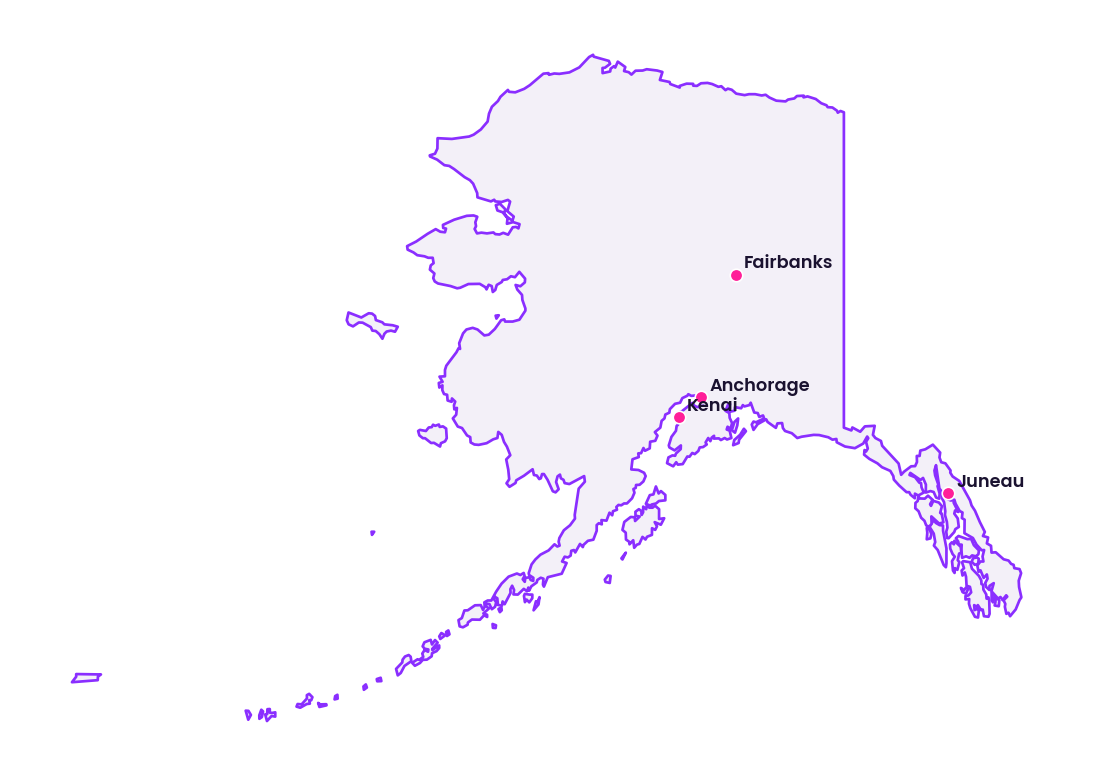
Public sources accessed here do not provide a concise, current breakdown of Alaska’s population change into domestic migration, international migration, and natural increase in a directly usable format. As a result, this review does not present specific net migration figures. Qualitatively, the near flat population trajectory suggests that while certain regions, such as Anchorage, the Matanuska Susitna Borough, and parts of the Kenai Peninsula, remain employment and population hubs, some rural and resource dependent communities experience stagnation or gradual decline.
For investors, this pattern means that demand growth is highly localized. Statewide stability hides divergent trends between metros with stable or growing populations and smaller communities facing out migration. Underwriting must therefore emphasize submarket level demographics rather than relying on statewide growth alone.
Section 03Jobs and Economic Anchors
Alaska’s labor market data from the Bureau of Labor Statistics show a state that has recently transitioned from slight year over year job losses to modest gains. The seasonally adjusted civilian labor force was 368.7 thousand persons in January 2026, 369.4 thousand in February, 369.7 thousand in March, 369.4 thousand in April, 368.7 thousand in May, and 368.1 thousand in June. Employment over the same months was 351.0 thousand persons in January, 351.9 thousand in February, 352.4 thousand in March, 352.2 thousand in April, 351.9 thousand in May, and 351.8 thousand in June, while unemployment decreased from 17.7 thousand persons in January to 16.3 thousand in June.
The unemployment rate, seasonally adjusted and statewide, was 4.8 percent in January 2026, 4.7 percent in February and March, 4.6 percent in April and May, and 4.4 percent in June. Total nonfarm wage and salary employment, measured in thousands of jobs and seasonally adjusted, was 337.2 in January, 337.1 in February, 336.7 in March, 337.6 in April, 339.5 in May, and 341.4 in June 2026. The 12 month change in total nonfarm employment improved from negative 0.2 percent in January and February to negative 0.4 percent in March, then to negative 0.2 percent in April, positive 0.3 percent in May, and positive 1.2 percent in June 2026.
Sector level data illustrate Alaska’s industry mix. Mining and logging employment, which captures much of the state’s resource activity including oil and gas, totaled 13.8 thousand jobs in January 2026 and 14.1 thousand in June, with 12 month changes ranging from 5.3 percent early in the year to 7.6 percent in April and 6.8 percent in May and June. Construction employment was 18.9 thousand jobs in January 2026 and 18.8 thousand in June, with 12 month changes moving from negative 3.1 percent in January to a low of negative 6.1 percent in April and then improving to negative 0.5 percent in June. Leisure and hospitality, a seasonal driver, employed 39.1 thousand people in June, up 8.0 percent year over year, the strongest sector gain, while trade, transportation, and utilities employed 68.3 thousand people, up 1.6 percent. Government employment, at 77.4 thousand jobs in June, was down 1.9 percent over the year, and manufacturing, at 12.2 thousand jobs, was down 2.4 percent.
These data underscore that Alaska’s economy remains heavily influenced by resource extraction and construction, alongside government, health care, tourism, transportation, and logistics. The improvement in total nonfarm job growth from negative to positive territory by June 2026, combined with steady unemployment rates in the mid 4 percent range, suggests a labor market moving into a more expansionary phase after a period of softness. For real estate investors, this mix implies that multifamily and commercial demand is closely tied to the health of the energy sector, federal and state government employment, and seasonal tourism. Resilience may be greater in Anchorage and other diversified hubs than in communities concentrated around a single resource project.
Section 04Income
Per capita income levels in Alaska are high by national standards and have grown significantly in recent years. According to the Bureau of Economic Analysis, per capita personal income, in current dollars, was 58,997 dollars in 2018, 60,504 dollars in 2019, 61,912 dollars in 2020, 65,788 dollars in 2021, 69,233 dollars in 2022, 72,581 dollars in 2023, 76,606 dollars in 2024, and 80,175 dollars in 2025. Between 2018 and 2025, per capita personal income increased by 21,178 dollars, reflecting a combination of wages and salaries, investment income, and transfer payments. The strongest gains occurred between 2020 and 2025, when per capita income rose from 61,912 to 80,175 dollars, a period that includes recovery from the pandemic and the impact of commodity price cycles and federal economic support.
When paired with the resident population series, which shows population moving from 736.624 to 737.270 thousand persons on a thousands of persons basis between 2018 and 2025, the income data imply rising total personal income despite nearly flat headcount. For real estate investors, high and growing per capita income, even amid modest population change, supports demand for quality housing and services but also raises cost structures for labor and some services. It can underpin higher achievable rents and pricing in core metros but requires careful segmentation to ensure affordability for target renter cohorts.
Section 05Housing and Multifamily
Alaska’s housing market has experienced substantial price appreciation over the past eight years, though less dramatic than in some markets in the lower 48. The All Transactions House Price Index for Alaska from the Federal Housing Finance Agency tracks home prices on an index where the first quarter of 1980 equals 100. The index stood at 319.07 in the first quarter of 2018, 323.83 in the first quarter of 2019, 333.31 in the first quarter of 2020, 347.59 in the first quarter of 2021, 391.36 in the first quarter of 2022, 423.18 in the first quarter of 2023, 445.85 in the first quarter of 2024, 461.27 in the first quarter of 2025, and 495.28 in the first quarter of 2026. From early 2018 to early 2026, the index rose by 176.21 points, with particularly strong gains between 2020 and 2022 when it moved from 333.31 to 391.36; this history is not indicative of future results. This trajectory reflects the combined effects of limited land and construction capacity in key markets, pandemic era demand, and broader national price appreciation.
HousingHandbook’s Alaska profile uses population weighted Zillow Home Value Index data across 245 ZIP codes and reports a typical and median home value of 410,324 dollars statewide, along with a median rent of 1,904 dollars and a population of 735,134 residents. These values illustrate a relatively high priced housing market compared with many mainland states, consistent with high per capita incomes and cost structures in remote and logistics intensive regions.
Publicly accessible statewide data specific to multifamily performance, such as average asking rents by class, concessions, absorption, and detailed vacancy rates, are typically maintained by private providers and are not present in the open datasets reviewed here. The Alaska Housing Finance Corporation is an important source of institutional debt for both single family and multifamily properties, and commercial borrowing costs in the current environment are considerably higher than in the early 2020s. For investors, this combination of elevated home values, significant long term price appreciation, and relatively high financing costs means multifamily returns must balance strong rent potential against higher debt service. Well located, energy efficient assets with stable tenancy in metros such as Anchorage and the Matanuska Susitna Borough are better positioned to support these borrowing costs than older or more remote properties with thinner renter pools.
Section 06Rents
Rents in Alaska are materially higher than in many states, reflecting high construction and operating costs and limited supply in key markets. HousingHandbook’s Alaska profile, using population weighted Zillow rental data, reports a median rent of 1,904 dollars statewide, alongside a typical and median home value of 410,324 dollars, a population of 735,134 residents, and 245 ZIP codes. These figures indicate that a representative rental household faces monthly housing costs near 2,000 dollars, with considerable variation by metro, neighborhood, and property type.
The U.S. Department of Housing and Urban Development publishes Fair Market Rents for Alaska by county and metropolitan area and maintains a history file spanning 1983 through 2026. The accessible documentation confirms the existence of detailed rent schedules by bedroom count for fiscal year 2026, but the Alaska specific numeric values are contained in large datasets that are not directly parsable in this environment. Consequently, this review does not state specific Fair Market Rent dollar amounts for Anchorage, Fairbanks, Juneau, or other areas.
No statewide public series retrieved here provides current numeric rent levels by property class, unit type, or submarket beyond the HousingHandbook median. Private providers maintain such data, but they are outside the scope of publicly accessible numbers. For investors, the HousingHandbook median rent of 1,904 dollars, when viewed alongside a 410,324 dollar median home value and per capita income of 80,175 dollars in 2025, suggests that many households can support relatively high rent payments, but affordability is a concern for lower income workers and residents in high cost metros. Detailed rent surveys and submarket data are therefore essential inputs to property level underwriting.
Section 07Vacancy
Vacancy rates directly affect cash flow and pricing, but comprehensive statewide vacancy statistics for Alaska by property type are not readily available in the public data reviewed here. The U.S. Census Bureau releases national and regional rental and homeowner vacancy rates, and private firms track apartment, office, industrial, and retail vacancy in detail. However, no concise, current statewide series for Alaska’s multifamily, single family rental, office, or industrial vacancy was identified in the accessible public sources.
As a result, this review does not present specific numeric vacancy percentages for Alaska’s property types. Qualitatively, the combination of limited new supply in some markets, high construction costs, and steady if modest employment growth suggests that well located multifamily and single family rental properties in Anchorage and other key metros likely experience relatively tight vacancy, while older stock, functionally obsolete commercial properties, and assets in shrinking communities face higher vacancy and leasing risk.
For accredited investors, the absence of publicly accessible statewide vacancy metrics reinforces the need to rely on local broker reports, appraisals, and property level operating histories when evaluating acquisitions, particularly in smaller markets or specialized asset classes.
Section 08Supply Pipeline
The series that measures new private housing units authorized by building permits in Alaska, based on U.S. Census Bureau data, provides monthly counts of new private housing units authorized statewide. These figures illustrate both the scale and volatility of Alaska’s construction pipeline. In 2018, Alaska authorized 111 units in January, 111 in February, 140 in March, 129 in April, 186 in May, and 221 in June, with monthly totals between 106 and 165 units from July through December. In 2019, permits included 90 units in January, 88 in February, 120 in March, 150 in April, 192 in May, and 139 in June, and monthly counts between 115 and 193 units later in the year.
In 2020, authorization dropped to 42 units in March, followed by 98 in April, 113 in May, and 147 in June, reflecting early pandemic disruptions, before recovering to 135 units in December. In 2021, monthly values included 111 units in January, 115 in February, 145 in March, 166 in April, 138 in May, 157 in June, and between 106 and 146 units in the second half of the year. In 2022, permits totaled 109 units in January, 128 in February, 149 in March, 152 in April, 148 in May, and 128 in June, then ranged from 68 to 134 units from July through December. In 2024, the series shows 26 units in January, 35 in February, 45 in March, 64 in April, a notable spike to 213 units in May, and 75 units in June, with monthly counts between 57 and 109 units in the second half of the year. The first half of 2026 shows 41 units in January, 58 in February, 118 in March, 55 in April, 82 in May, and 73 in June.
These figures indicate that Alaska’s residential construction pipeline is relatively small in absolute terms and subject to significant month to month variation. Occasional spikes, such as the 213 units authorized in May 2024, likely correspond to a limited number of large multifamily or mixed use projects rather than a broad surge. The modest scale of monthly authorizations relative to the statewide population underscores structural supply constraints, particularly in markets with limited developable land, short building seasons, and high construction costs.
For investors, the limited new supply in many periods helps support pricing and rents for existing assets but also restricts the scale at which institutional multifamily strategies can be executed. Project level risks are magnified because a single large development can materially affect a submarket’s vacancy and rent trajectory.
Section 09Single Family Homes
Single family homes play a central role in Alaska’s housing stock and investment landscape. HousingHandbook’s Alaska profile, using population weighted Zillow data, reports a typical and median home value of 410,324 dollars statewide, along with a median rent of 1,904 dollars, a population of 735,134 residents, and 245 ZIP codes. These values highlight a relatively high cost ownership market aligned with the state’s high per capita income and structural cost drivers.
Redfin’s Alaska housing market data provide transaction based metrics. In May 2026 the median sale price for all home types in Alaska was 420,506 dollars, up 2.6 percent compared with May 2025. The same source notes that there were 2,501 homes for sale in Alaska in May 2026, down 4.3 percent year over year, and that 22.9 percent of homes sold above list price in that month, 1.4 percentage points lower than a year earlier. These figures suggest a market with constrained supply, fewer homes for sale than a year before, moderate price appreciation, and a still meaningful share of competitive, above list transactions, though slightly less intense than in the prior year.
Redfin’s publicly accessible statewide overview in this environment does not provide Alaska specific numeric values for metrics such as median days on market or months of supply, so this review does not cite those indicators. Nonetheless, the combination of a 420,506 dollar median sale price, a 2.6 percent year over year price increase, lower for sale inventory, and a substantial share of above list sales points to a market that remains relatively tight, especially in desirable neighborhoods of Anchorage, the Matanuska Susitna Borough, and coastal communities.
For single family rental investors, the relationship between a 410,324 dollar median home value and a 1,904 dollar median rent, together with the Redfin sale price and appreciation figures and per capita income of 80,175 dollars in 2025, suggests that households with stable incomes can support relatively high rent payments, particularly in employment centers. Investment strategies that focus on durable, well located homes with good access to jobs and services may find resilient demand, though acquisition pricing and operating costs must be carefully managed to achieve target yields.
Section 10Commercial Real Estate and Retail Centers
Alaska’s commercial real estate market spans office buildings in downtown Anchorage and other hubs, industrial and logistics facilities serving ports and resource operations, and a mix of retail formats, including grocery anchored and neighborhood shopping centers. However, comprehensive statewide public data on vacancy rates, effective rents, and cap rates for office, industrial, and retail assets are not available in the open sources accessed for this review.
The Bureau of Labor Statistics sector employment figures for mining and logging and construction provide indirect insight into demand for industrial and construction related space, but they do not quantify real estate performance metrics. Publicly accessible statewide datasets do not present numeric vacancy or rental rate series for Alaska’s office, industrial, or retail sectors, and aggregated cap rate data are similarly confined to private market reports and transaction databases.
Qualitatively, office markets in Alaska, particularly in downtown Anchorage, face the same structural challenges as many cities across the country, including shifts toward remote and hybrid work, tenant preferences for higher quality space, and the need for capital investment in older buildings. Industrial and logistics properties benefit from Alaska’s role in air cargo, marine shipping, resource extraction, and regional distribution, and are likely to exhibit relatively low vacancy and stable or rising rents where linked to durable demand drivers. Grocery anchored and necessity retail centers in stable trade areas benefit from ongoing consumer demand and limited competition, while some discretionary or tourist oriented retail is more cyclical.
For accredited investors, the absence of statewide numeric vacancy and rent data underscores the need for submarket specific research when evaluating commercial and retail assets. Industrial and necessity retail properties in strong trade areas may present risk adjusted opportunities, though returns are not assured, while office investments require detailed tenant, lease, and capital expenditure analysis.
Section 11Transactions and Capital Markets
Statewide transaction volumes, aggregate sales values, and average cap rates for Alaska’s multifamily, single family, office, industrial, and retail assets are not summarized in the public datasets used in this review. Deed records, multiple listing services, and commercial transaction databases contain detailed information, but statewide roll ups are typically provided by proprietary data vendors and are not accessible as public numeric series.
The Alaska Housing Finance Corporation is a significant lender for both single family and multifamily properties, offering a range of programs that include options for rural owner occupied and non owner occupied properties. While this review does not quote its specific published rates, which vary weekly and by loan type, both residential and commercial borrowing costs are significantly higher than in the ultra low rate environment of the early 2020s. This has clear implications for pricing, leverage, and return expectations, since cap rates must adjust to compensate for higher interest costs, and loan proceeds may be constrained by debt service coverage rather than loan to value limits.
For investors, transaction underwriting in Alaska must be grounded in current financing terms, property specific cash flows, and local capital market conditions. Without statewide public transaction aggregates, reliance on broker opinions, appraisals, and proprietary data becomes crucial.
Section 12Taxes
Tax policy influences the after tax returns of Alaska real estate investments, but the public content accessed here provides only a high level view. The Alaska Department of Revenue, through its Tax Division, is charged with collecting state taxes and administering tax laws, regulating charitable gaming, and providing revenue estimating and economic forecasting, supported by online services, tax forms, and taxpayer guidance.
However, the retrieved content does not include a concise, current table of Alaska’s state level individual or corporate income tax rates, statewide or local sales tax rates, or typical effective property tax rates by jurisdiction. As a result, this review does not quote specific numeric tax rates or brackets or provide detailed structural descriptions of Alaska’s income and sales tax systems.
For accredited investors, this means that tax assumptions in underwriting should be based on up to date information from the Alaska Department of Revenue and relevant municipalities, as well as professional tax advice. Given the importance of property taxes, local sales taxes, and any special assessments to net operating income and net returns, property specific tax diligence is essential. This review is not tax advice; investors should consult qualified tax advisors regarding their specific circumstances.
Section 13Insurance
Insurance costs and regulations are particularly important in Alaska due to exposure to earthquakes, coastal storms, riverine flooding, wildfires, permafrost thaw, and other hazards. The state’s insurance regulatory functions sit within its commerce agencies, but the accessible public content in this environment did not provide readable statewide summaries of average premiums, loss ratios, or rate changes for homeowners, renters, or commercial property insurance.
Because that content was not available, this review does not present specific numeric insurance cost figures for Alaska. Nevertheless, it is clear that insurance markets must price for multiple overlapping risks, and insurers may impose higher premiums, deductibles, and mitigation requirements in certain regions or for specific building types.
For investors, the key implication is that insurance cost assumptions cannot be generalized statewide. Site specific insurance quotes and coverage terms are essential, particularly for assets exposed to earthquake and flood risk or located in communities where wildfire or permafrost related settlement is a concern. Insurance availability and affordability directly affect net operating income and the feasibility of leverage.
Section 14Landlord Tenant and Regulatory Environment
Alaska’s landlord tenant framework is established by state statutes and supplemented by local ordinances, but the legislative texts and detailed summaries that would provide precise rules on issues such as security deposits, notice periods, and eviction timelines were not accessible in a parsed format in this environment. As a result, this review does not quote specific statutory limits or procedural timelines.
Broadly, Alaska’s regulatory environment for residential landlords and tenants is shaped by state law, court procedures, and local enforcement practices. There is no publicly accessible statewide rent control policy summary in the datasets reviewed here. Municipalities may impose their own requirements related to rental registration, inspections, or housing standards, particularly in larger cities.
For accredited investors, this means that legal and regulatory risk is predominantly asset specific and jurisdiction specific. Due diligence should include consultation with local counsel and review of municipal codes and court practices for any market where a material portfolio investment is contemplated.
Section 15Infrastructure
Infrastructure capacity and reliability are critical determinants of real estate performance in Alaska, given the state’s vast geography, challenging climate, and dispersed population. The Alaska Department of Transportation and Public Facilities manages transportation and public facilities across the state from its base in Juneau, but the publicly visible content in this environment does not provide numeric summaries of highway miles, airport counts, ferry routes, or capital budgets.
Nevertheless, the nature of Alaska’s built environment, with reliance on highways, rural roads, airports, and marine transportation, means that access is more variable than in most states. Properties in well served corridors benefit from relatively reliable access for residents, workers, and goods, while remote communities can face seasonal or weather related disruptions.
For investors, infrastructure considerations must be integral to site selection and underwriting. Proximity to reliable transportation, utilities, and communications infrastructure can markedly improve resilience and liquidity, while properties in locations with limited access may offer higher nominal yields but greater operational and exit risk.
Section 16Climate and Physical Risks
Alaska faces a distinctive set of climate and physical risks that directly affect real estate assets. The National Centers for Environmental Information’s Climate at a Glance statewide time series tool allows selection of Alaska and examination of temperature and precipitation trends over time, but Alaska specific numeric series are not visible in the retrieved content in this environment. Even without explicit numeric values, scientific consensus and empirical observation point to warming temperatures, changing precipitation patterns, thawing permafrost, coastal erosion, increased wildfire risk in some regions, and shifting freeze thaw cycles.
The Federal Emergency Management Agency’s Resilience Analysis and Planning Tool includes more than 100 preloaded layers with data on population, infrastructure, and hazards, and it draws on the National Risk Index, which identifies communities most at risk from 18 natural hazards across the United States, though Alaska specific risk scores are not shown in the accessible summary. These tools confirm that multiple hazards, including earthquakes, floods, coastal storms, and wildfires, are systematically mapped and quantified, even if the specific values are not available here.
For real estate investors, climate and physical risks in Alaska manifest through structural damage risk, operating cost volatility, interruption risk, and long term habitability concerns. Assets in permafrost areas may face foundation challenges as ground conditions change, coastal assets may be exposed to erosion and storm surge, and wildland urban interface properties may confront wildfire risk. Insurance availability, building codes, and local mitigation investments all interact with these hazards and must be considered during underwriting.
Section 17Opportunities
The data and context assembled here highlight several opportunity themes for accredited investors in Alaska, each subject to material risk and with no assurance of any particular outcome. First, high and rising per capita personal income, from 58,997 dollars in 2018 to 80,175 dollars in 2025, alongside a nearly stable population base supports sustained demand for quality housing and services, particularly in core metros. Households with stable incomes can support relatively high rents and home prices, creating room for income producing investments.
Second, the significant increase in the All Transactions House Price Index for Alaska from 319.07 in early 2018 to 495.28 in early 2026, combined with a 420,506 dollar median sale price and 2.6 percent year over year appreciation in May 2026, suggests that residential real estate has shown meaningful historical price gains while still showing continued, if moderated, price growth; past performance is not indicative of future results. This environment may be considered for long term hold strategies in resilient submarkets.
Third, constrained new supply, as indicated by monthly building permits often ranging between roughly 40 and 200 units statewide, limits the risk of widespread overbuilding and supports pricing power for existing well located properties. A single multifamily project can meaningfully affect local supply, but statewide oversupply is less likely.
Fourth, the Alaska Housing Finance Corporation’s active single family and multifamily lending programs, including options targeted at rural owner occupied and non owner occupied properties, provide institutional financing avenues tailored to local conditions. These programs can facilitate both homeownership and investment strategies, particularly where program features align with asset profiles.
Fifth, industrial and logistics assets benefiting from Alaska’s role in air cargo, marine shipping, and resource development may generate income, though income is not assured, supported by infrastructure investments and the state’s strategic location.
Section 18Risks
Alaska’s market also presents elevated and distinctive risks. Economic cyclicality is a primary concern, since sector employment data show that total nonfarm job growth only recently turned positive, and mining and logging and construction employment levels are sensitive to commodity prices, federal spending, and project pipelines. A downturn in resource activity or government spending can quickly affect housing demand and commercial occupancy in affected communities.
Second, high construction and operating costs and relatively high financing rates for both residential and commercial borrowers compress equity returns unless rents and asset pricing adjust accordingly. Projects that were underwritten with lower cost of capital assumptions face refinancing and performance risks.
Third, climate and physical hazards, including earthquakes, thawing permafrost, floods, coastal erosion, and wildfires, introduce long term uncertainty about asset durability, operating costs, and insurability. Without easily accessible quantitative hazard scores in this environment, investors must rely on site specific technical assessments and insurance market feedback, increasing diligence requirements.
Fourth, the lack of publicly aggregated statewide data on vacancy rates, cap rates, and transaction volumes reduces transparency relative to more data rich markets. Investors relying solely on national datasets may underestimate local nuances in demand, supply, and pricing, leading to mispricing of risk.
Section 19Investor Implications
For accredited investors evaluating Alaska, the public data indicate a market where income levels are high, population is stable, and housing is valuable and relatively scarce, while financing costs and physical risks are elevated. This combination rewards disciplined, research driven strategies that focus on resilient locations, durable tenant demand, and conservative leverage.
Multifamily investments in Anchorage and other core metros can benefit from high incomes and limited supply, provided that underwriting reflects realistic rent levels, operating expenses, and capital needs, particularly around energy efficiency and resilience. Single family rental portfolios focused on stable neighborhoods in employment hubs may generate income, though income is not assured, and acquisition pricing and maintenance costs require careful calibration.
Industrial and logistics properties tied to ports, airports, and resource operations can provide diversification benefits and exposure to long term trade and energy trends, but are sensitive to project pipelines and commodity cycles. Necessity retail centers serving local populations may offer income, though income is not assured, while office and discretionary retail require the most caution.
Across all asset classes, investors need to integrate Alaska specific factors, such as limited building seasons, remote logistics, localized employment drivers, and climate and hazard profiles, into their underwriting frameworks. The statewide metrics presented here serve as a macro foundation, and successful investment decisions will depend on deeper submarket and asset level analysis.
Section 20Conclusion
Alaska’s statewide real estate and multifamily market reflects a small but high income population, a resource influenced economy, meaningful house price appreciation, and structurally constrained housing supply in many areas. Public data from the U.S. Census Bureau, the Bureau of Economic Analysis, the Federal Housing Finance Agency, the Federal Reserve Bank of St. Louis, the Bureau of Labor Statistics, HousingHandbook, Redfin, the Alaska Housing Finance Corporation, the Alaska Department of Revenue, the Alaska Department of Transportation and Public Facilities, the U.S. Department of Housing and Urban Development, the National Centers for Environmental Information, and the Federal Emergency Management Agency collectively describe a market with both attractive fundamentals and heightened complexity.
For accredited investors, Alaska offers opportunities in multifamily, single family rentals, and selected commercial sectors, particularly in infrastructure served, employment anchored metros. These opportunities are balanced by economic cyclicality, climate and physical risks, high construction and financing costs, and limited public transparency on some key real estate metrics. Using the sourced figures and qualitative context from this review as a starting point, investors can better frame where and how Alaska exposure may fit within diversified real estate portfolios, while recognizing that robust local diligence and ongoing monitoring are indispensable.
Sources
- U.S. Bureau of Labor Statistics, Alaska Economy at a Glance,, https://www.bls.gov/eag/eag.ak.htm
- Federal Reserve Bank of St. Louis (FRED), Resident Population in Alaska (AKPOP),, https://fred.stlouisfed.org/series/AKPOP
- Federal Reserve Bank of St. Louis (FRED), Per Capita Personal Income in Alaska (AKPCPI),, https://fred.stlouisfed.org/series/AKPCPI
- Federal Reserve Bank of St. Louis (FRED), All Transactions House Price Index for Alaska (AKSTHPI),, https://fred.stlouisfed.org/series/AKSTHPI
- Federal Reserve Bank of St. Louis (FRED), New Private Housing Units Authorized by Building Permits for Alaska (AKBPPRIV),, https://fred.stlouisfed.org/series/AKBPPRIV
- HousingHandbook, Alaska Real Estate Data,, https://housinghandbook.com/state/ak
- Redfin, Alaska Housing Market: House Prices and Trends,, https://www.redfin.com/state/Alaska/housing-market
- Alaska Housing Finance Corporation,, https://www.ahfc.us/
- Alaska Department of Revenue, Tax Division,, https://tax.alaska.gov/
- Alaska Department of Transportation and Public Facilities,, https://dot.alaska.gov/
- U.S. Department of Housing and Urban Development, Fair Market Rents by State, County, and Metropolitan Area,, https://www.huduser.gov/portal/datasets/fmr.html
- National Oceanic and Atmospheric Administration (NOAA), Climate at a Glance: Statewide Time Series,, https://www.ncei.noaa.gov/access/monitoring/climate-at-a-glance/statewide/time-series
- Federal Emergency Management Agency (FEMA), Resilience Analysis and Planning Tool (RAPT),, https://www.fema.gov/emergency-managers/practitioners/resilience-analysis-and-planning-tool