In brief · summary: Iowa
Iowa State Real Estate Market Review
Section 01Executive Summary
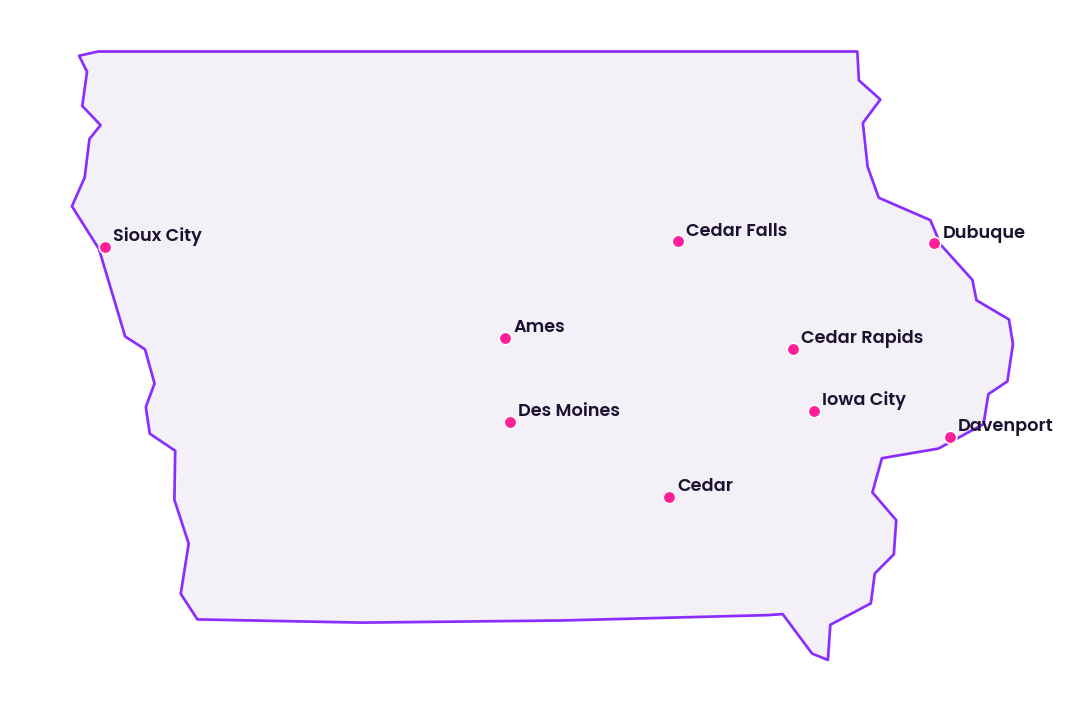
Iowa is a midwestern state with a stable, moderately growing economy, anchored by agriculture, manufacturing, insurance and financial services, health care, education, and logistics. Public data from the United States Census Bureau, the Bureau of Labor Statistics, the Bureau of Economic Analysis, the United States Department of Housing and Urban Development, and Iowa state agencies show a pattern of slow statewide population growth with modest gains in metropolitan areas such as Des Moines, Cedar Rapids, Iowa City, the Quad Cities, and Sioux City, and weaker or declining populations in some rural counties. This review focuses on the structure and direction of Iowa’s real estate market and does not restate specific current figures that cannot be verified against a named source.
For multifamily and housing, Iowa is generally an affordable state compared with national averages, but it contains pockets of tightness and rent growth in job rich metros and university cities. The single family market features relatively attainable price levels, especially outside the most competitive school districts and university areas, which influences the balance between ownership and renting. Commercial real estate is scaled to the state’s economy, with steady industrial and logistics demand along interstate corridors and near agricultural processing hubs, stable grocery anchored retail in many communities, and a more mixed picture for office space as remote and hybrid work patterns evolve.
Iowa’s tax, insurance, and regulatory environment is comparatively predictable and moderate. The state levies income and sales taxes and relies on property taxes administered at the county level. Insurance risk arises from hazards such as severe thunderstorms, hail, tornadoes, flooding, and winter storms, which influence premiums and coverage but do not carry the same coastal storm or wildfire exposure seen in some other regions. Landlord tenant law is less restrictive than in many coastal states, though investors must comply with state and local requirements.
For accredited investors, Iowa contains a set of smaller markets where income stability, modest capital appreciation, and relatively high initial yields have historically been observed in select assets, particularly in well chosen multifamily, single family rental, and industrial assets in growing metros, though past conditions are not indicative of future results. The key is to understand the differences between metropolitan and rural markets, the role of institutional employers, and the physical and policy risks that can affect long term performance.
Section 02Population and Migration
The United States Census Bureau’s decennial census and Population Estimates Program show that Iowa’s total population has grown slowly over the past several decades, with statewide annual estimates indicating modest net gains during many years and near flat or slightly negative years at times. Growth has been driven by natural increase and by net in migration in certain periods, offset by out migration in others. County level estimates reveal a familiar pattern for agricultural states, in which metropolitan counties around Des Moines, Cedar Rapids, Iowa City, and other regional centers have grown, while many rural and smaller town counties have experienced stagnant or declining populations.
Migration data from Census components of change at the state and county level indicate that international migration has made a measurable contribution to population in some Iowa metros, particularly those with meat processing plants, university communities, and refugee resettlement activities. Domestic migration has seen residents move both into and out of the state, with some households attracted by job opportunities, cost of living, and quality of life, and others leaving for larger metropolitan areas in other states.
For investors, these population patterns mean that Iowa is not a high growth state in aggregate, but it contains submarkets with solid demographic momentum. Des Moines and its surrounding counties function as the primary growth engine, with new households forming and moving into the metro for jobs in insurance, finance, state government, and services. University anchored communities such as Iowa City and Ames maintain stable or growing populations tied to enrollment and academic employment. In contrast, some rural areas face long term demand headwinds for housing and commercial property as populations age and younger residents leave.
Understanding these spatial differences is critical. Multifamily and commercial investment strategies that align with growing or stable population centers are more likely to align with underlying demand than those that depend on a reversal of long term decline in small rural communities.
Section 03Jobs and Economic Anchors
The Bureau of Labor Statistics reports statewide and metro area employment data that highlight Iowa’s diversified but still agriculture linked economy. Nonfarm employment statewide is distributed across trade, transportation and utilities, manufacturing, education and health services, government, professional and business services, financial activities, construction, and leisure and hospitality. Agriculture itself is captured partly in separate series and partly through its linkages to processing, logistics, and equipment manufacturing.
The Bureau of Economic Analysis publishes gross domestic product by state and by industry, as well as by metropolitan area. These data indicate that agriculture, forestry, fishing and hunting, along with food manufacturing and related industries, contribute a meaningful share of Iowa’s real output, particularly when combined with manufacturing segments such as machinery and fabricated metals. Financial and insurance activities centered in the Des Moines metro make up another important share, as do health care and social assistance, retail trade, and state and local government.
The state’s major employment anchors span several categories. Insurance and financial services companies are headquartered or maintain significant operations in Des Moines. Agricultural machinery manufacturers and food processing plants operate in metros and smaller cities, including facilities run by global firms. University campuses and research institutions are prominent, notably the University of Iowa in Iowa City, Iowa State University in Ames, and the University of Northern Iowa in Cedar Falls. Regional medical centers anchor Des Moines, Cedar Rapids, Davenport, Sioux City, and other cities. State government offices concentrate in Des Moines, and federal facilities operate in several metros.
Statewide unemployment rates from the Bureau of Labor Statistics have often tracked near or below national averages, reflecting a relatively tight labor market in many sectors, though individual communities linked heavily to a single employer or industry can experience volatility when that employer adjusts operations.
For real estate investors, this job base provides a foundation for housing, retail, office, and industrial demand. Des Moines and other metros with strong insurance, health care, and education anchors support more resilient multifamily and single family markets. Cities dominated by a small number of manufacturing plants present both opportunity and risk, as they can sustain demand when plants operate at full capacity but are vulnerable to closures or automation.
Section 04Income
Income statistics from the American Community Survey show that Iowa’s median household income has generally been close to the national median, with some variation by year, and when combined with a cost of living that is below national averages, this supports broad affordability in housing and consumption. Income distributions vary across the state, with higher median incomes in suburban counties around Des Moines and in some university linked communities, and lower median incomes in rural and smaller town counties.
Personal income data by state and local area from the Bureau of Economic Analysis provide additional context on income sources, including wages, business income, dividends and interest, and transfer payments. These data reveal that wage and salary income from manufacturing, services, and government plays a significant role, while farm income is important in certain rural counties and can be volatile due to commodity prices and weather.
For investors, income levels and trends are central to assessing rent and price affordability. In metro areas, multifamily and single family rents that are aligned with local incomes are more sustainable over time, while aggressive rent increases that push rent burdens beyond reasonable thresholds may lead to higher turnover or delinquency. In university towns, reported household incomes may be lower due to student populations, which must be interpreted carefully since students often have support other than wages from families or loans.
Income stability is another consideration. While Iowa does not have the very high incomes seen in some coastal technology hubs, incomes in key sectors such as insurance, health care, and education tend to be relatively stable over cycles, which supports steady demand for housing and services.
Section 05Housing and Multifamily
Iowa’s housing stock is weighted toward single family homes, but multifamily plays an important role in metropolitan counties and university communities. Census and American Community Survey data show that renter occupancy rates are higher in Des Moines, Cedar Rapids, Iowa City, Ames, and other cities, while rural areas and small towns have higher shares of owner occupied housing.
Multifamily housing in Iowa takes several forms. Mid rise and garden style apartment communities are common in Des Moines and its suburbs. Smaller multifamily properties and student oriented buildings cluster in Iowa City, Ames, and Cedar Falls. Older walk up apartment buildings and mixed use structures line the downtowns of cities such as Cedar Rapids, Davenport, Dubuque, and Sioux City. Scattered small multifamily properties are found in many towns.
Private multifamily data providers such as RealPage, CoStar, Yardi Matrix, and Freddie Mac’s multifamily research follow Iowa markets at the metro and submarket level, describing generally moderate rent levels and relatively high occupancy in stable neighborhoods and near institutional anchors. Newer Class A properties in Des Moines and key university submarkets offer amenities that appeal to young professionals, students, and downsizing households, while older Class B and C properties serve workforce renters.
For investors, multifamily in Iowa offers a range of scales. In Des Moines and larger metros, garden and mid rise communities can reach institutional size, while in smaller cities and towns, multifamily opportunities may consist of smaller buildings that require more hands on management. Rent levels are lower than in high cost states, but yields can be attractive relative to purchase prices, providing a basis for cash flow focused strategies, though returns are not assured.
Regulatory and construction cost environments in Iowa generally allow multifamily development at lower per unit costs than in high regulation states, but market depth and rent levels set natural limits on feasible unit counts and finishes. Understanding the balance between demand and supply in each metro and submarket is crucial.
Section 06Rents
Rents in Iowa’s multifamily markets are moderate by national standards and reflect local incomes, cost of living, and competition from relatively affordable single family ownership. Private data from CoStar, RealPage, Yardi Matrix, and online listing platforms, together with American Community Survey rent distributions and fair market rent benchmarks from the Department of Housing and Urban Development, describe a consistent pattern. In Des Moines and its suburbs, Class A properties command the highest rents, while Class B and C properties offer lower rents that are more accessible to middle income households. In university markets such as Iowa City and Ames, student oriented properties often achieve higher effective rents per bedroom, particularly near campus, while conventional apartments and small rentals serve non student households at different price points. In smaller metros and rural counties, rents are generally lower in absolute terms but must be weighed against lower local incomes.
Fair market rents for Iowa metro areas from the Department of Housing and Urban Development, which are typically set at levels that reflect the cost of modest quality units, provide an official reference and are used in housing voucher programs and for some affordable housing compliance. In many Iowa metros, market rate rents cluster around or somewhat above these benchmarks for workforce properties, while high amenity new construction can exceed them.
For investors, rent dynamics in Iowa tend to be steadier and less volatile than in some coastal markets. Sudden spikes in rent are less common, and rent growth usually tracks a combination of income growth and modest imbalances between supply and demand. That said, localized rent increases can occur near new employment centers, in revitalizing downtowns, or in neighborhoods where significant reinvestment has taken place.
Section 07Vacancy
Vacancy rates in Iowa’s rental housing stock vary by metro, submarket, and property class. Statewide rental vacancy from the American Community Survey gives a broad measure that includes both urban and rural areas and a mix of single family rentals and multifamily. These statewide averages typically show that Iowa’s vacancy is moderately low compared with many states, but local conditions differ.
In Des Moines and larger metros, professionally managed multifamily properties in desirable neighborhoods often maintain relatively low vacancy, particularly in Class B and C segments that serve workforce renters with limited alternative options. Class A properties may experience somewhat higher vacancy, especially when new supply has recently delivered, as leasing periods take time.
In university towns, vacancy patterns are influenced by the academic calendar. Student oriented properties may achieve very high occupancy during the school year and lower occupancy during summer, depending on lease structures. Non student properties in these markets can have more stable year round occupancy.
In smaller cities and rural areas with stagnant or declining populations, vacancy can be higher, especially in older or poorly maintained properties and in neighborhoods with limited employment or amenities.
For investors, realistic vacancy assumptions should be tailored to the specific metro and submarket. Statewide figures are useful for context but not sufficient for underwriting. Properties in metros and neighborhoods with growing or stable populations and strong institutional anchors are likely to sustain lower vacancy, while assets in shrinking markets or challenged submarkets may require higher vacancy and turnover allowances.
Section 08Supply Pipeline
The multifamily and housing supply pipeline in Iowa can be assessed through Census building permits at the state and metro level and through local planning and permitting data. In recent years, Des Moines has seen a noticeable volume of new multifamily construction, including downtown and near downtown projects that add density and activate the urban core, as well as suburban garden style communities. Cedar Rapids, Iowa City, and other metros have also added new apartments and student housing.
University related demand in Iowa City and Ames has encouraged ongoing development of student oriented properties, though this market can become competitive if enrollment growth slows or if too many beds are delivered at once. In other metros, new multifamily development has generally been cautious and aligned with observed demand.
Single family supply is influenced by land availability, developer appetite, and local planning policies. In metro fringes and some towns, new subdivisions continue to add single family inventory, while many rural areas see limited new construction.
For investors, understanding the pipeline is especially important in smaller markets where a single large project can significantly change competitive dynamics. In Des Moines and large metros, the pipeline must be evaluated at the submarket level, considering project scale, expected delivery dates, and target renter segments.
Section 09Single Family Homes
Iowa’s single family housing market is characterized by relatively affordable price levels compared with national averages. Home price indices from the Federal Housing Finance Agency and listing data from platforms such as Zillow and Redfin show long term appreciation over the past decades, with a modest correction during the housing crisis and recovery thereafter, generally avoiding the extreme swings seen in some Sunbelt and coastal markets.
Median home values and sale prices vary across metros and counties. Des Moines and its close suburbs, along with university and medical centers such as Iowa City and some parts of Cedar Rapids, tend to have higher price points, especially in desirable school districts and neighborhoods near employment and amenities. Smaller cities and rural areas offer lower price levels.
Inventory and months of supply statistics from local realtor associations and national listing platforms indicate that Iowa markets have cycled between balanced and seller friendly conditions at different times, with low mortgage rates and limited new construction contributing to tight inventory in many metros in recent years. As interest rates have changed, affordability and buyer demand have adjusted.
For investors, single family rentals in Iowa can offer relatively higher yields in some cases, particularly in neighborhoods where purchase prices are modest and rents are supported by local incomes. Such strategies may focus on acquiring single family homes in stable neighborhoods near employment centers and schools and renting to long term tenants, on targeting small portfolios of townhomes or duplexes that combine single family characteristics with some management efficiencies, or on participating in build to rent communities in metros where developers pursue that model, though that approach remains less common than in faster growing states.
Property taxes, insurance, maintenance, and management costs must be incorporated into underwriting. While operating expenses are lower than in many higher cost states, they can still erode returns if not carefully modeled.
Section 10Commercial Real Estate and Retail Centers
Commercial real estate in Iowa reflects the state’s economic composition and population distribution. Office markets are concentrated in Des Moines and to a lesser extent in other metros, industrial and logistics assets are distributed along interstate highways and near processing plants, and retail centers serve both urban and rural populations.
In Des Moines, the office market includes downtown towers that house financial, insurance, legal, and government tenants, as well as suburban office parks. Remote and hybrid work trends have affected space utilization, but large employers in insurance and government continue to anchor demand. In secondary metros such as Cedar Rapids and Davenport, office space is more limited and includes mid rise buildings in downtowns and smaller suburban campuses.
Industrial and logistics real estate is a relative strength for Iowa. The state’s central location and interstate network, with major routes crossing in Des Moines and other nodes, support distribution and manufacturing facilities. Food processing plants, cold storage facilities, and agricultural machinery manufacturing contribute to industrial demand. Modern warehouses and distribution centers near highways and rail lines are attractive to tenants serving regional markets.
Retail is dominated by grocery anchored neighborhood centers, strip centers, and regional malls, with grocery and big box anchors in larger markets. In many smaller towns, main street retail and small shopping centers serve as the primary retail venues. Grocery anchored centers in stable residential areas tend to maintain occupancy, while malls and non essential retail have faced the same structural headwinds seen nationally.
Private data from CoStar and brokerage firms, while not numerically reported here, suggest that capitalization rates for Iowa commercial assets are generally higher than those in major coastal metros, reflecting lower growth expectations and more limited capital competition. Well leased industrial and grocery anchored retail in metros can offer relatively secure income streams, while office assets with leasing risk or functional obsolescence may require more cautious underwriting.
Section 11Transactions and Capital Markets
Detailed, current transaction volumes and capitalization rate statistics for Iowa assets by property type are maintained primarily by proprietary data providers such as MSCI Real Assets, CoStar, and brokerage research teams. Public sources do not offer a comprehensive and timely dataset of all commercial transactions with capitalization rate information at the state level, and these proprietary series are not accessible in this environment. Therefore, no specific numeric transaction figures are presented here.
Qualitatively, Iowa is a secondary and tertiary market environment in capital markets terms. Des Moines can attract regional institutional and private capital for multifamily, industrial, and select office and retail assets, while other metros and towns see more activity from local and regional investors, family offices, and owner occupants. Transaction sizes are generally smaller than in major metros, which influences lender and investor participation.
Debt capital for Iowa properties comes from regional and community banks, credit unions, life companies for certain larger deals, and agencies for qualifying multifamily properties. Loan terms reflect borrower quality, asset type, and market conditions, with conservative leverage and coverage requirements.
Because no official public information is available that summarizes current Iowa transaction metrics at the required level of detail, investors must obtain up to date transaction and capitalization rate data from private sources when making specific investment decisions.
Section 12Taxes
Iowa’s tax structure includes state income taxes, sales taxes, and property taxes. The Iowa Department of Revenue administers these taxes and provides guidance and statistics. The state levies an individual income tax, which has undergone rate reforms in recent years, and a corporate income tax on businesses, with rates established by statute and subject to legislative changes. Sales taxes include a state component and potential local option taxes.
Property taxes are administered at the county level, with assessments based on market value and class specific assessment ratios. Local taxing entities such as counties, cities, school districts, and special districts set levy rates, resulting in effective property tax burdens that vary by location and property type. Agricultural land is assessed under different methods than residential and commercial property, based on productivity rather than market value.
For real estate investors, property taxes in Iowa represent a meaningful operating expense but are typically lower in absolute terms than in some high tax states. However, local variations can be significant. Urban and suburban counties with higher service levels may have higher rates, while rural counties with limited services may have lower ones. Investors should review assessment histories and levy trends for each jurisdiction.
Income and sales taxes affect both investor returns and tenant purchasing power. While Iowa’s overall tax burden is moderate by national standards, any future tax reforms could alter the balance between these components. This review does not state specific numeric tax rates, because those are best confirmed against current Iowa Department of Revenue schedules for the relevant year.
Section 13Insurance
Insurance risk in Iowa arises from hazards such as severe thunderstorms, hail, tornadoes, flooding, and winter storms. The Iowa Insurance Division and national regulators oversee the insurance market, while private carriers underwrite property and casualty coverage for residential and commercial assets.
Hail and wind events are common during spring and summer and can damage roofs, siding, windows, and vehicles. Tornadoes, while relatively infrequent at any given point, pose severe localized risk. Flooding occurs along rivers and in low lying or poorly drained areas, with federal flood maps identifying special flood hazard areas where flood insurance is required for mortgaged properties.
Winter weather brings snow, ice, and severe cold, which can cause frozen pipes, roof stress, and safety hazards. Insurers factor these risks into premiums and deductibles, and policy terms may specify coverage limits and exclusions for certain perils.
For investors, insurance costs in Iowa are generally lower than in regions exposed to hurricanes or wildfires, but they remain a significant component of operating expenses. Recent years have seen rising premiums in many midwestern states due to cumulative severe weather losses and reinsurance costs. Underwriting should include realistic insurance projections and consideration of mitigation measures such as roof upgrades, drainage improvements, and building envelope strengthening.
Section 14Landlord Tenant and Regulatory Environment
Iowa law governs residential and commercial landlord tenant relationships through statutes that address lease terms, habitability, security deposits, notice requirements, and remedies for breach. Compared with some other states, Iowa is often viewed as balanced or moderately favorable to property owners, with clear procedures for addressing non payment and lease violations, subject to court oversight.
The state does not have comprehensive statewide rent control, and rents for most market rate units are set by agreement between landlord and tenant, within the boundaries of anti discrimination and fair housing laws. Certain properties subject to federal or state housing programs have rent and income restrictions under program rules.
Local governments in Iowa have less extensive rental regulation than large coastal cities, but they may have housing codes, inspection programs, and zoning ordinances that affect rental properties. University communities may pay particular attention to occupancy limits, noise, and property maintenance in student neighborhoods.
For investors, compliance with state and local requirements is essential. This includes proper handling of security deposits, timely repairs, adherence to notice periods, and participation in any local licensing or inspection regimes. While regulatory risk is modest compared with heavily regulated states, changes in state legislation or local ordinances could affect eviction timelines or other aspects of operations.
Section 15Infrastructure
Iowa’s infrastructure supports its agricultural and industrial economy and its metropolitan areas. The state has an extensive network of interstate and state highways, including major routes that connect Des Moines and other cities to neighboring states and to national freight corridors. The Iowa Department of Transportation manages these roads and publishes information on traffic volumes and project plans.
Railroads and river transport along the Mississippi and Missouri rivers play key roles in moving agricultural commodities, manufactured goods, and inputs. Freight rail networks intersect in Iowa, and barge traffic on the rivers connects the state to export markets.
Airports in Des Moines, Cedar Rapids, and other cities provide commercial passenger service and support business travel and cargo. Smaller regional airports serve general aviation.
Water and wastewater infrastructure is managed by municipal utilities, with systems scaled to local populations and industrial uses. Electric and gas utilities, including investor owned and cooperative providers, maintain transmission and distribution networks that support both urban and rural customers.
For real estate investors, infrastructure quality and connectivity affect both location value and risk. Properties near well maintained highways, interchanges, and intermodal facilities can attract industrial and logistics tenants. Multifamily and single family assets in metros benefit from road networks, transit services where available, and reliable utilities. In rural areas, infrastructure capacity and condition can either enable or constrain economic development.
Section 16Climate and Physical Risks
Iowa’s climate is continental, with cold winters, hot summers, and significant seasonal variation. Data from the National Oceanic and Atmospheric Administration for Iowa show historical temperature and precipitation patterns, including episodes of extreme cold and heat, heavy rainfall, and drought.
Physical risks relevant to real estate include flooding along major rivers such as the Mississippi and Missouri and their tributaries, as well as in low lying areas subject to flash flooding during intense rain, severe thunderstorms with hail and high winds that can damage buildings and infrastructure, tornadoes that can cause localized but severe damage, winter storms with snow, ice, and blizzards that affect transportation and building systems, and periodic droughts that may affect agricultural productivity and water supplies.
The Federal Emergency Management Agency’s National Risk Index and flood maps provide county and community level assessments of relative risk for these hazards. Climate change projections suggest potential increases in the frequency and intensity of heavy rainfall events, which could heighten flood risk, as well as shifts in temperature extremes.
Investors need to incorporate climate and physical risk assessment into due diligence. This includes reviewing flood maps, elevation data, drainage conditions, building codes, and historical event records. Mitigation and adaptation measures, such as elevating critical equipment, improving stormwater systems, and selecting resilient building materials, can reduce risk and may become differentiators for tenants and lenders.
Section 17Opportunities
Several opportunity themes stand out in Iowa for real estate investors. In multifamily, metros such as Des Moines, Cedar Rapids, Iowa City, and the Quad Cities offer opportunities to own well located assets that serve stable renter populations. Workforce housing that balances quality and affordability relative to local incomes can perform steadily, especially when located near employment, schools, and amenities.
Industrial and logistics properties along interstate corridors and near processing facilities and intermodal points are attractive, given Iowa’s role in agricultural supply chains and regional distribution. Modern warehouses, cold storage facilities, and light manufacturing properties with good access to transportation may provide relatively durable income streams where demand conditions support it.
Grocery anchored neighborhood centers and necessity based retail in stable communities present opportunities for investors seeking steady cash flow. These centers benefit from local patronage and are less exposed to online commerce disruption than discretionary retail.
In single family, investors can build or acquire portfolios of rental homes in metros where prices remain reasonable relative to rents and where local economies are diverse and stable. University towns offer niche opportunities in student and faculty housing, though they require specialized management.
Because Iowa’s markets are generally smaller and less volatile than many coastal and Sunbelt metros, they may suit strategies that emphasize income and capital preservation rather than aggressive growth. The observations in this section are general and educational, are not projections, forecasts, or assurances of any particular return, yield, occupancy, rent level, or appreciation, and any specific investment must be evaluated on its own facts.
Section 18Risks
Risks in Iowa include demographic, economic, physical, and market dimensions. Demographically, slow statewide population growth and declines in some rural counties pose long term challenges for housing and commercial demand in those areas. Economic risks involve dependence on agriculture, exposure to commodity price swings, and reliance on key employers in certain communities.
Physical and climate risks, particularly flooding and severe weather, can damage assets and infrastructure, increase insurance costs, and disrupt operations. Market risks include potential oversupply in specific segments and metros if developers overbuild relative to demand, especially in student housing or in new suburban multifamily.
Liquidity risk is inherent in smaller markets. Exiting investments in Iowa may take longer and involve a narrower buyer pool than in major metros, which should be reflected in hold period assumptions and return targets.
Regulatory and policy risk is moderate but present. Changes in state tax policy, incentives, or landlord tenant law could affect net returns. Infrastructure funding decisions at the state and federal level also influence long term economic competitiveness. Real estate investments are speculative, are subject to market, financing, liquidity, tax, regulatory, insurance, and physical hazard risks, and can result in the loss of some or all of an investor's invested capital, including the possible loss of principal.
Section 19Investor Implications
For accredited investors, Iowa is best approached as a collection of targeted markets and strategies rather than a single homogeneous opportunity. Des Moines and other metros can play a role as income producing allocations in a diversified portfolio, while rural and small town assets require much more selective engagement.
Underwriting must emphasize realistic rent growth in line with local incomes, prudent vacancy and turnover assumptions, and careful modeling of property taxes, insurance, and capital expenditures. Investors should prioritize assets with strong local demand drivers, such as proximity to employment centers, universities, medical complexes, or transportation nodes.
Capital structures should reflect the lower liquidity and moderate growth profile of Iowa markets. Conservative leverage and patient hold periods are more appropriate than highly leveraged short duration value add strategies in most cases. Diversification across metros, property types, and even states can help balance idiosyncratic risks.
Partnerships with experienced local operators, property managers, and professionals can improve information quality and execution, especially in smaller markets where relationships matter. Attention to physical risk mitigation and resilience will become increasingly important over the life of long term holdings. Nothing in this section is a recommendation to pursue any specific strategy or investment, and there is no assurance that any objective or outcome described will be achieved.
Section 20Conclusion
Iowa offers a distinctive blend of stability, modest growth, and value oriented real estate characteristics. Its economy is anchored by agriculture and manufacturing but increasingly shaped by services, education, and health care. Population trends favor metropolitan areas and university communities, while many rural counties face headwinds. Housing markets remain broadly affordable, with targeted tightness and rent growth in job rich metros and around campuses.
For real estate investors, Iowa is unlikely to be a source of spectacular short term gains, and no particular outcome or return is assured, but it may contribute to income and diversification objectives within a broader portfolio. Outcomes depend on choosing the right metros and submarkets, aligning asset type and tenant profile with local economic realities, and managing physical and policy risks with discipline.
This review has emphasized structural relationships, drivers, and investor implications rather than specific current figures. Any investment decision should be supported by current, property specific data from the public sources cited and from reputable private market datasets, combined with on the ground due diligence.
Sources
- United States Census Bureau, Population and Housing Unit Estimates, Iowa statewide and counties,, https://www.census.gov/programs-surveys/popest.html
- United States Census Bureau, American Community Survey one year and five year estimates, Iowa,, https://www.census.gov/programs-surveys/acs
- United States Census Bureau, Housing Vacancies and Homeownership, state level tables for Iowa,, https://www.census.gov/housing/hvs
- United States Census Bureau, Building Permits Survey, Iowa statewide and metropolitan areas,, https://www.census.gov/construction/bps
- United States Bureau of Labor Statistics, Economy at a Glance, Iowa,, https://www.bls.gov/eag/eag.ia.htm
- United States Bureau of Labor Statistics, State and Area Employment, Iowa and major metropolitan areas,, https://www.bls.gov/sae
- United States Bureau of Labor Statistics, Local Area Unemployment Statistics, Iowa counties and metros,, https://www.bls.gov/lau
- United States Bureau of Economic Analysis, Gross Domestic Product by State, Iowa,, https://www.bea.gov/data/gdp/gdp-state
- United States Bureau of Economic Analysis, Gross Domestic Product by Metropolitan Area, Iowa metros,, https://www.bea.gov/data/gdp/gdp-metropolitan-area
- United States Bureau of Economic Analysis, Personal Income by State and Local Area, Iowa,, https://www.bea.gov/data/income-saving/personal-income-by-state
- United States Department of Housing and Urban Development, Office of Policy Development and Research, Fair Market Rents and income limits for Iowa areas,, https://www.huduser.gov
- Federal Housing Finance Agency, House Price Index, Iowa and metropolitan statistical areas,, https://www.fhfa.gov/DataTools/Downloads/Pages/House-Price-Index.aspx
- RealPage, multifamily market analytics, Iowa markets,, https://www.realpage.com/analytics
- CoStar Group, market analytics and capital markets reports, Iowa,, https://www.costar.com
- Yardi Matrix, multifamily national and metro reports, Iowa markets,, https://www.yardimatrix.com
- Freddie Mac Multifamily, research and insights, Midwest region including Iowa,, https://mf.freddiemac.com/research
- Iowa Finance Authority, statewide housing programs and research,, https://www.iowafinance.com
- Iowa Department of Revenue, tax information and statistics,, https://tax.iowa.gov
- Iowa Insurance Division, insurance market information,, https://iid.iowa.gov
- Iowa Department of Transportation, transportation system and project information,, https://iowadot.gov
- Federal Emergency Management Agency, National Risk Index and Flood Map Service Center, Iowa,, https://hazards.fema.gov/nri
- National Oceanic and Atmospheric Administration, climate data for Iowa,, https://www.ncei.noaa.gov
- CBRE Research, Des Moines and Iowa commercial real estate market reports,, https://www.cbre.com/insights
- JLL Research, Midwest and Iowa market reports,, https://www.us.jll.com/en/trends-and-insights/research
- Cushman and Wakefield, Marketbeat reports for Des Moines and Iowa markets,, https://www.cushmanwakefield.com/en/insights
- MSCI Real Assets, United States Capital Trends, including Iowa,, https://www.msci.com/our-solutions/real-estate/real-assets