In brief · summary: Kansas
Kansas State Real Estate Market Review
Section 01Executive Summary
Kansas is a central United States state with a modest statewide population, a diversified but still agriculture linked economy, and a real estate landscape dominated by single family homes with meaningful multifamily and commercial activity in a small number of metropolitan areas. Public sources such as the United States Census Bureau, the American Community Survey, the Bureau of Labor Statistics, the Bureau of Economic Analysis, the United States Department of Housing and Urban Development, and Kansas state agencies show patterns of slow statewide population growth or stagnation, modest net growth in metropolitan areas around Kansas City, Wichita, and university communities, and population decline in many rural counties. This review focuses on structure and direction rather than explicit current figures, which are publicly available through the named sources but are not restated here.
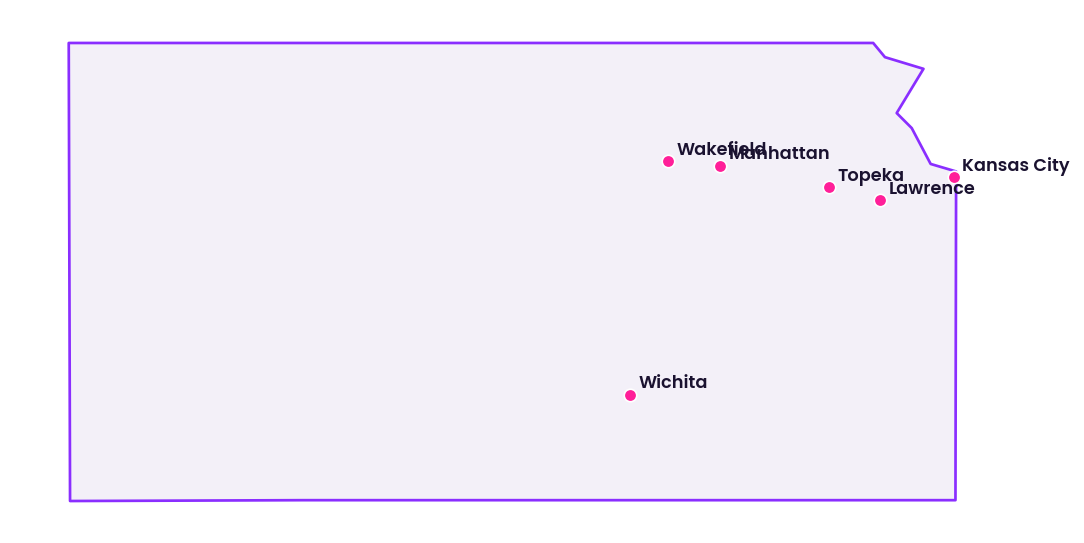
For multifamily and apartments, Kansas presents a classic midwestern pattern. Purpose built rental communities and mixed use buildings are concentrated in the Kansas City Kansas suburbs, in Wichita, Topeka, Lawrence, Manhattan, and a few other centers, while much of the rest of the state relies on small multifamily and single family rentals. Rents are moderate in absolute terms compared with national averages, and vacancy and rent growth are tied closely to local employment, higher education, and military installations.
Single family homes in Kansas are generally affordable relative to incomes, especially outside the highest demand submarkets. This supports high homeownership rates in many communities, while still leaving room for single family rental strategies that serve households who prefer to rent for flexibility or due to credit and savings constraints. Commercial real estate includes office space linked to government, education, health care, and services, industrial and logistics facilities along interstate corridors and near manufacturing and distribution hubs, and retail centers scaled to local populations, with grocery anchored centers playing a stabilizing role.
The state’s tax and regulatory environment is moderate, with state income and sales taxes and property taxes administered at the county level. Insurance risk reflects exposure to severe thunderstorms, hail, tornadoes, flooding, and drought, and recent years have seen increasing attention to severe weather impacts on premiums. Landlord tenant law is less restrictive than in many coastal states, but investors must understand the specific statutes and any local ordinances.
For accredited investors, Kansas is not a high growth story at the state level, but it does offer opportunities for income oriented strategies in stable metros and institutional anchor communities, particularly in well located multifamily, workforce single family rentals, industrial and logistics facilities, and necessity retail. The key is careful submarket selection and disciplined underwriting that respects the state’s demographic and economic realities.
Section 02Population and Migration
The United States Census Bureau’s decennial counts and Population Estimates Program data show that Kansas has a relatively small population compared with many coastal and Sunbelt states, and that statewide growth over recent decades has been modest. Some periods have seen slight increases in total population, while others have been effectively flat. County level estimates reveal a classic pattern for an agricultural and manufacturing oriented state. Urban and suburban counties in the northeast, around the Kansas portion of the Kansas City metropolitan area, and metropolitan counties around Wichita and university towns such as Lawrence and Manhattan have experienced growth or stability, while many rural counties have seen long term population decline as agricultural employment has become more capital intensive and young residents have moved to cities.
Migration components, as reported in Census county and state level series, show that natural increase and international migration have made contributions to population in certain regions, particularly in metropolitan and meat processing or manufacturing communities, while net domestic migration has been negative in some periods at the statewide level. Within Kansas, there is movement from rural to urban counties, and between Kansas counties and neighboring states, often in response to job opportunities, housing costs, and educational choices.
For real estate investors, these population and migration patterns mean that statewide metrics mask significant differences. Metropolitan counties that include Kansas City Kansas suburbs, Wichita, Topeka, Lawrence, and Manhattan are where demand for new housing and commercial space is most resilient. Rural counties with declining populations may offer very low acquisition prices but face structural demand headwinds that limit rent growth and capital appreciation. University communities and areas near military installations can have more stable or even counter cyclical demand due to enrollment and defense spending.
Section 03Jobs and Economic Anchors
The Bureau of Labor Statistics provides employment statistics that highlight Kansas’s mix of industries. Statewide nonfarm employment is distributed across trade, transportation and utilities, manufacturing, education and health services, government, professional and business services, leisure and hospitality, construction, and financial activities. Agriculture and related industries, while not fully captured in nonfarm series, remain economically important through crop and livestock production and through linkages to processing, transportation, and equipment manufacturing.
The Bureau of Economic Analysis reports gross domestic product by state and by industry, which shows that key contributors to Kansas’s economy include agriculture and food production, particularly in grain and livestock, and manufacturing, notably aerospace and aviation manufacturing in and around Wichita, which has historically been branded as an air capital due to its aircraft production clusters. Logistics and warehousing are supported by interstate highways and proximity to other midwestern and plains markets. Insurance and financial services show meaningful activity in the Kansas City metropolitan region. Education and health care are prominent, particularly in metros with universities and regional medical centers, and government employment includes state government centered in Topeka along with local governments.
These sectors anchor employment in different parts of the state. For example, Wichita’s economy is closely tied to aerospace manufacturing and related suppliers, while Lawrence and Manhattan are dominated by university employment and student spending, and Kansas City Kansas suburbs are integrated into the broader Kansas City metropolitan labor market that spans state lines.
From a real estate standpoint, these anchors support demand for multifamily and single family housing, industrial and logistics space, office and service space, and retail. However, reliance on specific industries such as aerospace and agriculture introduces cyclicality and concentration risk in certain markets. Investors need to understand which employers and sectors dominate each local economy, how diversified they are, and how sensitive they are to national and global economic conditions.
Section 04Income
Income data from the American Community Survey indicate that Kansas’s median household income has been close to or slightly below the national median in many recent years, with a lower cost of living than many coastal states. Incomes vary across the state. Suburban counties around Kansas City, and some neighborhoods in university and medical center metros, tend to have higher median household incomes, while rural counties and some older industrial or agricultural cities record lower income levels.
The Bureau of Economic Analysis publishes personal income by state and local area, which shows that wage and salary income in manufacturing, services, government, and agriculture forms the core of earnings in Kansas, with farm income playing a notably larger role in some rural counties. Transfer payments and retirement income are also significant in communities with older populations.
Income distribution is important for housing. While Kansas residents generally face lower housing costs than in high priced coastal markets, lower incomes in some areas and limited housing choices in others can still produce affordability challenges. Renters in lower income communities and in some university towns may spend a significant portion of income on housing, according to American Community Survey rent to income tabulations, even when absolute rents are modest.
For investors, aligning rent and price strategies with local income profiles is essential. Class A multifamily and for sale housing in higher income suburbs can target households with greater ability to pay, while workforce housing in manufacturing and service oriented communities must remain affordable to local incomes to sustain occupancy and collections. In university markets, reported incomes for student households can be misleading, since many students receive financial support from families or loans, so segmentation is necessary.
Section 05Housing and Multifamily
Kansas’s housing stock is heavily oriented toward single family homes, but multifamily plays a key role in metropolitan and university markets. Census and American Community Survey data show that owner occupancy rates in Kansas are higher than national averages, especially in rural and suburban areas, while renter shares increase in cities and university communities.
Multifamily housing is concentrated in the Kansas portion of the Kansas City metropolitan area, including Kansas City Kansas and nearby suburbs, in Wichita and its suburbs with garden style and some mid rise communities, in Topeka, which hosts state government and regional employment, and in university towns such as Lawrence, home to the flagship state university, and Manhattan, home to another major university, where student oriented and conventional apartments are common. Smaller multifamily buildings are present in many towns, often in the form of two to four unit properties, older walk up buildings, or mixed use properties with residential units above ground floor commercial.
Private data providers such as RealPage, CoStar, Yardi Matrix, and Freddie Mac’s multifamily research cover these markets and report moderate rent levels and generally healthy occupancy in well located properties, particularly in metros with institutional anchors and low volumes of new supply. Newer multifamily communities tend to cluster near highways, employment centers, and campuses.
For investors, Kansas multifamily offers a range of scales. In the Kansas City metropolitan area, properties can reach institutional size and attract national capital, while in smaller metros and university towns, assets are often smaller and more management intensive. Yields can be attractive relative to acquisition costs, but rent growth potential and liquidity must be evaluated carefully. The absence of extreme price and rent volatility seen in some coastal markets can be a positive for income focused strategies, while limiting speculative upside.
Section 06Rents
Rents in Kansas multifamily markets are moderate in absolute terms and reflect a balance between local incomes, housing costs, and competition from ownership. Public information from the American Community Survey on gross rent distributions, together with fair market rent benchmarks from the Department of Housing and Urban Development for Kansas metropolitan and nonmetropolitan areas, shows that median and higher percentile rents in Kansas are well below those in high cost coastal metros, although they may be comparable to or slightly below national medians, depending on the area.
Within the state, rent levels differ by metro and submarket. Kansas City Kansas suburbs and certain Wichita neighborhoods have higher rents, particularly in newer Class A communities with amenities. University oriented properties in Lawrence and Manhattan can achieve relatively high effective rents per bedroom, especially near campus. In smaller metros and rural towns, rents are lower in nominal terms, but they must be weighed against lower incomes.
Rent growth in Kansas has tended to be modest but positive over time in metros with job growth and constrained new supply. Periods of macroeconomic weakness or significant new construction can lead to slower rent growth or flatter periods, but large rent declines are less common outside of specific local downturns.
For investors, rent trajectories should be modeled conservatively, in line with local income growth and supply additions. There is opportunity to improve rents through property upgrades and better management, particularly in older Class B and C assets, but markets are competitive and tenants have alternatives in both multifamily and affordable single family rentals.
Section 07Vacancy
Vacancy patterns in Kansas vary by metro, property class, and neighborhood. Statewide rental vacancy data from the American Community Survey, which combine urban and rural areas, offer a general sense of the share of rental units that are unoccupied and available, but they obscure the more relevant metropolitan variation.
In metropolitan areas such as the Kansas portion of Kansas City, Wichita, and Lawrence, professionally managed multifamily properties in good locations often maintain relatively low vacancy, particularly in Class B and C segments that serve workforce renters and students. New Class A properties may experience higher vacancy during initial leasing periods, especially if multiple communities open at similar times.
In smaller towns and rural counties, vacancy can be higher in older or less desirable properties, particularly where population has declined and demand has shifted. In some communities with aging housing stock and limited reinvestment, vacancy reflects both weaker demand and functional obsolescence.
For investors, underwriting must incorporate realistic stabilized vacancy rates that reflect local market conditions. Assets in metros with steady or growing populations, diversified employers, and limited new supply can be underwritten with lower stabilized vacancy than properties in locations with population decline or concentrated employment. Property specific factors such as management quality, condition, and tenant mix also influence actual vacancy performance.
Section 08Supply Pipeline
The housing and multifamily supply pipeline in Kansas is visible in Census building permit data and local planning and permitting records. In recent years, multifamily permits have been concentrated in metropolitan counties, especially in and around the Kansas City area and Wichita, with smaller volumes in university communities such as Lawrence and Manhattan.
In the Kansas City metropolitan area, development has focused on suburban and infill sites with access to highways and employment centers, often in the form of garden style or low rise communities with surface parking and amenities such as pools and clubhouses. In Wichita, multifamily development has occurred in both suburban corridors and some central areas. In university towns, student oriented projects with higher bedroom counts and amenities have been part of the pipeline.
Single family permits, meanwhile, have been more widely distributed, with higher activity in growing suburban counties and university linked communities.
Because specific permit counts or unit totals are not presented here, it is important for investors to consult current local data when assessing submarket supply. However, the general pattern is that Kansas does not experience the same intensity of multifamily construction seen in some fast growth Sunbelt markets, but localized supply waves can still affect vacancy and rent in specific corridors.
Section 09Single Family Homes
Single family housing in Kansas is central to both the housing market and many communities’ identities. Census data show that the majority of occupied housing units in the state are single family detached or attached homes, particularly outside central parts of larger cities. Private data from platforms such as Zillow and Redfin provide detailed statistics on median sale prices, listing volumes, days on market, and months of supply for Kansas metros and counties, but those series are not restated in this environment for numeric reporting.
Qualitatively, single family homes in Kansas are relatively affordable compared with national averages, particularly in smaller metros and rural areas. In metropolitan areas, prices vary by neighborhood, school district, and proximity to employment and amenities. Kansas City area suburbs on the Kansas side, and desirable neighborhoods in Wichita, can have higher price levels, while more distant or economically challenged areas have lower price points.
Inventory conditions influence whether markets favor buyers or sellers. During periods of low mortgage rates and limited new construction, many Kansas metros have experienced tight supply and seller friendly conditions, with multiple offers on desirable properties. As interest rates have risen, demand may cool somewhat, but inventory levels and construction responses determine how much negotiating power shifts toward buyers.
For investors, single family rentals can be attractive in Kansas where acquisition pricing relative to achievable rents allows for acceptable yields and where tenant demand is stable. Such strategies may focus on acquiring homes in stable neighborhoods near jobs and schools and renting to long term tenants, on building or acquiring small portfolios in university towns aimed at faculty, staff, and graduate students, or on participating in build to rent communities in growing suburban areas where they are available. Property taxes, insurance, maintenance, and property management must be accounted for in underwriting, but overall operating costs are lower than in many high cost states.
Section 10Commercial Real Estate and Retail Centers
Commercial real estate in Kansas reflects its economic structure and geography. Office, industrial, and retail assets are concentrated in Kansas City Kansas suburbs, Wichita, Topeka, and a few other metros, with smaller scale assets in regional centers and towns.
Office space in the Kansas portion of the Kansas City metro and in Wichita consists of downtown and suburban buildings that host professional services, insurance, health care, government, and corporate tenants. Remote and hybrid work trends have affected office demand, particularly for older properties without modern layouts and amenities, but core tenants in stable sectors continue to require space, especially for client facing and collaborative functions.
Industrial and logistics properties are an important strength. Kansas sits along major interstate highways and rail corridors that connect the Midwest, the plains, and other regions. Distribution centers, warehouses, light manufacturing facilities, and agricultural processing plants populate industrial zones near highways and in specialized areas. Demand for logistics and distribution space has been supported by online commerce and supply chain strategies that value central locations.
Retail real estate in Kansas includes grocery anchored neighborhood centers, strip centers, enclosed malls, and main street retail in smaller towns. Grocery anchored centers serving stable residential areas tend to maintain occupancy and rent levels, as residents rely on these centers for daily needs. Malls and power centers, particularly in smaller markets, face national headwinds from online commerce competition and shifting consumer preferences, with some properties exploring redevelopment or partial reconfiguration.
Private market data from CoStar and brokerage firms, though not numerically reported here, suggest that capitalization rates for well leased industrial and grocery anchored retail in Kansas are higher than those for similar assets in coastal gateways, reflecting local income levels and growth expectations, though yields alone do not determine outcomes and returns are not assured.
Section 11Transactions and Capital Markets
Comprehensive, current quantitative data on transaction volumes and capitalization rates for Kansas properties are maintained primarily by proprietary data providers such as MSCI Real Assets, CoStar, and brokerage research teams. Public state and county records document property transfers and prices but do not aggregate and normalize them into state level transaction and capitalization rate series suitable for this review.
Qualitatively, Kansas is a secondary and tertiary market environment in terms of capital flows. The Kansas City metropolitan area, including its Kansas side, attracts regional and some national capital for larger multifamily, industrial, and retail assets, especially when combined with the Missouri side in broader strategies. Wichita, Topeka, and university metros see more regional and local investors, along with some institutional activity in specific property types.
Transaction volumes rise and fall with national credit and equity conditions, but overall market liquidity is lower than in major coastal metros. Capitalization rates tend to be higher, reflecting perceived risk, lower growth expectations, and limited buyer pools.
Because no official public information is available within this environment that provides a complete, current, numeric view of Kansas transaction volumes and capitalization rates by property type, this section remains qualitative. Investors should obtain up to date proprietary data and local brokerage intelligence when making specific acquisition or disposition decisions.
Section 12Taxes
Kansas levies state personal and corporate income taxes and sales taxes, with rates administered and collected by the Kansas Department of Revenue. Local governments may impose additional sales and use taxes within state limits. Tax policy has been the subject of legislative debate and adjustment over the past decade, affecting effective tax burdens for residents and businesses.
Property taxes are assessed and collected at the county level, using assessed values and mill levies set by counties, cities, school districts, and other taxing entities. Assessment practices and effective property tax rates can vary by county and by property type. Agricultural, residential, commercial, and industrial properties may be assessed under different rules.
For real estate investors, property taxes are a material component of operating expenses and must be incorporated into underwriting. While Kansas property tax burdens are generally lower than those in the highest tax states, they are not trivial, and changes in assessed value after acquisition can increase tax bills. Investors should analyze recent assessment histories, appeal processes, and levy trends for each jurisdiction in which they invest.
State income and sales taxes also affect investor returns and tenant disposable incomes. Relative to states with no income tax, Kansas imposes an additional layer of taxation that may influence migration and business decisions at the margin, but the overall environment remains competitive within the Midwest. This review does not state specific numeric tax rates, because those are best confirmed against current Kansas Department of Revenue and county schedules for the relevant year.
Section 13Insurance
Insurance considerations in Kansas are shaped by exposure to severe weather. The Kansas Insurance Department regulates the insurance market at the state level, while private carriers underwrite property, casualty, and liability coverage.
Severe thunderstorms and hail are common hazards, particularly in spring and summer. Hail storms can damage roofs, siding, windows, and vehicles, leading to insurance claims and pressure on premiums. Tornadoes, although highly localized, pose significant risk where they occur, and building codes and construction practices aim to mitigate some of this risk.
Flooding occurs along rivers and streams during heavy rainfall events and snowmelt. Federal flood maps identify special flood hazard areas where flood insurance is required for mortgaged properties. Many Kansas properties are outside these zones but can still experience localized flooding. Winter storms bring snow and ice, which can damage structures and create liability exposures.
Insurance premiums and deductibles in Kansas have been influenced by cumulative severe weather losses and reinsurance costs. While they are generally lower in absolute terms than premiums in coastal hurricane zones, they have trended upward in many areas. For investors, it is important to obtain property specific quotes, assess roof age and condition, and consider mitigation measures such as impact resistant roofing and improved drainage. Budgeting for potential premium increases over the hold period is prudent.
Section 14Landlord Tenant and Regulatory Environment
Kansas landlord tenant law is defined primarily by state statutes, which govern residential and commercial leases, security deposits, habitability, notice requirements, remedies for breach, and eviction procedures. Compared with heavily regulated jurisdictions, Kansas’s framework is often considered relatively balanced or moderately favorable to property owners, but landlords still must comply strictly with statutory requirements.
There is no statewide traditional rent control regime in Kansas. Rents for most market rate units are set by negotiation between landlords and tenants, subject to contract and anti discrimination laws. Properties that participate in federal or state housing programs have rent and income restrictions under program rules.
Local governments may adopt housing and building codes, inspection requirements, and zoning ordinances that affect rental properties, but there are fewer local rent and eviction control regimes than in some coastal states. University communities may have specific occupancy and nuisance rules affecting student rentals.
For investors, compliance with Kansas landlord tenant law means using written leases that are clear and consistent with statute, handling security deposits according to legal requirements, maintaining properties in habitable condition and addressing repairs promptly, and following proper notice and court procedures in the event of non payment or lease violations. Regulatory risk is present but modest relative to more restrictive states. However, investors should monitor legislative developments that could adjust eviction procedures, tenant rights, or local regulatory powers.
Section 15Infrastructure
Kansas infrastructure supports its roles in agriculture, manufacturing, and regional distribution. The state’s highway network includes multiple interstate and major state routes that connect Kansas to neighboring states and to national freight corridors. The Kansas Department of Transportation manages these roads and bridges, many of which are critical for moving grain, livestock, manufactured goods, and consumer products.
Rail infrastructure, operated by freight railroads, supports agricultural exports and manufacturing shipments. Rivers provide some transportation and recreation opportunities, though barge traffic is more limited than in some neighboring states.
Airports in Wichita and the Kansas City metropolitan area offer commercial passenger service and cargo capacity, while smaller regional airports support general aviation and some business travel.
Water and wastewater infrastructure is managed locally, with municipal systems sized to population and industrial needs. Electric and gas utilities, including investor owned and cooperative providers, operate transmission and distribution networks that deliver energy to urban and rural customers.
For real estate investors, access to transportation and utilities influences property desirability and use. Industrial and logistics assets near highway interchanges, rail lines, or airports have structural advantages. Multifamily and single family properties in metros benefit from road networks, public transit where available, and reliable utilities. In rural areas, infrastructure adequacy may constrain new development.
Section 16Climate and Physical Risks
Kansas’s climate is continental, with hot summers, cold winters, and significant seasonal variation. National Oceanic and Atmospheric Administration climate records show that the state experiences a mix of severe weather hazards that are relevant for real estate, including severe thunderstorms with hail, strong winds, and lightning, tornadoes, particularly in central and eastern parts of the state during spring and early summer, heavy rainfall events that can cause flash flooding and river flooding, winter storms with snow, ice, and blizzard conditions, especially in the western and northern parts of the state, and periodic droughts that affect agriculture, water supplies, and wildfire risk in grasslands.
The Federal Emergency Management Agency’s National Risk Index and flood maps provide county level assessments of relative risk for flood, wind, and other hazards. Some counties have higher relative tornado and hail risk, while others have more flood exposure.
In practice, physical risks affect building design, maintenance, insurance, and resilience strategies. Buildings must be constructed to withstand wind loads, with attention to roof design and attachments. Drainage and site grading must manage heavy rainfall. Winterization is necessary for plumbing and building systems.
For investors, physical climate risk should be evaluated at the asset level, with attention to hazard history, building age and materials, and local mitigation measures. Over time, climate trends may alter hazard profiles, and regulation and insurance practices may evolve in response.
Section 17Opportunities
Kansas offers several opportunity themes for accredited investors. In multifamily, properties in metros such as the Kansas side of the Kansas City area, Wichita, Lawrence, and Manhattan may provide relatively stable income anchored by employment, education, and government. Workforce oriented communities that balance rent levels with local incomes, and that are well located relative to jobs, schools, and amenities, are particularly relevant.
Industrial and logistics assets along interstate corridors and near major manufacturing and processing facilities can benefit from ongoing demand for storage, distribution, and production space. Modern facilities with good access, adequate clear heights, and flexible configurations are well positioned.
Grocery anchored neighborhood centers in stable communities, both urban and suburban, offer relatively defensive retail exposure. As long as they maintain strong anchors and a mix of daily needs tenants, these centers may produce relatively steady cash flow.
In single family, investors may build portfolios in metros where property values are modest relative to achievable rents, targeting long term tenants in stable neighborhoods. University towns provide niche opportunities in student and faculty housing, though they require specialized management and sensitivity to seasonal patterns.
Because Kansas markets are smaller and less volatile than many high growth states, they may serve as income oriented components of a diversified real estate portfolio. The observations in this section are general and educational, are not projections, forecasts, or assurances of any particular return, yield, occupancy, rent level, or appreciation, and any specific investment must be evaluated on its own facts.
Section 18Risks
Risks in Kansas real estate include demographic, economic, physical, and market factors. Demographic risk arises from slow statewide growth and population decline in many rural counties, which can dampen long term demand for housing and commercial space in those areas. Economic risk includes dependence on agriculture, exposure to commodity price swings, and reliance on key employers in aerospace and manufacturing.
Physical and climate risks, particularly severe weather such as hail, tornadoes, and flooding, can cause direct damage to properties and infrastructure, increase insurance costs, and disrupt operations. Market risk involves the potential for localized oversupply in specific property segments, such as student housing or new suburban multifamily, if development outpaces demand.
Liquidity risk is inherent in smaller markets. Exiting investments in Kansas, especially outside major metros, may involve longer marketing periods and a narrower buyer pool, which should be reflected in return requirements and hold period assumptions.
Regulatory and policy risks at the state level are relatively modest compared with highly regulated states, but changes in tax policy, infrastructure funding, or local regulatory authority could affect net returns over time. Real estate investments are speculative, are subject to market, financing, liquidity, tax, regulatory, insurance, and physical hazard risks, and can result in the loss of some or all of an investor's invested capital, including the possible loss of principal.
Section 19Investor Implications
For accredited investors, Kansas is best approached through a disciplined, selective lens. Strategies should focus on metros and submarkets with diversified and stable economic bases, such as the Kansas portion of the Kansas City area, Wichita, and university centers, rather than broad exposure to the entire state.
Underwriting must integrate conservative rent growth assumptions, realistic vacancy and turnover expectations, and careful modeling of taxes, insurance, and capital expenditures. Investors should pay particular attention to tenant profiles, lease structures, and the durability of local demand drivers.
Capital structures suited to Kansas markets emphasize moderate leverage, strong debt service coverage, and patient hold periods. Given the potential for slower appreciation and lower liquidity, return expectations should be set accordingly, and portfolios should be diversified across markets and property types.
Local partnerships with experienced operators, property managers, and professionals in legal, tax, and insurance fields can improve execution and risk management. Attention to physical resilience and mitigation can enhance the long term attractiveness of assets to tenants, lenders, and future buyers. Nothing in this section is a recommendation to pursue any specific strategy or investment, and there is no assurance that any objective or outcome described will be achieved.
Section 20Conclusion
Kansas is a stable but modest growth real estate jurisdiction, with opportunities concentrated in a few metropolitan and institutional anchor markets. Its economy blends agriculture, manufacturing, services, and government, and its housing markets are generally affordable in absolute terms. Multifamily, single family rentals, industrial and logistics assets, and grocery anchored retail in strong submarkets may offer income and modest appreciation potential for accredited investors, though no particular outcome or return is assured.
At the same time, demographic headwinds in rural areas, exposure to severe weather, and the structural characteristics of smaller markets require caution. Investors who combine realistic expectations, conservative underwriting, and targeted submarket selection may use Kansas to complement higher growth, higher volatility exposures elsewhere in their portfolios.
Any specific investment decision should be supported by current quantitative data from the public sources cited below and by reputable private market data, alongside thorough property level due diligence and scenario analysis.
Sources
- United States Census Bureau, Population and Housing Unit Estimates, Kansas statewide and counties,, https://www.census.gov/programs-surveys/popest.html
- United States Census Bureau, American Community Survey one year and five year estimates, Kansas,, https://www.census.gov/programs-surveys/acs
- United States Census Bureau, Housing Vacancies and Homeownership, state level tables for Kansas,, https://www.census.gov/housing/hvs
- United States Census Bureau, Building Permits Survey, Kansas statewide and metropolitan areas,, https://www.census.gov/construction/bps
- United States Bureau of Labor Statistics, Economy at a Glance, Kansas,, https://www.bls.gov/eag/eag.ks.htm
- United States Bureau of Labor Statistics, State and Area Employment, Kansas and major metropolitan areas,, https://www.bls.gov/sae
- United States Bureau of Labor Statistics, Local Area Unemployment Statistics, Kansas counties and metros,, https://www.bls.gov/lau
- United States Bureau of Economic Analysis, Gross Domestic Product by State, Kansas,, https://www.bea.gov/data/gdp/gdp-state
- United States Bureau of Economic Analysis, Gross Domestic Product by Metropolitan Area, Kansas metros,, https://www.bea.gov/data/gdp/gdp-metropolitan-area
- United States Bureau of Economic Analysis, Personal Income by State and Local Area, Kansas,, https://www.bea.gov/data/income-saving/personal-income-by-state
- United States Department of Housing and Urban Development, Office of Policy Development and Research, Fair Market Rents and income limits for Kansas areas,, https://www.huduser.gov
- Federal Housing Finance Agency, House Price Index, Kansas and metropolitan statistical areas,, https://www.fhfa.gov/DataTools/Downloads/Pages/House-Price-Index.aspx
- RealPage, multifamily market analytics, Kansas markets,, https://www.realpage.com/analytics
- CoStar Group, market analytics and capital markets reports, Kansas,, https://www.costar.com
- Yardi Matrix, multifamily national and metro reports, Kansas markets,, https://www.yardimatrix.com
- Freddie Mac Multifamily, research and insights, Midwest region including Kansas,, https://mf.freddiemac.com/research
- Kansas Housing Resources Corporation, statewide housing programs and research,, https://kshousingcorp.org
- Kansas Department of Revenue, tax information and statistics,, https://www.ksrevenue.gov
- Kansas Insurance Department, insurance market information,, https://insurance.ks.gov
- Kansas Department of Transportation, transportation system and project information,, https://www.ksdot.gov
- Federal Emergency Management Agency, National Risk Index and Flood Map Service Center, Kansas,, https://hazards.fema.gov/nri
- National Oceanic and Atmospheric Administration, climate data for Kansas,, https://www.ncei.noaa.gov
- CBRE Research, Kansas City and Kansas commercial real estate market reports,, https://www.cbre.com/insights
- JLL Research, Midwest and Kansas market reports,, https://www.us.jll.com/en/trends-and-insights/research
- Cushman and Wakefield, Marketbeat reports for Kansas City and Wichita,, https://www.cushmanwakefield.com/en/insights
- MSCI Real Assets, United States Capital Trends, including Kansas,, https://www.msci.com/our-solutions/real-estate/real-assets