In brief · summary: Maine
Maine State Real Estate Market Review
Section 01Executive Summary
Maine is a small, coastal, and largely rural state with a concentrated band of economic activity and housing demand along the southern and mid coast corridor and in a few interior service centers. Public information from the United States Census Bureau, the American Community Survey, the Bureau of Labor Statistics, the Bureau of Economic Analysis, the United States Department of Housing and Urban Development, and Maine state agencies shows a state with slow overall population growth, an aging population, an economy weighted toward health care, education, tourism, forest products, shipbuilding, and small scale manufacturing, and housing markets that are tight and relatively expensive in the Portland region and more moderate in many rural counties. This review does not restate current point figures, even though they appear in those sources, and instead focuses on structural patterns, scopes, and investor implications.
Multifamily and apartment markets in Maine are concentrated in the Portland South Portland Biddeford metropolitan area, in Bangor and Lewiston Auburn, and in a few smaller centers. Rents in the Portland region are comparatively high relative to statewide incomes, with low vacancy and limited new supply, while in other metros and rural areas rents are lower but incomes are also lower. Single family homes dominate the housing stock statewide, but investor interest in single family rentals has grown in recent years, especially in commuter towns near Portland and in some coastal communities, where demand from remote workers and second homebuyers has pushed up prices.
Commercial real estate is modest in scale but important for local economies. Office demand is centered in Portland and Augusta, with smaller nodes in Bangor and Lewiston. Industrial and logistics space follows the interstate corridor, ports, and rail, while retail is anchored by grocery centers and neighborhood shopping in regional hubs and tourist towns. Maine’s tax, insurance, and regulatory environment is moderate but strongly shaped by coastal climate risk, aging infrastructure, and a policy focus on environmental and community objectives.
For accredited investors, Maine is not a scale market but offers targeted opportunities in workforce and middle market multifamily in the Portland region, in single family and small multifamily rentals in commuter and amenity rich towns, and in well located industrial and grocery anchored retail tied to regional distribution and essential services. These opportunities must be weighed against demographic headwinds in many rural areas, construction and entitlement challenges, and coastal climate and insurance risks.
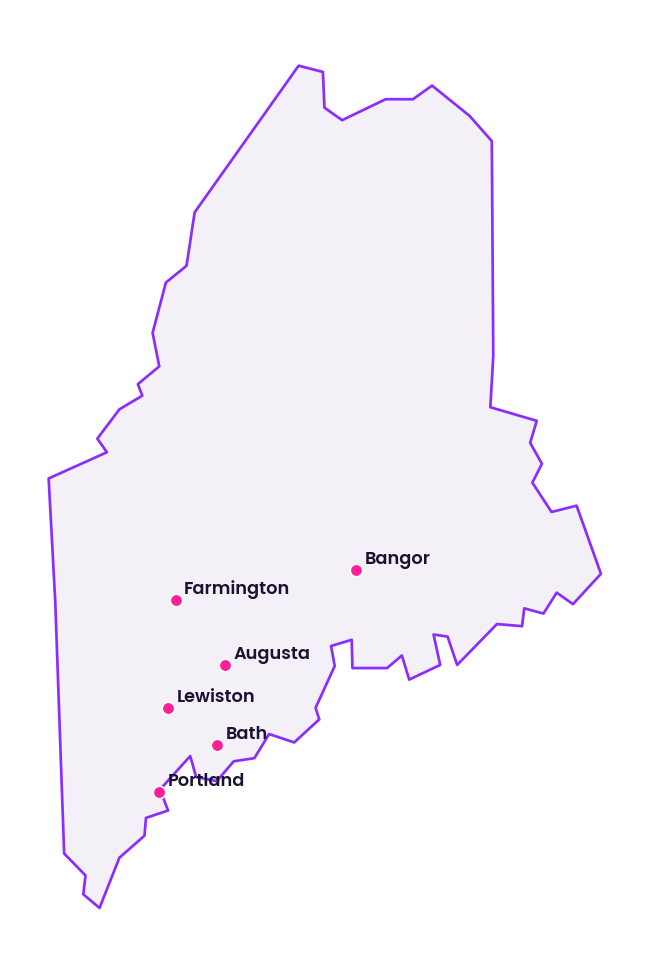
Section 02Population and Migration
The United States Census Bureau’s Population Estimates Program and the American Community Survey show that Maine’s statewide population has grown slowly over recent decades, with annual statewide estimates indicating low single digit percentage changes over multi year periods rather than rapid expansion. Population growth has been concentrated in southern and coastal counties, particularly in and around Cumberland and York Counties, which include the Portland South Portland region, while many northern and interior counties have experienced flat or declining populations.
Census and American Community Survey county level data also highlight Maine’s distinctive age profile. The state has one of the highest median ages in the country in recent years, with a large share of residents in older age cohorts. This reflects a combination of long time residents aging in place, net out migration of some younger adults in search of education and employment elsewhere, and in migration of older households and retirees from other states who are drawn to Maine’s quality of life.
Migration components, as presented in Census statewide and county level series, indicate that net domestic migration has been modestly positive in some recent years for the state overall, especially during periods when remote work and lifestyle preferences increased interest in New England coastal and rural areas. International migration has played a smaller but meaningful role, with arrivals concentrated in a few communities that have refugee and immigrant support networks.
For investors, these population patterns mean that demand for housing and services is concentrated in a limited band of metros and towns, with Portland South Portland at the core, while many rural markets face shrinking or aging populations that can constrain long term housing demand. Submarket selection within Maine therefore requires attention to local demographic momentum, age structure, and the balance between in migration and out migration.
Section 03Jobs and Economic Anchors
The Bureau of Labor Statistics and the Bureau of Economic Analysis provide employment and output data for Maine that illustrate a mixed economy. Statewide nonfarm employment is distributed across education and health services, trade transportation and utilities, leisure and hospitality, government, professional and business services, manufacturing, and construction. Gross domestic product by state and by industry from the Bureau of Economic Analysis shows that real output contributions come heavily from health care and social assistance, retail and wholesale trade, real estate and rental and leasing, manufacturing including forest products and paper, and tourism related services.
In the Portland South Portland metro, employment is concentrated in health care systems, educational institutions, finance and insurance, professional services, tourism and hospitality, and a growing technology and creative services cluster. The port and related logistics activities, while smaller than in some larger states, still contribute to trade and warehousing functions. In Bangor and Lewiston Auburn, health care, education, retail, and small manufacturing are key employment bases. Rural and northern areas have more limited job bases that depend on forest products, small manufacturing, agriculture and fisheries, and public services.
Shipbuilding at a major yard in Bath and naval facilities in nearby regions are significant employers and support a network of suppliers and service providers. Seasonal employment tied to tourism, recreation, and hospitality in coastal and lake regions is also important, with employment spiking during certain months.
For real estate investors, this employment structure implies stable or growing demand for housing and services in the Portland region and in select regional hubs, supported by health care, education, and services, more seasonal and cyclical demand in tourism heavy areas, which affects hotels, short term rentals, and some retail, and more fragile demand in rural and resource dependent communities, where housing and commercial absorption is tightly linked to a few employers. Investments that align with durable anchors such as hospitals, universities, and regional service centers may offer better long term resilience than those tied solely to seasonal or single industry demand.
Section 04Income
Income statistics from the American Community Survey show that Maine’s median household income is close to or slightly below national medians, depending on the year, with lower living costs in some rural areas and higher housing and service costs near Portland. Statewide and county level data reveal meaningful variation, as households in Cumberland County, which includes Portland, typically report higher median incomes than households in many rural counties, while interior and northern regions often have lower median incomes and higher poverty rates.
Personal income by state and local area from the Bureau of Economic Analysis provides further insight into sources of income, including wages and salaries, business income, dividends and interest, and transfer payments such as Social Security and retirement benefits. These data show that wages in health care, education, professional services, finance, and government form a substantial part of income in the southern and central counties, while retirement and transfer income play larger roles in older and rural communities.
For housing and real estate investors, this income structure means that rents and home prices in the Portland region can be higher in absolute terms but must still be matched to local incomes and willingness to pay, especially for workforce and middle market product, that incomes in rural and smaller town markets support lower rents and home prices with limited headroom for upward movements without eroding affordability, and that retiree and second home markets can support higher pricing in some coastal and amenity rich locations, though this demand is often more discretionary and sensitive to asset market and tax changes. Investment strategies that focus on moderate rent housing accessible to middle income households in the Portland region and key hubs are more likely to align with income realities than strategies that rely on luxury positioning in areas without sufficient high income demand.
Section 05Housing and Multifamily
Maine’s housing stock consists largely of single family detached homes and small multifamily structures, with larger apartment communities and higher density buildings primarily located in the Portland South Portland metro and in a few smaller cities. Census and American Community Survey housing characteristics confirm that owner occupancy rates are relatively high statewide, especially in rural areas, while renter shares rise in Portland, Bangor, Lewiston Auburn, and some service centers.
Multifamily housing in Maine includes urban and near urban apartment buildings and mixed use properties in Portland and surrounding towns, with a mix of historic buildings and newer developments, smaller garden style communities and townhouse complexes in suburban areas and secondary cities, two and three family homes and small apartment buildings in older neighborhoods in cities and larger towns, and student oriented and conventional rentals near university campuses in locations such as Orono and Farmington.
MaineHousing, the state housing finance authority, and program data from the Department of Housing and Urban Development highlight the presence of subsidized and income restricted multifamily properties in many communities, particularly serving low income households, seniors, and persons with disabilities.
In the Portland region, public and private sources agree that multifamily supply has lagged demand in recent years, leading to low vacancy and strong rent pressures. Zoning constraints, neighborhood opposition to density, building costs, and cold climate construction requirements all contribute to relatively slow multifamily production. In Bangor, Lewiston Auburn, and other metros, multifamily supply is smaller in absolute terms, and new construction has been more limited.
For investors, multifamily in Maine offers stronger rent and occupancy fundamentals in the Portland metro, but with higher acquisition and development costs, entitlement complexity, and climate related operating challenges, modest opportunities in secondary cities where demand from health care, education, and local services supports stable occupancy at lower rent levels, and the potential to partner with MaineHousing and the Department of Housing and Urban Development on affordable and workforce housing developments, which may offer stable cash flows and competitive financing but require regulatory compliance expertise.
Section 06Rents
Rents across Maine reflect the interplay of constrained supply in some markets, lower incomes in others, and rising operating costs. Fair market rent benchmarks from the Department of Housing and Urban Development for Maine metropolitan and nonmetropolitan areas provide a baseline for modest units, and American Community Survey gross rent distributions indicate that statewide median gross rent is below national medians in absolute terms but that rent burdens can be high in areas where incomes are low or housing supply is tight.
In the Portland South Portland metro, fair market rents for two bedroom units are higher than in other parts of the state, and local market surveys reported by the Department of Housing and Urban Development and state housing agencies show that market rate rents for newer or renovated Class B and Class A properties can exceed these benchmarks. Vacancy is generally low in this segment, which supports these rent levels, though affordability pressures and regulatory responses can temper future rent growth.
In Bangor, Lewiston Auburn, and other cities, average rents are lower than in Portland, but they must be considered against local incomes. Rent and income cross tabulations from the American Community Survey for these areas show that a meaningful share of renter households devote a large portion of their income to housing.
For investors, the rent environment suggests that Portland area multifamily can achieve higher absolute rent levels, particularly for well located, well built properties, but that investors should be cautious about extrapolating recent rent growth into the future without regard to income and political constraints, that secondary markets support lower rents with more limited potential for rent growth but often lower asset prices, presenting opportunities for yield oriented investments, and that there is an ongoing need for affordable and workforce housing across the state, so investment in these segments, particularly when coupled with public financing and support, can address social needs while providing predictable revenue streams.
Section 07Vacancy
Rental vacancy patterns in Maine vary by metro and property type. American Community Survey statewide rental vacancy rates suggest that Maine has at times had vacancy levels similar to or slightly above national averages, but these statewide measures combine tight and soft markets. Locally sourced data from state housing agencies and private providers indicate that Portland and nearby communities experience low vacancy in most professionally managed multifamily properties, especially in Class B and moderate Class A segments, reflecting persistent demand and constrained new supply, that vacancy in older or more marginal properties can be higher if quality, location, or management is poor even in tight overall markets, that in Bangor, Lewiston Auburn, and other regional hubs stabilized multifamily generally maintains moderate vacancy with variations tied to local employment and supply, and that rural and small town areas may have higher structural vacancy in older stock due to population decline and limited demand, even when there is latent demand for well maintained, appropriately priced units.
Investors should evaluate vacancy at the metro, submarket, and property levels, avoiding reliance on statewide averages. Well located, professionally managed multifamily in the Portland region can be underwritten with low stabilized vacancy assumptions, while assets in rural markets or in submarkets with weaker demand should be modeled with higher vacancy allowances and turnover expectations.
Section 08Supply Pipeline
The supply pipeline for housing and multifamily in Maine can be tracked through Census building permits at the state and metro level and through local planning and permitting authorities. Over recent years, building permits have shown relatively modest volumes of multifamily permits compared with national averages, with a notable concentration in the Portland South Portland metro, where new apartment projects, mixed use developments, and adaptive reuse initiatives have come forward within the limits of zoning and infrastructure, limited multifamily permitting in Bangor, Lewiston Auburn, and other metros, though some projects have been undertaken, especially when supported by MaineHousing or local incentives, and single family permitting activity in suburban and rural areas when demand from in migration and local households supports new construction, particularly in southern and coastal counties.
The implication for investors is that Portland’s multifamily supply pipeline is meaningful relative to its base but still constrained compared with higher growth metros, which can support occupancy and rents for well conceived projects, although near term competition in certain submarkets may increase as projects deliver, that secondary markets are unlikely to see oversupply from new multifamily construction but older stock may not meet modern expectations without investment, and that supply limitations and construction costs create barriers to entry that can protect existing assets but also make new development challenging and capital intensive. Monitoring permit data and local planning processes is essential for assessing future competition and identifying areas where supply is likely to remain constrained.
Section 09Single Family Homes
Single family homes form the majority of Maine’s housing stock, particularly in rural and suburban communities. American Community Survey housing data show that detached single family units dominate in many counties, while attached homes and small multifamily are more common in urban centers. Private data from sources such as Zillow, Redfin, and local listing systems, not quoted numerically here, indicate that median home values in Maine have risen in recent years, with particularly strong appreciation in the Portland region and in some coastal and amenity rich towns as demand from in state and out of state buyers has increased, that interior and northern counties still have lower median home values in absolute terms though some communities have seen price increases from low bases, and that inventory levels and months of supply in the Portland region have often been tight, leading to competitive bidding and seller favorable conditions, while rural areas may have more balanced or buyer favorable conditions.
For investors, single family rental strategies in Maine include acquiring homes in commuter towns within reach of Portland and renting them to local workers and remote workers who need more space than urban apartments offer, targeting small portfolios of homes near universities, hospitals, or major employers in Bangor and other hubs, and participating selectively in coastal second home markets through seasonal or mixed use rental strategies, though these are more exposed to tourism cycles and climate risk. Key considerations include property taxes, insurance costs in coastal and storm exposed areas, maintenance for older homes in harsh winter and coastal environments, and tenant demand at rent levels consistent with local incomes.
Section 10Commercial Real Estate and Retail Centers
Commercial real estate markets in Maine are relatively small but diversified across office, industrial and logistics, and retail.
Office demand is concentrated in Portland, which hosts regional headquarters, professional and financial services firms, technology and creative companies, and government offices, and in Augusta, which houses state government agencies. Smaller office markets exist in Bangor, Lewiston, and other cities. Remote and hybrid work trends have softened demand for some traditional office space, especially older and less efficient properties, while well located, flexible, and amenity rich buildings have fared better.
Industrial and logistics properties line the interstate corridors, especially the Interstate 95 spine that runs through southern and central Maine, and cluster near ports and rail terminals. These assets support warehousing and distribution for regional consumption, light manufacturing, and food and forest product processing. Demand for industrial space has benefited from regional online commerce growth and from the need for regional distribution nodes, even if Maine is not a primary national logistics hub.
Retail includes downtown shopping streets in Portland and other towns, neighborhood retail in service centers, and grocery anchored shopping centers that serve local communities. Grocery anchored centers in stable markets tend to maintain occupancy and modest rent growth, as residents rely on them for daily needs. Seasonal tourism inflates retail demand in coastal and lake regions during peak months, supporting restaurants, specialty shops, and hospitality related uses, while year round demand is concentrated in service centers and suburban corridors.
For investors, commercial real estate in Maine offers opportunities in well located industrial and logistics assets that benefit from stable regional distribution and modest competition, targeted investments in grocery anchored centers and essential retail in resilient communities in the Portland region and regional hubs, selective office investments only in the best located and adaptable buildings in Portland and Augusta with a clear strategy for tenant mix and amenities, and smaller mixed use properties that combine street level retail with upper floor residential in walkable neighborhoods and towns.
Section 11Transactions and Capital Markets
Transaction volumes and capital flows in Maine real estate are inherently smaller than in larger states, and they are recorded in county registries and private capital markets datasets such as those maintained by CoStar and MSCI Real Assets. Public sources do not provide a unified, timely dataset of transaction volumes and capitalization rates by property type that can be used in this environment, so this section is qualitative.
Activity has been strongest in multifamily and mixed use properties in Portland and nearby communities, where institutional and private capital has targeted yield and moderate growth, in single family and small multifamily portfolios in coastal towns and commuter communities driven by a mix of local and out of state buyers, in industrial and logistics properties near Portland and along interstate corridors as regional and national investors seek stable industrial yields, and in grocery anchored and essential retail centers in regional hubs.
Capitalization rates for Maine assets, based on proprietary reports and broker commentary, are generally higher than for comparable assets in major coastal gateway cities, reflecting smaller market size and liquidity, but lower than those in more distressed or very small markets. Debt capital is provided by local and regional banks, credit unions, agencies for qualifying multifamily properties, and occasionally by life companies and national lenders for larger or stronger assets.
Because no official public quantitative series is accessible here, investors must rely on up to date private data and local broker guidance for specific pricing and capitalization rate benchmarks.
Section 12Taxes
Maine’s tax environment includes state and local components that affect real estate. Maine Revenue Services administers state individual income taxes, corporate income taxes, sales and use taxes, and property tax frameworks. The state has a progressive income tax structure and a statewide sales tax, with certain exemptions and additional local options for specific goods and services.
Property taxes are levied locally by municipalities and assessed based on property values, with rates varying by town and city. Municipalities rely heavily on property taxes to fund schools and local services, which can lead to meaningful effective tax rates, particularly in communities with high service demands and smaller tax bases. Homestead and other exemptions moderate tax burdens for qualifying owner occupants.
For investors, property taxes are a material operating expense, particularly for multifamily and commercial properties, where no homestead exemptions apply. Underwriting should consider assessment practices and current assessed values, local millage rates and historical rate changes, potential reassessments after acquisition or improvement, and differences in property tax burdens between municipalities within the same metropolitan area. State income and sales taxes influence investor net returns and tenant purchasing power but are midrange compared with some other northeastern states. This review does not state specific numeric tax rates, because those are best confirmed against current Maine Revenue Services and municipal schedules for the relevant year.
Section 13Insurance
Insurance is a significant consideration in Maine, especially along the coast and in areas exposed to storms, flooding, and winter weather. The Maine Bureau of Insurance oversees insurance markets, while private carriers set premiums, coverage limits, and deductibles based on risk assessments.
Coastal properties face risks from northeasters, winter storms, wind, storm surge, and in some cases hurricanes or post tropical systems. Inland regions face winter weather, heavy rainfall, and some river and surface flooding. Federal flood maps identify coastal and riverine areas with higher flood probabilities, and properties in these zones that carry federally related mortgages must obtain flood insurance through the National Flood Insurance Program or private carriers.
Ice and snow loads, freeze thaw cycles, and roof and building envelope stresses increase maintenance and insurance risk statewide. Properties with older roofs or heating and plumbing systems may face higher premiums and deductibles.
Investors should obtain current property and flood insurance quotes for each asset, assess coverage terms including coverage for wind, water, and business interruption, evaluate building condition, elevation, and mitigation features that may affect risk and premiums, and plan for potential premium increases and changing carrier appetites, particularly in coastal and flood exposed areas.
Section 14Landlord Tenant and Regulatory Environment
Maine’s landlord tenant law is defined by state statutes and, in some cases, by local ordinances. State law sets out obligations for landlords and tenants, including requirements for habitability, repairs, security deposits, notices, and court procedures for evictions. The state does not have a statewide rent control regime that imposes strict caps on rent increases, although local debates regarding rental regulation and tenant protection have occurred, and some measures have been adopted, particularly in the Portland region.
Residential landlords must comply with fair housing laws, health and safety codes, and procedures for entering units, raising rents, and terminating tenancies. Recent years have seen increased attention to tenant protections in some municipalities, including registration and inspection programs and notice requirements, though Maine remains a less restrictive environment than some larger coastal markets.
Commercial leases are largely governed by contract, but landlords and tenants must still comply with building codes, accessibility requirements, and general legal standards.
Investors should ensure that leases and property management practices comply with Maine law and any relevant local ordinances, that security deposits and rental increases are handled in accordance with statute, that eviction and dispute resolution processes are managed properly through the courts, and that any plans for property repositioning or redevelopment consider tenant protections and regulatory approvals.
Section 15Infrastructure
Maine’s infrastructure network is shaped by its geography, with a long coastline, forested interior, and relatively low population density. The Maine Department of Transportation manages state highways and works with localities on road networks and bridges. The interstate highway system, especially the corridor through southern and central Maine, supports commuter and freight movement and links the state to neighboring New Hampshire and beyond.
Rail service supports freight movement for forest products, chemicals, and other goods, with some passenger service in select corridors. Ports along the coast enable cargo and passenger traffic, including ferries and some cruise operations.
Airports in Portland, Bangor, and other communities provide passenger and cargo services, connecting Maine to national networks and supporting tourism and business travel.
Water, sewer, and stormwater infrastructure is more developed in urban and suburban areas and more limited in rural regions, where private wells and septic systems are common. Electric and telecommunications infrastructure covers much of the state but faces challenges in remote and heavily forested areas, leading to ongoing efforts to improve broadband and grid resilience.
For investors, infrastructure quality and access play a central role in location decisions. Properties near major roads, ports, airports, and infrastructure nodes benefit from better access and tenant appeal. Rural properties may face infrastructure limitations that affect development feasibility and operating costs.
Section 16Climate and Physical Risks
Maine’s climate features cold winters, cool to warm summers, and significant precipitation throughout the year. National Oceanic and Atmospheric Administration climate records show that the state experiences snow and ice, northeasters, heavy rain events, coastal storms, and occasional tropical or post tropical systems. Climate change projections for the region suggest warmer average temperatures, with implications for heating and cooling loads and ecological systems, more frequent and intense heavy rainfall events that can increase flood risk, sea level rise that exacerbates coastal erosion and storm surge impacts, and increased variability in winter weather, including freeze thaw cycles that affect infrastructure.
Physical risks relevant to real estate include coastal flooding and erosion in low lying and exposed shorefront areas, river and surface flooding in communities along rivers and in areas with limited drainage capacity, wind and wave damage from coastal storms, and snow and ice loads on structures with associated safety risks.
Investors must incorporate these risks into underwriting and asset management by evaluating flood maps, storm surge models, and erosion trends from federal and state sources, assessing building elevations, structural systems, and envelope resilience, planning for mitigation measures such as elevating structures, reinforcing roofs and cladding, and improving drainage and seawalls where applicable, and recognizing that physical risk can affect long term viability and liquidity for some coastal and low lying properties, as well as insurance and financing terms.
Section 17Opportunities
Maine’s real estate markets offer several opportunity themes for accredited investors.
One major theme is workforce and middle income multifamily in the Portland metro, where demand from health care workers, educators, service employees, and remote professionals is strong, and supply is constrained. Well located, well constructed properties that provide quality housing at rent levels consistent with local incomes may achieve stable occupancy and moderate rent growth potential.
A second theme lies in single family and small multifamily rentals in commuter and amenity rich towns within reach of Portland and other regional hubs. These assets can serve households who need more space or prefer smaller communities but still require access to employment and services.
Industrial and logistics assets near interstate corridors and ports provide a third opportunity. Functional warehouses and distribution facilities that support regional supply chains and local manufacturing and processing may offer steady income, particularly when modernized and located in resilient areas.
Grocery anchored neighborhood centers and essential retail in stable communities represent a fourth theme, as they meet day to day needs and tend to maintain occupancy across cycles.
Finally, there are mission oriented opportunities in affordable and senior housing, especially given Maine’s aging population and affordability challenges. These investments often rely on state and federal financing tools and require specialized capabilities but can offer long term, predictable cash flows. The observations in this section are general and educational, are not projections, forecasts, or assurances of any particular return, yield, occupancy, rent level, or appreciation, and any specific investment must be evaluated on its own facts.
Section 18Risks
Risks in Maine’s real estate landscape include demographic risk, as statewide population growth is slow and some rural areas face decline and aging populations, which can reduce housing and commercial demand over time. Economic risk stems from reliance on a mix of services, tourism, forest products, and small manufacturing, which can be sensitive to national cycles and structural changes. Climate and physical risk is significant, particularly along the coast and in flood prone areas, where storms, sea level rise, and erosion can threaten properties and infrastructure and raise insurance and capital costs. Policy and regulatory risk includes potential changes in land use, environmental, and housing policies that reflect Maine’s environmental priorities and community concerns. Liquidity risk arises because Maine is a small market with fewer institutional buyers than larger states, so exits may take longer and transaction sizes are often smaller. Finally, construction and operating cost risk arises as cold climate building requirements, material and labor costs, and energy prices can increase project budgets and operating expenses. Real estate investments are speculative, are subject to market, financing, liquidity, tax, regulatory, insurance, and physical hazard risks, and can result in the loss of some or all of an investor's invested capital, including the possible loss of principal.
Section 19Investor Implications
For accredited investors, Maine is best approached as a niche market with selective opportunity rather than as a broad allocation target. The implications include focusing on the Portland South Portland metro and a handful of regional hubs where demand is most robust and diversified, aligning asset strategies with durable demand from health care, education, logistics, and remote workers rather than relying solely on tourism or second home demand, underwriting conservatively with limited rent growth assumptions, realistic vacancy, and explicit modeling of property taxes, insurance, and capital expenditures including climate resilience investments, structuring capital with modest leverage and patient holding periods given the smaller buyer pool and potential for slower transaction processes, diversifying geographically beyond Maine to balance climate and market risks even while capturing specific Maine based opportunities, and partnering with local operators, property managers, and professionals who understand municipal politics, permitting, building practices, and seasonal dynamics. Nothing in this section is a recommendation to pursue any specific strategy or investment, and there is no assurance that any objective or outcome described will be achieved.
Section 20Conclusion
Maine occupies a distinctive position in the United States real estate landscape as a small, coastal, and largely rural state with a concentrated band of economic and housing activity in and around Portland and a few secondary markets. Public data from federal and state sources show that the state’s population growth is modest, its age profile is older than average, and its economy is service and resource based, with important contributions from health care, education, tourism, forest products, and shipbuilding.
For accredited investors, the state offers opportunities that can complement larger market exposures, particularly in workforce and middle market multifamily in the Portland area, in single family and small multifamily rentals in commuter and amenity rich communities, in well located industrial and logistics assets, and in essential retail, though no particular outcome or return is assured. These opportunities require careful attention to income levels, climate and physical risks, insurance and tax costs, and local regulatory and political environments.
This review has focused on structural dynamics and investor implications rather than current figures. Any specific investment decision should be informed by up to date figures from the cited public sources, augmented by private market data and thorough property level due diligence.
Sources
- United States Census Bureau, Population and Housing Unit Estimates, Maine statewide and counties,, https://www.census.gov/programs-surveys/popest.html
- United States Census Bureau, American Community Survey one year and five year estimates, Maine,, https://www.census.gov/programs-surveys/acs
- United States Census Bureau, Housing Vacancies and Homeownership, state level tables for Maine,, https://www.census.gov/housing/hvs
- United States Census Bureau, Building Permits Survey, Maine statewide and metropolitan areas,, https://www.census.gov/construction/bps
- United States Bureau of Labor Statistics, Economy at a Glance, Maine,, https://www.bls.gov/eag/eag.me.htm
- United States Bureau of Labor Statistics, State and Area Employment, Maine and Portland South Portland metro,, https://www.bls.gov/sae
- United States Bureau of Labor Statistics, Local Area Unemployment Statistics, Maine counties and metros,, https://www.bls.gov/lau
- United States Bureau of Economic Analysis, Gross Domestic Product by State, Maine,, https://www.bea.gov/data/gdp/gdp-state
- United States Bureau of Economic Analysis, Gross Domestic Product by metropolitan area, Portland South Portland and other Maine metros,, https://www.bea.gov/data/gdp/gdp-metropolitan-area
- United States Bureau of Economic Analysis, Personal Income by State and Local Area, Maine,, https://www.bea.gov/data/income-saving/personal-income-by-state
- United States Department of Housing and Urban Development, Office of Policy Development and Research, Fair Market Rents and income limits for Maine areas,, https://www.huduser.gov
- Federal Housing Finance Agency, House Price Index, Maine and metropolitan statistical areas,, https://www.fhfa.gov/DataTools/Downloads/Pages/House-Price-Index.aspx
- Maine State Housing Authority, housing data and reports,, https://www.mainehousing.org
- RealPage, multifamily market analytics, Maine and northern New England markets,, https://www.realpage.com/analytics
- CoStar Group, market analytics and capital markets reports, Maine,, https://www.costar.com
- Yardi Matrix, multifamily national and metro reports, New England markets,, https://www.yardimatrix.com
- Freddie Mac Multifamily, research and insights, northeastern region including Maine,, https://mf.freddiemac.com/research
- Maine Revenue Services, state tax information and statistics,, https://www.maine.gov/revenue
- Maine Bureau of Insurance, property and casualty insurance information,, https://www.maine.gov/pfr/insurance
- Maine Department of Transportation, transportation system and project information,, https://www.maine.gov/mdot
- Federal Emergency Management Agency, National Risk Index and Flood Map Service Center, Maine,, https://hazards.fema.gov/nri
- National Oceanic and Atmospheric Administration, climate data for Maine,, https://www.ncei.noaa.gov
- CBRE Research, Portland and northern New England commercial real estate market reports,, https://www.cbre.com/insights
- JLL Research, New England market reports,, https://www.us.jll.com/en/trends-and-insights/research
- Cushman and Wakefield, Marketbeat reports for Portland Maine,, https://www.cushmanwakefield.com/en/insights
- MSCI Real Assets, United States Capital Trends, including Maine,, https://www.msci.com/our-solutions/real-estate/real-assets