In brief · summary: Maryland
Maryland State Real Estate Market Review
Section 01Executive Summary
Maryland sits at the heart of the Mid Atlantic corridor between Washington District of Columbia and the Northeast, with a compact geography but an outsized economic role anchored by the federal government, defense and intelligence agencies, life sciences, port and logistics activity in Baltimore, and a broad professional services sector. Public data from the United States Census Bureau, the American Community Survey, the Bureau of Labor Statistics, the Bureau of Economic Analysis, the United States Department of Housing and Urban Development, the Federal Housing Finance Agency, and Maryland state agencies show a state with steady population growth over recent decades, very high household income levels in the Washington suburbs, more moderate conditions in Baltimore and smaller metros, and a housing market where ownership and rental costs are above national averages in many counties.
This review does not restate specific numeric values, even though they are available directly from the named datasets. Instead, the analysis focuses on structural patterns, relative positions, and investor implications, while directing attention to the appropriate public datasets in the Sources section for precise figures. Within that focus, several themes emerge.
First, Maryland is a bifurcated state. Counties that are part of the Washington metropolitan area, especially Montgomery and Prince George’s, and some Howard and Frederick County communities, display high incomes, tight housing markets, and strong demand for both single family and multifamily assets. The Baltimore metropolitan area has important anchors and select growing neighborhoods but also faces legacy disinvestment, older housing stock, and pockets of high vacancy. Smaller cities and rural counties on the Eastern Shore and in Western Maryland have more modest economic bases and lower price and rent levels.
Second, multifamily and apartment markets are strongest in the Washington suburban counties and in parts of Baltimore City and its inner suburbs, with a deep presence of garden style, mid rise, and high rise properties. Single family homes dominate much of the state’s housing stock, but single family rentals have become an important component of the market, particularly in Prince George’s, Baltimore County, and some exurban communities. Commercial real estate includes a significant office inventory along the Interstate corridor, a large and evolving industrial and logistics base around the Port of Baltimore and the Baltimore Washington International airport, and a network of grocery anchored and community retail centers.
Third, Maryland’s regulatory, tax, and climate context has become more complex. State and local taxes are meaningful for both residents and investors. Insurance costs and underwriting standards are increasingly influenced by coastal and tidal flood risk along the Chesapeake Bay and Atlantic coast and by severe weather trends. State and county level landlord tenant law and housing policy initiatives, particularly around eviction procedures and tenant protections, also shape operating risk.
For accredited investors, Maryland offers a combination of core and core plus opportunities in high income Washington adjacent counties, value add and mission oriented strategies in parts of Baltimore and smaller metros, and stable industrial and necessity retail plays tied to port and logistics corridors. The state is not a low cost market, and successful strategies require careful attention to submarket selection, regulatory nuances, and climate and infrastructure risk.
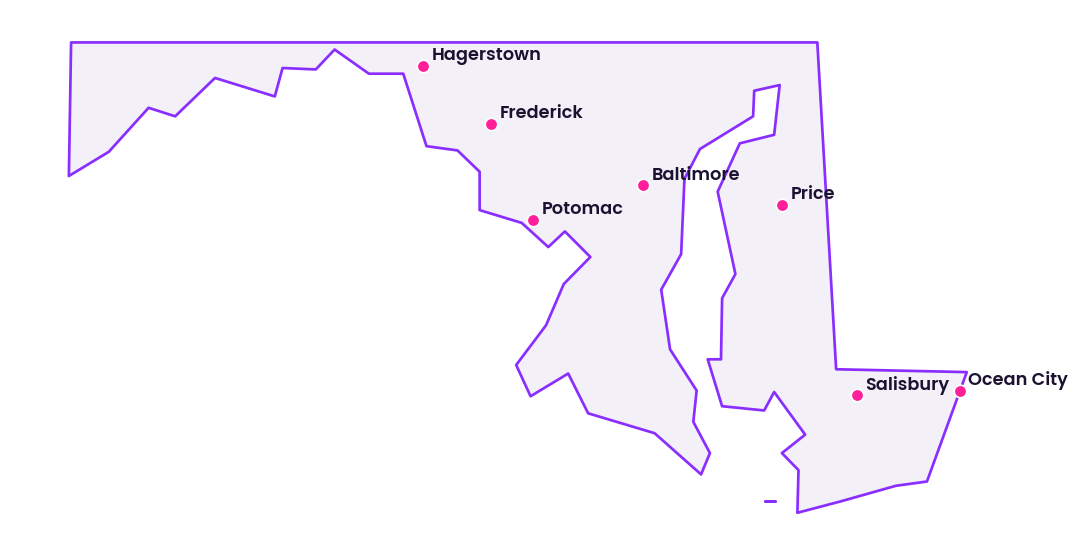
Section 02Population and Migration
Decennial Census counts and annual Population Estimates from the United States Census Bureau show that Maryland’s population has grown steadily over the past several decades, although at a more moderate pace in recent years compared with high growth southern and western states. Growth has been driven by natural increase, international migration, and domestic migration tied to federal and professional employment in the Washington metropolitan region.
The Washington suburban counties, especially Montgomery and Prince George’s, together with Howard, Frederick, and Charles, have accounted for a large share of net growth. These counties benefit from proximity to major federal agencies, research institutions, and private employers in nearby District of Columbia and Northern Virginia, while offering a wide range of suburban and urban neighborhoods. The Baltimore metropolitan area, including Baltimore City and Baltimore County, has seen more mixed patterns, with some suburban areas growing and many city neighborhoods experiencing population decline or only modest stabilization. Rural areas in Western Maryland and on parts of the Eastern Shore have tended to see slower growth or net out migration.
The American Community Survey indicates that Maryland hosts a substantial immigrant population, particularly in the Washington region suburbs and parts of suburban Baltimore, contributing to linguistic and cultural diversity and adding to housing demand in certain corridors. Age distribution patterns show relatively high shares of working age adults in counties with strong employment centers, and more aging populations in some rural and small town communities.
For investors, these population and migration dynamics mean that statewide aggregates mask divergent local trajectories. Housing and commercial demand is concentrated in a crescent that runs from Montgomery County through Prince George’s and Howard to Baltimore and Harford Counties, with additional nodes in Frederick and some Eastern Shore communities. Submarkets outside those corridors can still present opportunities, but growth expectations should be set conservatively and grounded in local employer and amenity patterns.
Section 03Jobs and Economic Anchors
The Bureau of Labor Statistics state and metro level employment series and the Bureau of Economic Analysis gross domestic product and personal income data portray Maryland as an affluent, service oriented economy with a strong government and technology overlay. Total nonfarm employment in the state is distributed across education and health services, professional and business services, government, trade transportation and utilities, leisure and hospitality, manufacturing, construction, and financial activities.
Federal government and associated contractors are central. Montgomery and Prince George’s Counties host major federal agencies and installations, including research laboratories, headquarters functions, and intelligence operations. The National Security Agency and related defense complexes sit in Anne Arundel County near Fort Meade, with spillover activity into Howard and surrounding areas. This base supports a dense ecosystem of information technology, cybersecurity, engineering, and professional services firms.
The Baltimore metropolitan area is anchored by healthcare, higher education, port and logistics activity, and medical research. Large hospital systems and universities, including major campuses within Baltimore City, support a wide range of medical, academic, and administrative jobs. The Port of Baltimore serves as a major hub for autos, containers, and bulk commodities, and nearby industrial zones house distribution centers, manufacturing plants, and maritime support services.
Life sciences and biotechnology form another key pillar. Montgomery County’s corridor hosts numerous research institutes, pharmaceutical and biotechnology firms, and laboratories that work closely with federal agencies and universities. These activities generate high wage employment and support demand for both laboratories and associated office space, as well as upscale and workforce housing.
Manufacturing remains present but is a smaller share of the economy than in earlier decades, with activity centered in chemicals, food processing, defense related manufacturing, and advanced materials. Tourism and hospitality contribute employment along the Chesapeake Bay, in resort communities such as Ocean City, and in historic and cultural destinations.
From an investment standpoint, the depth and diversity of Maryland’s economic anchors, particularly in the Washington and Baltimore corridors, support relatively stable long term housing and commercial demand. However, reliance on federal budgets and procurement introduces exposure to policy shifts and spending cycles, which can affect office and specialized commercial segments.
Section 04Income
The American Community Survey consistently places Maryland among the highest income states in the country in terms of median household income, with statewide median levels above national averages and with especially high medians in Washington metropolitan counties such as Montgomery, Howard, and parts of Prince George’s and Frederick. These counties host concentrations of high wage professionals in government, defense, technology, and life sciences.
Within the state, income distribution is uneven. Baltimore City and some inner suburban and rural counties exhibit lower median household incomes and higher poverty rates than the statewide average. In Baltimore, legacy disinvestment, educational attainment gaps, and historic patterns of segregation contribute to lower household incomes and concentrated poverty in many neighborhoods, even as some areas experience reinvestment and rising incomes. On the Eastern Shore and in Western Maryland, incomes are supported by a mix of agriculture, tourism, small manufacturing, and services, and are generally below those of the Washington suburbs.
Personal income data from the Bureau of Economic Analysis underline the importance of wages and salaries in government, professional services, and healthcare, along with significant contributions from dividends, interest, and transfer payments. Retirement income is a meaningful component in some communities, particularly in coastal and amenity rich areas that attract retirees.
For real estate investors, these income patterns have direct implications. Class A multifamily and higher priced single family assets in Washington adjacent counties can target a deep pool of high income households, but they must compete on quality and location. Workforce and affordable housing strategies in Baltimore and lower income regions must take into account the limited ability of local households to absorb rent or price increases. Investments that rely on rapid appreciation of already high rents or prices in income constrained submarkets carry elevated risk.
Section 05Housing and Multifamily
Maryland’s housing stock reflects its mix of dense inner suburbs, historic urban cores, and rural and small town communities. Data from the Census Bureau and the American Community Survey show that single family detached homes are the predominant housing type statewide, particularly in suburban counties and rural areas, while multifamily and attached units are more common in urbanized corridors, including Baltimore City, parts of Prince George’s and Montgomery Counties, and selected small cities.
The multifamily market can be understood in three broad regional segments. In the Washington suburban counties, principally Montgomery, Prince George’s, and parts of Howard and Frederick, the dominant stock consists of garden style and mid rise communities, some high rise product near transit, and mixed use projects at town centers. These are largely institutional quality assets with strong incomes and tight occupancy, and investor attention centers on transit access, school quality, and amenities. In the Baltimore metropolitan area, which includes Baltimore City and County along with Harford and Anne Arundel, the stock spans urban mid and high rise assets, historic conversions, garden communities, and small walk up buildings, presenting a mix of core and value add opportunities with wide variation by neighborhood quality and demand. In the smaller metros and rural counties, such as Hagerstown, Salisbury, Western Maryland, and Eastern Shore towns, the stock is composed of smaller garden communities, low rise buildings, and scattered site rentals, with a thinner institutional presence and opportunities mainly for regional players pursuing yield and workforce housing.
Within the Washington suburbs, multifamily properties are often located near transit stations, commuter rail, major highways, and town center style mixed use developments. These assets target professionals, government employees, and students and staff at universities and research institutions, with amenity sets that include structured parking, fitness centers, and common spaces.
In Baltimore, the multifamily landscape includes historic mid and high rise buildings downtown and around the Inner Harbor, new or renovated properties in emerging neighborhoods, garden communities in city and county suburban areas, and a large stock of older rowhouses and small buildings that serve as de facto multifamily and small rental properties. Many properties require capital investment to address age, deferred maintenance, and modern amenity expectations.
Smaller metros and rural areas rely more on modest garden style communities and scattered site rentals to serve local employment bases, including healthcare, education, logistics, and tourism. These markets typically exhibit lower rent levels and thinner demand but can offer relatively stable occupancy when tied to durable employers.
For investors, multifamily in Maryland ranges from core and core plus institutional assets in high income locations to deeply value add or mission driven projects in older urban neighborhoods and smaller towns. Underwriting must be tailored to local income and demand patterns, regulatory environments, and property condition.
Section 06Rents
Rents in Maryland vary widely by region, property type, and vintage. United States Department of Housing and Urban Development fair market rent schedules for Maryland metro and non metro areas show that rent benchmarks for modest quality units in the Washington suburban counties are significantly higher than national averages, while benchmarks for Baltimore and many rural counties are closer to or somewhat above national levels. These fair market rents, which are calculated annually using survey and administrative data, serve as reference points for Housing Choice Vouchers and other programs.
American Community Survey gross rent distributions indicate that renter households in high cost counties such as Montgomery and Howard face substantial rent burdens, particularly at lower income levels, even though household incomes are high in absolute terms. In Baltimore City and some Prince George’s neighborhoods, many renter households also devote a large share of income to housing, despite more moderate rent levels, because incomes are lower.
Private multifamily data from providers such as CoStar, Yardi Matrix, and RealPage consistently show tiered rent structures across asset classes. Newer Class A properties near transit and employment centers in the Washington suburbs command the highest asking rents in the state, with amenity packages and unit finishes that target high income renters. Class B and renovated properties in both Washington adjacent and Baltimore submarkets achieve mid range rents with relatively strong occupancy, while older Class C assets in Baltimore and in smaller markets charge lower rents that align more closely with voucher and workforce housing parameters.
For investors, rent strategy in Maryland depends on segment and location. In high income suburbs, there is room for premium rents, but competition is intense, and political and community scrutiny of affordability is growing. In Baltimore and smaller metros, investors must temper rent growth expectations and focus on occupancy and operating efficiencies. Across the state, alignment with local incomes and awareness of evolving affordability and tenant protection debates are critical.
Section 07Vacancy
Vacancy patterns in Maryland’s rental markets reflect the same geographic segmentation. American Community Survey rental vacancy rates at the state level have generally been moderate, but within that average, Washington suburban counties often exhibit lower vacancy, while Baltimore City and some rural areas show higher vacancy and more vacant units.
Private multifamily datasets for Maryland’s major metros typically report relatively low stabilized vacancy for Class A and reasonably well located Class B properties in Montgomery, Prince George’s, Howard, and Frederick Counties, supported by high incomes, limited land in some corridors, and constraints on new supply adjacent to transit. In Baltimore, vacancy is more varied. Prime downtown and waterfront properties and well managed communities in stronger neighborhoods can sustain healthy occupancy, while older buildings in disinvested areas may experience chronic vacancy, both physical and economic.
In smaller metros and rural counties, vacancy depends heavily on local employment conditions and property quality. Where there is a stable hospital, university, or logistics hub, modest properties can maintain occupancy, but assets tied to weaker or single industry economies can have higher and more volatile vacancy.
Investors should avoid overreliance on statewide or even metro level vacancy averages and instead focus on submarket and property level patterns. In many Maryland submarkets, especially around Washington, underwriting can assume relatively low stabilized vacancy with appropriate stress testing. In Baltimore and outlying regions, conservative assumptions and significant reserves for credit loss and turnover are more appropriate.
Section 08Supply Pipeline
New housing and multifamily supply in Maryland can be traced through Census Bureau building permit data and state and local planning and permitting records. Over recent years, building permits and planning reports show that multifamily construction has been concentrated in the Washington suburban counties and in certain parts of the Baltimore region.
In Montgomery and Prince George’s Counties, new multifamily development has clustered around transit nodes, town centers, and mixed use corridors. Projects include mid rise and high rise buildings near transit stations, as well as garden and podium style communities near major highways and employment centers. Local zoning reforms and redevelopment initiatives have enabled some increased density, although community opposition and infrastructure constraints can still limit the pace of new construction.
Around Baltimore, new supply has focused on downtown, the Inner Harbor, waterfront redevelopment zones, and select neighborhoods undergoing revitalization, along with suburban garden communities in Baltimore County and Anne Arundel County. Some older office and industrial buildings have been converted to residential use, particularly in Baltimore City.
In smaller metros and rural counties, multifamily construction volumes are lower, with occasional projects supported by state and federal housing programs and modest market rate garden communities responding to local employer needs.
For investors, the supply pipeline in Maryland requires careful local monitoring. In the Washington suburbs, there is ongoing debate about the balance between housing supply and demand, with some corridors facing near term competition from multiple deliveries, while others remain supply constrained. In Baltimore, new supply is smaller relative to the state’s total but can have a pronounced impact on fragile submarkets. Projects that can differentiate through location, design, and affordability can still perform well in a competitive environment.
Section 09Single Family Homes
Single family homes play a dominant role in Maryland’s housing landscape. The American Community Survey shows that detached single family units make up a majority of occupied housing statewide, with attached townhouses and duplexes adding another significant share, especially in suburban counties. Urban cores, such as Baltimore City, have a large stock of rowhouses that function as both owner occupied and rental properties.
Public and private data sources, including property records and housing market datasets from firms such as Zillow and Redfin, report that typical home values in Maryland are higher than the national median, with the highest values in Montgomery and Howard Counties and in certain parts of Anne Arundel and Frederick. Home values in Baltimore City, parts of Prince George’s, and some rural counties are lower in absolute terms, although individual neighborhoods within those jurisdictions have seen meaningful appreciation.
Inventory and months of supply metrics for Maryland’s for sale market, as reported by listing services and private data providers, have often indicated seller favored conditions in many Washington adjacent suburban communities in recent years, with relatively low inventory and competitive bidding for well located, updated homes. In Baltimore and some outlying areas, conditions can be more balanced or even buyer favorable, with more properties on the market and longer days on market for older or less desirable stock.
Single family rentals have become an important component of Maryland’s housing system. Investor owned houses and townhouses provide rental options for households that prefer or need detached or larger units, particularly in Prince George’s, Baltimore County, and some exurban communities. These rentals can offer attractive yields when acquisition costs are reasonable and management is efficient, but property taxes, insurance, and maintenance for aging stock can erode returns.
For investors, single family strategies in Maryland range from core plus ownership of newer homes in strong school districts to value oriented acquisition and renovation of older homes in revitalizing neighborhoods. Given the regulatory and tax environment, as well as the complexity of managing scattered site portfolios, institutional investors often focus on scale in specific submarkets and strong property management partnerships.
Section 10Commercial Real Estate and Retail Centers
Maryland’s commercial real estate markets span office, industrial and logistics, and retail segments, with each shaped by the state’s economic anchors and transportation infrastructure.
Office inventory is concentrated along the Interstate corridor from the District of Columbia line through Montgomery and Prince George’s Counties into Baltimore and its suburbs. Class A office clusters near federal campuses, research parks, and suburban town centers in Montgomery and Prince George’s have historically enjoyed strong occupancy and rents, though the shift toward remote and hybrid work has increased vacancy and sublease space in some locations. In Baltimore City, downtown office buildings face competition from flex and suburban options, as well as a trend toward conversion of some older buildings to residential or mixed use.
Industrial and logistics assets are a relative strength for Maryland. The Port of Baltimore, with its roll on roll off facilities and container terminals, anchors a network of warehouses, distribution centers, and light manufacturing facilities in Baltimore City and County. The Baltimore Washington International airport area in Anne Arundel County hosts additional logistics and air freight related facilities. Along the Interstate corridor and beltways, industrial parks and flex spaces serve regional and national tenants. Private market data generally point to healthy occupancy rates and rent growth for well located industrial assets, driven by e commerce, auto imports, and regional distribution.
Retail real estate in Maryland includes regional malls, power centers, grocery anchored neighborhood centers, and urban and suburban main street corridors. Some regional malls have struggled with changing retail patterns and competition from online shopping, leading to repositioning and redevelopment. In contrast, grocery anchored centers that serve stable neighborhoods and suburbs, particularly in higher income counties and established Baltimore suburbs, tend to maintain occupancy and support modest rent growth. Urban retail corridors in Baltimore and Washington adjacent suburbs experience varied performance, with some benefiting from revitalization and others hampered by perceptions of safety and limited spending power.
For investors, industrial and logistics assets in port and airport adjacent locations present compelling core and core plus opportunities. Office investments require greater selectivity, with emphasis on buildings that can attract or retain high quality tenants in a hybrid work environment or that have credible conversion paths. Retail strategies center on necessity and service oriented centers with strong anchors and well defined trade areas.
Section 11Transactions and Capital Markets
Comprehensive and timely public data on commercial real estate transaction volumes, pricing, and capitalization rates for Maryland are limited, as most detailed series are maintained by private providers such as CoStar and MSCI Real Assets, and by brokerage houses. County level property records in Maryland’s counties document individual transactions but are not aggregated here into state level quantitative series.
Qualitatively, capital market activity in Maryland has been strongest in the Washington suburban counties and in select parts of the Baltimore region. Institutional capital is active in Class A multifamily in Montgomery and Prince George’s Counties, in industrial assets around the port and airport, and in grocery anchored retail centers in high income trade areas. Baltimore multifamily and mixed use assets in strong neighborhoods attract both institutional and private buyers, with pricing that reflects higher perceived risk and operating complexity.
Capitalization rates for stabilized multifamily and industrial assets in Maryland are generally lower in high income Washington adjacent locations and higher in Baltimore and smaller metros, reflecting differences in income levels, growth expectations, and liquidity. Office assets, especially older or commodity buildings, have seen widening capitalization rates and reduced transaction volumes due to uncertainty around long term demand.
Investors considering Maryland transactions should supplement public information with current data from private providers and local brokerage insight to understand yield expectations, financing terms, and liquidity conditions in specific submarkets and asset classes.
Section 12Taxes
Maryland’s tax system includes state and local income taxes, property taxes, and transfer and recordation taxes, all of which affect real estate investors. The Maryland Comptroller administers state income taxes on individuals and corporations, with counties and the City of Baltimore levying additional local income tax rates that are collected by the state. Overall income tax burdens are meaningful, particularly for high income households in the Washington suburbs, but are partially offset by high income levels.
Property taxes are administered at the county and municipal level, with assessments overseen by the Maryland Department of Assessments and Taxation. Rates and effective burdens vary by jurisdiction. Counties such as Montgomery, Prince George’s, Howard, Baltimore County, and Baltimore City impose different tax rates on residential and commercial property, and some municipalities add their own layers. Homestead and other credits can moderate tax burdens for owner occupied properties, but income producing properties do not benefit from such protections.
Real estate transfer and recordation taxes are levied on property transactions, with rates set by the state and counties and, in some cases, municipalities. These taxes can be material closing costs for both buyers and sellers and should be factored into acquisition and disposition underwriting.
This review does not state specific numeric tax rates, because those are best confirmed against current Maryland Comptroller, Maryland Department of Assessments and Taxation, and county schedules for the relevant year. For investors, careful review of current assessments, local tax rates, and potential reassessment impacts following purchase or redevelopment is essential. Differences in property tax burdens and transfer tax structures across counties can influence relative returns and location decisions.
Section 13Insurance
Property insurance in Maryland is influenced by a mix of inland and coastal risks. The Maryland Insurance Administration oversees insurance regulation, while private carriers set premiums, deductibles, and coverage based on property characteristics and hazard exposure.
Along the Chesapeake Bay, tidal rivers, and Atlantic barrier islands such as Ocean City, properties face risk from coastal storms, tidal flooding, and wind events. Federal Emergency Management Agency flood maps delineate special flood hazard areas where properties with federally related mortgages must maintain flood insurance through the National Flood Insurance Program or private insurers. Sea level rise and land subsidence in some coastal areas may exacerbate long term risk.
Inland, severe thunderstorms, tornadoes, and winter storms can cause wind and water damage, while heavy rainfall events can strain drainage systems and cause localized flooding. Older roofs, inadequately maintained structures, and buildings with outdated electrical and plumbing systems are more vulnerable to losses and can attract higher premiums or coverage limitations.
Investors should obtain updated insurance quotes, including both property and flood coverage where applicable, during due diligence. They should also consider building condition and potential mitigation measures, such as roof upgrades, elevation of critical systems, flood proofing, and improved drainage, which can reduce risk and, in some cases, premiums. Planning for possible premium increases over time, particularly in coastal and flood prone areas, is prudent.
Section 14Landlord Tenant and Regulatory Environment
Maryland’s landlord tenant framework is defined by state statutes and augmented by county and municipal ordinances. State law governs basic aspects of residential leasing, including lease terms, security deposits, repair obligations, notice requirements, and eviction procedures. Evictions proceed through district courts, and recent legislative and local policy debates have focused on balancing property rights with tenant protections, particularly in the wake of economic disruptions.
Some counties and municipalities, particularly those in the Washington metropolitan area, have adopted local measures related to rental licensing, inspection regimes, and notice and procedural requirements for rent increases and terminations. While Maryland does not have a uniform statewide rent control regime, certain jurisdictions have explored or implemented forms of rent stabilization or enhanced tenant protections, and more extensive housing code enforcement in Baltimore City influences operating practices there.
For investors, the regulatory environment requires attention to jurisdiction specific rules. Compliance with registration and licensing programs, inspection requirements, lead paint and environmental regulations, and eviction and rent increase procedures is fundamental to operating residential properties. Commercial leases are primarily governed by contract, but landlords must still comply with building, safety, and accessibility standards.
Careful legal review and engagement with experienced property managers or counsel who are conversant in Maryland’s varied county and city requirements are important risk management tools.
Section 15Infrastructure
Maryland’s infrastructure network is dense in its central corridor and more limited in rural regions. The Interstate system and major highways, including routes that connect Washington, Baltimore, and the Northeast, support heavy commuter and freight traffic. The Maryland Department of Transportation and local agencies manage roads, bridges, and transit assets.
Rail infrastructure includes commuter rail services that connect suburban and outlying communities to Washington and Baltimore, as well as freight rail lines serving the port and industrial areas. Washington region residents benefit from rapid transit connections that extend into Montgomery and Prince George’s Counties, complementing commuter rail.
The Port of Baltimore is a critical asset, handling autos, containers, and bulk commodities and providing direct deepwater access that supports industrial and logistics real estate. Baltimore Washington International airport is a major passenger and cargo hub, reinforcing the state’s connectivity.
Water, sewer, and stormwater systems vary in age and capacity. Urban areas such as Baltimore and some inner suburbs have older combined sewer and stormwater systems that require upgrades to meet environmental standards, while suburban and rural communities use a mix of centralized and decentralized systems. Electric and broadband infrastructure is robust in the central corridor but can be more limited in some rural regions, leading to ongoing investment efforts.
For real estate investors, proximity to transportation and utility infrastructure is a key determinant of asset performance. Properties near transit, highways, and strong utility networks are better positioned to attract tenants and maintain value, while those in areas with infrastructure deficits or undergoing major replacement projects may face higher costs or disruption.
Section 16Climate and Physical Risks
Maryland is exposed to a range of climate and physical risks documented by the National Oceanic and Atmospheric Administration and the Federal Emergency Management Agency. The state experiences hot, humid summers, cold winters, and significant precipitation throughout the year. Coastal and tidal areas along the Chesapeake Bay and Atlantic coast are vulnerable to storm surge, tidal flooding, and erosion associated with tropical storms, hurricanes, and nor’easters.
The Federal Emergency Management Agency National Risk Index and flood maps identify areas with elevated flood risk along tidal shorelines, estuaries, and river corridors such as the Patapsco, Patuxent, and Potomac. Sea level rise and land subsidence in some parts of the Chesapeake region are projected to increase the frequency and extent of coastal flooding over coming decades, potentially affecting residential and commercial properties, transportation infrastructure, and critical facilities.
Inland, heavy rainfall events can trigger flash flooding in urbanized watersheds with large impervious surface areas. Winter storms can bring snow and ice that stress roofs, trees, and power infrastructure and create safety and liability risks.
Investors must integrate climate and physical risk assessment into underwriting and asset management in Maryland. This includes reviewing flood maps and historical flood records, assessing elevation and building envelope resilience, considering the cost and feasibility of mitigation measures, and recognizing that some locations may face long term viability questions due to repeated flooding or erosion. Insurance costs, lender requirements, and potential regulatory changes concerning coastal development need to be factored into long range planning.
Section 17Opportunities
Maryland offers several notable opportunity themes for accredited real estate investors. One major theme is core and core plus multifamily in the Washington adjacent counties, where high incomes, deep employment bases, and constrained infill locations support stable occupancy and rent levels. Assets near transit, town centers, and employment clusters that can provide quality housing at price points aligned with local incomes can perform well across cycles.
A second opportunity lies in workforce and middle income housing in Baltimore and strong suburban submarkets. Properties that can be renovated and repositioned to improve living conditions and appeal, while remaining affordable to local wage earners, can capture durable demand. Partnerships with public and nonprofit stakeholders, including the state housing finance agency and local housing departments, can enhance financing and impact.
Industrial and logistics assets represent a third major opportunity, particularly in corridors near the Port of Baltimore and the Baltimore Washington International airport. Modern and functional warehouses and distribution centers that support port activity, auto processing, and regional distribution of goods have strong fundamentals and may offer relatively reliable income streams.
Grocery anchored and necessity retail centers in stable neighborhoods and suburbs present a fourth opportunity. Demand for daily needs retail persists even as e commerce affects other retail segments, and centers anchored by strong grocers and complemented by service tenants tend to exhibit resilient occupancy.
Finally, there are mission aligned strategies focused on resilience and adaptation, including redevelopment of vulnerable coastal and flood prone properties into more resilient forms, and investments that incorporate energy efficiency, green building practices, and climate risk mitigation, which may benefit from policy support and evolving tenant and investor preferences. The observations in this section are general and educational, are not projections, forecasts, or assurances of any particular return, yield, occupancy, rent level, or appreciation, and any specific investment must be evaluated on its own facts.
Section 18Risks
Risks in Maryland’s real estate markets are multi dimensional. Affordability pressures, especially in high cost Washington adjacent counties and in parts of Baltimore, create political and regulatory risk as policymakers consider tenant protections, zoning reforms, and affordability mandates. Investors whose strategies rely heavily on rapid rent or price increases may encounter resistance and potential policy shifts.
Climate and physical risks are significant. Coastal and tidal flooding, sea level rise, storm surge, and inland flooding pose threats to buildings and infrastructure, especially in the Chesapeake Bay and Atlantic coastal zones. These risks can increase insurance costs, limit financing options, and affect long term asset values.
Economic and fiscal risks include dependence on federal spending and defense budgets, which, while relatively stable, are not immune to policy changes. State and local fiscal pressures can influence tax policy, infrastructure investment, and public service quality, which in turn affect property attractiveness.
Market and liquidity risks vary by submarket. Core Washington adjacent multifamily and industrial assets may remain liquid, but properties in weaker parts of Baltimore or in rural counties can be harder to sell, with fewer potential buyers and more volatile pricing. Office assets face structural demand uncertainty across the state due to remote and hybrid work patterns.
Operational risks encompass regulatory compliance, particularly around landlord tenant law, housing and building codes, lead and environmental regulations, and local licensing in cities and counties. Missteps in compliance can lead to fines, litigation, or reputational damage. Real estate investments are speculative, are subject to market, financing, liquidity, tax, regulatory, insurance, and physical hazard risks, and can result in the loss of some or all of an investor's invested capital, including the possible loss of principal.
Section 19Investor Implications
For accredited investors, Maryland is best approached as a nuanced portfolio of submarkets rather than a monolithic state exposure. Concentrating capital in high income, transit oriented, and employment rich corridors in the Washington suburban counties and in select Baltimore and suburban locations can provide core and core plus characteristics, supported by strong incomes and institutional grade assets.
At the same time, thoughtful exposure to workforce and mission oriented housing in Baltimore and secondary markets can contribute both impact and yield, provided that investors are prepared to engage with complex regulatory, social, and property condition issues. Industrial and logistics assets near the port and airport can serve as a stable income backbone within a diversified portfolio.
Across all segments, conservative underwriting that recognizes tax, insurance, and climate costs, and that avoids overestimating rent growth or occupancy in markets with slower population growth, is essential. Partnering with experienced local operators and advisors who understand Maryland’s county level differences in taxation, regulation, and politics is crucial.
Portfolio level diversification beyond Maryland remains important, both to balance geographic and climate risk and to hedge against state specific policy or economic shocks, even as Maryland provides attractive opportunities in its strongest corridors. Nothing in this section is a recommendation to pursue any specific strategy or investment, and there is no assurance that any objective or outcome described will be achieved.
Section 20Conclusion
Maryland occupies a distinctive position in the United States real estate landscape, combining very high income suburban markets tied to the federal government and advanced industries, an historic port city with both reinvestment and distress, and a set of smaller metros and rural communities. Public data from federal and state sources show a state with steady but not explosive population growth, high median incomes, elevated housing costs in many areas, and strong anchors in government, life sciences, healthcare, education, and logistics.
For real estate investors, this environment presents a mix of core stability and localized complexity. Multifamily, single family rental, industrial, and necessity retail assets in the Washington adjacent and stronger Baltimore and suburban corridors may offer long term potential when acquired at appropriate pricing and managed with attention to community, regulatory, and physical risks, though no particular outcome or return is assured. More opportunistic strategies in Baltimore and smaller markets can deliver higher apparent yields but demand greater expertise and risk tolerance.
This review has emphasized structural relationships and investor implications rather than specific figures. Any concrete investment decision in Maryland should be grounded in up to date numerical data from the cited public sources, complemented by private market information and rigorous property level analysis.
Sources
- United States Census Bureau, Population and Housing Unit Estimates, Maryland statewide and counties,, https://www.census.gov/programs-surveys/popest.html
- United States Census Bureau, American Community Survey one year and five year estimates, Maryland,, https://www.census.gov/programs-surveys/acs
- United States Census Bureau, Decennial Census of Population and Housing, Maryland,, https://www.census.gov/programs-surveys/decennial-census.html
- United States Census Bureau, Building Permits Survey, Maryland and metropolitan areas,, https://www.census.gov/construction/bps
- United States Census Bureau, Housing Vacancies and Homeownership, state and regional tables including Maryland,, https://www.census.gov/housing/hvs
- United States Bureau of Labor Statistics, Economy at a Glance, Maryland,, https://www.bls.gov/eag/eag.md.htm
- United States Bureau of Labor Statistics, State and Area Employment, Maryland and its metropolitan areas,, https://www.bls.gov/sae
- United States Bureau of Labor Statistics, Local Area Unemployment Statistics, Maryland counties and metropolitan areas,, https://www.bls.gov/lau
- United States Bureau of Economic Analysis, Gross Domestic Product by State, Maryland,, https://www.bea.gov/data/gdp/gdp-state
- United States Bureau of Economic Analysis, Gross Domestic Product by metropolitan area, Baltimore and Washington metropolitan areas including Maryland counties,, https://www.bea.gov/data/gdp/gdp-metropolitan-area
- United States Bureau of Economic Analysis, Local Area Personal Income, Maryland counties and metropolitan areas,, https://www.bea.gov/data/income-saving/local-area-personal-income
- United States Department of Housing and Urban Development, Office of Policy Development and Research, Fair Market Rents and income limits for Maryland areas,, https://www.huduser.gov
- Federal Housing Finance Agency, House Price Index, Maryland and its metropolitan areas,, https://www.fhfa.gov/DataTools/Downloads/Pages/House-Price-Index.aspx
- Maryland Department of Planning, State Data Center and planning reports,, https://planning.maryland.gov
- Maryland Department of Housing and Community Development, housing and community development programs,, https://dhcd.maryland.gov
- Maryland Department of Labor, employment and labor market information,, https://www.labor.maryland.gov
- Maryland Comptroller, state tax information and statistics,, https://www.marylandtaxes.gov
- Maryland Department of Assessments and Taxation, property assessment and taxation information,, https://dat.maryland.gov
- Maryland Insurance Administration, property and casualty insurance information,, https://insurance.maryland.gov
- Maryland Department of Transportation, transportation system and project information,, https://www.mdot.maryland.gov
- Maryland Port Administration, Port of Baltimore information,, https://mpa.maryland.gov
- Maryland Aviation Administration, Baltimore Washington International Thurgood Marshall Airport,, https://bwiairport.com
- Federal Emergency Management Agency, Flood Map Service Center, Maryland,, https://msc.fema.gov
- Federal Emergency Management Agency, National Risk Index, Maryland,, https://hazards.fema.gov/nri
- National Oceanic and Atmospheric Administration, National Centers for Environmental Information, climate data for Maryland,, https://www.ncei.noaa.gov
- CoStar Group, Maryland multifamily, office, industrial, and retail market analytics,, https://www.costar.com
- Yardi Matrix, Maryland and Mid Atlantic multifamily market reports,, https://www.yardimatrix.com
- RealPage, multifamily market analytics for Baltimore and Washington metropolitan areas,, https://www.realpage.com/analytics
- Freddie Mac Multifamily, research on Mid Atlantic multifamily markets,, https://mf.freddiemac.com/research
- Zillow Research, Maryland home value and rental data,, https://www.zillow.com/research/data
- Redfin Data Center, Maryland housing market data,, https://www.redfin.com/news/data-center
- CBRE Research, Baltimore Washington region commercial real estate market reports,, https://www.cbre.com/insights
- JLL Research, Mid Atlantic office, industrial, and retail market insights,, https://www.us.jll.com/en/trends-and-insights/research
- Cushman and Wakefield, Marketbeat reports for Baltimore and Washington metropolitan areas,, https://www.cushmanwakefield.com/en/insights
- MSCI Real Assets, United States Capital Trends, including Maryland,, https://www.msci.com/our-solutions/real-estate/real-assets