In brief · summary: Michigan
Michigan State Real Estate Market Review
Section 01Executive Summary
Michigan is a large Great Lakes state with a diverse economic base that spans automotive and advanced manufacturing, healthcare, higher education and research, logistics, agriculture, and a growing services and technology sector. Public information from the United States Census Bureau, the American Community Survey, the Bureau of Labor Statistics, the Bureau of Economic Analysis, the United States Department of Housing and Urban Development, the Federal Housing Finance Agency, the Michigan State Housing Development Authority, the Michigan Department of Treasury, the Michigan Department of Insurance and Financial Services, and federal climate and risk agencies portrays a state that has stabilized after earlier population and job losses, with modest growth in some regions, continued headwinds in others, and significant variation between the Detroit metropolitan area, other large cities, and smaller towns and rural counties.
These sources provide detailed numeric series on population, employment, income, home values, rents, vacancies, and construction volumes. This review does not restate specific numeric figures, ratios, or year by year changes, even though they exist in the cited datasets, and instead focuses on directional trends and structural relationships indicated by those sources. Where city level data are sparse, metropolitan and statewide statistics are used as proxies and this relationship is stated plainly. Any investment decision should be supported by up to date numeric pulls from the listed sources.
For investors, Michigan presents a dual profile. In southeastern Michigan, particularly the Detroit metropolitan area and its suburbs, and in growing regions such as Grand Rapids and parts of west Michigan, multifamily and single family markets show improving fundamentals and selective growth opportunities, especially in neighborhoods linked to job centers and higher education. At the same time, some legacy industrial cities and rural regions continue to experience stagnant or declining population, weaker housing markets, and older building stock. Commercial real estate fundamentals are strongest in industrial and logistics assets tied to automotive and distribution, in select suburban office and medical clusters, and in necessity retail, while older central business district offices and some retail centers face structural challenges. Climate and physical risks around Great Lakes water levels, river and surface flooding, and severe winter weather, as well as policy and tax considerations, are important components of the risk profile.
Section 02Population and Migration
United States Census decennial counts show that Michigan experienced robust population growth through much of the twentieth century, followed by slower growth and, in some periods, net decline in the early twenty first century. Statewide counts between the two most recent decennial censuses indicate that Michigan slightly lost population over that interval, reflecting losses in some regions and slow growth in others. Annual Population Estimates from the Census Bureau suggest that more recent years have seen a mix of modest gains and losses, with overall statewide change remaining subdued compared with faster growing southern and western states.
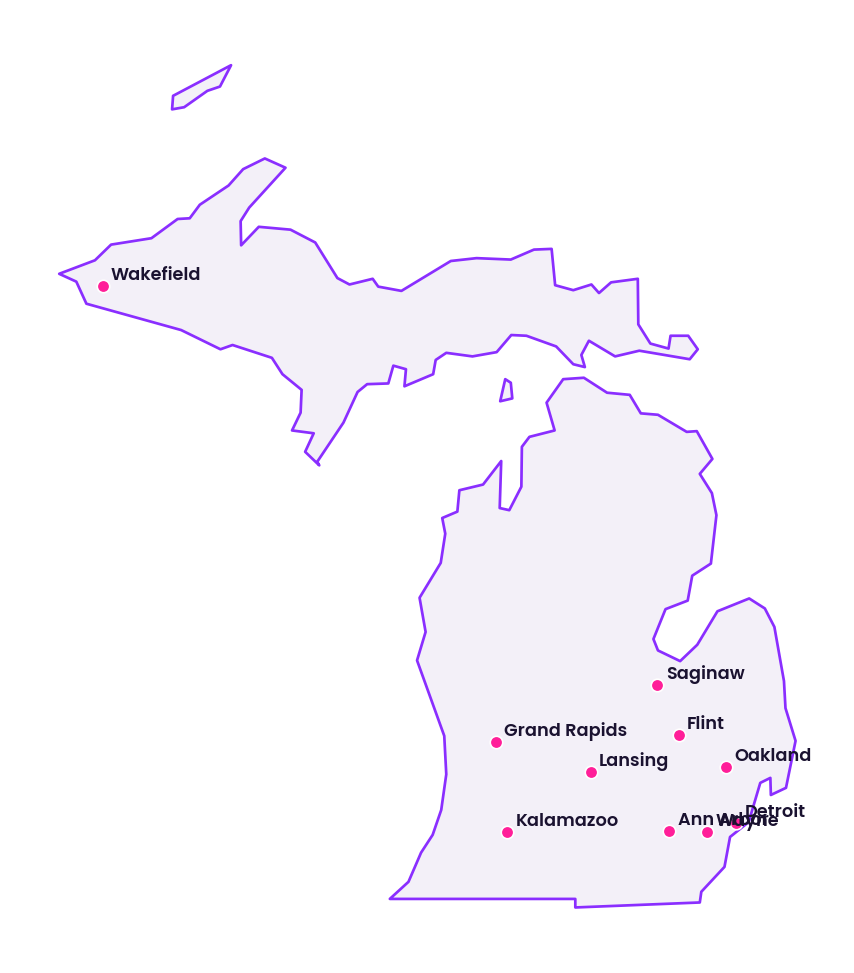
Within the state, population dynamics vary sharply by region. The Detroit metropolitan area, which includes Wayne, Oakland, Macomb, and surrounding counties, remains the largest concentration of population and has seen inner city depopulation offset in part by growth and densification in suburban and fringe areas. Downtown Detroit and nearby neighborhoods have seen some population stabilization and even growth due to reinvestment, while many legacy neighborhoods still have large numbers of vacant lots and structures. West Michigan, centered on Grand Rapids and surrounding counties, has experienced more consistent population growth, supported by a diversified economic base and quality of life factors. College and university towns, such as Ann Arbor, East Lansing, and Kalamazoo, maintain stable or modestly growing populations tied to higher education.
American Community Survey data show that the Michigan population includes a mix of long established White residents, significant Black communities especially in Detroit and other cities, and substantial Hispanic, Arab American, and other immigrant groups, particularly in southeastern Michigan. Age distribution patterns indicate a growing older adult population statewide, reflecting aging in place and limited overall growth, as well as younger cohorts concentrated in university areas and in neighborhoods that attract early career workers.
For investors, these population and migration patterns mean that statewide averages can be misleading. Markets such as west Michigan and selected Detroit suburbs benefit from positive net migration and household formation, supporting housing demand. Other areas face shrinking or aging populations, which can dampen demand and increase vacancy risk. Asset strategies must therefore be grounded in regional and subregional demographic trajectories rather than in state level totals.
Section 03Jobs and Economic Anchors
Bureau of Labor Statistics data for Michigan and its metropolitan areas reveal a labor market that has shifted from a concentration in traditional automotive manufacturing toward a more diversified mix that still includes autos and parts but also encompasses healthcare, education, business and professional services, logistics, and advanced manufacturing. Statewide employment has recovered from the deep job losses during the Great Recession and has experienced further cyclical gains and setbacks in the years since, with total nonfarm employment trending upward over the long term but with persistent structural differences across regions.
Automotive and mobility industries remain central in southeastern Michigan. Major automakers and suppliers maintain headquarters, assembly plants, research and development facilities, and engineering centers in and around Detroit, Dearborn, Warren, and other communities. These facilities support both direct employment and a large ecosystem of suppliers, service providers, and related businesses. However, automation, globalization, and shifts in consumer demand have reduced employment intensity per unit of output compared with past decades, even as production and productivity have improved.
Healthcare and education are major employers statewide. Large health systems operate hospitals and clinics in Detroit, Grand Rapids, Lansing, Ann Arbor, and other cities, employing physicians, nurses, technicians, and administrative staff. Universities and colleges contribute substantial jobs in teaching, research, and support roles and attract students who drive housing and service demand. Public sector employment at the state and local level, including in Lansing as the state capital, provides additional anchors.
The Bureau of Economic Analysis reports that Michigan gross domestic product includes significant contributions from manufacturing, finance and insurance, real estate, healthcare, retail and wholesale trade, and professional and business services. Regions such as Grand Rapids and Ann Arbor have developed strong niches in medical devices, life sciences, information technology, and advanced services, reducing reliance on autos alone. Logistics and warehousing have expanded along key interstate corridors and near border crossings and ports that serve Great Lakes and cross border trade.
For investors, this economic structure implies that demand for real estate is closely tied to both legacy industries and emerging sectors. Properties that are well located relative to automotive and advanced manufacturing clusters, health and education campuses, and logistics routes can tap into durable demand. Assets in areas that have not successfully diversified remain more vulnerable to economic shocks.
Section 04Income
American Community Survey estimates place Michigan median household income somewhat below the national median, with significant variation between regions. Suburbs in Oakland County and other affluent parts of the Detroit metro, as well as certain west Michigan communities and university towns, report incomes that exceed state and national medians. Many legacy industrial cities, rural counties, and some urban neighborhoods record lower household incomes and higher poverty rates.
Bureau of Economic Analysis personal income data show that statewide per capita personal income has grown over time but continues to trail levels in many coastal and high cost states. Within Michigan, income growth has been stronger in regions that have successfully attracted high wage employment in healthcare, technology, business services, and advanced manufacturing. In contrast, communities that remain heavily dependent on lower wage service jobs or that have experienced plant closures and disinvestment lag behind.
Income distributions within regions are also uneven. In metropolitan Detroit, for example, high income households in certain suburbs coexist with areas of concentrated poverty in parts of the city and inner ring suburbs. Similar patterns exist, though often at smaller scales, in other metros.
For investors, the income profile suggests that strategies must be carefully matched to local purchasing power. Class A multifamily and higher end single family product can succeed in affluent suburbs and select urban districts, while workforce and affordable housing are more appropriate in many other areas. Retail and service properties must be underwritten with realistic expectations about tenant sales and consumer spending in their catchment areas.
Section 05Housing and Multifamily
United States Census and American Community Survey housing data indicate that Michigan has an older housing stock than the nation overall, with a large share of units built before the middle of the twentieth century. Detached single family homes, duplexes, and small multifamily buildings dominate in many cities and towns, particularly in older neighborhoods of Detroit, Grand Rapids, Flint, Lansing, and other cities. Larger multifamily complexes and high rise apartments are more common in central business districts, university areas, and some suburban nodes.
Multifamily housing plays an important role in both urban and suburban markets. In downtown and midtown Detroit, large redevelopment and rehabilitation projects over the past decade have created new apartments and lofts in former office and industrial buildings and have added new construction mid rise and high rise properties. Similar, though often smaller scale, revitalization has occurred in downtown Grand Rapids and in other city centers. Suburban multifamily communities provide rental options near employment centers, shopping, and schools, and include both garden style properties from the postwar period and newer mid rise and townhome developments.
Affordable and income restricted multifamily housing is a critical component of the Michigan housing system. The Michigan State Housing Development Authority administers programs that finance rent restricted properties for households at various income levels, using tools such as the Low Income Housing Tax Credit and tax exempt bonds. Public housing authorities in cities across the state own and manage additional units. Despite these efforts, demand for affordable units exceeds supply in many communities, with long waiting lists and high rent burdens among low income renters.
The condition of multifamily stock varies widely. Some properties have been well maintained or recently renovated, while others suffer from deferred maintenance, functional obsolescence, or environmental issues. These differences create both risk and opportunity, particularly in older urban neighborhoods where acquisition costs may be relatively low but capital needs are high.
For investors, multifamily opportunities in Michigan include core and core plus properties in stronger urban and suburban submarkets, value add rehabilitations of older stock, and mission oriented investments in affordable housing. Regional variation is substantial, so success depends on careful selection of location, asset quality, and business plan.
Section 06Rents
United States Department of Housing and Urban Development fair market rent schedules for Michigan metropolitan areas illustrate the diversity of rental cost levels across the state. Fair market rents in the Detroit metro and in some other larger metros are higher than statewide medians, reflecting stronger demand and higher operating costs, while fair market rent levels in smaller cities and rural counties are lower in absolute terms. Although precise dollar amounts are not restated here, the relative ordering is clear from the data.
American Community Survey gross rent distributions indicate that many renter households in Michigan spend a significant share of income on housing. In large metros, a notable portion of renters pays more than thirty percent of income toward rent and utilities, and a substantial subset pays more than half, especially in lower income areas. In smaller towns and rural counties, nominal rents are lower, but incomes are also lower, so cost burdens remain an issue.
Private multifamily datasets from providers such as CoStar, Yardi Matrix, RealPage, and Freddie Mac Multifamily report that asking rents for Class A properties in strong urban and suburban submarkets are meaningfully higher than for older Class B and Class C assets in weaker locations. In downtown and midtown Detroit, for example, newer apartments and lofts command premium rents compared with older walk up and small property stock. In Grand Rapids and other growing metros, urban core and prime suburban rents have also risen as demand has strengthened.
For investors, rent levels and growth trajectories must be evaluated at the submarket level. In strong demand nodes, there may be room for continued rent growth, especially in properties that deliver improved amenities and finishes, though affordability constraints and new supply in some corridors will set limits. In softer markets, rent growth may be minimal, and value creation must come from occupancy gains, cost control, or strategic repositioning rather than from rate increases.
Section 07Vacancy
Public vacancy data for Michigan housing come from Census surveys, which provide broad estimates, and from private multifamily and commercial analytics, which offer more detailed submarket views. While precise vacancy rates vary by source, several patterns are evident.
In stronger metropolitan areas, such as parts of the Detroit suburbs, Grand Rapids, and certain college and medical anchored markets, stabilized multifamily vacancy has generally been moderate to low, with occasional increases when significant new supply delivers. In central Detroit neighborhoods experiencing reinvestment, vacancy has fallen from historically high levels but remains elevated in some blocks due to the legacy of abandonment and continued demolition of obsolete structures.
In weaker markets, including some smaller cities and rural counties, both rental and ownership vacancy can be higher, reflecting limited demand, economic challenges, and surplus or obsolete housing stock. Long term vacancy and blight in certain neighborhoods create negative externalities for remaining residents and complicate investment decisions.
For investors, vacancy risk is highly location specific. In growing submarkets with diversified employment bases, underwriting can assume relatively low stabilized vacancy, while still stress testing for cyclical downturns and supply surges. In struggling areas, higher vacancy and credit loss allowances are prudent, and strategies may need to incorporate plans for repositioning, consolidation, or alternate uses.
Section 08Supply Pipeline
Residential construction activity in Michigan, as captured by Census Building Permits Survey data, declined sharply during the housing downturn of the late two thousands and has since recovered to more moderate levels. Statewide permit counts remain below the peak of the prior cycle, which has contributed to tighter housing markets in some regions. Within the state, building permit trends show more sustained multifamily and single family activity in metros such as Grand Rapids, the greater Detroit suburbs, and certain college towns, with less new construction in smaller cities and rural areas.
Housing supply is constrained by several factors. In older urban neighborhoods, fragmented ownership, environmental conditions, and infrastructure limitations make redevelopment complex. In suburban areas, zoning regulations and community preferences can limit density and multifamily development, especially in affluent municipalities. Construction costs, including materials and labor, have increased, affecting project feasibility.
In Detroit, targeted public and private initiatives have focused on stabilizing and rebuilding specific corridors and neighborhoods, including downtown, midtown, and certain residential districts. Outside Detroit, cities such as Grand Rapids, Ann Arbor, and Kalamazoo have seen clusters of new multifamily and mixed use development in their cores.
For investors, understanding the local supply pipeline is critical. In markets where new construction is limited relative to demand, existing assets may benefit from constrained competition. In corridors with active development, particularly in urban cores, the timing and scale of new deliveries can influence rents, lease up dynamics, and valuation. Detailed, up to date review of municipal planning documents and private pipeline data is essential for underwriting.
Section 09Single Family Homes
Single family homes are central to Michigan housing, particularly in suburban and rural areas. American Community Survey data show that detached houses account for a substantial share of owner occupied stock statewide. Many of these homes were built in the mid twentieth century and earlier, with subsequent waves of suburban construction in the late twentieth century.
Public home value and sales data from platforms such as Zillow and Redfin consistently indicate that statewide typical home values and median sale prices in Michigan are below national medians but vary widely across regions. Suburbs in Oakland County, parts of Ann Arbor, Grand Rapids, and certain lakeshore communities record higher values, while many legacy neighborhoods in Detroit, Flint, Saginaw, and smaller towns have much lower values, sometimes constrained by appraisals and limited financing availability.
Price trends over the last decade show meaningful appreciation in many markets, especially in west Michigan and selected Detroit suburbs, as economic conditions have improved and new households have entered the market. In some legacy cities, prices have recovered from very low levels but remain modest in absolute terms. Inventory and months of supply data at the metro level suggest that for sale markets in stronger regions have often favored sellers, with limited listings and relatively quick sales for well maintained, appropriately priced homes. In weaker markets, inventory can be higher and marketing times longer.
Single family rentals form a significant component of the rental stock, particularly in Detroit and other cities with many small properties, as well as in suburbs where investors have acquired homes as rentals. These properties offer families rental options with yards and neighborhood amenities but pose management challenges due to dispersion and property age. Returns depend on acquisition basis, rent levels relative to local incomes, property tax and insurance costs, and capital expenditure needs.
For investors, single family strategies in Michigan include scattered site rental portfolios in select neighborhoods, build to rent communities in growth corridors, and acquisition and resale or rehabilitation plays in undervalued areas. Each of these approaches requires careful analysis of local market dynamics, regulatory context, and operational capacity.
Section 10Commercial Real Estate and Retail Centers
Michigan commercial real estate spans office, industrial and logistics, retail, and specialized sectors such as medical and research facilities. Performance varies by asset type and location, with patterns informed by private data from CoStar, JLL, CBRE, Cushman and Wakefield, and other sources, which provide directional insights.
Office markets are anchored in downtown Detroit, suburban corridors such as Southfield and Troy, downtown Grand Rapids, Lansing, Ann Arbor, and smaller city centers. The rise of remote and hybrid work has challenged traditional office demand, especially for older properties in secondary locations. Downtown Detroit has seen substantial renovation and adaptive reuse, with some office towers partially converted to residential or mixed use, while a subset of modern buildings with strong tenancy remains in demand. Suburban office parks experience varied performance depending on tenant mix, design, and access.
Industrial and logistics assets are among the strongest segments. The Michigan location on the Great Lakes, at major border crossings with Canada, and along interstate corridors makes it a key node in automotive, manufacturing, and distribution supply chains. Modern warehouses, distribution centers, and specialized manufacturing facilities in strategic locations generally maintain solid occupancy and rent trends, supported by demand from automotive and parts manufacturers, third party logistics providers, e commerce firms, and other industrial users. Older or less functional industrial properties, especially in areas with limited reinvestment, face higher vacancy and weaker rent performance.
Retail performance is mixed. Regional malls and certain power centers face headwinds from e commerce and changing consumer preferences, leading to store closures, redevelopments, or repositioning. In contrast, grocery anchored neighborhood centers and smaller strip centers that serve daily needs in stable residential areas have been more resilient. Urban and town center retail in revitalizing downtowns, such as parts of downtown Detroit and Grand Rapids, has benefited from increased residential and visitor activity, but remains sensitive to broader economic conditions.
For investors, the most compelling commercial opportunities often lie in industrial and logistics assets in prime locations, medical and specialized office anchored by strong institutions, and well located grocery anchored and service oriented retail. Traditional office and discretionary retail require more selective approaches and, in some cases, willingness to pursue conversion or redevelopment strategies.
Section 11Transactions and Capital Markets
There is no single public database that aggregates all Michigan real estate transactions with full detail on volumes, pricing, and capitalization rates. County registers of deeds record property transfers, and private data providers such as CoStar and MSCI Real Assets produce detailed transaction and pricing series for Michigan and its metropolitan markets. This review does not restate specific transaction counts, dollar volumes, or capitalization rate averages, and instead describes the qualitative pattern.
Michigan sits between core coastal gateways and smaller regional markets in the national capital markets hierarchy. Metropolitan Detroit, Grand Rapids, and to a lesser extent Ann Arbor and Lansing attract institutional and national private capital, especially for multifamily, industrial, and select office and retail assets. Secondary and tertiary markets rely more on regional and local investors, with thinner buyer pools and more idiosyncratic pricing.
Over the last cycle, capitalization rates for high quality multifamily and industrial assets in stronger Michigan metros compressed as national capital flowed into higher yielding markets outside coastal cores. The subsequent rise in interest rates and evolving sector risk perceptions have led to repricing and reduced transaction volumes, particularly in office and weaker retail segments. Multifamily and industrial deals continue to close but at yields and leverage levels that reflect higher financing costs and more conservative underwriting.
For investors, the capital markets backdrop in Michigan implies that liquidity and pricing are most favorable for well located, institutional grade assets in the major metros and that exit options for properties in smaller or weaker markets may be limited. Equity and debt capital are available but often require strong sponsorship and clear business plans.
Section 12Taxes
The Michigan tax structure combines state level income and business taxes with local property taxes and various fees. The Michigan Department of Treasury administers state personal income tax, corporate income tax, and sales and use taxes, among others. For real estate investors, property taxes and their interaction with state level programs and local fiscal conditions are particularly important.
Property taxes are levied by counties, cities, townships, school districts, and other local taxing authorities. Property values are assessed by local assessors, subject to state constitutional and statutory rules that, among other things, limit annual increases in taxable value for properties under continuous ownership, with taxable value typically uncapped upon transfer. Millage rates vary considerably across jurisdictions, reflecting differences in service levels, school funding, and tax base composition.
Michigan has complex programs related to property tax relief, incentives, and special assessments, including mechanisms that support redevelopment of blighted or obsolete properties, capture tax increment in designated districts, or provide abatements for certain investments. These programs can materially affect operating expenses and returns if used effectively and understood fully.
This review does not state specific numeric tax rates or millage figures, because those are best confirmed against current Michigan Department of Treasury and local jurisdiction schedules for the relevant year. From an investor standpoint, careful analysis of current and projected property taxes is essential. This includes understanding equalized value, taxable value, millage rates, and the impact of ownership changes or significant improvements on taxable value. It also requires attention to local fiscal health, as communities under stress may seek to adjust rates or fees, within legal limits, to stabilize budgets.
Section 13Insurance
Michigan insurance considerations are shaped by its inland and Great Lakes geography, its severe winter climate, and localized weather and flooding risks. The Michigan Department of Insurance and Financial Services regulates carriers and market practices, but premium levels and coverage terms reflect insurer assessments of risk from snow, ice, wind, hail, thunderstorms, and flooding.
While Michigan does not face Atlantic hurricanes, it does experience strong storms, heavy lake effect snow in some areas, ice storms, and severe cold snaps that can damage roofs, plumbing, and building systems. The Great Lakes and extensive river and inland lake systems create localized flood risk, particularly in low lying areas near rivers, lakes, and drainage channels. Federal Emergency Management Agency flood maps delineate special flood hazard areas where flood insurance is required for properties with federally related mortgages.
In many locations, standard property policies exclude flood damage, requiring separate flood coverage through the National Flood Insurance Program or private markets. Older buildings with outdated roofs, inadequate insulation, or aging mechanical systems may face higher premiums or more stringent underwriting. Properties in areas with known subsidence, erosion, or shoreline instability may also encounter specialized insurance issues.
Investors must obtain detailed insurance quotes, including property, liability, flood where applicable, and business interruption coverage, as part of due diligence. They should plan capital investments that improve resilience to winter and storm related hazards, such as roof upgrades, insulation enhancements, drainage improvements, and protection of critical systems.
Section 14Landlord Tenant and Regulatory Environment
Michigan residential landlord tenant relations are governed by state statutes and case law, which set out obligations related to habitability, repairs, security deposits, entry rights, and eviction procedures. State law requires landlords to provide safe and habitable premises and to follow specific processes for notices and court filings when seeking to terminate tenancies or evict tenants. Local governments enforce building and housing codes and may have additional registration, inspection, or rental licensing requirements.
Compared with some states, Michigan does not have a statewide traditional rent control regime for private market housing, and eviction timelines, while subject to due process, are more streamlined than in heavily regulated jurisdictions. However, courts oversee the process, and improper or incomplete filings can delay outcomes. Some cities have adopted local ordinances aimed at improving housing quality or tenant protections, such as requirements for rental registration, inspection programs, or anti blight enforcement.
Short term rental regulation varies by municipality, with some cities adopting ordinances that limit or control such uses. Zoning and land use regulations, which affect where multifamily and certain rental types can be developed, differ widely between jurisdictions and are often a major constraint on new supply, particularly in suburban areas.
For investors, the regulatory environment offers flexibility in rent setting and lease structuring, subject to fair housing and consumer protection laws, but demands attention to local code requirements and enforcement practices. Reputable property management and legal support are important, especially in larger or more complex portfolios.
Section 15Infrastructure
Michigan infrastructure encompasses roads, bridges, transit systems, water and sewer networks, and energy and communication grids. The Michigan Department of Transportation manages state highways and many bridges, while counties, cities, and townships maintain local roads. The state has long grappled with aging infrastructure and funding gaps, particularly with respect to roads and bridges that have experienced harsh winter conditions and decades of heavy use.
Transit options vary by region. The Detroit metropolitan area has a regional bus system, limited rail services, and localized transit offerings in Detroit and suburban communities. Grand Rapids operates a bus rapid transit line and bus network. Many smaller cities rely primarily on bus agencies or demand response services. Overall, transit coverage and frequency are more limited than in many coastal metros, and most households rely on private vehicles.
Water and sewer infrastructure is managed by local systems and regional authorities. Some systems, especially in older cities, face challenges related to combined sewer overflows, aging pipes, and compliance with updated water quality standards. The Flint water crisis highlighted the potential consequences of infrastructure failures and governance breakdowns. Electric and gas utilities provide energy services under state regulation, with ongoing investments in grid modernization and reliability.
For real estate investors, infrastructure quality and access have important implications for location desirability, operating costs, and resilience. Properties with convenient access to highways, stable local roads, reliable utilities, and, where relevant, transit connections are better positioned to attract tenants and buyers. Assets in areas with failing infrastructure may face higher costs, reduced demand, or regulatory burdens related to upgrades.
Section 16Climate and Physical Risks
The Michigan climate is characterized by cold winters, warm summers, and significant seasonal variation, with patterns influenced by the Great Lakes. National Oceanic and Atmospheric Administration climate data show that lake effect snow affects many western and northern counties, while southern and eastern regions experience a mix of snow, rain, and freezing conditions. Severe thunderstorms, occasional tornadoes, and heavy rainfall events occur statewide, particularly in warmer months.
Physical risks include snow and ice loads on roofs, freeze thaw cycles that damage building materials and infrastructure, high winds that can down trees and power lines, and flooding along rivers, lakes, and low lying urban drainage areas. Great Lakes shorelines face erosion and fluctuating water levels that can affect coastal properties and infrastructure. Climate change projections suggest that Michigan will see warmer average temperatures, more intense precipitation events, and reduced but heavier snowfall episodes in some regions.
Federal Emergency Management Agency flood maps and the National Risk Index identify areas with elevated flood and storm risk. Urban heat island effects, while less pronounced than in some southern cities, still affect densely built neighborhoods with limited tree cover.
Investors should incorporate these climate and physical risks into site selection, design, and operations. This includes assessing elevation and proximity to water bodies, evaluating building envelopes and roofs for snow and wind resilience, planning for efficient heating and cooling systems, and considering backup power and flood mitigation measures. Over the long term, assets that are better adapted to evolving climate conditions are likely to retain value more effectively.
Section 17Opportunities
Michigan offers a range of real estate investment opportunities that align with its economic and demographic profile. One important theme is multifamily and mixed use investment in growing metros such as Grand Rapids, Ann Arbor, and selected Detroit suburbs, where employment growth, quality of life, and constrained new supply in certain submarkets support stable demand. Well located properties near job centers, universities, and amenities may provide relatively resilient cash flows.
A second opportunity lies in value add multifamily and mixed use projects in revitalizing urban districts, including parts of downtown and midtown Detroit, downtown Grand Rapids, and other city centers where reinvestment and public initiatives have improved safety, amenities, and perceptions. Adaptive reuse of historic buildings and repositioning of older assets may create returns when acquisition pricing, capital budgets, and leasing strategies are aligned with local demand, though no particular outcome is assured.
Industrial and logistics assets constitute a third opportunity. Properties near interstate corridors, border crossings, ports, and rail hubs that serve automotive, manufacturing, and distribution networks are positioned to be affected by supply chain evolution and onshoring or nearshoring trends. Modern facilities with appropriate clear heights, loading, and locations are particularly relevant.
Single family and small multifamily rentals in selected neighborhoods and suburbs present another opportunity, especially where homeownership barriers and lifestyle preferences support rental demand. Portfolios that combine careful market selection with disciplined rehabilitation and management may capture income and potential appreciation in submarkets with improving fundamentals.
Finally, mission oriented investments in affordable and workforce housing, often in partnership with public and nonprofit entities and using tools from the Michigan State Housing Development Authority, can address pressing social needs while providing income that is typically more modest. The observations in this section are general and educational, are not projections, forecasts, or assurances of any particular return, yield, occupancy, rent level, or appreciation, and any specific investment must be evaluated on its own facts.
Section 18Risks
Investing in Michigan real estate also entails notable risks that must be factored into strategy and underwriting. Demographic risk is significant in regions that continue to lose population or have stagnant growth. In such areas, demand for housing and commercial space may weaken over time, making it difficult to sustain rents and occupancy or to exit investments at favorable prices.
Economic risk stems from continued exposure to automotive and related manufacturing cycles. While the sector has evolved, it remains a substantial part of the state economy, and downturns in global auto demand or rapid shifts in technology and supply chains could affect employment and income in affected communities. Regions that have not diversified adequately are particularly vulnerable.
Physical and climate risks, as discussed earlier, can increase operating costs, accelerate capital expenditure needs, and affect insurability and financing. Properties in flood prone or weather exposed locations may see rising premiums and stricter underwriting, or may require expensive mitigation measures.
Regulatory and policy risks include changes in tax policy, redevelopment incentives, zoning and land use controls, and environmental regulations. Local fiscal stress in some municipalities can lead to efforts to adjust tax rates or fees or to reduce services, with implications for property values. Political and community perceptions around redevelopment, gentrification, and equity can affect entitlement and permitting processes.
Market and liquidity risks vary by asset type and location. While core assets in major metros can attract national capital, properties in smaller or weaker markets may have limited buyer pools and greater price volatility. Sector specific risks, particularly in office and some retail formats, further complicate the picture. Real estate investments are speculative, are subject to market, financing, liquidity, tax, regulatory, insurance, and physical hazard risks, and can result in the loss of some or all of an investor's invested capital, including the possible loss of principal.
Section 19Investor Implications
For accredited investors, Michigan should be viewed as a heterogeneous market that requires nuanced, region specific strategies rather than a single statewide thesis. Successful investment approaches typically share several characteristics.
They target locations with durable demand drivers, such as diversified employment bases, strong educational and healthcare institutions, and positive demographic trends, and they avoid overexposure to areas with persistent decline and weak prospects for reinvention. They select asset classes that align with these drivers, favoring multifamily, industrial, and necessity retail in strong submarkets, and approach office and discretionary retail with caution.
They underwrite conservatively, recognizing that operating costs for taxes, insurance, and maintenance can rise faster than general inflation, especially in an environment of aging infrastructure and evolving climate risks. They incorporate realistic assumptions about rent growth, vacancy, and capital expenditure, and they stress test for economic and financing shocks.
They engage with public programs and incentives where appropriate, but they do not rely solely on subsidies to make fundamentally weak deals work. They cultivate local relationships with experienced operating partners, property managers, and advisors who understand the nuances of municipal regulation, neighborhood dynamics, and tenant expectations.
Finally, they pay attention to environmental, social, and governance considerations, both because these factors can affect regulatory exposure and capital costs, and because they are increasingly important to capital sources and stakeholders. Nothing in this section is a recommendation to pursue any specific strategy or investment, and there is no assurance that any objective or outcome described will be achieved.
Section 20Conclusion
Michigan occupies a distinctive position in the national real estate landscape as a mature industrial and service economy with substantial legacy assets, emerging growth nodes, and a complex mix of strengths and challenges. Its large metros and university anchored regions offer opportunities for stable, income oriented and value add investments in multifamily, industrial, and select commercial assets, while many smaller communities face ongoing headwinds.
This review has provided a qualitative overview of statewide real estate and multifamily dynamics, anchored in public data and focused on structural trends and investor implications rather than on specific numeric series. The central message is that Michigan can play a meaningful role in diversified real estate portfolios when approached with discipline, local insight, and a clear understanding of regional diversity and risk, though no particular outcome or return is assured.
Any specific investment decision should be supported by up to date numerical data from the cited sources, detailed asset and market due diligence, and careful structuring of capital and operations to accommodate both the opportunities and the risks present in this state.
Sources
- United States Census Bureau, Population and Housing Unit Estimates, Michigan statewide and counties,, https://www.census.gov/programs-surveys/popest.html
- United States Census Bureau, American Community Survey one year and five year estimates, Michigan statewide, metropolitan areas, and places,, https://www.census.gov/programs-surveys/acs
- United States Census Bureau, Decennial Census of Population and Housing, Michigan,, https://www.census.gov/programs-surveys/decennial-census.html
- United States Census Bureau, Building Permits Survey, Michigan and metropolitan areas,, https://www.census.gov/construction/bps
- United States Census Bureau, Housing Vacancies and Homeownership, regional tables including Michigan,, https://www.census.gov/housing/hvs
- United States Bureau of Labor Statistics, Economy at a Glance, Michigan,, https://www.bls.gov/eag/eag.mi.htm
- United States Bureau of Labor Statistics, Economy at a Glance, Detroit Warren Dearborn MI metropolitan area,, https://www.bls.gov/eag/eag.mi_detroit_warren_dearborn_msa.htm
- United States Bureau of Labor Statistics, Economy at a Glance, Grand Rapids Kentwood MI metropolitan area,, https://www.bls.gov/eag/eag.mi_grand_rapids_kentwood_msa.htm
- United States Bureau of Labor Statistics, State and Area Employment, Michigan and metropolitan areas,, https://www.bls.gov/sae
- United States Bureau of Labor Statistics, Local Area Unemployment Statistics, Michigan counties and metropolitan areas,, https://www.bls.gov/lau
- United States Bureau of Economic Analysis, Gross Domestic Product by State, Michigan,, https://www.bea.gov/data/gdp/gdp-state
- United States Bureau of Economic Analysis, Gross Domestic Product by metropolitan area, Michigan metros,, https://www.bea.gov/data/gdp/gdp-metropolitan-area
- United States Bureau of Economic Analysis, Local Area Personal Income, Michigan counties and metropolitan areas,, https://www.bea.gov/data/income-saving/local-area-personal-income
- United States Department of Housing and Urban Development, Office of Policy Development and Research, Fair Market Rents and income limits, Michigan metropolitan and nonmetropolitan areas,, https://www.huduser.gov
- Federal Housing Finance Agency, House Price Index, Michigan and its metropolitan statistical areas,, https://www.fhfa.gov/DataTools/Downloads/Pages/House-Price-Index.aspx
- Michigan State Housing Development Authority, housing and community development programs and research,, https://www.michigan.gov/mshda
- Michigan Department of Treasury, state and local tax information including property tax guidance,, https://www.michigan.gov/treasury
- Michigan Department of Insurance and Financial Services, insurance market information,, https://www.michigan.gov/difs
- Michigan Department of Transportation, state transportation system information,, https://www.michigan.gov/mdot
- Federal Emergency Management Agency, Flood Map Service Center, Michigan,, https://msc.fema.gov
- Federal Emergency Management Agency, National Risk Index, Michigan,, https://hazards.fema.gov/nri
- National Oceanic and Atmospheric Administration, National Centers for Environmental Information, climate data for Michigan,, https://www.ncei.noaa.gov
- CoStar Group, Michigan multifamily, office, industrial, and retail market analytics,, https://www.costar.com
- Yardi Matrix, Midwest and Michigan multifamily market reports,, https://www.yardimatrix.com
- RealPage, multifamily market analytics for Michigan metros,, https://www.realpage.com/analytics
- Freddie Mac Multifamily, research on Midwest multifamily markets including Michigan,, https://mf.freddiemac.com/research
- Zillow Research, Michigan home value and rental data,, https://www.zillow.com/research/data
- Redfin Data Center, Michigan housing market data,, https://www.redfin.com/news/data-center
- CBRE Research, Detroit and Michigan commercial real estate market reports,, https://www.cbre.com/insights
- JLL Research, Detroit and Michigan office, industrial, and retail market insights,, https://www.us.jll.com/en/trends-and-insights/research
- Cushman and Wakefield, Marketbeat reports for Detroit and Michigan,, https://www.cushmanwakefield.com/en/insights
- MSCI Real Assets, United States Capital Trends including Michigan,, https://www.msci.com/our-solutions/real-estate/real-assets