In brief · summary: Mississippi
Mississippi State Real Estate Market Review
Section 01Executive Summary
Mississippi is a relatively small, slow growing Southern state with a dispersed settlement pattern, persistent economic challenges, and a real estate market that is dominated by single family homes and small scale rental properties rather than large institutional multifamily assets. Public data from the United States Census Bureau, the American Community Survey, the Bureau of Labor Statistics, the Bureau of Economic Analysis, the United States Department of Housing and Urban Development, the Federal Housing Finance Agency, the Mississippi Home Corporation, the Mississippi Department of Revenue, the Mississippi Insurance Department, and federal climate and risk agencies indicate that Mississippi has one of the lowest income profiles among United States states, slower population growth than the national average, and pockets of long term outmigration in many rural counties.
These sources provide exact figures for population, income, home values, rents, vacancies, building permits, and sector level employment. This review does not restate specific counts, dollar values, or percentages, even though they exist in the cited datasets, and instead uses those datasets qualitatively to describe relative levels, trends, and structural patterns, noting clearly when public, aggregated transaction or capitalization rate data are not available in a form that can be quoted here. Any specific investment decision in Mississippi should be supported by a fresh data pull from the listed sources.
For investors, Mississippi offers a mix of modest cost housing, regionally important transport and industrial corridors along the Gulf Coast and Mississippi River, stable institutional anchors in state government, healthcare, higher education, and manufacturing, and university towns with structurally stronger demand. At the same time, the state carries meaningful risks, including low income levels and limited rent headroom, demographic stagnation or decline in many counties, concentrated economies in a few sectors and employers, high exposure to hurricanes and river flooding, and more limited liquidity and institutional ownership than larger Sun Belt markets. Investors who approach Mississippi with realistic expectations, a clear focus on specific metros and micro markets, and careful underwriting may find niche opportunities, but the state is not a broad growth story.
Section 02Population and Migration
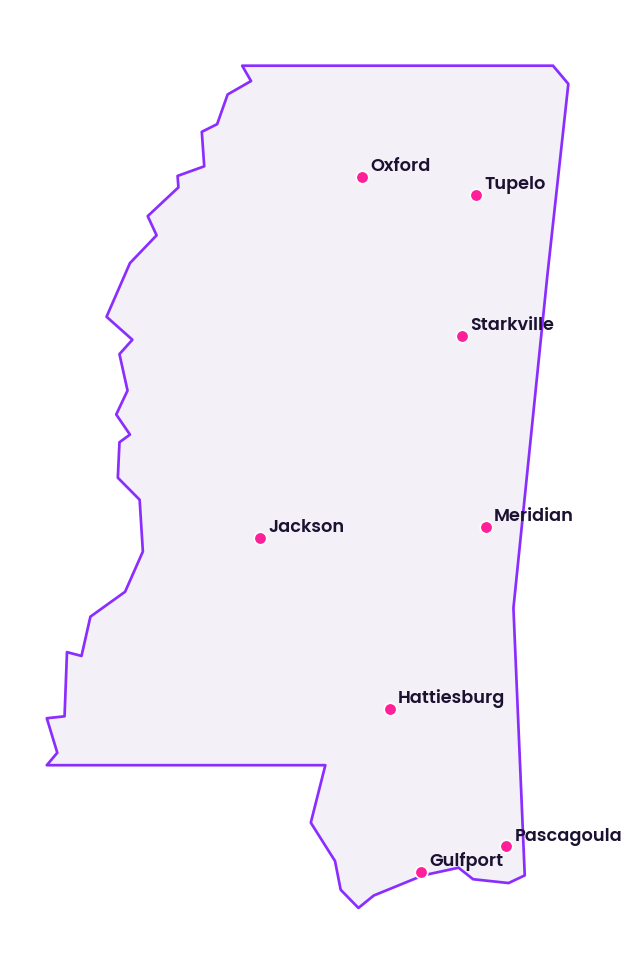
United States Census Bureau decennial counts and annual population estimates show that Mississippi population has grown only slowly over the last several decades and has experienced periods of stagnation and net outmigration, particularly among younger adults moving to higher opportunity states. The state has large rural areas, small and mid sized cities, and a limited number of larger metropolitan centers, including the Jackson metropolitan area in the center of the state, Gulf Coast metros such as Gulfport and Biloxi, DeSoto County communities that function as part of the Memphis metropolitan region, and regional hubs such as Hattiesburg and Tupelo.
American Community Survey results indicate that the population is relatively dispersed, with a significant share living outside large cities, and that urban cores in places like Jackson have often lost residents to surrounding suburbs and exurbs. Coastal counties experienced both growth and loss over time due to hurricane impacts, reconstruction, and economic cycles, while some areas along the Mississippi Delta have seen long term population decline as agriculture mechanized and manufacturing shifted.
International in migration is limited compared with many Sun Belt peers, and domestic migration has often been negative, as residents move to faster growing states in the Southeast, Southwest, and beyond. Within the state, there has been some internal shift toward suburban and exurban counties near Jackson and toward North Mississippi counties that benefit from their integration into the larger Memphis employment and logistics hub.
From an investor perspective, these population and migration patterns create a highly uneven landscape. A handful of counties and metros have stable or modestly growing populations, while many rural and legacy industrial or agricultural counties face long term demographic headwinds. Successful strategies in Mississippi must focus on the specific markets that either serve as regional anchors or participate in larger cross border metropolitan systems, rather than relying on statewide averages.
Section 03Jobs and Economic Anchors
Bureau of Labor Statistics data for Mississippi over recent decades show an economy that has diversified somewhat beyond its agricultural roots but still relies heavily on a mix of manufacturing, healthcare and social assistance, government, retail trade, transportation and warehousing, and services. Total nonfarm employment has trended upward in the long run with cyclical fluctuations, but job growth has lagged faster growing states, reflecting both structural and demographic constraints.
The largest concentration of employment is in the Jackson metropolitan area, which hosts state government, insurance and financial services firms, regional healthcare systems, higher education institutions, and a range of business and professional services. State government employment is a major anchor, providing stable although not high wage jobs that support office demand and local services. Healthcare systems in Jackson and other cities such as Gulfport, Biloxi, Hattiesburg, Meridian, and Tupelo provide many of the higher wage and stable jobs in the state.
Manufacturing remains important in Mississippi, with facilities producing automobiles, shipbuilding and marine equipment, furniture, food products, and other goods. Automotive plants in North Mississippi and shipyards and related marine manufacturing along the Gulf Coast are particularly significant, creating clusters of higher wage production and logistics jobs that spill over into housing and retail demand. Transportation and warehousing jobs are also meaningful along the Mississippi River corridor and in counties with major interstates and rail lines.
The Bureau of Economic Analysis reports that Mississippi gross domestic product and personal income have grown in nominal terms over time, but at a slower pace than the national economy. The industrial structure is skewed toward sectors with lower average productivity and wages, and that reality is reflected in household incomes and tax base strength.
For investors, the implication is that demand for real estate is anchored by a mix of public sector employment, healthcare, manufacturing, and logistics. Markets tied closely to these anchors, such as Jackson government and healthcare districts, Gulf Coast ports and shipyards, and North Mississippi automotive and logistics corridors, have more durable demand, while communities without such anchors may struggle to support new or upgraded space.
Section 04Income
American Community Survey estimates show that median household income and per capita income in Mississippi are among the lowest in the United States, and that income levels lag the national medians by a substantial margin. The income distribution has a high share of households with modest wages, especially in rural areas and in regions dependent on lower margin manufacturing, agriculture, and service industries.
Within the state, there is significant variation. Suburban counties near Jackson and DeSoto County in North Mississippi, which benefits from its integration into the Memphis labor market, have higher median incomes and more households in middle and upper middle income brackets. University towns and certain Gulf Coast communities also show income levels above the state median, reflecting higher shares of professionals and dual income households. In contrast, many Delta counties and some small cities have much lower incomes and higher poverty rates, with a large portion of households spending substantial shares of income on basic needs.
Bureau of Economic Analysis personal income data confirm this picture, with Mississippi ranking near the bottom among states for per capita personal income and wage and salary accruals per worker. Transfer payments constitute a larger share of total income than in many states, reflecting federal programs such as Social Security, Medicare, Medicaid, and nutrition assistance.
For investors, low income levels translate into limited rent and price headroom in much of the state, which constrains achievable rents and limits the feasibility of high specification or luxury developments. At the same time, they underscore the depth of need for affordable and workforce housing and the importance of federal and state subsidy programs in making many projects viable. Underwriting must assume lower rent levels and slower rent growth than in higher income markets, and it must reflect higher sensitivity of tenants and buyers to economic downturns.
Section 05Housing and Multifamily
United States Census and American Community Survey housing data show that Mississippi housing stock is dominated by single family detached units, with manufactured housing and mobile homes constituting a larger share of occupied housing than in many states. Multifamily units represent a smaller share of total units than the national average, and much of the multifamily inventory is made up of small buildings, garden style communities, and older properties rather than large institutional scale assets.
In metropolitan areas such as Jackson, Gulfport Biloxi, Hattiesburg, and Tupelo, multifamily housing includes a mix of older garden style complexes, smaller walk up buildings, and some newer properties that cater to workforce renters, students, and professionals. University linked markets such as Oxford and Starkville have student oriented properties near campuses that provide higher density rental housing, including purpose built student housing and off campus apartments. In DeSoto County, which is tied to the Memphis metropolitan area, suburban style multifamily communities serve commuters and local workers in logistics and manufacturing facilities.
Affordable housing is a central theme. The Mississippi Home Corporation administers federal Low Income Housing Tax Credit allocations and other programs that finance income restricted multifamily properties throughout the state. Many of these developments are small to mid sized properties that address housing needs for very low income and low income households, seniors, and special needs populations. Waiting lists for subsidized properties and housing vouchers in some markets point to significant unmet demand.
To illustrate the diversity of multifamily dynamics, it is useful to distinguish several broad statewide regions. The Jackson metropolitan area, driven by state government, healthcare, insurance, and services, mixes older urban neighborhoods with expanding suburbs, and its multifamily stock is largely garden style and small scale with limited new class A product, so investors tend to focus on stable workforce housing while attending to neighborhood variation and governance issues. The Gulf Coast, including Gulfport, Biloxi, and Pascagoula, is shaped by ports, shipbuilding, casinos, tourism, and the military, with coastal and near coastal single family homes, apartments, and manufactured housing, and a mix of older complexes and some newer properties near job nodes, so the region carries pronounced exposure to hurricanes and storm surge alongside opportunities near employment centers. North Mississippi and DeSoto County, tied to automotive, logistics, and manufacturing as part of the Memphis region, feature suburban single family homes and townhomes plus suburban garden multifamily linked to Memphis jobs, benefiting from the larger metropolitan area's growth while still carrying modest rent levels. The Delta and rural counties, dependent on agriculture, limited manufacturing, and services, have lower density housing with a high share of older and manufactured units and only sparse, often small and aging multifamily, so they face demographic and economic headwinds that leave mostly selective, mission oriented opportunities.
For investors, Mississippi multifamily is mostly a story of smaller scale, workforce oriented assets in markets with modest rents and limited institutional competition. Opportunities often revolve around acquiring and improving under managed properties, preserving affordable units with public program support, and selectively backing new development in markets with clear demand anchors such as universities, ports, and major industrial facilities.
Section 06Rents
United States Department of Housing and Urban Development fair market rent schedules for Mississippi metropolitan and nonmetropolitan areas show that rent benchmarks for one to four bedroom units across the state are materially below national fair market rent levels, reflecting lower incomes and market rents. Even within the state, there are clear differences, with fair market rents on the Gulf Coast, in the Jackson area, and in North Mississippi counties linked to Memphis generally higher than those in Delta and rural nonmetropolitan counties.
American Community Survey data on gross rents and rent burdens indicate that despite low nominal rent levels, many Mississippi renter households still devote a large share of income to housing, particularly in lower income counties and in areas with limited quality rental stock. A significant share of renters pays more than thirty percent of income toward rent and utilities, and a meaningful subset pays substantially more, especially among very low income households.
Private multifamily data sources such as CoStar, Yardi Matrix, RealPage, and Freddie Mac Multifamily report that asking rents for the relatively small number of modern class A properties in Mississippi urban markets are higher than rents for older class B and C stock but still lower than typical class A rents in larger Southeast metros. In many Mississippi markets, the spread between classes is modest in dollar terms, and rent ceilings are constrained by local income levels.
For investors, this rent profile means that absolute cash flow per unit is modest, and that value add strategies must be designed with conservative assumptions about achievable rent premiums. There is often limited room to raise rents without stressing tenant budgets, particularly in markets without strong wage growth. However, the same dynamics make subsidized and income restricted projects, or projects targeted to specific workforce segments, an important part of the opportunity set.
Section 07Vacancy
Public housing vacancy information from Census surveys and private multifamily analytics suggests that Mississippi rental vacancy has tended to be somewhat higher on average than in faster growing Sun Belt states, especially in weaker markets with demographic decline. However, vacancy patterns are heterogeneous. In university towns such as Oxford and Starkville, and in job centers with constrained supply, stabilized vacancy in well located properties can be low, especially during academic years or periods of economic expansion.
In the Jackson metropolitan area, vacancy conditions vary by submarket and property quality. Some suburban submarkets and neighborhoods near major employers and institutions maintain relatively low vacancy, while aging properties in challenged urban neighborhoods can see higher physical and economic vacancy due to deferred maintenance, safety concerns, and limited tenant demand among higher income households. On the Gulf Coast, vacancy is influenced by tourism cycles, hurricane events, and reconstruction activity, sometimes creating short term dislocations followed by periods of tight occupancy when replacement housing is scarce.
Small towns and rural areas often experience a mix of high vacancy in older or substandard properties and tight conditions in the limited stock of decent quality, professionally managed units. Functional obsolescence and physical condition issues can render part of the stock effectively vacant even when occupancy appears numerically acceptable.
For investors, understanding vacancy risk at the micro market and property level is critical. In stronger Mississippi submarkets, investors can underwrite relatively low stabilized vacancy but should still model cyclical increases and tenant turnover. In weaker or transitional areas, higher vacancy and credit loss allowances, alongside capital expenditure for improvements and repositioning, are necessary components of a realistic business plan.
Section 08Supply Pipeline
United States Census Building Permits Survey data indicate that Mississippi residential construction has been modest, with single family permits historically exceeding multifamily permits by a wide margin. The overall level of permitting is lower than in rapidly growing states, consistent with slower population growth and more limited household formation. Multifamily permitting is concentrated in a few metros, including the Jackson area, the Gulf Coast, and university linked cities such as Oxford and Starkville, as well as in North Mississippi counties tied to the Memphis metropolitan region.
State and local planning documents show that new multifamily projects in Mississippi are generally small to mid sized developments. Many larger projects involve some form of public support, such as Low Income Housing Tax Credits, HOME funds, or other subsidy programs administered by the Mississippi Home Corporation and local partners. Market rate development without subsidy is focused in pockets where achievable rents justify construction costs, such as near universities, major hospitals, ports, or suburban job nodes.
In many rural and small town markets, new residential construction consists mainly of single family homes and manufactured housing placed on individual lots, with very limited multifamily construction. As a result, older multifamily properties in these areas face little direct competition from new buildings, but they also operate in thin markets with constrained demand.
For investors, the supply pipeline suggests that most Mississippi markets are not at risk of the kind of large scale multifamily overbuilding seen in some faster growing Sun Belt metros. However, localized oversupply can still occur in small markets when a single new project adds a significant share of local inventory. New projects in university towns and job nodes can compete directly with existing properties, requiring careful attention to timing, unit mix, and amenity packages.
Section 09Single Family Homes
Single family homes are the backbone of Mississippi housing. Census and American Community Survey data indicate that detached single family units account for a large majority of owner occupied homes and a significant share of renter occupied units, particularly in rural and suburban areas. Manufactured housing also provides a notable share of single family like dwellings, often in rural counties and on the fringes of metropolitan areas.
Public home value and transaction data from platforms such as Zillow and Redfin show that typical home values and median sale prices in Mississippi are well below national medians, making the state one of the least expensive housing markets in dollar terms. There is substantial variation within the state, with higher price levels in suburban Jackson counties, DeSoto County, certain Gulf Coast neighborhoods, and university towns, and lower price levels in many Delta and rural counties.
Inventory levels and months of supply metrics at the state and metro level suggest that Mississippi has generally experienced more balanced or buyer leaning conditions than hot coastal and Sun Belt markets, with more available listings relative to demand and longer marketing times in many areas. That said, specific submarkets with strong employment anchors and limited new construction, such as desirable school district zones near Jackson, DeSoto County suburbs of Memphis, and certain Gulf Coast neighborhoods, can exhibit tighter conditions and quicker sales for well maintained homes at appropriate prices.
Single family rentals are an important part of the Mississippi housing system, particularly for lower income households and those unable or unwilling to qualify for mortgages. Many single family rentals are owned by small local investors, with some presence of regional and national single family rental operators in select submarkets such as DeSoto County. Returns can appear attractive in yield terms because acquisition prices are low, but they must be evaluated against operating costs, property taxes, insurance premiums, and required capital expenditure to maintain aging structures and satisfy modern quality expectations.
For investors, single family strategies in Mississippi are best framed as targeted plays in specific metros and neighborhoods rather than broad statewide allocations. Concentrated portfolios in employment linked submarkets, backed by strong local management, can produce cash flow, while scattered acquisitions in struggling counties pose significant tenant quality and liquidity risks.
Section 10Commercial Real Estate and Retail Centers
Mississippi commercial real estate reflects the scale and structure of its economy. Office inventory is concentrated in the Jackson metropolitan area, with additional smaller concentrations in Gulf Coast cities, Hattiesburg, Meridian, and a few other regional hubs. Downtown Jackson historically served as the primary office district, hosting state agencies, law firms, insurance companies, and professional services, while suburban office parks and medical office buildings have developed along major corridors and near hospitals.
Private data from firms such as CoStar, CBRE, JLL, and Cushman and Wakefield suggest that Jackson office vacancy has been elevated relative to national averages, particularly in older downtown stock, as tenants gravitate toward more efficient, well located space or suburban medical and professional offices. Rents in Mississippi office markets are modest in absolute terms, and capital expenditure requirements for renovating aging buildings often outweigh potential rent gains, limiting the case for speculative investment in older office properties.
Industrial and logistics real estate is a relative strength in certain Mississippi corridors. North Mississippi counties near Memphis host warehouses, distribution centers, and light manufacturing facilities that leverage interstate and rail connectivity and access to a major logistics hub. Along the Gulf Coast, port related facilities and industrial plants support demand for specialized industrial buildings and yards. Smaller distribution and light industrial clusters exist along interstates crossing the state, including corridors linking Jackson to neighboring regions.
Retail centers in Mississippi are anchored by grocery stores, national discounters, and big box formats, along with smaller neighborhood centers and standalone pads. Regional malls and power centers in Jackson, Gulf Coast metros, and a few other cities have faced the same structural challenges as malls nationwide, including store closures and repositioning needs. Grocery anchored and necessity retail centers serving stable neighborhoods and trade areas perform relatively better and maintain occupancy and rent stability, albeit at low absolute rent levels.
For investors, commercial opportunities in Mississippi are most compelling in industrial and logistics assets in strategic locations connected to Memphis, Gulf ports, or interstate corridors, and in grocery anchored neighborhood centers in stable trade areas. Office assets, particularly older downtown stock, require very careful underwriting and often a repositioning or adaptive reuse strategy, and even then the depth of tenant demand may be limited. Retail investments should focus on centers with durable anchors and limited shadow competition, while acknowledging that local purchasing power is modest.
Section 11Transactions and Capital Markets
There is no single public, statewide database that aggregates Mississippi commercial and multifamily transactions with comprehensive information on prices, capitalization rates, and buyer types in a way that can be quoted here. Individual transactions are recorded in county deed records, and private data providers such as CoStar and MSCI Real Assets compile transaction and capital flow statistics for Mississippi markets, but those numeric series are not restated in this review.
Qualitatively, Mississippi sits on the periphery of national institutional capital allocation. Large national and global investors tend to focus on gateway and major Sun Belt markets and only selectively invest in smaller states like Mississippi, often through regional or specialized strategies. As a result, much of the Mississippi transaction market consists of local and regional investors, family offices, and specialized sponsors, with smaller transaction sizes and thinner buyer pools than in larger metros.
During periods of abundant liquidity and low interest rates, capitalization rates for stable multifamily and necessity anchored retail in stronger Mississippi submarkets compressed somewhat, but they have generally remained higher than in top tier markets, reflecting perceived risk and lower growth expectations. The shift to higher interest rates and tighter credit conditions has slowed transaction volumes, particularly for assets with short term lease rollover, significant capital needs, or exposure to weaker tenant bases.
For investors, this capital markets context implies that Mississippi assets may offer higher going in yields but lower exit liquidity and smaller buyer universes. Financing may depend more on regional banks, agencies for qualifying multifamily, and relationship lenders, and deals may require more conservative leverage and longer hold periods to realize value.
Section 12Taxes
The Mississippi tax structure includes state income tax, sales and use tax, and property taxes administered at the local level. The Mississippi Department of Revenue manages state level taxes, including an individual income tax, corporate income tax, and state sales tax applied to a broad base of goods and certain services, with local option additions in some jurisdictions.
Property taxes are levied by counties, municipalities, and school districts, with assessments based on property classifications and assessed values. Compared with many states, Mississippi has relatively low effective property tax burdens, reflecting both lower property values and policy choices. Classifications and assessment ratios vary by property type, with distinctions between owner occupied residential, other residential, commercial, and industrial properties. Millage rates set by local taxing entities determine the ultimate tax bill.
This review does not state specific numeric tax rates, assessment ratios, or millage figures, because those are best confirmed against current Mississippi Department of Revenue and local jurisdiction schedules for the relevant year. For investors, low property tax levels can be a relative advantage when compared with higher tax states, improving net operating income for a given rent roll. However, tax base limitations and pressures on local government budgets can lead to millage rate increases over time, especially in jurisdictions facing declining populations or infrastructure needs. Investors should analyze historical assessment trends, current effective tax rates, and the fiscal condition of local governments to avoid surprises and to gauge the risk of future increases.
Section 13Insurance
Insurance is a central consideration in Mississippi real estate, especially along the Gulf Coast. The Mississippi Insurance Department oversees the property and casualty insurance market in the state, which is shaped by exposure to hurricanes, storm surge, tornadoes, hail, and inland flooding. Coastal counties such as Harrison, Hancock, and Jackson face elevated risk from tropical cyclones, which drive higher wind and storm related insurance premiums and greater use of specialized windstorm and flood policies.
Standard property insurance policies generally exclude flood damage, so owners of properties in Federal Emergency Management Agency mapped flood zones must obtain separate flood insurance, often through the National Flood Insurance Program, though private flood options exist in some segments. Inland properties are less exposed to storm surge but still face flood risk from heavy rainfall and river flooding, as well as tornadoes and severe thunderstorms.
Insurance premiums for older properties with weaker roof structures, outdated building systems, or poor maintenance are higher and may come with larger deductibles and coverage limitations. Newer properties built to modern wind and flood standards can achieve relatively better pricing and more comprehensive coverage, though premiums remain an important operating expense. In some markets, insurance availability and cost have become binding constraints on both new development and the economics of existing assets.
Investors in Mississippi must obtain detailed insurance quotes early in the underwriting process, stress test for premium increases, consider the cost and benefits of resilience investments such as roof upgrades and flood mitigation, and evaluate lender requirements for coverage limits and deductibles. The relationship between insurance costs, achievable rents, and local incomes is particularly important in lower rent markets, where large premium increases can erode already modest margins.
Section 14Landlord Tenant and Regulatory Environment
Mississippi landlord tenant law is established by state statutes and common law and is generally considered more favorable to landlords than regimes in many coastal states. State law defines requirements for written leases, notices, maintenance of habitability, security deposits, and eviction procedures, and it provides relatively straightforward processes for addressing nonpayment and lease violations, subject to court oversight.
There is no statewide rent control, and local governments in Mississippi have not adopted broad rent regulation or just cause eviction ordinances comparable to those seen in some other states. Local code enforcement and housing quality standards still apply, and landlords must comply with federal and state fair housing laws that prohibit discrimination on the basis of protected characteristics.
At the same time, Mississippi courts can be attentive to procedural defects and equity considerations, and poor property conditions or abusive practices can invite legal and reputational risk. In some communities, informal rental markets and substandard housing conditions are more prevalent, which may increase enforcement activity from local authorities and expose landlords to compliance risk.
For investors, the regulatory environment allows flexibility in rent setting and lease structuring within the bounds of consumer protection and fair housing law, but it demands careful attention to statutory requirements, documentation, and property condition. Effective property management and local legal counsel are essential to navigate this framework and to maintain stable operations.
Section 15Infrastructure
Mississippi infrastructure reflects its role as a crossroads of river, highway, and Gulf Coast transport networks. The state is traversed by major interstate highways, including corridors that connect the Gulf Coast to inland markets and link Mississippi to neighboring states and national logistics routes. Rail lines and the Mississippi River enable bulk commodity and container movements, supporting manufacturing, agriculture, and energy sectors.
The Port of Gulfport and other Gulf Coast facilities in Pascagoula and surrounding areas handle cargo, shipbuilding, and related maritime activities, anchoring local employment and industrial demand. Inland ports along the Mississippi River and its tributaries facilitate barge traffic and connect regional producers to national and global markets. Airports in Jackson, Gulfport Biloxi, and other cities provide commercial and cargo service, though at smaller scales than in major hub states.
Water, sewer, and stormwater infrastructure is managed by municipalities and utilities, with widely varying conditions. Some systems, particularly in older urban areas and small towns with limited tax bases, require significant reinvestment to address aging pipes, treatment plants, and stormwater systems. Electric and natural gas utilities supply energy, with a generation mix that includes natural gas and other sources, and telecommunications networks provide broadband and wireless service, although coverage and speed can be uneven in rural areas.
For investors, infrastructure proximity and quality are key determinants of real estate potential. Industrial and logistics assets near ports, interstates, and rail hubs benefit from Mississippi connectivity, while properties in communities with stressed water and sewer systems or limited broadband access may face constraints on growth and competitiveness. Infrastructure funding and improvement plans at the state and local level should be part of due diligence, particularly for development projects.
Section 16Climate and Physical Risks
Mississippi is highly exposed to climate and physical risks. National Oceanic and Atmospheric Administration climate data indicate a humid subtropical climate with hot summers, mild winters, and significant precipitation throughout the year. The Gulf Coast is vulnerable to hurricanes and tropical storms, which can bring high winds, storm surge, heavy rainfall, and inland flooding, as demonstrated by past events that caused extensive damage to coastal communities and infrastructure.
Federal Emergency Management Agency flood maps and the National Risk Index identify broad swaths of coastal and riverine areas as having elevated flood risk, including zones along the Gulf Coast, the Mississippi River, and numerous smaller rivers and streams. Inland areas face risks from severe thunderstorms, tornadoes, hail, and flash flooding due to intense rainfall. Heat waves and droughts also pose risks to agriculture, water supply, and energy systems.
Climate change projections suggest that Mississippi will experience more intense rainfall events, higher average temperatures, and possibly stronger tropical cyclones, with greater potential for flooding and storm damage. Sea level rise may exacerbate storm surge and chronic inundation risks in coastal areas over time, affecting both residential and commercial properties and critical infrastructure.
For investors, climate and physical risks in Mississippi must be central to asset selection, design, and operations. Evaluating elevation, proximity to floodplains and coastlines, building construction quality, drainage and stormwater management, and redundancy of power and communications systems is crucial. Long term investment horizons should reflect potential changes in risk profiles, insurance availability, regulatory responses, and tenant behavior related to climate impacts.
Section 17Opportunities
Despite its challenges, Mississippi offers several distinct real estate investment opportunities for investors with appropriate risk tolerance and local knowledge. One opportunity lies in workforce and affordable multifamily housing in metropolitan and regional hubs where demand is stable and supply of quality units is limited. Properties in Jackson suburbs, Gulf Coast employment nodes, and North Mississippi communities linked to Memphis may deliver relatively consistent occupancy and income when managed effectively and aligned with local income levels.
A second opportunity is industrial and logistics assets positioned along strategic transportation corridors. Warehouses, distribution centers, and light manufacturing facilities in North Mississippi near Memphis, along Gulf Coast ports, and near interstate interchanges can benefit from continued growth in logistics and manufacturing activity, especially as companies optimize supply chains and seek lower cost locations within reach of national networks.
Third, mission driven and public private partnership projects in affordable housing, senior housing, and community facilities can leverage programs administered by the Mississippi Home Corporation and federal agencies to create financially viable developments that address critical needs. These projects may offer lower but more stable returns and can align with impact investing objectives.
There are also selective opportunities in university centered markets, where student demand, faculty and staff housing needs, and related retail and service demand can support targeted multifamily, single family rental, and mixed use investments. In all cases, success depends on disciplined underwriting, high quality property management, and a clear understanding of local market dynamics. The observations in this section are general and educational, are not projections, forecasts, or assurances of any particular return, yield, occupancy, rent level, or appreciation, and any specific investment must be evaluated on its own facts.
Section 18Risks
Real estate investment in Mississippi carries significant risks that must be acknowledged and managed. Demographic risk is substantial in many areas, with population stagnation or decline, aging populations, and outmigration of younger and more educated residents limiting demand growth and eroding tax bases. Economic risk is also pronounced, given reliance on a limited number of sectors and employers, vulnerability to plant closures, policy changes affecting healthcare and defense spending, and cyclicality in manufacturing and resource linked industries.
Climate and environmental risks are acute along the Gulf Coast and in flood prone inland areas, where hurricanes, storm surge, flooding, and severe storms can cause catastrophic damage, disrupt operations, and drive volatility in insurance costs and availability. Even inland markets face tornado and storm risk that can damage properties and infrastructure.
Market and liquidity risks arise from the small scale and peripheral nature of many Mississippi markets. Thin buyer and tenant pools can lead to longer lease up and sales timelines, higher tenant concentration risk, and challenges in exiting or refinancing properties, particularly in periods of broader market stress. Capital expenditure risk is heightened by the age and condition of much of the housing and commercial stock, which often requires substantial investment to meet modern standards and tenant expectations.
Regulatory and governance risks are also relevant. Weak municipal finances, governance issues, and uneven code enforcement in some jurisdictions can complicate operations, while potential changes in tax and incentive structures could alter project economics. Investors must incorporate these risks into required returns and capital structures and should be prepared for more hands on involvement than in more liquid, institutionalized markets. Real estate investments are speculative, are subject to market, financing, liquidity, tax, regulatory, insurance, and physical hazard risks, and can result in the loss of some or all of an investor's invested capital, including the possible loss of principal.
Section 19Investor Implications
For accredited investors, Mississippi should be viewed as a niche component of a diversified real estate portfolio rather than a core growth engine. The state can offer higher going in yields, lower purchase prices, and the potential for stable cash flow in carefully selected assets, but it also presents greater structural risks around growth, climate, and liquidity than many alternative markets.
Investors considering Mississippi should emphasize submarkets with clear and durable demand anchors, such as employment centers in Jackson, Gulf Coast industrial and port related zones, university towns, and North Mississippi communities embedded in the Memphis economic region. Within those markets, strategies that focus on workforce multifamily, necessity oriented retail, and well located industrial and logistics assets are more likely to succeed than speculative office or high end residential plays.
Capital structures should be conservative, with moderate leverage, sufficient reserves for capital expenditures and insurance shocks, and longer term horizons that allow for illiquidity and cyclicality. Partnership with experienced local operators, lenders, and professionals who understand Mississippi specific legal, political, and cultural dynamics can mitigate execution risk.
Ultimately, the Mississippi real estate thesis is about carefully priced income in a challenging but not static environment, where disciplined asset selection and risk management can create value in spite of modest growth and high volatility in certain risk dimensions. Nothing in this section is a recommendation to pursue any specific strategy or investment, and there is no assurance that any objective or outcome described will be achieved.
Section 20Conclusion
Mississippi is a complex and often overlooked real estate market that combines low incomes, slow growth, and significant climate exposure with affordable entry costs, pockets of durable demand, and opportunities in workforce housing and logistics. Public data from federal and state agencies and private market analytics, even when used qualitatively, support the view that the state is unlikely to deliver broad based, high growth outcomes but can provide targeted opportunities for investors who are selective and realistic, though no particular outcome or return is assured.
This review has outlined the state's population and migration trends, economic structure, income profile, housing and multifamily characteristics, rent and vacancy patterns, supply pipeline, single family dynamics, commercial real estate segments, capital markets context, tax and insurance environment, regulatory framework, infrastructure, and climate risks, along with the resulting opportunities and risks for investors. Given the structural constraints and vulnerabilities, Mississippi is best approached as a series of local and regional niches, each with its own demand drivers and risk profile.
Investors who combine the qualitative insights presented here with current quantitative data from the cited sources, rigorous property level due diligence, and thoughtful capital planning will be better positioned to evaluate whether and how Mississippi fits into their broader strategies.
Sources
- United States Census Bureau, Population and Housing Unit Estimates, Mississippi statewide and counties,, https://www.census.gov/programs-surveys/popest.html
- United States Census Bureau, Decennial Census of Population and Housing, Mississippi,, https://www.census.gov/programs-surveys/decennial-census.html
- United States Census Bureau, American Community Survey one year and five year estimates, Mississippi statewide, metropolitan areas, and counties,, https://www.census.gov/programs-surveys/acs
- United States Census Bureau, Building Permits Survey, Mississippi and its metropolitan areas,, https://www.census.gov/construction/bps
- United States Census Bureau, Housing Vacancies and Homeownership, regional tables including Mississippi,, https://www.census.gov/housing/hvs
- United States Bureau of Labor Statistics, Economy at a Glance, Mississippi,, https://www.bls.gov/eag/eag.ms.htm
- United States Bureau of Labor Statistics, State and Area Employment, Mississippi and metropolitan areas,, https://www.bls.gov/sae
- United States Bureau of Labor Statistics, Local Area Unemployment Statistics, Mississippi counties and metropolitan areas,, https://www.bls.gov/lau
- United States Bureau of Economic Analysis, Gross Domestic Product by State, Mississippi,, https://www.bea.gov/data/gdp/gdp-state
- United States Bureau of Economic Analysis, Gross Domestic Product by metropolitan area, Mississippi metros,, https://www.bea.gov/data/gdp/gdp-metropolitan-area
- United States Bureau of Economic Analysis, Local Area Personal Income, Mississippi counties and metropolitan areas,, https://www.bea.gov/data/income-saving/local-area-personal-income
- United States Department of Housing and Urban Development, Office of Policy Development and Research, Fair Market Rents and income limits for Mississippi metropolitan and nonmetropolitan areas,, https://www.huduser.gov
- Federal Housing Finance Agency, House Price Index, Mississippi and its metropolitan statistical areas,, https://www.fhfa.gov/DataTools/Downloads/Pages/House-Price-Index.aspx
- Mississippi Home Corporation, housing program and Low Income Housing Tax Credit information,, https://www.mshomecorp.com
- Mississippi Department of Revenue, state and local tax information including property tax guidance,, https://www.dor.ms.gov
- Mississippi Insurance Department, property and casualty insurance information,, https://www.mid.ms.gov
- Mississippi Development Authority, economic and community development resources,, https://www.mississippi.org
- Federal Emergency Management Agency, Flood Map Service Center, Mississippi,, https://msc.fema.gov
- Federal Emergency Management Agency, National Risk Index, Mississippi,, https://hazards.fema.gov/nri
- National Oceanic and Atmospheric Administration, National Centers for Environmental Information, climate data for Mississippi,, https://www.ncei.noaa.gov
- CoStar Group, Mississippi multifamily, office, industrial, and retail market analytics,, https://www.costar.com
- Yardi Matrix, Southeast and Mississippi multifamily market reports,, https://www.yardimatrix.com
- RealPage, multifamily market analytics for Mississippi metros,, https://www.realpage.com/analytics
- Freddie Mac Multifamily, research on Southern and Mississippi multifamily markets,, https://mf.freddiemac.com/research
- Zillow Research, Mississippi home value and rental data,, https://www.zillow.com/research/data
- Redfin Data Center, Mississippi housing market data,, https://www.redfin.com/news/data-center
- CBRE Research, Jackson and Gulf Coast Mississippi commercial real estate market reports,, https://www.cbre.com/insights
- JLL Research, Gulf Coast and Southern United States commercial real estate insights,, https://www.us.jll.com/en/trends-and-insights/research
- Cushman and Wakefield, Marketbeat reports for Jackson and Gulf Coast Mississippi,, https://www.cushmanwakefield.com/en/insights
- MSCI Real Assets, United States Capital Trends including Mississippi,, https://www.msci.com/our-solutions/real-estate/real-assets