In brief · summary: Nebraska
Nebraska State Real Estate Market Review
Section 01Executive Summary
Nebraska is a mid continent state whose real estate market is anchored by two midsized metropolitan areas, Omaha and Lincoln, and a network of smaller regional centers and rural counties tied to agriculture, food processing, transportation, and manufacturing. Public information from the United States Census Bureau and American Community Survey, the Bureau of Labor Statistics, the Bureau of Economic Analysis, the United States Department of Housing and Urban Development, the Federal Housing Finance Agency, the Nebraska Investment Finance Authority, the Nebraska Department of Revenue, the Nebraska Department of Insurance, the Federal Emergency Management Agency, the National Oceanic and Atmospheric Administration, and private market data providers such as CoStar, Yardi Matrix, RealPage, Zillow, Redfin, Freddie Mac, and national brokerage research shows that Nebraska combines stable population and employment fundamentals with relatively affordable housing and modest but steady demand for multifamily and commercial space.
These sources provide precise figures for Nebraska's population, employment by sector, personal income, home values, rents, vacancies, building permits, and transaction volumes. This review does not restate exact counts, dollar values, or percentages, even though they exist in the cited datasets, and instead draws qualitatively on the direction and structure of those series. Where statewide or city specific figures cannot be confirmed, the text explains that limitation and relies on relative comparisons and structural descriptions.
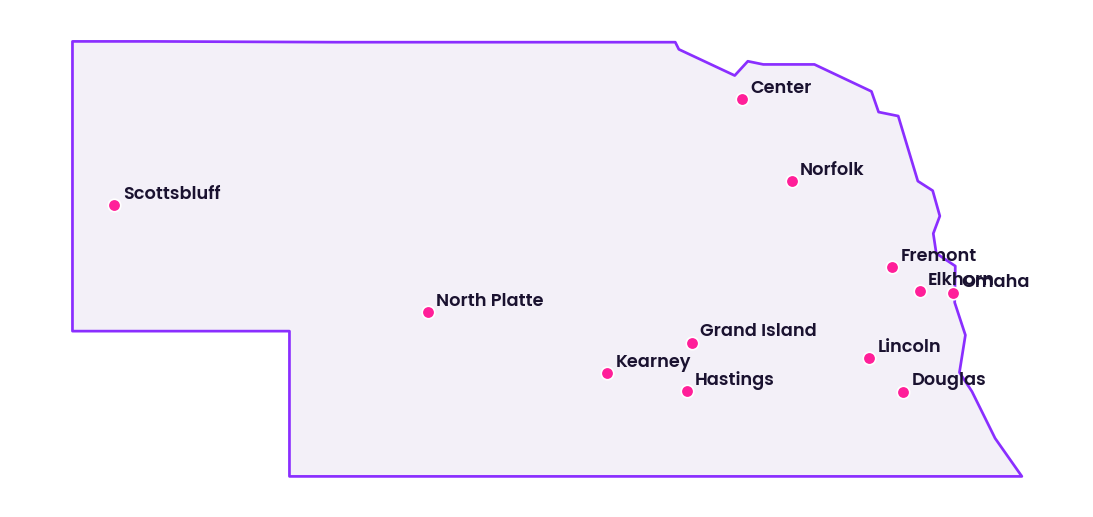
For investors, the central themes are that Nebraska offers income oriented opportunities in stable multifamily, single family rental, and industrial assets in and around Omaha and Lincoln, with more modest and localized plays in smaller metros such as Grand Island, Kearney, Hastings, North Platte, Scottsbluff, and Norfolk. Housing remains more affordable than in many coastal and Sun Belt markets, but some urban neighborhoods and lower income rural areas exhibit rent and cost burdens. Commercial real estate is tilted toward industrial and logistics and necessity retail rather than trophy office. Risks include slow or negative population growth in many rural counties, exposure to agricultural cycles and commodity prices, severe weather and flooding, relatively high property tax burdens, and limited liquidity in smaller markets.
Section 02Population and Migration
United States Census Bureau decennial counts and annual population estimates show that Nebraska's total population has grown gradually over recent decades, but statewide growth rates have been modest compared with faster growing western and southern states. Within Nebraska, population growth is concentrated in the Omaha metropolitan area in Douglas, Sarpy, and adjacent counties, and in Lincoln in Lancaster County. Many rural counties, particularly in the central and western parts of the state, have experienced flat or declining populations as agricultural consolidation, mechanization, and limited nonfarm employment reduce the number of local residents.
American Community Survey data indicate that Nebraska's age profile is close to the national average, but with some important regional differences. Urban counties that include Omaha and Lincoln have substantial youth and young adult populations because of universities, medical centers, and entry level job opportunities. Rural counties often skew older because younger residents move to metropolitan areas or out of state for education and work. Some rural communities have attracted immigrant populations that help stabilize population levels and provide labor for agriculture, meatpacking, and manufacturing.
Migration patterns reported by the Census Bureau show that Nebraska has experienced a mix of domestic in migration, domestic out migration, and international migration over different periods. In recent years, the Omaha and Lincoln metros have attracted residents from smaller Nebraska communities and from neighboring states, as well as international migrants who join family networks or take jobs in agriculture, processing, health care, and services. At the same time, higher educated young adults may move from Nebraska to larger national metros in search of specialized career opportunities.
For investors, these population dynamics mean that demand for housing and commercial space is most durable in and near the Omaha and Lincoln metros, which concentrate population and job growth. Regional centers such as Grand Island, Kearney, and Scottsbluff can offer localized opportunities where population is stable, while many rural counties present higher demand risk and less predictable long term occupancy for both residential and commercial assets.
Section 03Jobs and Economic Anchors
Bureau of Labor Statistics employment data show that Nebraska's economy is diversified across agriculture, food processing, manufacturing, transportation and warehousing, health care and social assistance, education, finance and insurance, professional and business services, government, and retail. Agriculture and related industries remain central to the state's identity and to rural employment, but service sectors dominate job counts in metropolitan areas.
Omaha is the largest employment center, with a significant presence of financial services and insurance firms, including large national insurers and financial institutions, as well as transportation and logistics companies, health care systems, and corporate headquarters. The city's location at the intersection of interstate highways and major rail routes reinforces its logistics role. Lincoln serves as the state capital and a major university town, with employment concentrated in state government, the University of Nebraska system, health care providers, and related services. Combined, these two metros account for a substantial share of Nebraska's total nonfarm employment.
Bureau of Economic Analysis gross domestic product by state and local area personal income data confirm that Nebraska has meaningful output and income contributions from agriculture and food processing, but also from durable and nondurable manufacturing, financial activities, and services. Large meatpacking and processing plants, grain handling and ethanol facilities, farm equipment manufacturers, and other industrial employers anchor smaller metros and rural communities.
For investors, the economic base implies that multifamily and single family rental assets in Omaha and Lincoln benefit from relatively diverse and stable employment, though they remain sensitive to national cycles in financial services, manufacturing, and logistics. In regional centers, dependence on a few large employers increases tenant concentration risk, but long operating histories and local embeddedness can mitigate some of that risk. Agricultural and commodity price cycles can influence incomes, credit, and demand for rural housing and commercial space.
Section 04Income
American Community Survey estimates indicate that Nebraska's median household income is close to or slightly above the national median, reflecting relatively high participation in the labor force and modest living costs. However, income levels vary significantly across the state. Omaha and Lincoln metropolitan counties exhibit higher median household incomes and per capita incomes than many rural counties, particularly those in the western and northern parts of Nebraska, where agriculture, small scale retail, and services dominate employment.
Within metropolitan areas, income differences appear across neighborhoods and suburbs. In Omaha, western and southwestern suburbs tend to have higher incomes and more professional and managerial employment, while some inner city and older suburban areas have lower incomes and higher shares of service and blue collar jobs. In Lincoln, neighborhoods near the university and government centers display a mix of student, professional, and public sector incomes.
Bureau of Economic Analysis personal income data show that Nebraska's per capita personal income is influenced by volatile farm income, with agricultural booms and busts affecting statewide averages. Transfer payments and investment income also contribute, particularly for retirees and landowners. Income inequality exists, but compared with some coastal states, there are fewer very high income households with outsized effects on averages.
For investors, income patterns suggest that Nebraska can support stable demand for workforce and middle market housing, particularly in metros and strong regional centers. Luxury or high rent strategies aimed at small top tier income segments may be viable in selective Omaha and Lincoln submarkets but are unlikely to scale statewide. In rural areas with low incomes, rent levels that appear modest by national standards can still be at the edge of local affordability, so rent growth assumptions must be conservative.
Section 05Housing and Multifamily
United States Census and American Community Survey housing data show that Nebraska's housing stock is dominated by single family detached homes, but also includes duplexes, small multifamily buildings, and apartment communities, primarily in Omaha, Lincoln, and regional centers. Statewide homeownership rates are higher than in many coastal states, consistent with lower house prices and long standing cultural preferences for ownership in the Great Plains and Midwest. At the same time, renter households represent a significant share of residents in urban areas, especially near universities and employment centers.
Multifamily housing in Nebraska is most concentrated in Omaha and Lincoln. In these metros, the stock includes mid twentieth century walk up and garden style communities, newer suburban garden and midrise developments, downtown loft conversions, and student oriented housing near campuses. Smaller metros such as Grand Island, Kearney, Hastings, North Platte, Scottsbluff, and Norfolk have more limited multifamily inventory, often in the form of two story walk up buildings and older small properties, with relatively few large, institutional grade complexes.
State and local housing needs assessments coordinated by the Nebraska Investment Finance Authority point to shortages of quality rental housing in many communities, particularly for low and moderate income households, seniors, and workers in growing sectors. At the same time, some older properties are functionally obsolete or in need of significant rehabilitation, especially in small towns and rural areas where reinvestment has lagged.
Private multifamily market data from CoStar, Yardi Matrix, RealPage, Freddie Mac, and brokerage firms typically classify Omaha as a secondary market and Lincoln as a smaller secondary or tertiary market, with rent and occupancy metrics that have been stable or gradually improving over time. These sources also track limited but meaningful institutional interest in larger properties in both metros.
To frame Nebraska's multifamily landscape, the state can be segmented into functional regions from a multifamily perspective. The Omaha metro, including Omaha, Bellevue, Papillion, and La Vista, holds the largest and most diverse multifamily inventory, spanning class A suburban and urban infill, workforce garden style properties, and student adjacent housing, and it supports core and value add multifamily strategies with institutional scale assets available. The Lincoln metro, made up of Lincoln and nearby communities, carries a moderate inventory that mixes student housing, workforce apartments, and some newer developments, with university anchored demand and stable workforce housing in smaller but attractive assets. The Tri Cities corridor of Grand Island, Kearney, and Hastings offers smaller garden style and walk up communities with limited new construction, characterized by local and regional ownership and a focus on stable cash flow and modest growth. Other regional centers such as North Platte, Scottsbluff, Norfolk, and Fremont contain scattered small multifamily buildings and complexes that present niche plays with higher management intensity and limited liquidity. Finally, the rural counties, made up of numerous small towns and unincorporated areas, have very limited multifamily, often aging stock, suited to opportunistic or mission driven investment and carrying high vacancy and exit risk.
This structure underscores that scaled, professionally managed multifamily opportunities are largely confined to Omaha and Lincoln, with selected plays in the Tri Cities and other regional centers.
Section 06Rents
The United States Department of Housing and Urban Development publishes fair market rents by bedroom size for Nebraska's metropolitan and nonmetropolitan areas. Fair market rents for the Omaha Council Bluffs and Lincoln metropolitan areas are higher than those for nonmetropolitan Nebraska regions, reflecting stronger demand and higher incomes in the urban markets. Even in the metros, however, nominal rent levels remain lower than in many coastal and high growth Sun Belt metros.
American Community Survey data on gross rents and rent burdens show that a significant share of renter households in Nebraska spend more than thirty percent of their income on housing costs, with higher burden rates in lower income urban neighborhoods and in rural areas where incomes are low and housing quality may be poor. In Omaha and Lincoln, rent burdens are particularly acute for lower wage service workers, recent immigrants, and seniors on fixed incomes.
Private multifamily datasets report that asking and effective rents in newer class A properties in Omaha and Lincoln are meaningfully higher than rents in older class B and class C properties, but that across all classes, rent levels are generally consistent with workforce affordability when incomes are solid. Rent growth over the past decade has been positive, with periods of stronger growth during tight labor markets and limited new supply, and more moderate trends during weaker economic periods.
For investors, the rent environment in Nebraska suggests that there is room for professionally managed, well located multifamily assets to provide attractive relative affordability to tenants while still generating steady income. However, aggressive rent growth strategies are constrained by local income dynamics. Properties that offer quality improvements and amenities without pushing rents beyond the reach of core tenant segments are better positioned for sustainable performance.
Section 07Vacancy
Rental vacancy patterns in Nebraska differ by region, property class, and unit type. Census surveys for the Midwest region and state level housing assessments indicate that overall rental vacancy in Nebraska has generally been moderate, with some tightening in metropolitan areas during economic expansions and gradual easing in downturns. The Omaha and Lincoln metros tend to show lower vacancy rates than many rural counties, reflecting stronger and more diversified demand.
Within Omaha and Lincoln, vacancy is often lowest in well located class B and class C properties that serve a broad middle market tenant base and that maintain properties adequately. Newer class A properties can experience higher vacancy during initial lease up or during periods of increased competitive supply, but typically stabilize at solid occupancy levels when the broader economy is healthy. Student oriented properties display seasonal leasing dynamics, with high occupancy during academic terms.
In smaller metros and rural markets, vacancy is more volatile. Older, lower quality multifamily and single family units can remain vacant for extended periods if they are poorly maintained or badly located. Conversely, in communities with significant industrial or agricultural employment and limited recent construction, decent quality rentals can maintain high occupancy even in modest economic conditions.
Detailed, up to date vacancy statistics by class, submarket, and property type for Nebraska are available through private data providers and local brokers, though those series are not restated here. For investors, this means that individual asset vacancy risk must be assessed through property specific due diligence, including rent rolls, historical occupancy trends, and competitive set analysis, rather than through reliance on a single statewide metric.
Section 08Supply Pipeline
United States Census Building Permits Survey data show that Nebraska's residential construction has followed national cycles, with increased permitting in the years preceding the global financial crisis, a pronounced drop during the downturn, and a gradual recovery and expansion in the following decade. Omaha and Lincoln account for a large share of the state's multifamily permits, while single family permits are spread across metros, suburbs, and some growing regional centers.
In recent years, multifamily construction in Omaha has included urban infill and downtown projects, as well as suburban garden and midrise communities in western and southern parts of the metro. Lincoln has seen multifamily and mixed use development near the university, downtown, and along key corridors. The Tri Cities and other regional centers have experienced more modest multifamily construction, primarily in the form of small garden style properties.
Single family construction has concentrated in suburban and fringe areas around Omaha and Lincoln, and in selected regional centers where population and employment are stable or growing. Rural areas with declining populations have seen limited new construction, and much of the existing housing stock dates from earlier decades.
This review does not restate precise unit numbers by year and region, but the qualitative pattern is that new supply in Nebraska's multifamily market is meaningful in Omaha and Lincoln but still moderate relative to larger national metros, while most smaller markets see only measured additions. For investors, this suggests that supply risk is manageable in the major metros when projects are well located, but that it is important to monitor the pipeline in specific submarkets to avoid pockets of oversupply.
Section 09Single Family Homes
Nebraska's single family housing market is defined by relatively low prices compared with national averages, high ownership rates, and strong ties to local employment and community structures. American Community Survey data confirm that single family detached homes account for the majority of housing units, particularly in suburbs and rural areas. Townhomes, manufactured homes, and small multifamily are also present, but at lower shares.
Home value and appreciation patterns from the Federal Housing Finance Agency, Zillow, Redfin, and brokerage reporting identify Nebraska as a state where home prices have risen steadily over the long term, with more muted volatility than in coastal or boom and bust markets. Recent years have seen stronger appreciation as low interest rates and limited inventory increased competition, especially in Omaha and Lincoln suburbs and in certain attractive neighborhoods near employment and amenities. Smaller metros and rural areas have experienced slower but still positive price trends, with some communities facing stagnant or declining values due to limited demand.
Inventory and months of supply metrics at the metro and regional level generally indicate that Nebraska's for sale housing market has oscillated between balanced and seller oriented conditions, with tighter inventory in entry level and mid priced segments in Omaha and Lincoln, and more balanced or buyer oriented conditions in some rural counties. New construction has helped meet some demand, but lot availability, construction costs, and local regulations influence the pace of additions.
Single family rentals play an important role in Nebraska's housing system. In Omaha and Lincoln, scattered site rentals in older neighborhoods and newer build to rent style properties in suburbs provide options for households that prefer or require renting. In smaller communities, single family rentals are often owned by local landlords and serve workers and families who are not ready or able to buy. Institutional single family rental ownership is less prevalent than in Sun Belt metros, but regional investors have started to explore portfolios in Nebraska's metros due to relative affordability and stable tenant bases.
For investors, Nebraska's single family market offers opportunities for long term, income oriented strategies that benefit from stable occupancy and modest but steady appreciation. Acquisition costs and property taxes must be weighed against achievable rents and operating expenses, and scattered site management considerations are significant. Markets with strong schools, short commutes to employment centers, and solid community amenities are likely to outperform.
Section 10Commercial Real Estate and Retail Centers
Commercial real estate in Nebraska reflects its role as a regional economic hub for the central United States. Office, industrial, and retail properties are concentrated in and around Omaha and Lincoln, with smaller inventories in regional centers. There is no public dataset that provides comprehensive, restatable statewide statistics on vacancy, rents, and capitalization rates by commercial property type, but qualitative insights can be drawn from private sources and observed patterns.
Office space in Nebraska is primarily low and midrise, with some larger towers in downtown Omaha and Lincoln. Omaha's downtown and suburban office corridors house corporate headquarters, financial services, insurance, legal, and professional service firms. Lincoln's office market is anchored by state government, the university, and associated services. Vacancy levels in both metros have tended to be moderate, with less dramatic swings than in major coastal central business districts. The increase in remote and hybrid work has affected demand, particularly for older, less efficient buildings, but overall impacts have been less severe than in larger gateway cities.
Industrial and logistics real estate is a relative strength for Nebraska. Warehouses, distribution centers, and manufacturing facilities are located along Interstate corridors and rail lines, especially near Omaha, Lincoln, and selected regional hubs. Growing online commerce, regional distribution needs, and manufacturing activity have supported demand for modern industrial space. Vacancy has been low in many well located industrial submarkets, and rents have trended upward as new space is absorbed.
Retail real estate in Nebraska is dominated by grocery anchored neighborhood and community centers, power centers with big box tenants, and a limited number of regional malls. Omaha and Lincoln serve as shopping destinations for surrounding areas, while smaller strip centers and main street districts serve local trade areas in regional centers and small towns. Grocery anchored centers and neighborhood retail that meet daily needs have generally performed well, while properties reliant on discretionary spending or outdated formats face pressure from changing consumer behavior and online retail.
For investors, Nebraska's commercial sector offers compelling opportunities in functional industrial and logistics assets and in necessity retail and medical office assets in strong trade areas. Office investments can be attractive when focused on well leased, modern buildings with credit tenants, but future space needs in some segments remain uncertain. Capitalization rates for Nebraska commercial assets are generally higher than for similar risk profiles in primary coastal markets, reflecting smaller market size and liquidity.
Section 11Transactions and Capital Markets
There is no single, publicly accessible dataset that aggregates all Nebraska real estate transactions, values, capitalization rates, and investor types in a way that allows restatement of detailed numeric series here. County level property transfer records, combined with private data from CoStar, MSCI Real Assets, and brokerage firms, provide transaction level information, but those series are not restated in this review.
Qualitatively, Nebraska's capital markets are characterized by a mix of local, regional, and national investors. In Omaha and Lincoln, larger multifamily, industrial, and retail centers attract regional private equity, family offices, and, in selected cases, institutional capital. Smaller assets and properties in regional centers and rural markets are more likely to trade among local owners and operators. Lenders include regional and community banks, life companies for select properties, and national agencies and securitized lenders for qualifying multifamily and commercial assets.
Transaction volumes in Nebraska are modest in national context but have been steady over time, with peaks during periods of favorable financing conditions and investor appetite for yield. The shift to higher interest rates has led to lower leverage, higher debt service coverage requirements, and greater selectivity by lenders, which in turn reduces transaction volumes and places downward pressure on pricing in some segments.
For investors, this means that Nebraska assets can offer attractive yields but must be evaluated in the context of less liquidity, narrower buyer pools, and more limited market transparency than in major metros. Entry pricing, tenant credit, lease structures, and exit strategies are critical considerations, and capital partners should be comfortable with longer hold periods and potentially longer marketing times at sale.
Section 12Taxes
Nebraska's tax structure has important implications for real estate investors. The state levies an individual income tax and a corporate income tax, as well as a statewide sales and use tax that is augmented by local sales taxes in many jurisdictions. Property taxes are a major source of revenue for local governments, including counties, cities, school districts, and special districts.
Property tax assessments are administered by county assessors under statewide guidelines, with taxable values based on market value for most property types. Millage rates vary by county and jurisdiction, and effective property tax burdens can be relatively high compared with some neighboring states, particularly for residential properties, including both owner occupied and rental units. Farmland assessments incorporate agricultural use considerations, but rising land values and budget pressures have raised concerns about tax burdens on both urban and rural property owners.
This review does not state specific numeric tax rates or levy figures, because those are best confirmed against current Nebraska Department of Revenue and local jurisdiction schedules for the relevant year. For investors, property taxes represent a significant operating cost that must be carefully underwritten. Acquisitions that involve major improvements or repositioning can trigger reassessment and higher taxes over time. It is essential to review recent assessment history, projected levy changes, and the local fiscal environment when evaluating assets. Income and sales tax obligations at the state and local level also factor into investor return calculations, particularly for entities with multi state operations.
Section 13Insurance
Property insurance in Nebraska is regulated by the Nebraska Department of Insurance, and the market must respond to the state's exposure to severe convective storms, hail, tornadoes, wind, flooding along rivers and streams, heavy snow and ice, and occasional extreme temperature events. Nebraska's central location within the region commonly referred to as Tornado Alley and its continental climate contribute to elevated risk of large hail and damaging winds, which can affect roofs, siding, windows, and vehicles.
Insurance premiums and deductibles for Nebraska properties depend on location, building construction and age, roof materials, mitigation features, loss history, and coverage limits. In recent years, national reinsurer and insurer responses to increasing catastrophe losses and reinsurance cost pressures have contributed to upward pressure on premiums in many states, including Great Plains states such as Nebraska, especially for properties exposed to hail and wind.
Flood risk is an important but more localized concern. Federal Emergency Management Agency flood maps highlight floodplains along rivers such as the Platte, Missouri, Elkhorn, and smaller tributaries. Properties within special flood hazard areas may be required by lenders to carry flood insurance, and premiums reflect both base flood elevation and building characteristics. Urban drainage and flash flood risks also exist where intense rainfall overwhelms stormwater systems.
For investors, prudent insurance planning includes obtaining multiple quotes, considering higher deductible structures paired with reserves, investing in mitigation measures such as impact resistant roofs and improved drainage, and evaluating portfolio level risk diversification. It is important to treat insurance expense assumptions as variable over time and to incorporate stress scenarios for premium increases into underwriting.
Section 14Landlord Tenant and Regulatory Environment
Nebraska's landlord tenant legal framework is generally regarded as balanced to moderately landlord friendly compared with many coastal states. State statutes govern lease terms, security deposits, habitability, repairs, notice requirements, and the eviction process. There is no statewide rent control or rent stabilization regime, and local jurisdictions have not adopted broad based rent control ordinances comparable to those in certain large cities elsewhere in the country.
Landlords are required to keep properties in a habitable condition, comply with building and housing codes, and follow due process for evictions, including proper notice and court proceedings. Tenants have rights to safe and functional housing and can seek remedies when landlords fail to meet obligations. Fair housing laws at federal and state levels prohibit discrimination against protected classes.
Local governments may have specific ordinances related to rental registration, inspections, nuisance abatement, and occupancy limits, particularly in university areas or certain neighborhoods. Short term rentals may be subject to zoning and licensing requirements in some jurisdictions.
For investors, the regulatory environment provides flexibility in rent setting and unit management, within market constraints and legal protections for tenants. Eviction processes are more predictable than in heavily regulated states, though courts have discretion and local practices vary. Compliance with safety codes, fair housing rules, and any local ordinances is essential to avoid legal and reputational risks.
Section 15Infrastructure
Nebraska's transportation and utility infrastructure supports its role as an agricultural and logistics hub. Interstate 80 runs east west across the state, connecting Omaha, Lincoln, and central and western communities and forming a key freight corridor for trucking. Other highways and state roads link smaller towns and regional centers. Railroads are central to freight movements, with major east west mainlines and north south branches carrying grain, coal, manufactured goods, and intermodal traffic.
Omaha hosts a significant airport with commercial passenger and cargo flights, while Lincoln and some regional centers have smaller commercial airports. Utilities, including electricity, natural gas, water, and telecommunications, are provided by a mix of public power districts, cooperatives, and private companies. Nebraska's public power structure, in which electric utilities are publicly owned, influences rate structures and investment decisions.
Water and sewer infrastructure in Omaha, Lincoln, and other cities supports urban growth, but aging systems and regulatory requirements for water quality, combined sewer overflows, and wastewater treatment require ongoing capital investment. Rural areas often rely on private wells and septic systems, which limit development density and require attention to groundwater quality. Broadband internet access has improved but remains uneven in some rural communities, and state and federal programs are focused on expanding coverage.
For investors, infrastructure quality and access are key differentiators among markets and sites. Industrial and logistics assets benefit from proximity to interstates, rail spurs, and reliable power. Multifamily and single family developments require adequate water, sewer, roads, and broadband to attract tenants and buyers. In rural areas, infrastructure constraints can both limit competition and increase costs for new development.
Section 16Climate and Physical Risks
Nebraska's climate is characterized by cold winters, warm to hot summers, and significant variability in precipitation and temperature. National Oceanic and Atmospheric Administration data describe a continental climate with frequent severe thunderstorms, hail, tornadoes, and blizzards. Climate change projections suggest that Nebraska may experience more frequent extreme heat days, shifts in precipitation patterns with increased heavy rainfall events, and changes in drought frequency and severity.
Federal Emergency Management Agency hazard assessments identify tornadoes, severe thunderstorms, hail, winter storms, flooding, and drought as major hazards across the state. Flooding risk is concentrated along major rivers and streams and in low lying areas that can experience flash floods. Dams and levees provide some flood protection but can also introduce systemic risk if not maintained.
For real estate investors, these climate and physical risks have implications for building design, site selection, insurance, and long term asset management. Properties should be evaluated for tornado and wind exposure, with attention to construction standards and the presence of safe rooms or shelters in some property types. Floodplain locations require mitigation measures and careful underwriting of potential loss and downtime. Drought and heat risks may affect landscaping choices, water usage, and energy demand.
Section 17Opportunities
Nebraska's real estate markets present several opportunity sets that can be attractive to accredited investors who appreciate stable, income oriented investments and are comfortable with smaller markets. In Omaha, opportunities include core and value add multifamily properties in established neighborhoods and suburbs, industrial and logistics facilities near transportation corridors, and well located grocery anchored and necessity retail centers. Lincoln offers similar, albeit smaller scale, opportunities tied to university, government, and health care anchors.
Regional centers such as Grand Island, Kearney, Hastings, North Platte, Scottsbluff, and Norfolk provide opportunities in workforce multifamily, single family rentals, and local shopping centers that serve wide trade areas. These markets can offer higher going in yields but require confidence in the staying power of key employers and the ability to manage properties with smaller, local tenant bases.
Affordable and workforce housing investments, often in partnership with the Nebraska Investment Finance Authority and federal programs, can address documented shortages while seeking stable returns with lower correlation to market cycles, at the cost of added regulatory oversight. Senior housing, particularly independent and assisted living in strong metros and regional hubs, can benefit from demographic trends, though it introduces operational complexity. The observations in this section are general and educational, are not projections, forecasts, or assurances of any particular return, yield, occupancy, rent level, or appreciation, and any specific investment must be evaluated on its own facts.
Section 18Risks
The risks associated with Nebraska real estate investments include structural, market, climate, and political elements. Structural risks arise from modest statewide population growth and demographic shifts that favor urban areas while many rural communities decline. Investments in areas without clear long term demand drivers face higher vacancy and value erosion risk.
Market risks include tenant concentration in certain sectors, particularly agriculture, meatpacking, manufacturing, and government, which can be vulnerable to commodity prices, trade policies, regulatory changes, and fiscal pressures. Smaller markets can see outsized impacts from the expansion or closure of a single major employer. Liquidity risk is ever present, as even in Omaha and Lincoln, buyer pools are limited compared with major national metros, and in regional centers and rural areas, marketing periods can be long and pricing uncertain.
Climate and physical risks, including severe storms, hail, tornadoes, flooding, and drought, can cause property damage, disrupt operations, and increase insurance costs. Regulatory risk is moderate, but changes in property tax policy, development regulations, or environmental standards could affect returns. Political and community opposition to certain types of development, particularly those perceived as out of scale or misaligned with local needs, can arise. Real estate investments are speculative, are subject to market, financing, liquidity, tax, regulatory, insurance, and physical hazard risks, and can result in the loss of some or all of an investor's invested capital, including the possible loss of principal.
Section 19Investor Implications
For accredited investors, Nebraska should be considered as part of a broader portfolio strategy that seeks diversification by geography and asset type and balances growth and income. Nebraska assets can provide stable cash flow, attractive yields relative to risk, and lower volatility than some coastal or boom markets, particularly when focused on well located multifamily, single family rental, industrial, and necessity retail assets in Omaha, Lincoln, and strong regional centers.
However, investors must calibrate expectations to the realities of modest growth, limited liquidity, and climate and weather risks. Conservative leverage, careful tenant and lease underwriting, and a focus on durable demand drivers are warranted. Investments should be sized to account for potential exit challenges, and business plans should allow for extended holding periods.
Aligning with experienced local operating partners, understanding county level tax and regulatory environments, and incorporating climate resilience and insurance strategies are critical. Nebraska can complement holdings in higher growth, higher volatility markets by providing ballast and consistent income, but it is unlikely to deliver rapid appreciation at scale. Nothing in this section is a recommendation to pursue any specific strategy or investment, and there is no assurance that any objective or outcome described will be achieved.
Section 20Conclusion
Nebraska's real estate and multifamily markets reflect its geographic position, economic structure, and demographic trends. The state's largest metros, Omaha and Lincoln, anchor demand for housing, industrial, and commercial space with diverse employers and institutions. Regional centers serve as hubs for agriculture, manufacturing, and services, while many rural areas confront long term depopulation and limited new investment.
Public data from federal agencies, state authorities, and private market providers reveal a picture of relative affordability, stable but modest growth, and pockets of opportunity in workforce housing, industrial and logistics, and necessity based commercial assets. At the same time, investors must navigate challenges posed by weather and climate risk, property tax burdens, tenant concentration, and liquidity.
This review provides a qualitative framework for evaluating Nebraska as part of an institutional portfolio. Accredited investors who pair these structural insights with up to date numeric analysis from the cited sources and robust asset level due diligence can make more informed decisions about whether and how to allocate capital to Nebraska's real estate markets, though no particular outcome or return is assured.
Sources
- United States Census Bureau, Decennial Census of Population and Housing, Nebraska,, https://www.census.gov/programs-surveys/decennial-census.html
- United States Census Bureau, Population and Housing Unit Estimates, Nebraska statewide and counties,, https://www.census.gov/programs-surveys/popest.html
- United States Census Bureau, American Community Survey one year and five year estimates, Nebraska statewide, metropolitan and micropolitan areas, and counties,, https://www.census.gov/programs-surveys/acs
- United States Census Bureau, Building Permits Survey, Nebraska and its metropolitan areas,, https://www.census.gov/construction/bps
- United States Census Bureau, Housing Vacancies and Homeownership, Midwest region including Nebraska,, https://www.census.gov/housing/hvs
- United States Bureau of Labor Statistics, Economy at a Glance, Nebraska,, https://www.bls.gov/eag/eag.ne.htm
- United States Bureau of Labor Statistics, State and Area Employment, Nebraska and its metropolitan and micropolitan areas,, https://www.bls.gov/sae
- United States Bureau of Labor Statistics, Local Area Unemployment Statistics, Nebraska counties and labor markets,, https://www.bls.gov/lau
- United States Bureau of Labor Statistics, Quarterly Census of Employment and Wages, Nebraska,, https://www.bls.gov/cew
- United States Bureau of Economic Analysis, Gross Domestic Product by State, Nebraska,, https://www.bea.gov/data/gdp/gdp-state
- United States Bureau of Economic Analysis, Local Area Personal Income, Nebraska counties and metropolitan areas,, https://www.bea.gov/data/income-saving/local-area-personal-income
- United States Department of Housing and Urban Development, Fair Market Rents and income limits, Nebraska metropolitan and nonmetropolitan areas,, https://www.huduser.gov
- Federal Housing Finance Agency, House Price Index, Nebraska and its metropolitan statistical areas,, https://www.fhfa.gov/DataTools/Downloads/Pages/House-Price-Index.aspx
- Nebraska Investment Finance Authority, housing studies, rental and homeownership programs,, https://www.nifa.org
- Nebraska Department of Revenue, property tax and state tax information,, https://revenue.nebraska.gov
- Nebraska Department of Insurance, property and casualty insurance regulation,, https://doi.nebraska.gov
- Federal Emergency Management Agency, Flood Map Service Center, Nebraska,, https://msc.fema.gov
- Federal Emergency Management Agency, National Risk Index, Nebraska,, https://hazards.fema.gov/nri
- National Oceanic and Atmospheric Administration, National Centers for Environmental Information, climate data for Nebraska,, https://www.ncei.noaa.gov
- CoStar Group, Nebraska and Omaha Lincoln multifamily, office, industrial, and retail market analytics,, https://www.costar.com
- Yardi Matrix, multifamily market reports for Midwest and Nebraska metros,, https://www.yardimatrix.com
- RealPage, multifamily analytics for Midwest and Nebraska markets,, https://www.realpage.com/analytics
- Freddie Mac Multifamily, research on Midwest multifamily markets including Nebraska,, https://mf.freddiemac.com/research
- Zillow Research, Nebraska home value and rent data,, https://www.zillow.com/research/data
- Redfin Data Center, Nebraska and Omaha Lincoln housing market data,, https://www.redfin.com/news/data-center
- CBRE Research, Midwest and Omaha Lincoln commercial real estate market reports,, https://www.cbre.com/insights
- JLL Research, Midwest commercial real estate insights,, https://www.us.jll.com/en/trends-and-insights/research
- Cushman and Wakefield, Marketbeat reports for Omaha and Midwest markets,, https://www.cushmanwakefield.com/en/insights
- MSCI Real Assets, United States Capital Trends including transactions in Nebraska,, https://www.msci.com/our-solutions/real-estate/real-assets